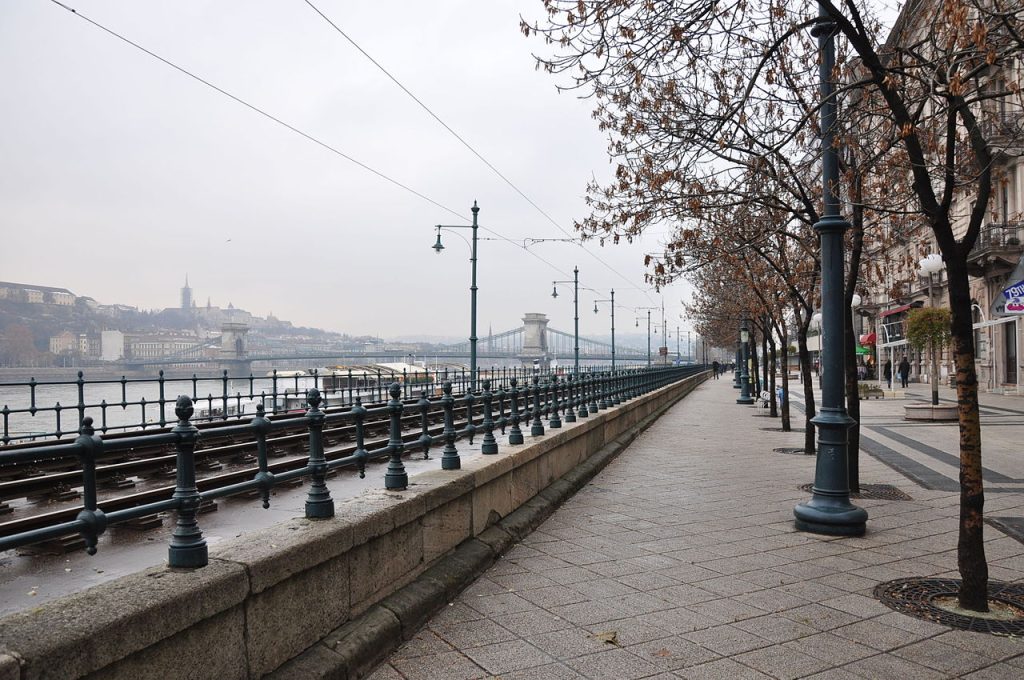
⏱️ TL;DR – Danube Promenade (Dunakorzó)
Budapest’s Cinematic Riverside Walk
Bottom line: If you only do one walk in Budapest, make it this one — ideally at sunset.
Introduction: The Front Row Seat to the Pearl of the Danube
Let’s be honest with each other right from the start: if you come to Budapest and you don’t walk the Danube Promenade, you haven’t actually been to Budapest. You’ve just been to a city with some nice old buildings and decent goulash. The Danube Promenade—or the Dunakorzó as we locals call it when we aren’t busy complaining about the construction noise or the price of sour cream—isn’t just a sidewalk next to a river. It is the city’s spine. It is the precise geographic location where the grandeur of the Austro-Hungarian Empire stares you right in the face, unblinking, and dares you not to be impressed.
The promenade is a place of duality, a physical manifestation of Budapest’s complicated soul. On one side, across the rolling grey-blue water, you have the Buda Castle District, a UNESCO World Heritage site that looks like a fairy tale illustration drawn by an architect with an unlimited budget for spires and domes. On the other side, breathing down your neck, you have a row of luxury hotels built in the 1970s and 80s that look like giant concrete radiators left out in the rain, remnants of a socialist ambition to court Western hard currency. You have the profound, gut-wrenching silence of the Shoes on the Danube memorial, a tribute to mass murder, sitting just a few hundred meters away from a guy trying to sell you a glowing fidget spinner or a boat ticket with the tenacity of a starving badger.
This guide isn’t just about telling you where to put your feet. I want to take you on the actual walk. I want you to smell the river water—which, depending on the day and the wind direction, smells like fresh rain, flowering linden trees, or slightly questionable algae. I want you to hear the metallic screech of the Number 2 Tram as it rounds the Parliament bend, a sound that is as much a part of Budapest’s soundtrack as Franz Liszt’s Rhapsodies. We are going to navigate the tourist traps, find the actual good spots, and I’m going to tell you exactly where to stand to get that photo that will make your ex jealous on Instagram. So, tie your shoelaces—double knot them, we have some walking to do—and let’s go for a stroll along the most scenic border line in Central Europe.
Insider Narrative: Arrival, Atmosphere, and the Sensoryscape
The Approach: Why You Never Just “Arrive”
I never just “arrive” at the middle of the Promenade. That is amateur hour. To truly appreciate the flow of the city, you have to approach it correctly, and for me, that usually means coming from the north, near Jászai Mari tér. Why? Because it allows me to take the Tram 2, a yellow, rattling time machine that National Geographic once listed as one of the most scenic tram routes in the world.
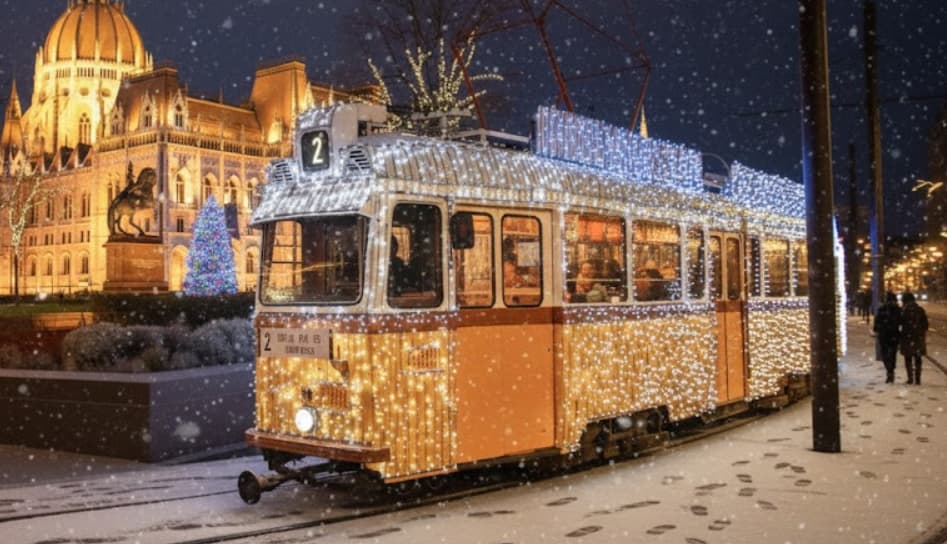
I hop on the tram, grabbing a window seat on the right side (the river side). As the carriage groans and lurches forward—it feels less like a modern transport vehicle and more like an old man getting out of a deep armchair—you are initially buried in the city streets. But then, as you curve around the massive bulk of the Parliament building, the world opens up. The river explodes into view. It is a cinematic reveal, a “director’s cut” moment where you transition from the claustrophobia of the inner districts to the vast, open lung of the Danube.
First Impressions: The Sound of Space
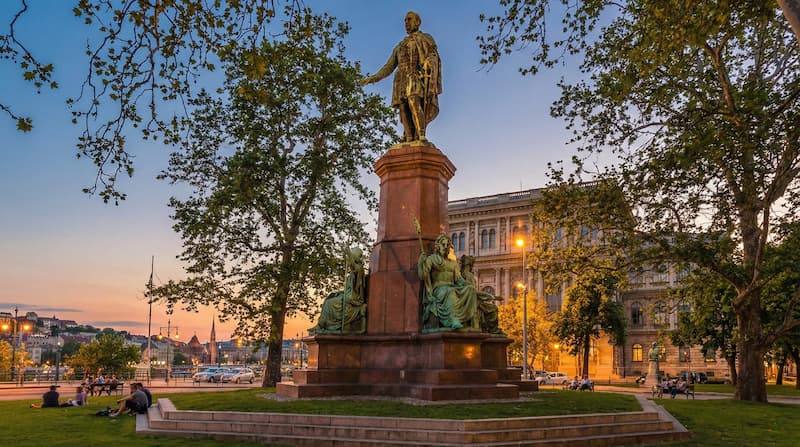
Stepping off the tram at Széchenyi István tér (the Chain Bridge stop), the first thing that hits you is the sound. Or rather, the change in sound. Budapest is a loud city; the inner districts of Pest hum with the noise of buses, drilling, and the clatter of cutlery. But here, the river acts as a dampener. The Danube is roughly 400 meters wide at this point. That massive expanse of water swallows the noise. What you hear instead is a specific riverside mix: the low-frequency thrum of the river cruise boat engines churning the water, the slap of waves against the stone embankment, and the distant, ambient roar of traffic from the Buda side, which sounds like static on a radio.
The Smell: From Linden Trees to Mayflies
Let’s talk about the sensory details that glossy travel brochures tend to gloss over. In the spring and early summer, the air here smells green. It carries the scent of the Buda hills and the flowering linden trees that line the streets nearby. It’s a wet, organic smell, distinct from the diesel and dust of the Grand Boulevard.
However, if you visit in late summer, particularly during a heatwave in August, you might encounter a phenomenon known as the “Hot Bug Summer”. The Danube is home to the Dunavirág (Danube Mayfly). When the water is clean—which is a good sign for the ecosystem—millions of these delicate white insects hatch simultaneously. They swarm the streetlights and the illuminated bridges in a blizzard of wings. It is not a smell, exactly, but a texture in the air. You might inhale a bug if you gasp too loudly at the view. Locals know to walk with their mouths slightly closed during these swarms, or to wear sunglasses at night to keep them out of their eyes. It’s nature’s way of reminding us that the Danube is a living river, not just a swimming pool for Viking River Cruises.

In winter, the sensory experience shifts entirely. The smell becomes crisp, almost metallic—the smell of frost and wet iron. The wind here is no joke. It picks up speed as it travels uninterrupted across the Great Hungarian Plain, funnels down the river valley, and hits the Promenade with a personal vendetta against your ears. When I walk here in January, I don’t just wear a coat; I wear layers of defense, bracing against a wind that feels like it’s trying to push me back into the hotel lobby.
The Human Landscape: The “Korzó” Culture
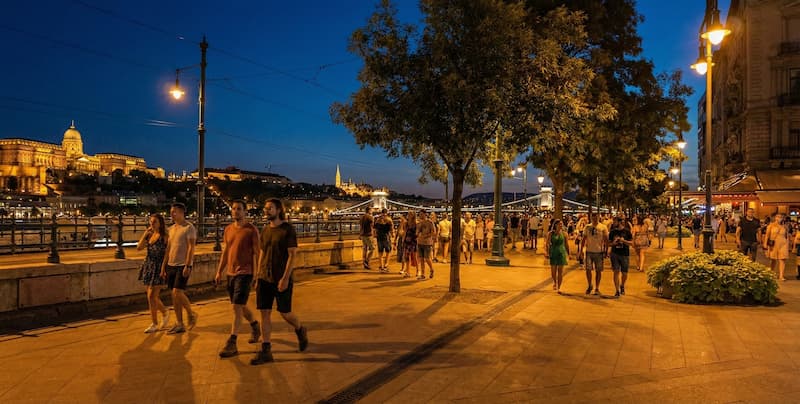
As I walk south from the Chain Bridge, passing the Hungarian Academy of Sciences, I notice a distinct shift in the crowd. Near the Parliament, the vibe is serious—suits, politicians, and tour groups moving with military precision. But as you hit the pedestrian-only zone of the Promenade proper, starting near the Intercontinental Hotel, the atmosphere loosens. It becomes a carnival.
This is the Korzó atmosphere. Historically, in the 19th century, this was the catwalk of the aristocracy. Ladies in silk dresses and men in top hats would stroll here to see and be seen. If you weren’t on the Korzó on a Sunday afternoon, you socially ceased to exist. Today, the top hats are gone, replaced by fanny packs, North Face jackets, and selfie sticks, but the impulse remains exactly the same. Couples hold hands so tightly you’d think they’re afraid of floating away. Teenagers hang their legs through the iron railings, dangling sneakers over the dark water. Elderly Hungarian men sit on the benches, smoking cigarettes with an intensity that suggests they are solving the world’s problems, one puff at a time. It is a place of performance, where the city comes to look at itself.
Detailed Walkthrough: From Parliament to Elizabeth Bridge
We are going to walk this north to south. This is the superior direction for a simple reason: the Buda Castle and Gellért Hill reveal themselves more dramatically as you move south, and you end up closer to the better food options in the Inner City.

1. The Parliament & The Shoes on the Danube
We start just slightly north of the official “Promenade,” at the Hungarian Parliament Building (Országház). You literally cannot miss it. It is the third-largest parliament building in the world, a neo-Gothic monster of limestone and spikes that looks like it was dipped in gold when the setting sun hits it. It dominates the embankment, a symbol of Hungarian sovereignty that is somehow both aggressive and delicate, like a lace fortress.
Walking south from the Parliament, keeping the river on your right, you will encounter the most powerful, and perhaps the most difficult, monument in the city: The Shoes on the Danube Bank.
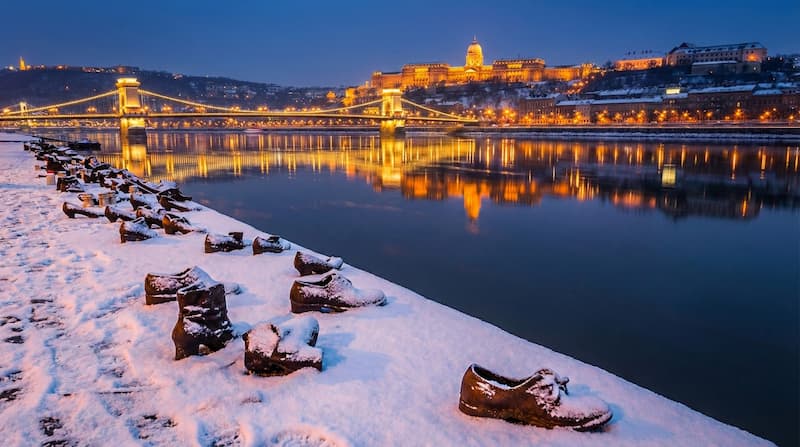
This is not a statue you look at, nod, and say, “Oh, pretty.” This is a punch to the gut. Created by film director Can Togay and sculptor Gyula Pauer in 2005, this memorial consists of sixty pairs of cast-iron shoes scattered along the stone edge of the embankment. They are rusted, fused to the stone, and terrifyingly realistic. You see men’s work boots, women’s delicate heels, and, most heartbreaking of all, tiny children’s shoes with the laces untied.
These shoes represent the Hungarian Jews who, in the brutal winter of 1944-1945, were marched to the riverbank by the Arrow Cross militiamen (the Hungarian Nazis). At the water’s edge, they were ordered to take off their shoes—because leather was a valuable commodity in wartime and could be traded or used by the killers. Once barefoot in the snow, they were shot so their bodies would fall into the freezing river and be washed away by the current. It was efficient, industrial murder.
Insider Observation: You will see people taking smiling selfies here. You will see people sitting in the shoes to pose. Don’t be that person. I have seen locals—and other tourists—yell at people for disrespecting this spot. It is a grave without bodies. The appropriate response here is silence. You might notice small stones or flowers placed inside the shoes; this is a traditional Jewish sign of remembrance. Place a stone if you wish, but leave the selfie stick in your bag.
For more on the history of this period, you can read our guide to Budapest’s Jewish Quarter and History
2. The Chain Bridge (Széchenyi lánchíd)
Continuing south, you pass under the stone lions of the Chain Bridge. This is the oldest permanent bridge connecting Buda and Pest, opened in 1849. It was the engineering marvel that allowed the two cities to eventually merge into one metropolis in 1873.
The Promenade technically “breaks” here because of the traffic at Széchenyi István tér, but you just cross the tram tracks and pick up the pedestrian path on the other side. Pause for a second and turn your back to the river (I know, it’s hard). The building facing the Chain Bridge is the Gresham Palace, which is now a Four Seasons Hotel. It is an Art Nouveau masterpiece, dripping with gold mosaic tiles, peacock gates, and flowing lines. If you have a kidney to sell, you can stay there. If not, just admire the façade, which screams “We have money and culture!”—exactly the vibe 19th-century Budapest wanted to project to its rival, Vienna.

3. The Core Promenade: Vigadó Tér to Március 15. Tér
Now you are in the pedestrian zone. No cars, just tram tracks and pavement. This is the heart of the stroll.
The Little Princess (Kiskirálylány)
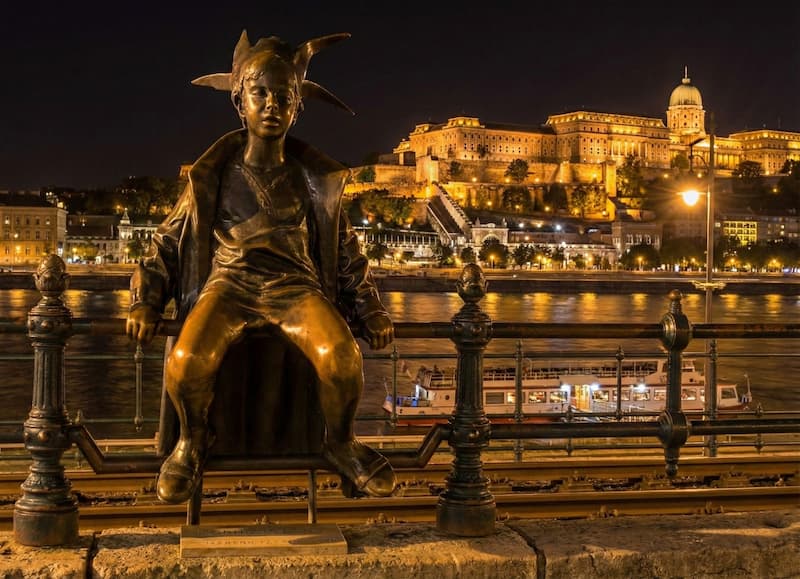
Sitting casually on the railing of the tram stop at Vigadó tér is a small bronze statue of a child wearing a paper crown and a bathrobe. This is the Little Princess (Kiskirálylány). The sculptor, László Marton, created this work in 1972 (installed here in 1990) based on his young daughter, Éva, who used to play dress-up as a princess in the Tabán park, using a bathrobe as a mantle and newspaper for a crown.
The Legend: You will notice her knees are polished to a shiny gold while the rest of her is dark bronze. That’s because thousands of people rub her knees for good luck. Does it work? Well, I’ve rubbed them about fifty times and I still haven’t won the lottery, but I also haven’t been eaten by a bear, so maybe it protects against bear attacks. It is a charming, tactile connection to the city—a moment of innocence that contrasts sharply with the shoes you saw earlier.
Vigadó Concert Hall
Behind the Little Princess stands the Pesti Vigadó. This is the second-largest concert hall in Budapest, but arguably the most beautiful. Built in the mid-1800s by architect Frigyes Feszl, it is a masterpiece of the “Romantic” style. Feszl wanted to create a uniquely Hungarian architecture, so he threw every motif he could find into a blender: Hungarian folk embroidery patterns, Oriental arches, and Moorish designs. The result is spectacular.
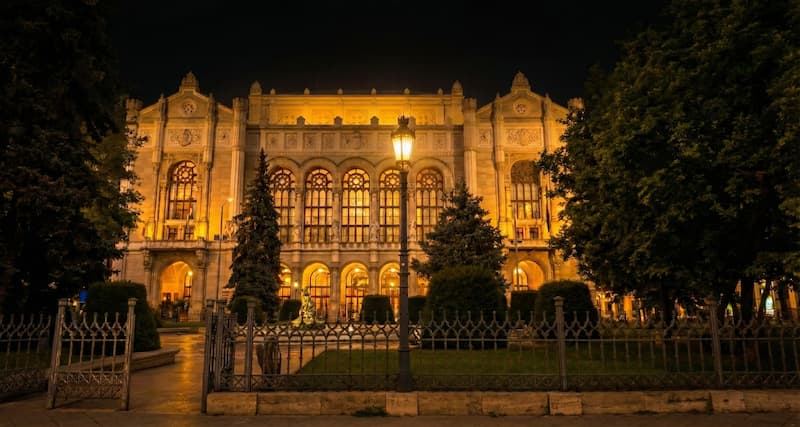
This building has seen it all. Franz Liszt played here. Johann Strauss Jr. conducted waltzes here. Béla Bartók performed here. It was the social heart of the city, damaged in the 1848 revolution, destroyed in WWII, and rebuilt again.
- Insider Tip: Most tourists just look at the outside. But you can buy a ticket to the Panoramic Terrace on the 6th floor. It costs around 2,500 – 3,000 HUF (approx. $7-8 USD) and offers a view of the Danube from a higher vantage point that most people miss.
The Hotel Row: A Socialist Legacy
Here is the aesthetic clash I mentioned. Lining this section are the Intercontinental, the Marriott, and the Sofitel. They are big, blocky, and undeniably ugly from the outside. They were built during the socialist era (or shortly after) to generate hard currency from Western tourists. They block the wind, which is nice, but they also block the view of the city behind them. However, if you are inside them, the view is incredible. It’s a classic case of “better to be inside looking out than outside looking in.”
What to Eat and Drink (And The “Tourist Tax”)
This is a critical section because the Danube Promenade is ground zero for “Tourist Tax” pricing. You are paying for the location, not necessarily the culinary innovation.
The Chimney Cake (Kürtőskalács) Situation
You will smell them before you see them. The scent of vanilla, cinnamon, and burnt sugar wafting from the kiosks is irresistible. Chimney cakes are a Transylvanian Hungarian pastry made from sweet yeast dough spun around a wooden cylinder, baked over charcoal (traditionally) or in an electric oven (usually, on the street), and rolled in sugar until it caramelizes into a crunchy shell.
- Where to buy: There are several kiosks along the promenade, such as Molnár’s Kürtőskalács (technically a shop on Váci utca but with a kiosk presence) or generic stands.
- The Price: This is where it hurts. On the Promenade, a chimney cake will cost you anywhere from 2,500 to 3,500 HUF ($7 – $9.50 USD).
- Insider Hack: If you walk five minutes away from the river into the city center (e.g., down a side street or into a subway underpass like at Deák Ferenc tér), the price drops to 1,200 – 1,800 HUF ($3.50 – $5 USD). But hey, you’re paying for the view here, and eating a hot, steaming cake while looking at the castle is worth the markup at least once.
- Flavor Tip: Don’t get the fancy ones filled with ice cream and Nutella and whipped cream unless you want to go into a diabetic coma and ruin your shirt. Stick to the classics: Fahéj (Cinnamon), Dió (Walnut), or Vanília (Vanilla).
Terrace Dining: The “Corso” Experience
There are several high-end terraces here, most notably the Corso Bar & Terrace (part of the Intercontinental) and Dubarry Restaurant.
- The Pros: The view is unbeaten. Sitting here with a cold spritzer (fröccs) or a beer while the sun goes down is a core memory experience. The service is usually professional, English is spoken perfectly, and the bathrooms are clean.
- The Cons: The price. You are paying for the real estate.
- Real Prices (2025 Estimates):
- Cappuccino: 1,200 – 1,800 HUF ($3.30 – $5.00 USD).
- Glass of Wine: 2,500 – 4,500 HUF ($7.00 – $12.50 USD).
- Main Course (e.g., Duck breast, Steak): 8,000 – 16,000 HUF ($22 – $44 USD).
- Service Charge: Almost always included (12-15%). Check the bill before tipping extra!
Is it worth it? For a drink? Yes. Absolutely. Treat yourself to one overpriced beer and nurse it for an hour while you watch the sunset. For a full dinner? Only if you have deep pockets and prioritize romance over food quality. For better food at half the price, walk ten minutes inward to the Basilica area or the Jewish Quarter.
Best Viewpoints & The “Blue Hour”
The Promenade is essentially one long viewpoint, but there are sweet spots where the angle is just right.
1. Vigadó Tér (By the Boat Station)
This is the widest part of the promenade. From here, you are directly opposite the Buda Castle Palace and the Castle Garden Bazaar. At night, when the palace is lit up in golden amber light, it reflects on the black water. It is breathtaking. The symmetry here is perfect for panoramic shots.
2. Március 15. Tér (Near Elizabeth Bridge)
Walk all the way south to the white Elizabeth Bridge. From here, you have the best angle on Gellért Hill and the Liberty Statue (the woman holding the palm leaf). You also get a great view looking back north, seeing the Promenade curve along the river with the Chain Bridge and Parliament aligned in the distance. This spot is also home to the Inner City Parish Church, the oldest church in Pest, built on Roman ruins.4
Photography Tip: The absolute best time to go is the “Blue Hour”—that 20-minute window just after the sun sinks below the Buda hills but before the sky goes pitch black. The city lights turn on, illuminating the bridges and the castle, but the sky retains a deep, rich indigo color. Your phone camera will love you for this. The contrast between the warm gold of the buildings and the cool blue of the sky is magic.
For more photography tips, check out our guide to Budapest Danube Cruise Best Photo Spots.
One Realistic Negative: The “Lighter Girls” Scam
I need to warn you about the one thing that can absolutely ruin your night. It is known as the “Consumer Scam” or the “Clip Joint Scam,” but locals often refer to it as the “Lighter Girls” or the “Váci Street Girls.” This is a sophisticated trap targeting solo male travelers or small groups of men.
The Scenario:
You are walking on the Promenade or the nearby Váci utca. Two attractive young women approach you. They don’t look like “professionals”; they look like normal students or tourists. They might hold a map to look lost.
The Script:
“Excuse me, do you have a lighter?” (Even if you clearly aren’t smoking).
If you say no, they pivot effortlessly. “Oh, we are from [Insert Nearby Country/City], we just got here. We are looking for a cool place to have a drink. Do you know anywhere? Do you want to join us?”
The Trap:
If you say yes, they will lead you to a specific bar. It will never be the bar you suggest. It will be a basement place with no prices on the door. You sit down. You order a beer. They order “special” cocktails or champagne. You have a mediocre conversation.
The Sting:
When the bill comes, it will be for something insane—like 100,000 HUF ($280 USD) per drink. The menu, if they even showed you one, had the price listed per centiliter in tiny print, or they swapped the menu. If you refuse to pay, the bouncers (who are suddenly very large and very present) will block the exit and escort you to an ATM.
How to Avoid It:
It is simple. If two attractive strangers randomly invite you to a specific bar within 30 seconds of meeting you on the street, you are not that charming. It is a scam. Just say “No thank you” and keep walking. Do not engage. Do not try to outsmart them. Just walk away.
Practical Tips & Logistics
Getting There
- Tram: Take Tram 2 to Széchenyi István tér, Vigadó tér, or Március 15. tér.
- Metro: Take the M1 (Yellow Line) to Vörösmarty tér and walk one block west to the river. Or take the M3 (Blue Line) to Ferenciek tere and walk towards the white bridge.
- Walking: It is easily walkable from St. Stephen’s Basilica (10 mins) or Deák Ferenc tér (10 mins).
Accessibility
The Promenade is extremely wheelchair and stroller friendly. It is flat, paved, and wide. There are ramps leading down from the street level to the riverside path in most places. The Tram 2 has low-floor carriages (mostly), but the older industrial models have steep stairs, so check the schedule or wait for a modern tram (Look for the wheelchair symbol on the display) if you have mobility issues.
Opening Hours
It is a public street, so it never closes.
- Safety Note: It is generally very safe at night, well-lit and patrolled. However, like any major city, pickpockets work the crowds, especially near the tram stops and in the crowds watching the sunset. Keep your wallet in your front pocket.
Weather & Seasonality
- Summer: It gets hot. There is very little shade on the promenade itself, as the trees are set back near the tram tracks. Wear sunscreen and bring water.
- Winter: It gets windy. The wind chill off the river can drop the “feels like” temperature by 5-10 degrees compared to the inner city streets. Wear a hat that covers your ears or you will regret it.
- Spring/Autumn: Perfection. The light is softer, the air is fresh, and the crowds are manageable.
Prices: The “Tourist vs. Local” Reality
A quick look at what you’ll pay on the Promenade compared to what locals pay just a few streets away.
Chimney Cake (Kürtőskalács)
Promenade
2,500–3,500 HUF (~€6.50–€9)
City Center
1,200–1,800 HUF (~€3–€4.60)
Draft Beer (0.5L)
Promenade
1,800–2,800 HUF (~€4.50–€7)
City Center
800–1,200 HUF (~€2–€3)
Glass of Wine
Promenade
2,500–4,500 HUF (~€6.50–€11.50)
City Center
1,200–1,800 HUF (~€3–€4.60)
Goulash Soup
Promenade
4,500–6,000 HUF (~€11.50–€15.50)
City Center
2,500–3,500 HUF (~€6.50–€9)
Bottle of Water (0.5L)
Promenade
800–1,200 HUF (~€2–€3)
City Center
300–400 HUF (~€0.80–€1)
Cappuccino
Promenade
1,200–1,800 HUF (~€3–€4.60)
City Center
700–1,000 HUF (~€1.80–€2.60)
Insider truth: The Danube Promenade charges you for the view — literally. Walk 2–3 blocks inland and prices drop by 40–60%.
Local Insider Hacks
- The “Free” Cruise: You don’t need to pay 20 Euros for a tourist river cruise if you are on a budget. Just riding Tram 2 back and forth from Jászai Mari tér to Közvágóhíd is effectively a “cruise on rails.” It costs the price of a single BKK ticket (450 HUF / $1.20 USD). Sit by the window. It’s the same view, just faster and with more rattling.
- The Bench War: The benches facing the castle are prime real estate. If you see someone looking like they are about to leave—checking their watch, gathering their bags—hover. Do not be shy. Hover like a vulture. As soon as a cheek leaves the wood, you slide in. It’s a competitive sport here.
- Toilet Situation: There are very few public toilets. The ones that exist cost money (usually 300-400 HUF, coin or card). Hack: Walk into the lobby of the Marriott or Intercontinental with confidence, like you own the place (or act like you are meeting someone at the bar), and find the restroom in the lobby. If you look like a backpacker who hasn’t showered in three days, this might not work. In that case, go to the McDonald’s on Régi Posta utca (you still have to pay the coin entry or buy a burger for the code, but it’s cheaper).
Summary
The Danube Promenade is Budapest in a nutshell. It is grand, historic, slightly crumbling, occasionally overpriced, and stunningly beautiful. It is where you go to fall in love with the city, even while you are secretly annoyed that a tube of grilled dough costs as much as a full lunch menu in the suburbs.
It is the place where you realize that no matter how many times you’ve seen a photo of the Parliament, the real thing is bigger, brighter, and pointier than you imagined. It is where you can feel the weight of history in the iron shoes and the lightness of life in the melody of a street violinist playing a waltz for the millionth time.
So go. Walk the line between the city and the river. Rub the Little Princess’s knees until they shine. Take the photo. Just don’t buy the overpriced water, and for the love of God, don’t follow the girls asking for a lighter.
FAQ (HungaryUnlocked Style)
Can I drink alcohol on the Promenade?
A: Technically, public drinking is regulated in the 5th District, but enforcement on the Promenade is… selective. If you are sitting quietly on a bench with a discreet can of beer watching the sunset, nobody will likely bother you. If you are screaming folk songs and smashing bottles, the police will introduce themselves very quickly.
Is the water in the Danube clean? Can I swim?
A: NO. Do not swim. The current is strong, the water is full of industrial traffic, and while it’s cleaner than it used to be (the mayflies prove it!), it’s not “let’s go for a dip” clean. Plus, it’s illegal in the city center. If you want to swim, go to a thermal bath or the Palatinus strand on Margaret Island.
Why are there so many river cruise boats?
A: Because tourism is a machine that must be fed. The boats are huge, they create smog, and locals have a love-hate relationship with them. They look pretty at night when lit up, but they block the view from the lower quay. We tolerate them because they bring you lovely people to our city.
What is the best side of the river, Buda or Pest?
A: Pest (the Promenade side) has the views of Buda. Buda has the views of Pest. So, to see the best of Buda, you stay in Pest. To see the best of Pest (the Parliament), you go to Buda. It’s a symbiotic relationship. But Pest has better bars.
How much time should I budget for the walk?
A: If you power walk, 20 minutes. If you are a normal human being who takes photos, stops for a chimney cake, and stares existentially at the castle: 1.5 to 2 hours.