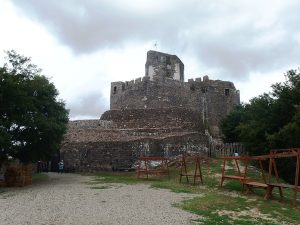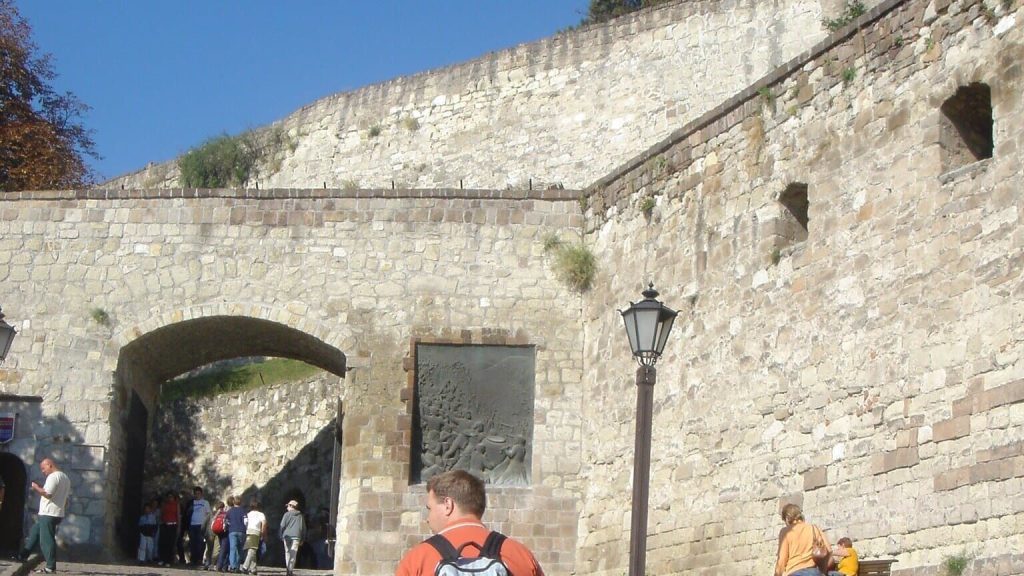
Introduction: Why Are We Here? (And Why You Should Be Too)
Let’s be honest for a moment. Most travelers to Hungary get stuck in what I affectionately call the “Budapest Bubble.” They hit the Parliament, ruin bars, maybe a thermal bath, eat a langos, and call it a day. And look, I get it. Budapest is magnificent. It is the Paris of the East, the Pearl of the Danube, and all those other shiny superlatives. But if you want to understand the soul of this country—the gritty, stubborn, “we-will-not-yield” attitude that defines the Magyar spirit—you have to leave the capital. You have to go to Eger.
I remember my first arrival in Eger vividly. I stepped off the train (a journey I’ll detail later, because it’s an adventure in itself that requires a specific kind of patience) and was immediately hit by two things: the smell of fresh rain on cobblestones and the overwhelming, looming presence of history. Eger isn’t just a pretty baroque town; it’s a battlefield disguised as a postcard. It feels different here. The air is heavier, not with smog, but with the weight of centuries of defiance.
The question I get asked constantly by people planning their 2025 itineraries is simple: Is Eger Castle worth the trek? Is it worth dragging yourself onto a MÁV train for two hours? Is it worth the steep uphill climb? Is it worth navigating the construction zones?
The short answer? Yes. But it comes with caveats the size of a cannonball. It’s not Disney World. It’s a rugged, partially ruined, currently-under-construction testament to a 16th-century bloodbath. It’s a place where you can touch the walls that held back the Ottoman Empire, wander through freezing underground tunnels that smell of damp earth and fear, and—if you’re not careful—get traumatized by some truly questionable wax figures that look like they haven’t slept in 400 years.
In this massive, exhaustive guide, I’m going to take you through everything. No fluff, no “hidden gem” clichés (unless they are actually hidden and I’m feeling generous enough to share them). I’m talking real prices in HUF and USD, the actual physical effort it takes to climb the minaret without passing out, where to eat so you don’t get ripped off by tourist traps, and the one thing about the castle that drives me absolutely crazy.
Welcome to HungaryUnlocked: The Eger Edition. Grab a glass of Kékfrankos; we’re going in deep.
Key Takeaways
- Eger Castle is located in the Bükk region of Hungary and is one of the most famous Hungarian castles.
- It played a crucial role in the 1552 siege and was later captured by the Ottoman Empire.
- The castle is currently undergoing restoration and visitors can explore various parts, including the Dobó-bástya and the Romkert.
- The castle houses a historical exhibition showcasing its history, including the famous siege and daily life during the Ottoman occupation.
The Insider Narrative: First Impressions & The Atmosphere
You arrive in Eger, and you have to walk from the station to the center. It’s about a 20-minute walk, and it’s not the prettiest start. You pass some concrete blocks, some questionable 1970s architecture, and you might wonder if you’ve made a mistake. But then, you cross a street, and suddenly, the timeline shifts. The streets tighten into narrow veins of cobblestone. The Baroque architecture explodes in shades of yellow and ochre. And then you see it. The Castle.
It sits on a volcanic hill, looking down on the city like a stern grandfather who has seen too much and is not impressed by your modern problems.
The walk up to the castle is your first test. Most people approach from Dobó István tér, the main square dominated by the statue of the man himself, István Dobó, sword raised, looking ready to slice through the Ottoman lines or perhaps just slice through the line at the local ice cream shop. As you ascend the narrow streets like Várkapu utca, the atmosphere shifts. It’s quieter up here. You smell the distinct aroma of chimney cakes (kürtőskalács) baking in small shop windows—vanilla and cinnamon wafting through the air—mixed with the dust of restoration work.
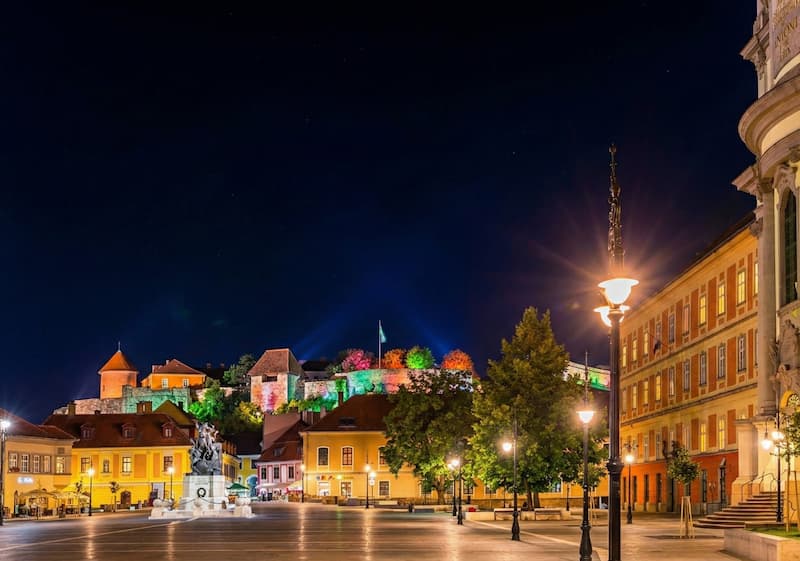
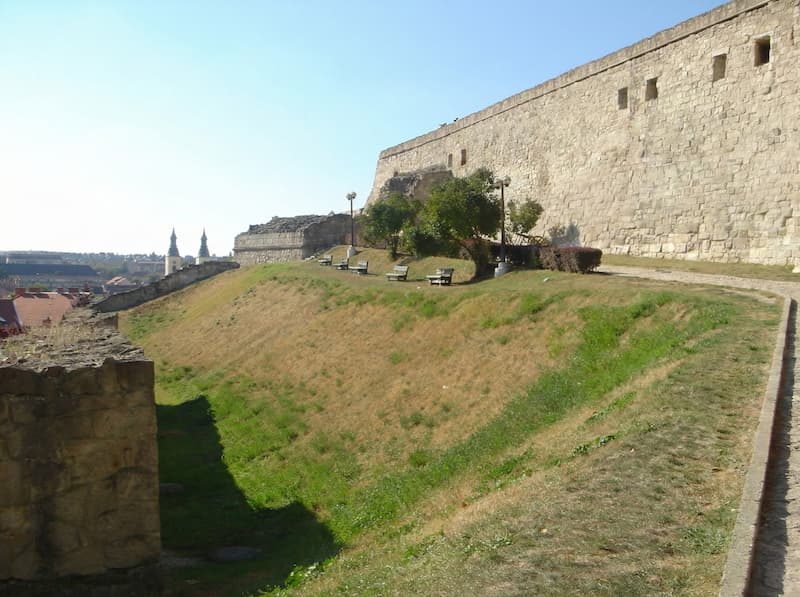
Because that is the reality of Eger Castle in 2025: it is in a state of becoming. It is being put back together, stone by stone. You will hear the clang of construction alongside the bells of the Minorite Church. It’s a living site, not a dead museum. And when you finally reach the Varkoch Gate, panting slightly because that incline is deceptive, you turn around. The view hits you. The red tiled roofs of Eger, the spires of the churches, the rolling Bükk mountains in the distance—it’s one of those views that makes you involuntarily reach for your camera, even though you know a photo won’t capture the depth of it.
This isn’t just sightseeing; it’s time travel. You are standing where 2,000 people stood against an empire. The wind up here feels colder, sharper. It carries the echoes of 1552. Or maybe that’s just the draft from the wine cellar. Either way, you’re here now.
The Historical Context: The Siege That Defined a Nation
Before we even talk about ticket prices, you need to understand why this pile of rocks matters. If you don’t know the story, Eger Castle is just a wall. If you know the story, it’s hallowed ground. This is the Hungarian Alamo, but with a better ending (for the Hungarians, at least).
The Siege of 1552: The “300” of Hungary
In the autumn of 1552, the Ottoman Empire was steamrolling Europe. Suleiman the Magnificent’s forces were unstoppable, chewing up fortresses and spitting out gravel. They turned their eyes toward Eger, the gateway to Upper Hungary. Capturing Eger meant opening the road to the rich mining towns of the north and eventually, Vienna.
The Ottomans arrived with an army estimated between 40,000 and 80,000 troops. They had heavy artillery, siege towers, camels, and the elite Janissaries. Standing in their way? István Dobó and a ragtag group of about 2,100 to 2,300 people.
The math was terrifying. The odds were roughly 35 to 1. The defenders weren’t just soldiers; they were mercenaries, peasants, craftsmen, and famously, the Women of Eger.
For 38 or 39 days (historians argue, but let’s say it felt like an eternity), the Turks bombarded the walls. They dug tunnels. They launched assaults. The defenders ran out of gunpowder. They ran out of food. They ran out of hope. But they didn’t break. The women of Eger famously joined the battle, pouring boiling pitch, water, and hot soup on the attackers trying to scale the walls. This wasn’t just a military engagement; it was total war.
The brilliance of the defense lay in innovation. Gergely Bornemissza, a lieutenant and something of a MacGyver of the 16th century, devised primitive grenades and bombs. He created a “fire wheel”—a large wooden wheel packed with gunpowder and oil—that they rolled into the Ottoman ranks, causing chaos and panic.
The Legend of Bull’s Blood
This is the story you will hear in every wine cellar in town. Legend has it that during the darkest days of the siege, when morale was crumbling, Dobó opened the castle wine cellars. He ordered the distribution of red wine to his exhausted troops to give them “liquid courage.” The soldiers drank deep. In their haste and frenzy, the red wine stained their beards, their shirts, and their armor.
When the Ottomans attacked the next morning, they saw these red-stained, maniacal Hungarians fighting with superhuman strength and ferocity. Rumors spread through the superstitious Ottoman ranks that the Hungarians were drinking the blood of bulls to gain demonic power. The Turks, terrified of fighting “blood-drinkers,” eventually retreated. Hence, Egri Bikavér (Bull’s Blood wine) was born.
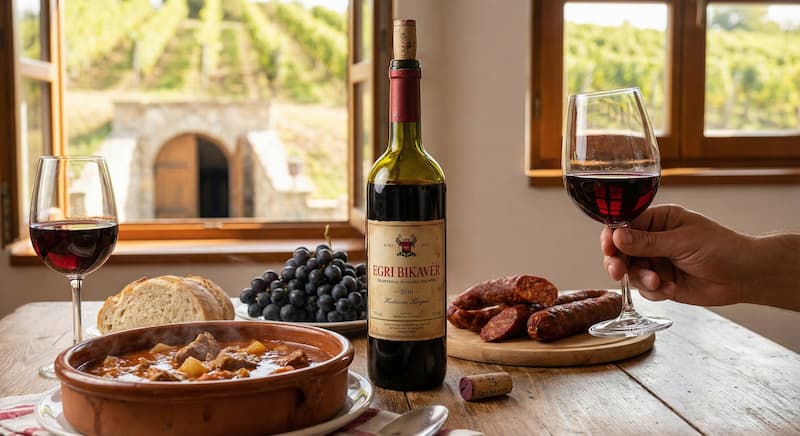
Is this historically accurate? Probably not. The term “Bikavér” likely didn’t appear until the mid-19th century. But does it matter? It captures the spirit of the place. It’s a story of psychological warfare, of turning a weakness (fear) into a weapon.
The siege ended in an Ottoman withdrawal. It was a humiliating defeat for the Empire and a glorious victory for Hungary. It stopped the Ottoman advance for decades. Sadly, the Ottomans returned in 1596 and actually took the castle (because the mercenaries weren’t paid and surrendered), holding it for 91 years. But we don’t talk about 1596 as much. We focus on 1552. That is the year that defines Eger.
Logistics: Getting To The Gates
Now that you’re emotionally invested, let’s get you physically there. Eger sits about 130km northeast of Budapest. It sounds close, and it is, but your choice of transport determines whether you arrive ready to conquer or ready for a nap.
The Train: The “Authentic” Experience
Taking the train from Budapest to Eger is the most common method, and honestly, my preferred way. It allows you to watch the landscape shift from the flat plains to the rolling hills. You depart from Keleti Pályaudvar (Keleti Railway Station) in Budapest.
- The Route: You want the Agria InterRegio train. It is a direct shot, usually leaving hourly.
- Time: It takes about 1 hour and 52 minutes. It’s not a bullet train; it’s a steady chug.
- The Vibe: The train ride cuts through the Great Hungarian Plain and then starts to hit the foothills of the Bükk. It’s scenic in a quiet, agricultural way. You’ll see endless fields of sunflowers (in summer) and sleepy villages.
- Insider Hack: Do not accidentally hop on a train that requires a transfer in Füzesabony unless you enjoy sprinting between platforms in 3 minutes flat with your luggage. Stick to the direct Eger lines. Also, use the MÁV app to buy your ticket. It is often 5-10% cheaper than buying at the counter, and you don’t have to deal with the grumpy ticket window lady who judges your pronunciation of “Eger”.
The Bus: The “Volánbusz” Option
Buses depart from Budapest, Stadion autóbusz-pályaudvar (Puskás Ferenc Stadion metro stop).
- Time: Roughly 2 hours 8 minutes.
- Why take it? The bus station in Eger is slightly closer to the city center than the train station, saving you about 10 minutes of walking. But honestly, the train is more comfortable. The bus can get stuffy, and you are at the mercy of traffic.
Driving: The Freedom Route
If you’ve rented a car, the drive takes about 1.5 hours via the M3 highway.
- Warning: You need a vignette (highway toll pass) for the M3! Don’t forget this, or the fine will ruin your trip. You can buy it at any gas station or online.
- Parking in Eger: Eger’s city center is largely pedestrian or restricted. Do not try to drive up to the castle gate unless you have specific permission or are staying at a hotel right there.
- Pro Tip: Look for parking lots near Ady Endre utca or the large lot near the Thermal Baths. From there, you walk. Eger is a walking city. If you hate walking, you picked the wrong century to visit.
Detailed Section: The Castle Tour (Walkthrough)
You’ve survived the journey. You’ve climbed the hill. You’ve paid the entrance fee (we’ll get to prices in a minute). Now, you are inside. Here is the breakdown of what you are actually looking at.
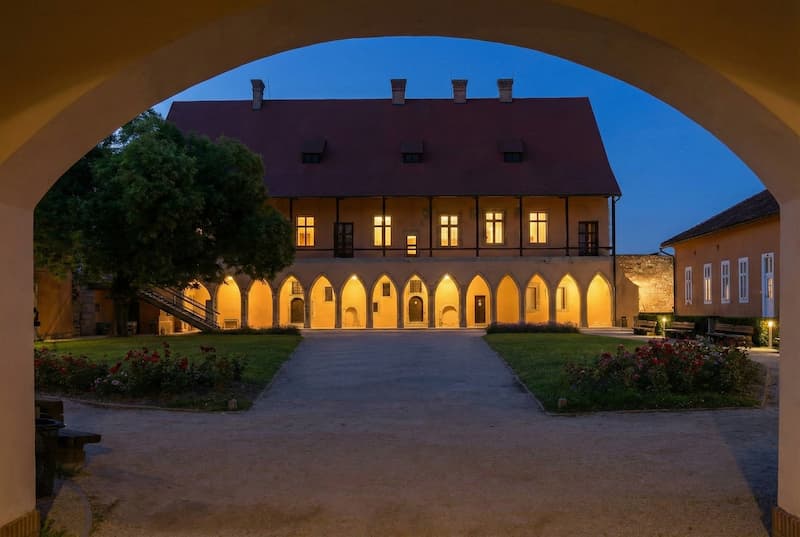
1. The Gothic Bishop’s Palace
This is the main museum building, and it’s the architectural crown jewel of the complex.
- The Vibe: Authentic Gothic. High arches, echoing stone floors, thick walls that radiate cold even in July.
- The Exhibits: Downstairs is the Hall of Heroes, dominated by the tomb of István Dobó. Here is a fun fact: his body isn’t actually here. He was buried in Dobóruszka (modern-day Slovakia) on his family estate. But the tomb is here to pay homage. The statues surrounding it are massive and imposing, designed to make you feel small and insignificant in the face of history.
- The Upstairs: This covers the history of the castle. You’ll see weapons, coins, and maps.
- The Reality: The signage is decent, usually in Hungarian and English. However, it can be a bit “dry” if you aren’t a hardcore history nerd. It’s a lot of “this is a pot shard from 1450.” Use Google Lens if you encounter Hungarian-only placards; it’s a lifesaver.
2. The Casemates (Kazamaták) – The Absolute Highlight
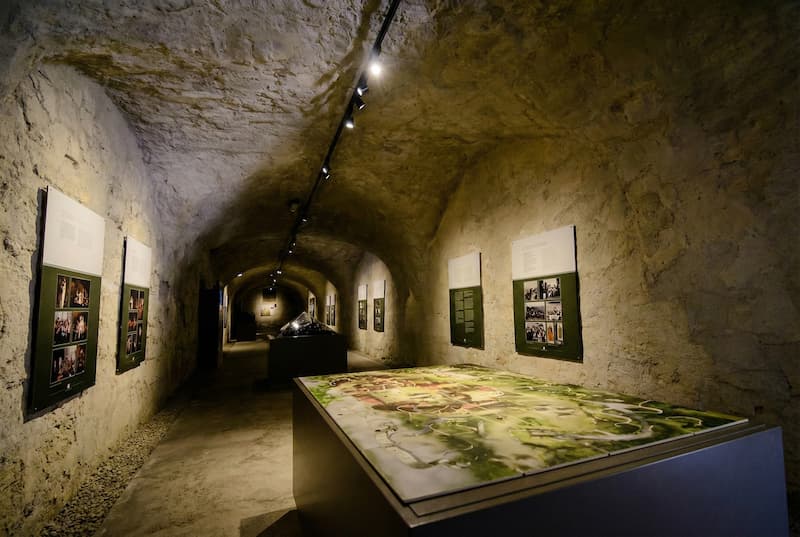
This is the underground tunnel system. If you do nothing else, do this.
- Why go? This is where the real defense happened. It’s a labyrinth of tunnels, listening posts (to hear Ottoman miners digging tunnels under the walls), and storage rooms.
- The Temperature: It is COLD down here. Even in August, when it’s 35°C outside, the tunnels sit at a chilly 12°C (54°F). Bring a hoodie! I cannot stress this enough. I’ve seen tourists shivering in tank tops, and it ruins the experience.
- The Experience: It smells like damp earth, old stone, and history. It’s eerie. The acoustics are strange; whispers carry for long distances. You can practically hear the ghostly whispers of the 1552 defenders plotting their next move.
- Warning: Some parts are only accessible via guided tour, so check the schedule at the info desk immediately upon arrival. Do not miss the chance to see the “listening corridors”.
3. The Panoptikum (Wax Museum) – The “What Were They Thinking?” Section
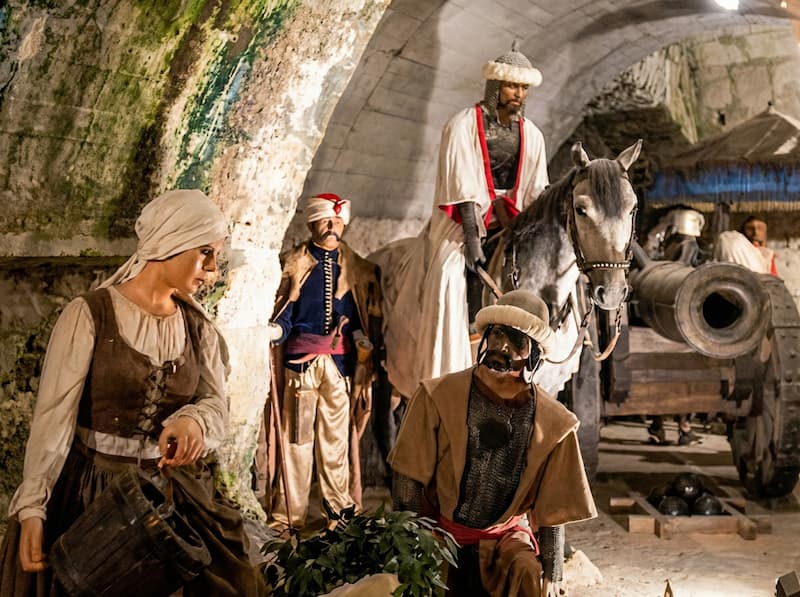
Located in the cellar of the Earth Bastion, this is the “Stars of Eger” wax exhibition.
- The Concept: Life-size wax figures depicting the characters from Géza Gárdonyi’s novel “Eclipse of the Crescent Moon.”
- The Reality: Okay, I have to be the honest “HungaryUnlocked” voice here. It is creepy. The figures look like they were made by someone who had once seen a human being, but only briefly and in the dark. Their eyes stare into your soul. Some are dimly lit in a way that makes you feel like you’re in a low-budget horror movie from the 90s.
- Review: Kids might find it funny or terrifying. Adults will find it unintentionally hilarious. Is it worth the extra few hundred forint? Yes, for the story and the sheer absurdity of it, but don’t expect Madame Tussauds quality. It’s “Hungarian countryside wax museum” quality, which is its own special genre.
4. The Ruins of the Cathedral (Rotunda)
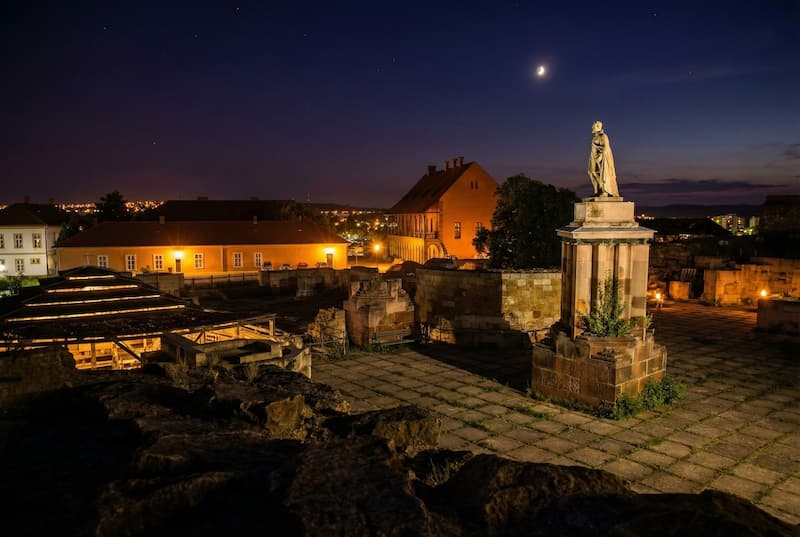
In the center of the courtyard lie the ruins of the old Romanesque/Gothic cathedral.
- The Vibe: It’s an open-air ruin garden. It gives you a sense of scale—this wasn’t just a fortress; it was a massive religious center before it became a war zone.
- Photo Op: This is great for moody, artistic shots. The broken pillar bases and crumbling walls against the stark blue sky create a beautiful contrast. It’s a reminder that before the soldiers, there were priests.
5. The Ramparts & The View
This is why you paid the money.
- The Walk: You can walk along the castle walls (the Sétány).
- The View: To the south, you see the red tiles of Eger city, the Baroque towers of the Minorite Church, and the pencil-thin Minaret rising like a needle. To the north/east, the Bükk mountains rise up, covered in forests and vineyards.
- Best Time: Golden Hour (Sunset). If you time your visit right, watching the sun dip behind the Mátra hills while standing on the Dobó Bastion is magical. The light hits the red roofs of the city and turns them into a sea of fire. It’s the best selfie spot in the county.
2025 Ticket Prices & Opening Hours (The Real Numbers)
Here is where it gets tricky. Eger Castle has a complex ticket structure that can confuse even locals. Do not just walk up and say “one ticket please,” or you might overpay or miss out.
Opening Hours (Winter/Spring 2025)
According to the latest data :
- Castle Gates: Open 9:00 AM – 6:00 PM (Winter/Spring). In peak summer, they often stay open until 10 PM.
- Museums/Exhibitions: Open 9:00 AM – 4:00 PM (Winter/Spring). Note: Indoor exhibits close earlier than the grounds! If you arrive at 3:30 PM, run to the museums first.
- Mondays: The grounds are open, but museums are usually closed (or have limited access) in the off-season (Nov-March). In peak season, they may be open, but always check.
2025 Ticket Prices
2025 Ticket Prices
Important Insider Hack:
If you just want the view and to walk the walls to watch the sunset, buy the Promenade Ticket (Sétajegy). It is significantly cheaper. But if you are a history nerd (like me) and want to see the Gothic Palace and the dungeons, you must buy the Full Ticket. The ticket ladies are strict, and they check.10
Eat & Drink: The “HungaryUnlocked” Recommendations
You cannot leave Eger without eating and drinking. The region is a gastronomic powerhouse.
Eat: Macok Bisztró
If you have one nice meal in Eger, make it here. It is located right at the foot of the castle gates at the Imola Udvarház.
- The Vibe: Playful fine dining. It has Michelin Bib Gourmand status, which means high-quality cooking at a good value. The interior is cozy, stylish, and welcoming.
- The Food: They mix traditional Hungarian with modern twists.
- Starter: Duck liver brulée with greaves cream, apple, and milk-loaf (4,890 HUF / ~$13). It is rich, creamy, and life-changing.
- Main: Beef cheek in red wine with potato mousse, porcini mushroom, and ham chips (6,990 HUF / ~$18.50). This dish falls apart if you look at it sternly. It is comfort food elevated to art.
- Dessert: Macok chocolate cake with sour cherry ice cream (3,290 HUF / ~$8.80).
- Insider Tip: Book a table in advance! It is the most popular spot in town, and walk-ins are often turned away on weekends.
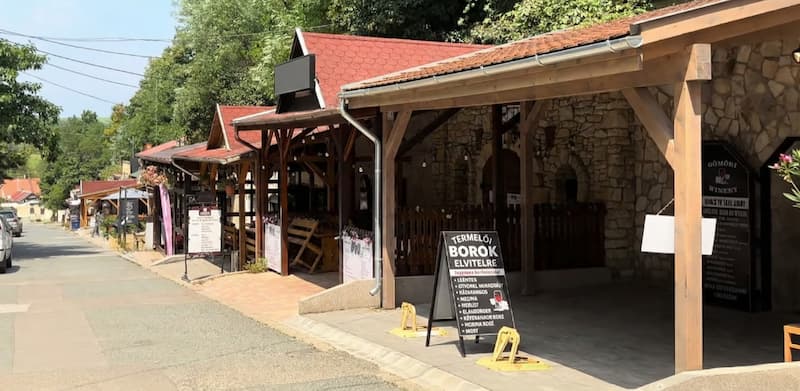
Drink: The Valley of the Beautiful Woman (Szépasszonyvölgy)
This is a wine Disneyland. It’s a valley on the edge of town with about 200 wine cellars carved into the soft volcanic rock (tuff).
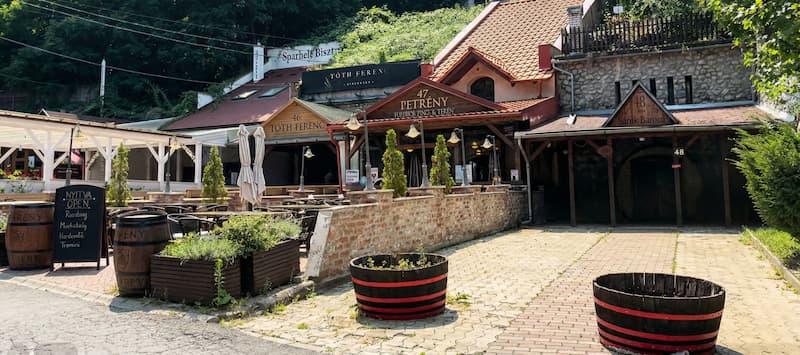
- How to get there: It’s a 20-minute walk from the center or a quick taxi/Dotto train ride.
- The Concept: You walk from cellar to cellar. You taste wine. You stumble to the next one. It’s organized chaos.
- The Wine: You must try Egri Bikavér (Red Blend) and Egri Csillag (White Blend). Bikavér is spicy, full-bodied, and perfect with a stew. Csillag is floral and crisp.
- The Price: Insanely cheap. A glass (1dl) can be 400 – 800 HUF ($1 – $2). A tasting flight of 5 wines might cost 3,000 HUF ($8).21
- Recommendation: Avoid the places selling wine in plastic 2-liter jugs unless you want a headache that lasts three days (the “table wine” quality varies). Look for Tóth Ferenc (Cellar 46) or Juhász (Cellar 40) for quality.22
- The Atmosphere: In the evening, people are grilling bacon, playing music, and sitting on benches. It’s unpretentious and joyous.
Street Food: Chimney Cake (Kürtőskalács)
You will smell them before you see them. The small stalls near Dobó Square sell these roasted sweet dough spirals. Get the cinnamon or walnut version. Eat it while it’s hot. It’s the law.
The City Below: Beyond the Castle Walls
You’ve done the castle. You’ve eaten. But Eger has three other “Must-Dos” before you can claim to have conquered the city.
1. The Minaret: The Claustrophobia Test
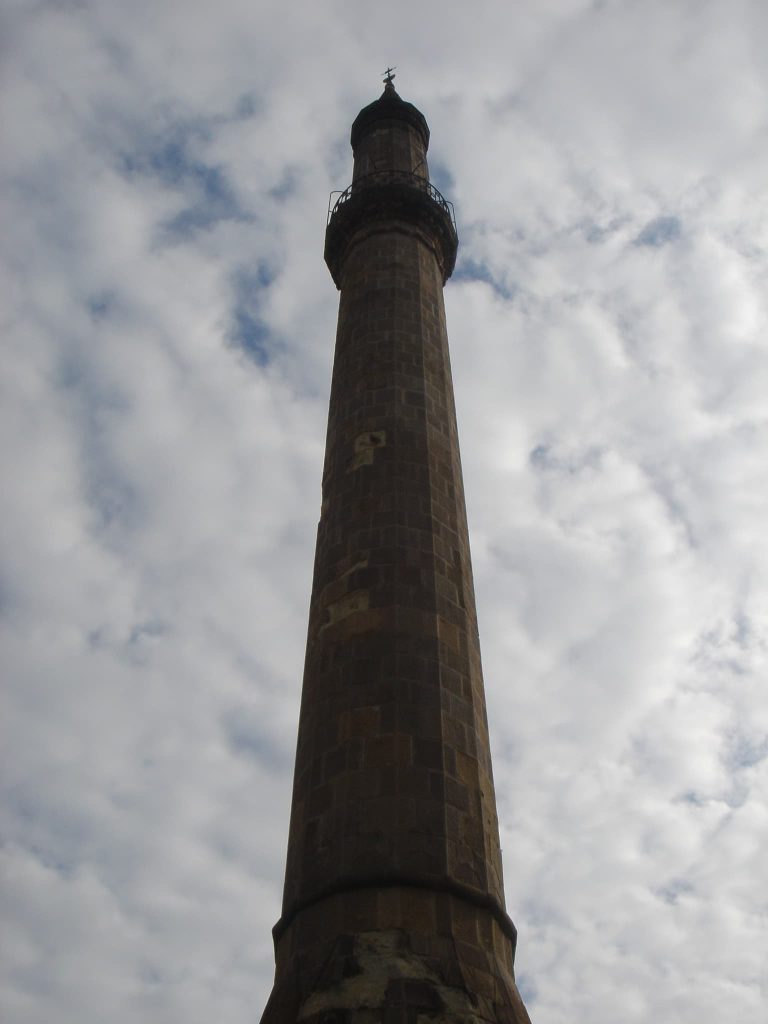
This is the northernmost historical minaret of the Ottoman era in Europe (mostly, depending on how you define borders). It is 40 meters high and stands alone, the mosque it was attached to long gone.
- The Challenge: 97 spiral steps.
- The Reality: The staircase is incredibly narrow. I mean narrow. If you are broad-shouldered, wearing a bulky backpack, or claustrophobic, DO NOT DO IT. You cannot turn around easily. Passing someone coming down while you are going up involves an intimate hug with a stranger that neither of you asked for. The stone is worn and slippery.
- The View: Incredible. You are high above the rooftops. But the balcony is tiny. The railing feels… historic (read: low).
- Price: ~600-800 HUF ($2.00).
2. The Lyceum & Camera Obscura
Located opposite the Basilica. This massive building was intended to be a university.
- The Library: The Archdiocese library is breathtaking. Baroque woodwork, ancient globes, thousands of leather-bound books, and a ceiling fresco that plays tricks on your eyes. It smells of old paper and wisdom.
- The Magic Tower: Climb to the top (yes, more stairs, about 314 of them) to see the Camera Obscura. It’s a periscope system from the 1700s that projects a live image of the city onto a white table in a dark room. It’s analog magic. You can see cars driving and people walking in real-time. It is totally worth the ticket.
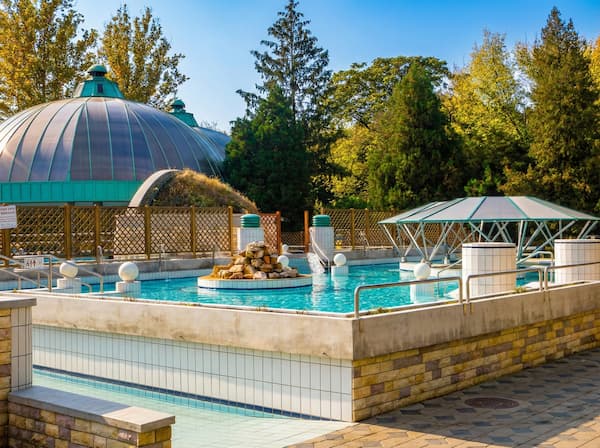
3. The Thermal Baths (Eger Termálfürdő)
After hiking the castle and the minaret, your legs will hate you. Go to the baths.
- The Water: Radioactive (in the good, healing way—radon water) and sulfurous. It heals joints and soothes the soul.
- The Vibe: It’s a park with pools. Very chill, very local. Old men playing chess in the water, families picnicking on the grass.
- Price (2025): Adult day ticket is 4,600 HUF (~$12.30 USD).
- Turkish Bath: There is also a historical 16th-century Turkish Bath (Török Fürdő) nearby with a stunning gold mosaic dome. It’s more upscale and atmospheric. Wellness tickets are ~4,400 HUF.
Insider Hacks & Safety
- Shoes: Do not wear heels. I repeat, do not wear heels. The cobblestones in Eger are ancient, uneven, and malicious. Wear sneakers or sturdy walking shoes.
- Water: Bring a bottle to the castle. The on-site cafe prices are “tourist adjusted,” and there is little shade on the ramparts.
- Safety: Eger is incredibly safe. The violent crime rate is virtually non-existent for tourists. The only “danger” is the slippery stairs in the Minaret or tripping on a castle ruin.
- Currency: Most places take cards (PayPass/contactless), but bring cash (HUF) for the smaller wine cellars in the Valley and for tips.
- Language: Young people speak English. The older lady selling chimney cakes might not, but pointing and smiling works wonders.
- The 15:52 Cannon: Every day at 15:52 (3:52 PM), a cannon is fired in the castle to commemorate the 1552 siege. It’s loud. It scares the pigeons. It scares the tourists. Be prepared.
The Negative: Honest Talk
I promised an honest report, so here is the negativity you need to prepare for.
- Perpetual Construction: Eger Castle has been undergoing massive renovations for years as part of the Modern Cities Program. There are often cranes in your photos. Entire sections (like the Zárkándy Bastion or the Hippolyt Gate) might be roped off with orange fencing. It can feel a bit like a construction site that happens to have a museum in it. It kills the immersion slightly when you are imagining a 16th-century siege and you hear a jackhammer.
- The Climb is No Joke: If you have bad knees or are pushing a stroller, the cobblestones are brutal. There is no elevator to the main gate. It is a physical commitment.
- Language Barrier: While major signs are in English, the audio guides can be glitchy, and some of the video presentations are Hungarian-only.
Summary: The Verdict
So, does Eger Castle beckon adventure?
Absolutely. It is the beating heart of Hungarian resistance history. Is it polished? No. Is it perfectly renovated? No. But that’s its charm. It feels real. It feels earned.
Standing on the ramparts at sunset, looking over the baroque towers of Eger, with the taste of Bull’s Blood wine still lingering on your palate and the smell of chimney smoke in the air, you understand why Dobó and his men fought so hard for this place. It’s not just a tourist attraction; it’s a national treasure.
Pros:
- Incredible history (Siege of 1552).
- Stunning panoramic views of the Bükk region.
- Underground tunnels (Casemates) are a unique, atmospheric experience.
- Eger town is walkable, affordable, and beautiful.
- The wine culture is accessible and fun.
Cons:
- Ongoing construction affects photos and access.
- Steep climb to enter is physically demanding.
- Wax museum is pure nightmare fuel (but funny).
- Indoor exhibits close early (4 PM).
Rating: 4.5/5 Paprikas.
Frequently Asked Questions (FAQ)
Can I do Eger as a day trip from Budapest?
Yes. It’s a long but totally doable day trip.
If you leave Budapest around 8:00 AM and return around 8:00 PM, you’ll comfortably fit in the castle, town center, basilica, and maybe even a quick wine stop.
Expect to be tired — but the satisfied kind of tired.
Is the castle dog-friendly?
Generally, yes — at least outdoors.
Dogs are allowed on the castle grounds, promenades, and courtyards, as long as they’re on a leash.
However, indoor museums typically restrict pets, so plan accordingly.
How much is a beer in Eger?
In most pubs, beer costs around 600–900 HUF (approx. $1.50–$2.50).
Eger is notably cheaper than Budapest, so your forints stretch further — especially if you enjoy “one more round.”
Is the Minaret climb scary?
For many people, yes, it can be.
The staircase is narrow, steep, and enclosed, and at the top the railing is quite low.
If you have vertigo or hate tight spaces, it may trigger that ancient “please don’t make me do this” instinct.
What is the “15:52” cannon shot?
Every day at 15:52 (3:52 PM), the castle fires a ceremonial cannon to commemorate the 1552 siege victory.
It’s a quick, loud tradition that honors Eger’s resilience — and it may startle you if you’re holding a drink.
Go forth, conquer the castle, survive the wax figures, and drink the wine. Egészségedre!