The glorious, chaotic hum of Budapest is addictive. But like any good drug, sometimes you need a detox before it eats you alive. That was the mood when I rounded up my two favorite test subjects for a road trip west. Our mission: escape the capital’s loving chokehold and investigate a so-called national treasure spoken of with the same reverence Hungarians usually reserve for holy relics or a perfectly aged Tokaji Aszú. The destination? Hévíz.
My companions, whose names have been redacted to protect them from their questionable reputations, were The Skeptic and The Spa Aficionado. The Skeptic firmly believes all thermal baths are basically oversized kettles of lukewarm human soup, seasoned with chlorine and regret. The Spa Aficionado, meanwhile, could probably teach a university course on pampering and claims to smell the mineral content of water like a sommelier sniffs wine.
And our target? Hévíz Lake — the largest biologically active thermal lake in the world, marketed as both a geological freak of nature and a sanctuary for healing. But what is it really? A genuine natural wonder, or just a glorified hot pond where German and Russian retirees gently poach themselves back to health? Swimsuits packed, cynicism locked and loaded, we hit the road. Because Hévíz is the ultimate Hungarian paradox: part state-run hospital, part natural marvel. A place where doctors prescribe bathing schedules and you float under water lilies. This isn’t a spa day. It’s a therapeutic pilgrimage. The only question: would we leave as skeptics… or as converts?

Key Takeaways
- Hévíz Lake is the largest biologically active natural thermal lake in the world, with a constant temperature of around 33 to 36 degrees Celsius throughout the year.
- The lake’s high mineral content, including sulfur, calcium, and magnesium, provides relief for various ailments and promotes healthy skin.
- The constant flow of fresh thermal water maintains the lake’s unique characteristics and therapeutic properties, supporting a diverse ecosystem.
- Exploration and study of Hévíz Lake, including the source cave, have enhanced understanding of its geological formation, historical records, and cultural significance.
The Great Hungarian Road Trip: Getting to Hévíz Without a Pálinka-Fueled Detour
There are two ways to get to Hévíz from Budapest, and your choice basically doubles as a personality test. Option one: the noble, slightly masochistic route — train to Keszthely (about three hours of watching sleepy villages roll by), followed by a bus or taxi hop to Hévíz itself. It’s scenic, it’s romantic, it’s the kind of thing you tell people you did if you want to sound cultured and vaguely French.
Option two: do what we did and embrace the open road. Roughly 193 kilometers, straight down the M7, about two hours if you’re disciplined… which you won’t be. The drive is a hypnotic blur of Hungarian flatlands — so flat, in fact, you start to suspect the country’s mapmakers just phoned it in. Then, like a mirage, Lake Balaton suddenly appears to your left: a giant, shimmering inland sea where half of Hungary goes to party, sunburn, and pretend they know how to sail. Hévíz, in contrast, is its calmer, more wellness-obsessed sibling — the yin to Balaton’s shot-of-Unicum yang.
nsider survival tip: You’ll be tempted by those shiny, modern service stations along the M7—don’t be fooled. They’re basically fuel stops serving limp hot dogs. The real magic lies in Széplaki Lángos Büfé (Siófok-Balatonszéplak, Hungária utca 27/B), a family-run stall since 1984 with a reputation as deep-fried as their dough. Recommended by culinary pros and crowned “Best Balaton Lángos,” you’ll want to stop here.
Visit their Facebook page »
Another strong contender: For a worthy backup (or if you’re exploring the southern shore), Gyuri Lángosózója in Alsóörs comes highly recommended for consistently delicious lángos made with quality ingredients and a friendly smile.

First Impressions: A Spa Town Suspended in Amber
Rolling into Hévíz feels less like arriving in a town and more like stumbling into an alternate timeline where everything smells faintly of sulphur and schnitzel. The place is a surreal cocktail of faded Austro-Hungarian villas, Cyrillic signage (because this has long been the wellness HQ for Russian and German retirees), and an atmosphere so hushed you half-expect someone to hand you a stethoscope at the border.
We parked and wandered down the Schulhof Vilmos promenade, a leafy boulevard shaded by plane trees and framed by 19th-century facades. The pace here isn’t “slow”—it’s glacial. Nobody rushes. People amble, they linger, they radiate the smug serenity of those on doctor-prescribed spa regimes that last weeks. Meanwhile, we were just day-trippers with cynicism in our backpacks, peeking into a culture of therapeutic discipline that takes wellness far more seriously than any yoga class back in Pest.
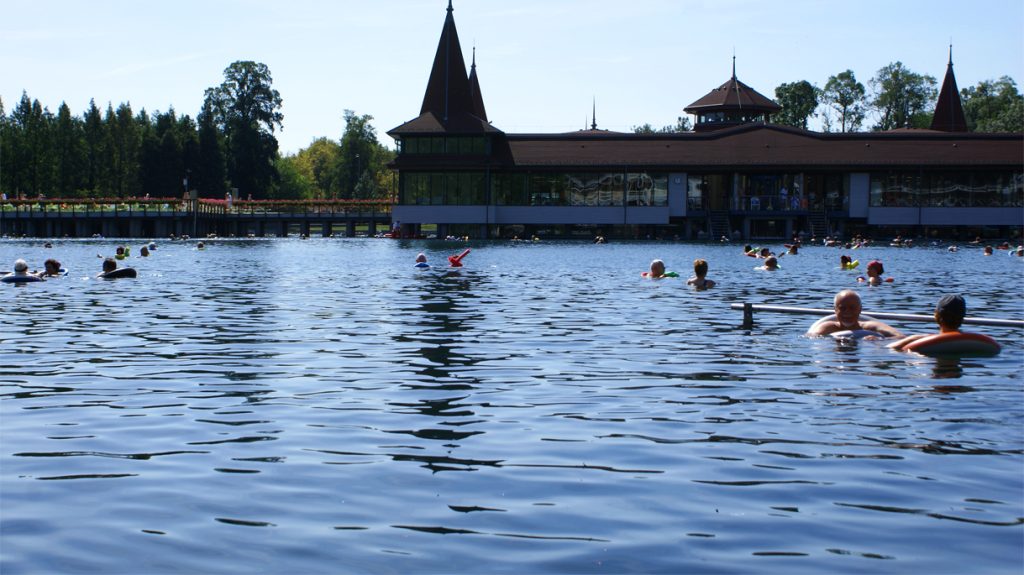
And then, the payoff. At the promenade’s end, rising like a misplaced seaside relic in the middle of a protected 60.5-hectare forest reserve, stood the main bathhouse. With its maroon roofs and ornate spires, it looked like a Victorian pier that accidentally teleported to western Hungary and decided to stay. From the entrance, the first sight of the lake hit us: an endless stretch of turquoise, steaming gently in the cool air, dotted with clusters of pink and white water lilies. It was, no exaggeration, breathtaking. Even The Skeptic—who normally ranks silence somewhere below dental surgery on his list of favorite activities—shut up for a full thirty seconds. A minor miracle.

Cracking the Code: A Practical Guide to Tickets, Lockers, and Not Losing Your Mind
Alright, let’s get down to business. Navigating the entrance to Hévíz Lake can feel like a Hungarian logic puzzle, but I’m here to be your guide. The first challenge: the tickets. The options are plentiful, but for most visitors, it boils down to two choices.
You can opt for the 2-hour ticket, which now includes wellness access—a win for your wallet compared to previous years. Need more float time? You can extend by one hour for 1,500 Ft. For dedicated soakers, there are also 10-hour and 20-hour passes. We chose the 2-hour option, planning to extend if the thermal magic took hold (spoiler: it did).
Once you’ve paid, you’re handed the key to the kingdom: a plastic electronic wristband. This little gadget operates your locker and tracks your time. This is where the real fun begins. We watched in amusement as seasoned regulars breezed through the turnstiles while we fumbled with the scanners, a moment of shared incompetence that bonded The Skeptic and The Spa Aficionado in their joint battle against the machine.
A crucial heads-up for the uninitiated: the changing rooms are mostly unisex, a common and efficient European system that can catch some visitors off guard. Don’t panic. There are plenty of private wooden cubicles where you can change in peace. The whole process—timed tickets, penalties for overstaying, automated systems—reinforces the feeling that this is a semi-medical institution, not just a casual swimming hole. It’s relaxation, but structured. Very Central European.
Important Note: The central bath building on the lake (known as Building “A” and Terrace “B”) is scheduled to be temporarily closed for technical reasons from March 18, 2025. However, all entrances to the Lake Bath remain open, and bathing in the magnificent thermal lake is completely unaffected.
To make your life easier, here’s a breakdown of the essential costs.
| Ticket Type | Price (HUF) | Approx. Price (USD) | Best For… |
| 3-Hour Adult (4 hours of use) | 4,500 Ft | ~$12 | A focused therapeutic soak or a half-day visit. |
| Daily Adult | 7,500 Ft | ~$20 | A full day of relaxation, lounging, and multiple dips. |
| 3-Hour Senior/Student | 4,000 Ft | ~$11 | Discounted visitors with valid ID. |
| Wellness Add-on | 2,000 Ft | ~$5.50 | Accessing the sauna and wellness area (ages 12+). |
| Swim-rig Rental | 700 Ft (+2,000 Ft deposit) | ~$2 (+$5.50 deposit) | Everyone. It’s not optional for true relaxation. |
Taking the Plunge: Floating in a Steamy, Lily-Padded Otherworld
Locker conquered, wristband secured — it was time for the main event. Descending the wooden steps into the lake is a sensation unlike any other. The water feels silky, almost oily, and the temperature is perfect: never a shock, always a warm embrace. In summer, it hits a toasty 38°C, while in the dead of winter it never dips below 22–24°C, thanks to the geothermal furnace humming beneath. Cold days wrap the lake in a veil of steam, an otherworldly fog that muffles sound and cocoons you in your own private, spa-flavored dimension.
Now, listen up, because this is the most important advice you’ll get: rent a swim-rig (úszógumi). Yes, it’s basically a foam noodle. Yes, you’ll look ridiculous. But skipping it is like trying to eat goulash with a fork — technically possible, utterly wrong.
The noodle isn’t just a flotation device; it’s a cultural artifact. It enforces the sacred, doctor-approved vertical bobbing position, gently stretching your spine and keeping the lake calm. No frantic splashing, no laps — just floating, drifting, and slow-motion bumper-car interactions with fellow bathers. All of this is powered by the lake’s engine: 410 liters of mineral-rich water per second surging up from a spring cave 38.5 meters below. That means the entire 4.4-hectare lake is refreshed every 72 hours, staying as pure as spa science allows.
Floating there, suspended between sky and spring, surrounded by the protected water lilies you are absolutely forbidden to damage, feels less like a swim and more like zero-gravity hydro-meditation. Even The Skeptic gave up complaining — which, frankly, is Hévíz’s biggest miracle.
The Good, The Bad, and The Slightly Mossy: An Unfiltered Verdict
So, after our four hours of prescribed relaxation, what’s the verdict?
The Good: The feeling of calm here isn’t subtle — it’s like someone reached in and manually untied every knot in your body. Muscles you didn’t even know existed surrender. The lake itself is stunningly beautiful, a genuine oasis that feels both natural and surreal. The Spa Aficionado was in heaven, ranking it among the top five thermal water experiences of her life (and she’s got a spreadsheet, trust me). She immediately began plotting a two-week “cure”, complete with doctor’s notes and a smug new sense of superiority.
The (Minor) Bad: Let’s keep it real. This is a natural lake, not an infinity pool on the top of a Budapest hotel. The bottom is lined with a meter-thick layer of therapeutic peat mud. Great for your joints, weird for your toes. Some of the wooden supports wear a soft, mossy coat, which is earthy and authentic but could trigger your inner germaphobe. And yes, the primary activity is… bobbing. If you’re solo and easily bored, you might find yourself longing for a waterproof Kindle. Honestly, Hévíz is best enjoyed with friends, conversation, or a willingness to stare at clouds until you forget what year it is.
The Skeptic’s Verdict: He emerged glassy-eyed, hair plastered to his forehead, and after a long, thoughtful pause declared it “surprisingly not-gross and deeply relaxing.” Coming from him, that’s basically a Michelin star.
Spending hours bobbing like a human buoy builds an appetite that a sad tourist-trap schnitzel just can’t satisfy. And Hévíz, bless it, has its fair share of overpriced cutlets the size of manhole covers. Rule number one: skip the café inside the bath complex. It’s where good ingredients go to die, reheated under fluorescent lights. You deserve better.
Step outside, and you’ll find a food scene that mirrors Hévíz’s own quirky identity. On one side, the old-school csárdas still churn out paprika-heavy stews, duck legs with crispy skin, and enough dumplings to weigh you down for another float. On the other, a new generation of sleek bistros and wine bars has arrived, aimed at visitors who want their craft cocktails shaken with the same care as their thermal-water schedule.
We, of course, did the heavy, cholesterol-raising research for you. Here are our top picks — where the lángos is fresh, the wine list isn’t an afterthought, and the only thing overpriced is your spa robe.
Hévíz for Foodies: Our Top Picks
| Restaurant | Vibe / Style | Must-Try Dish & Price | Price |
|---|---|---|---|
| Kocsi Csárda | Old-school csárda with checkered tablecloths and live gypsy music. A true time capsule. | Vörösboros szarvaspörkölt (Red Wine Venison Stew with dumplings) – 5,820 Ft / ~$16 | $$ |
| Brix Bistro | Modern, trendy, sophisticated; high-quality ingredients and a contemporary vibe. | Tanyasi préselt csirke, vargánya (Organic pressed chicken, porcini, corn textures, butter sauce) – 6,890 Ft / ~$19 | $$$ |
| Magyar Csárda | Classic Hungarian comfort food; generous portions, cozy atmosphere. | Kemencés csülök (Oven-baked Pork Knuckle with bacon & cabbage) – 5,890 Ft / ~$16 | $$ |
We opted for the full traditional experience at Kocsi Csárda, a few hundred meters from the lake. The venison stew was rich, dark, and deeply flavourful—prime hibernation fuel. Live music? Slightly cheesy, thoroughly charming. A perfectly, unapologetically Hungarian end to a perfectly, unapologetically Hungarian day.
Where to Sleep It Off: From Budget Bunks to Palatial Pampering
Hévíz isn’t just about floating like a warm dumpling—it’s also about sleeping well afterward. Whether you’re a budget-savvy traveler or someone who revels in spa luxury, Hévíz has got you covered.
Budget (Under $70/night)
You won’t get a doorman or luxury lobby, but you will get comfort, clean rooms, and great value—so you can spend your cash on wine, goulash, and massages instead.
- Aranyhal Apartman – Rated 9.4, these spotless, well-equipped apartments offer private parking, friendly hosts, and even a garden jacuzzi.
- Wegzen Guesthouse – Comfortable rooms with AC, Wi-Fi, and private parking—comfortably walkable to the lake.
Mid-Range ($100–180/night)
Mid-range is Hévíz’s sweet spot—full spa-hotel amenities without breaking the bank.
- Ensana Thermal Hévíz – A classic choice, directly connected to the main spa complex. Four-star comfort, multiple pools (some fed with thermal water), restaurants, and half-board packages.
Luxury ($200+/night)
Ready to treat yourself like royalty? Enter the realm of lavish spa indulgence:
- Lotus Therme Hotel & Spa – The pinnacle of Hévíz luxury: 5-star service, situated on a private 17-hectare estate, with multiple indoor/outdoor pools, full spa facilities, and Michelin-level relaxation.
Beyond the Bobbing: Exploring the Balaton Riviera
You can’t come all this way just to prune yourself into oblivion. Hévíz is the perfect launchpad for the West Balaton region — one of Hungary’s richest cultural and natural areas. Day trips here aren’t optional, they’re mandatory. Castles, vineyards, historic towns, and the shimmering expanse of Lake Balaton are all within easy reach. Think of Hévíz as your Wellness HQ, where you recharge between adventures.
Keszthely (6 km away): The Aristocratic Neighbor
A short drive or bus ride from Hévíz lies Keszthely, the cultural capital of Lake Balaton. Its crown jewel is the absurdly opulent Festetics Palace, Hungary’s answer to Downton Abbey. This magnificent Baroque palace was the home of the influential Festetics family for over 200 years. Plan to spend at least half a day exploring its many attractions, including the stunningly preserved period rooms, the breathtaking Helikon Library (the only intact aristocratic private library in Hungary), a vast Carriage Museum, and a Hunting Exhibition set in expansive, beautifully manicured gardens. For more information, you can visit the official website click here.
Sümeg (25 km away): For Your Inner Knight
For a dose of medieval drama, head north to the town of Sümeg, dominated by the magnificent Sümeg Castle. Perched dramatically on a hilltop, it’s one of Hungary’s largest and best-preserved fortresses. The castle hosts regular “knightly tournaments,” which are a gloriously entertaining spectacle of impressive horsemanship, sword fighting, and medieval pageantry. It’s a fantastic experience, especially for families, and offers panoramic views of the surrounding countryside. For more information, you can visit the official website click here.
Badacsony Wine Region (30 km away): Volcanic Vino
A pilgrimage for any self-respecting wine lover. The Badacsony region is a stunning landscape of truncated volcanic buttes rolling down to the northern shore of Lake Balaton. The unique terroir, with its heat-retaining black basalt soil, produces some of Hungary’s most distinctive and powerful white wines—full-bodied, fiery, and packed with minerality. While you’re there, you must seek out the region’s flagship grape,
Kéknyelű, a rare and elegant local variety that is experiencing a major renaissance. Dozens of wineries dot the hillside, many with terraces offering epic views.
My Pick: Make a reservation at Laposa Birtok. Their modern wine terrace offers guided tastings and cheese platters with a panorama of Lake Balaton that is simply unforgettable. For more information, you can visit their website click here.
Frequently Asked Questions (The Stuff You’re Actually Googling at 2 AM)
Let’s cut to the chase. Here are the answers to the questions buzzing around your head.
How long should I actually stay in the water?
The official medical advice is to limit your time in the potent thermal water to 20-30 minute intervals, followed by a break of at least half an hour. The water is powerful, so listen to your body. Don’t be a hero.
Is it safe for non-swimmers?
Yes, with a big caveat. The water is immediately deep—around 2 meters even near the steps—so you cannot stand. However, with the mandatory-in-my-opinion swim-rig, you are virtually unsinkable. You will be floating vertically, not swimming horizontally. For those who are truly nervous, there are also indoor pools within the complex that are shallower and more conventional.
Can I bring my kids?
This is a tricky one. Due to the water’s high mineral content and radioactivity (the good kind, apparently), bathing in the main lake is officially not recommended for children under the age of 12 or 14, as it can affect their hormonal systems. However, Hévíz is becoming more family-friendly. There is a seasonal outdoor children’s pool on-site, and the surrounding area is packed with kid-friendly attractions like adventure parks and castles.
What should I pack for the lake?
The essentials: a swimsuit, a towel, and flip-flops (which are mandatory to wear inside the complex). A bathrobe is a fantastic idea, especially in winter, for the walk from the changing rooms to the lake.
Crucial tip: Do not wear silver jewelry. The sulphur in the water will tarnish it, turning it a sad shade of black almost instantly.
Is it really open in winter?
Absolutely, and it’s arguably the most magical time to visit. There is nothing quite like floating in the warm, steaming water while snowflakes fall gently around you. It’s an unforgettable, core memory-making experience.
How long should I plan to spend at the lake itself?
For a first-time visitor, the 2-hour ticket (with the option to extend by one hour) is perfect. It gives you plenty of time to soak, relax, and experience the magic. The 10-hour or 20-hour passes are for dedicated relaxation artists or those on extended therapeutic stays.
Legends of Hévíz: No Kerubs or Elephants—Just Local Magic
Forget the made-up myth of cherubic guardians singing their hearts out—or spiritual elephants splashing around Hévíz Lake. Here’s the real story:
The Kerubs at the Gate
Walk into the Hévíz Spa via the Schulhof Vilmos promenade and you’ll pass under two kerub statues—real, tangible ones commissioned by the Festetics family around the turn of the 20th century, crafted in the Zsolnay style. They’re said to guard the entrance and ward off evil spirits, rooted in ancient Semitic mythology. Local legend goes that if you leave Hévíz without ever experiencing true love, the kerubs will sing to call you back… though nobody’s ever actually heard them belt out a tune (and Google’s quiet on it too).
Nelly the Elephant—For Real
This one’s not fiction either: in 1913, a young elephant from the zoo—affectionately known as Nelly—was diagnosed with rheumatism. The zoo vet prescribed spa therapy, so off she went to Hévíz. For months, she bathed here, becoming a beloved local celebrity—and yes, you can find an old grainy photo in the archives. No, she didn’t become the spa mascot forever, but she did prove that even pachyderms believed in the healing powers of Hévíz.
kronika.hu
TL;DR: The Real Hévíz Legends
| Legend Type | The Real Story |
|---|---|
| Kerubs | Stone guardians at the main gate; commissioned by Festetics, not celestial. |
| Nelly the Elephant | A real elephant guest who indeed soaked in the thermal water for healing. |
So yes, Hévíz has its myths—but they come with a side of folklore, architecture, and actual elephant folklore. No cosmic kerubs, no mystical beasts—just a town know
The Final Word: So, Is Hévíz Worth the Hype?
As we drove back towards Budapest, the car was unusually quiet. The Spa Aficionado was in a state of blissful, zen-like calm, already planning her return for a full therapeutic course. The Skeptic, to my astonishment, admitted that Hévíz was “a profoundly unique hydro-thermal experience” and that he “felt surprisingly… good.”
And me? I’m a convert. Hévíz is so much more than just Europe’s biggest hot tub. It’s a quintessential Hungarian treasure—a place where the raw power of nature, modern medical science, and a deep-seated culture of taking it easy all converge in a steamy, lily-padded paradise. It’s slightly weird, deeply calming, and utterly unforgettable.
Yes, it is absolutely worth the hype. Go. Rent the noodle. Float. And let the magic (and the sulphur) work on you.


