Is Normafa Still Worth It With the Elizabeth Lookout Closed?
On this page
- Normafa at a glance
- The lookout is closed for long-term repairs
- Where the name comes from
- Why the tower is there at all
- Getting up there
- The chairlift, and its October break
- Parking at Normafa
- Eating on the hill
- What to walk
- Wildlife on the hill
- Winter, when the snow comes
- The Children’s Railway
- With kids
- Worth the trip from Budapest?
- The verdict
Normafa is still a lovely day out. The one thing missing is the tower most people came for: the Elizabeth Lookout on János-hegy has been closed since February 2026 and needs years of careful repair.
Everything else on the hill is open and easy to reach. A 19-minute bus ride from Széll Kálmán tér gets you there, the ridge walk is gentle enough for trainers, and the Children’s Railway is run by children. The chairlift is free with a Budapest Card. This October, plan around one date: the chairlift is closed for maintenance until 16 October and runs again from the 17th.
Normafa at a glance
| What | Detail |
|---|---|
| Where | Buda Hills, District XII, on the ridge below János-hegy |
| Highest point | János-hegy, 527 m, the top of Budapest |
| Getting there | Bus 21 from Széll Kálmán tér, about 19 minutes |
| Ticket | 500 Ft (about $1.50) single, 2,750 Ft (about $8.50) for 24 hours |
| Elizabeth Lookout | Closed since February 2026 for long-term repairs |
| Chairlift | 3,000 Ft (about $9) one way, 4,000 Ft (about $12) return, free with a Budapest Card; closed 5 to 16 October 2026 |
| Children’s Railway | 1,000 Ft (about $3) adult single, 500 Ft (about $1.50) child, under-6s free |
| Parking | 440 Ft (about $1.50)/hour, weekends and public holidays 08:00-20:00 only |
| Time needed | Half a day, or a full one with the Children’s Railway |
The lookout is closed for long-term repairs
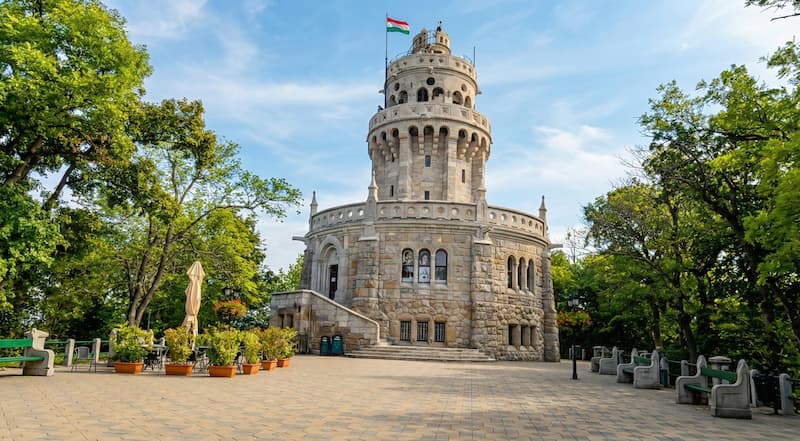
The Hegyvidék municipality closed the tower in February 2026 when render came away from the stonework. Drone surveys, crane inspections and structural tests followed, and they found a fault that goes back about a century. The heavy red star bolted to the roof in the 1950s, and later removed, made it worse.
The expert report recommends dismantling the top two levels and rebuilding them with modern waterproofing, keeping every original heritage detail. With the design work included, that takes several years and costs several billion forints, more than the district can fund alone, so it has asked the state for help. No reopening date has been set.
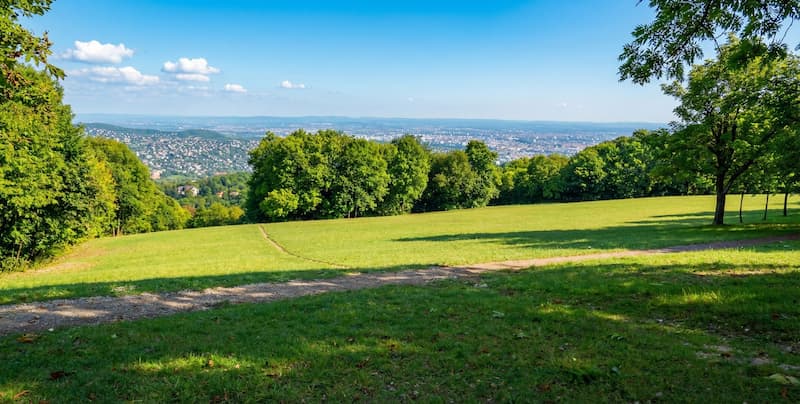
What this means for your visit: the tower terraces are off limits, but the clearing on János-hegy, the paths in every direction and the woods are all open. The Children’s Railway and, after 16 October, the chairlift run as normal. The views from the ridge, from the chairlift seat and from the Tündér-szikla outcrop are still there.
Source: Children’s Railway, Elizabeth Lookout page (MÁV) and the Hegyvidék municipality’s statement as reported by Economx on 16 July 2026, read on 6 October 2026.
Where the name comes from
Long before it was a park, the ridge held a huge solitary beech that the old Swabian families of the hill called the Viharbükk, the Storm Beech. In 1840 the actress and singer Schodelné Klein Róza, on a picnic up here with the National Theatre company, thought the tree looked just like the stage set for Bellini’s Norma and sang the aria beneath it. From then on it was the Norma tree, Normafa, and the name spread to the whole meadow.
Lightning brought the old beech down in 1927. A memorial plaque has marked the spot since 1967, carrying lines by the poet Gábor Devecseri, who lived on the hill himself.
Why the tower is there at all
Empress Elisabeth climbed János-hegy several times in 1882, when only a wooden lookout stood on top. Building a stone one in her memory took years of fundraising. Work began in 1908 to plans by Pál Kluzinger, with Frigyes Schulek, later famous for the Fisherman’s Bastion, redesigning the upper levels. It opened on 8 September 1910, and in 1926 it became the first building in Hungary with permanent floodlighting.
Source: Normafa Park, the name and its origin and Normafa Park, the Elizabeth Lookout on János-hegy, read on 6 October 2026.
Getting up there
| Route | Line | From | Time | Cost |
|---|---|---|---|---|
| Bus | 21, 21A | Széll Kálmán tér (M2) | about 19 min | 500 Ft ticket |
| Bus | 22, 22A, 222 | Széll Kálmán tér | 14-17 min to Szépjuhászné | 500 Ft ticket |
| Cogwheel railway | 60 | Városmajor to Széchenyi-hegy | then one Children’s Railway stop | 500 Ft ticket |
| Chairlift | Libegő | Zugliget, bus 291 from Nyugati | about 15 min in the air | 3,000 Ft one way |
| Car | n/a | anywhere | depends on traffic | 440 Ft/hour at weekends |
Bus 21 is the easy choice. It leaves from Széll Kálmán tér, climbs past the villas of Svábhegy and drops you at Normafa, ready to walk. On a sunny weekend it fills up with hikers, dogs and walking poles.
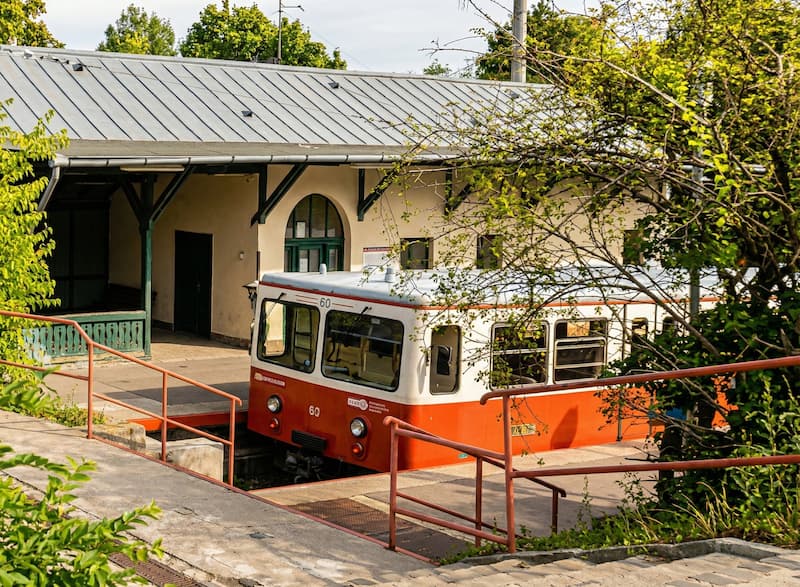
The cogwheel railway, line 60, is the more scenic ride. It climbs from Városmajor to Széchenyi-hegy, runs all year from early morning to late evening, and takes ordinary BKK tickets. At the top you can change straight onto the Children’s Railway, and Normafa is the first stop.
For any other start point, the BKK journey planner has the live route.
Source: Normafa Park, getting there by bus, Children’s Railway, cogwheel railway page and BKK ticket prices, checked 6 October 2026.
The chairlift, and its October break
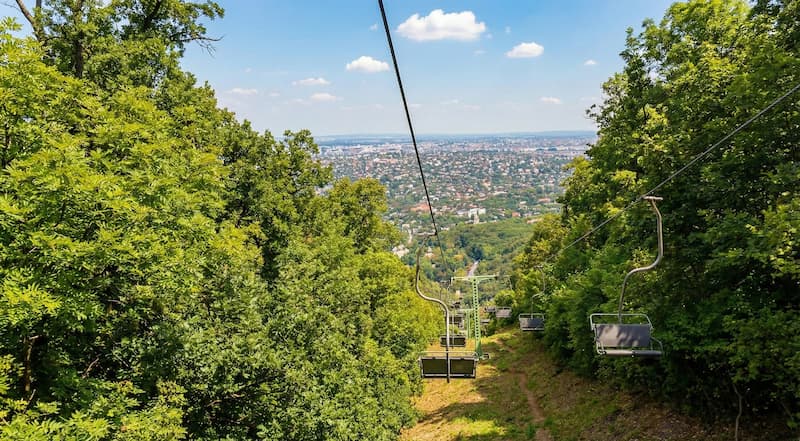
The Zugliget chairlift, the Libegő, runs 1,040 metres from Zugligeti út 97, at the bus 291 terminus, up 262 metres of hillside to Hármaskút-tető below János-hegy. The ride takes about 15 minutes in open two-seat chairs, with the canopy right under your feet. If you hold a Budapest Card it is the best deal on the hill, because the card covers it both ways.
| Ticket | One way | Return |
|---|---|---|
| Adult | 3,000 Ft (about $9) | 4,000 Ft (about $12) |
| Student, 15-25 | 1,500 Ft (about $4.50) | 2,500 Ft (about $7.50) |
| Child, 3-14 | 1,000 Ft (about $3) | 1,500 Ft (about $4.50) |
| Under 3 | free | free |
| Budapest Card | free | free |
Tickets come from machines at both stations. Every machine takes cards, one machine per station takes cash, and the BudapestGO app sells them too. A ticket stays valid for a year, so an unused return ride keeps. Children under 10 ride with an adult, and dogs travel only in a closed pet carrier on a full-price ticket.
Check the calendar before you go. The chairlift closes for maintenance on Mondays of even weeks, and it has two longer breaks a year. In 2026 those are 13 to 24 April and 5 to 16 October. From 17 October it runs again, and the snack bar at the upper station is open.
| Period | Hours |
|---|---|
| January | 10:00-15:30 |
| February | 10:00-16:00 |
| March | 10:00-17:00 |
| April (closed 13-24 April) | 10:00-18:00 |
| May to August | 10:00-19:00 |
| 1-4 October | 10:00-18:00 |
| 5-16 October | closed for maintenance |
| 17-25 October | 10:00-17:00 |
| 26-31 October | 10:00-16:00 |
| November, December | 10:00-15:30 |
In bad weather or after a technical fault the hours can change at short notice, so the operator asks you to check on the day.
Source: BKV, Zugliget Chairlift opening hours and fares, BKV, Budapest Card on the chairlift and BKV, the history of the chairlift, checked 6 October 2026.
Parking at Normafa
Driving up is free on weekdays and paid at the weekend.
| When | Rate |
|---|---|
| Weekends and public holidays, 08:00-20:00 | 440 Ft (about $1.50)/hour |
| District XII residents, paying by mobile | 50 percent off |
| Every other day and hour | free |
The car park belongs to the Hegyvidék municipality and is not guarded, and there is no maximum stay during paid hours. On busy autumn and spring weekends, and on snowy winter ones, it fills quickly, so the bus is usually the calmer choice.
Source: Normafa Park, getting there by car, checked 6 October 2026.
Eating on the hill
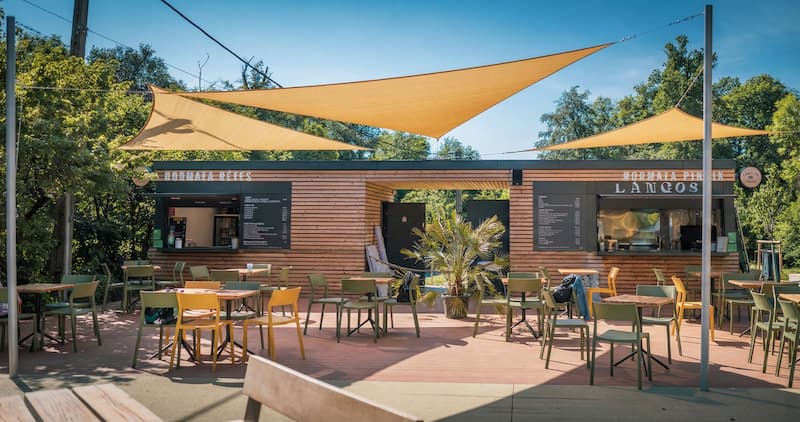
Normafa Rétes Büfé is the strudel counter many people plan their walk around. Sour cherry, poppy seed and curd cheese are the classics. The day’s prices are chalked up at the counter. Buy before your walk on a Sunday, because the queue grows through the early afternoon. Our strudel roundup for the city covers more counters.
Normafa Síház (Eötvös út 59) is the sit-down option, in the old ski house on the ridge. The kitchen starts from Hungarian classics and gives them a seasonal twist, Tuesday is Italian-style pizza day, and children and dogs are welcome. It opens Tuesday to Friday 12:00 to 22:00 and Saturday and Sunday 11:00 to 22:00. Book ahead at the weekend.
Source: Normafa Síház, opening hours checked 6 October 2026.
The pavilions sell lángos, and fried dough tastes especially good in cold air on a hillside. For a city-wide comparison, see where the lángos is really good.
What to walk
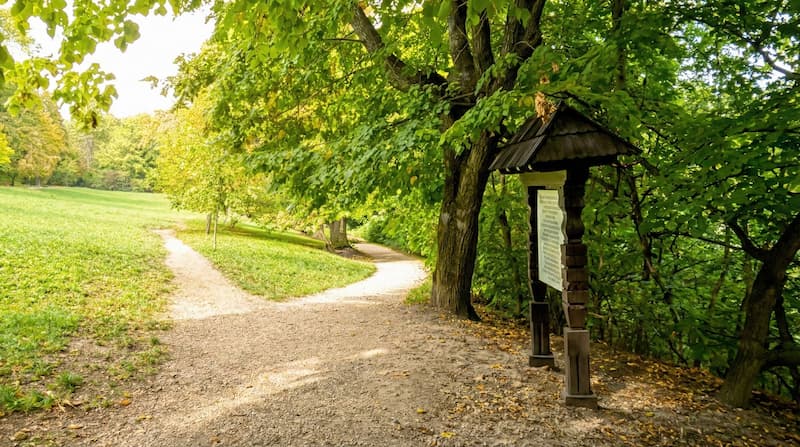
The ridge path, Normafa to János-hegy. The main path is wide, gentle and fine with a pushchair, with the city appearing through gaps in the beeches. Beside it runs a 2,040-metre rubber running track from Normafa to the lookout, 1,740 metres of it as far as the chairlift’s upper station, with motion-sensor lights for after dark. Runners have the track; walkers, cyclists, dog walkers and pushchairs use the path next to it.
The Tündér-szikla walk. The Fairy Rock is a dolomite outcrop on the side of the hill, protected since 1977, with a built path up and a view over Budapest from the top. Follow the green stripe from Normafa for about 2 km, around 30 minutes. The way back is uphill, so it suits older children and adults best.
The woods are beech and oak with planted pine, and in summer the air up here is noticeably cooler than down by the Danube.
Source: Normafa Park, running track and Tündér-szikla, read on 6 October 2026.
Wildlife on the hill
Wild boar live in these hills and are usually shy. Stay on the paths, keep dogs on a lead around dusk, and if you meet one, give it space and back away calmly.
Winter, when the snow comes
Normafa has more than a century of skiing history, and it still fills up on snowy days.
| Winter item | Detail |
|---|---|
| Natural slopes | Kis-Norma is the easiest, about 300 m, blue at the top and red lower down |
| Lifts, snowmaking, lighting | none on the natural slopes |
| Normafa Ski School | plastic learning slope with a tow lift, lessons only, booked online |
| Sledging | the Anna-rét slope, never the ski slopes |
The Kis-Norma slope starts near the bus 21 terminus and gets steeper as it goes down, so beginners stay on the top section. Sledges belong on the Anna-rét slope, which is gentle, has a flat run-out for stopping and a free toilet beside it. The ski slopes are no place for sledges, because skiers and sledgers cross paths there.
For a guaranteed slope, the Normafa Ski School teaches children and adults on a Neveplast plastic slope with a Sunkid tow lift, on the roof of the Normafa Kapuja visitor centre. It is used only for booked lessons, and it also welcomes skiers with disabilities with adapted equipment.
Source: Normafa Park, skiing, sledging and Normafa Ski School, read on 6 October 2026.
The Children’s Railway
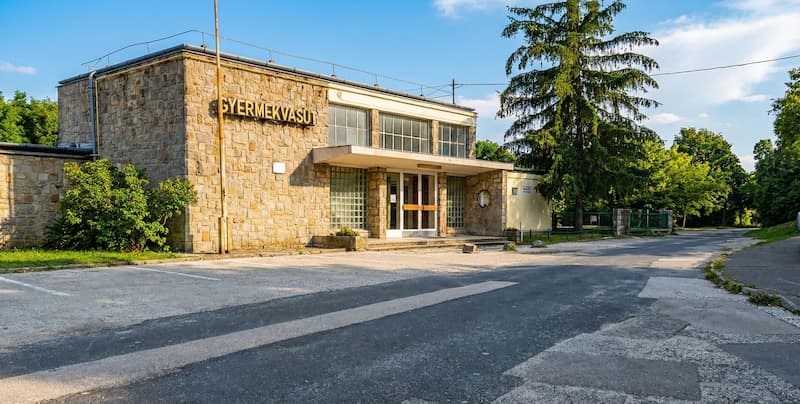
The Children’s Railway has been run by children since 1948. They sell and check tickets, work the signals and see off each train with complete seriousness. It is one of the most charming hours you can spend in Budapest.
The 11.7 km line runs from Széchenyihegy to Hűvösvölgy, with Normafa, Csillebérc, Virágvölgy, Jánoshegy, Szépjuhászné and Hárshegy in between. A full run takes 40 to 50 minutes. Trains run every day of the year, holidays included, except Monday school days between September and May.
| Ticket | Price |
|---|---|
| Adult single, any distance | 1,000 Ft (about $3) |
| Adult two-ride ticket | 1,800 Ft (about $5.50) |
| Child single, 6-18 | 500 Ft (about $1.50) |
| Child two-ride ticket | 900 Ft (about $2.50) |
| Family day ticket, 2 adults and 3 children or 1 and 4 | 5,000 Ft (about $15) |
| Under 6 | free |
| Heritage train supplement | 400 Ft adult, 200 Ft child |
On board you pay in forint cash only; the Hűvösvölgy and Széchenyihegy ticket offices also take cards. The railway has its own fares, so BKK tickets and travelcards do not cover it.
While Szépjuhászné station is being renovated, the autumn weekday timetable starts earlier: first trains leave Hűvösvölgy at 8:45 and Széchenyihegy at 9:45, last ones at 16:00 and 17:00. At weekends trains run every 40 to 50 minutes, with extra heritage trains. On 17 October 2026 Hűvösvölgy hosts a family fair day with a denser timetable.
For the lookout clearing, Virágvölgy is the gentle stop: a 1.7 km, mostly paved, step-free path. Jánoshegy station is closer at 1.1 km, but that path is steep, with steps in places. While the station toilets are being renovated, Hűvösvölgy and Virágvölgy have mobile toilets only for now, and the baby-changing room at Hűvösvölgy is out of use.
Source: Children’s Railway fares, autumn timetable notice and home page, checked 6 October 2026.

With kids
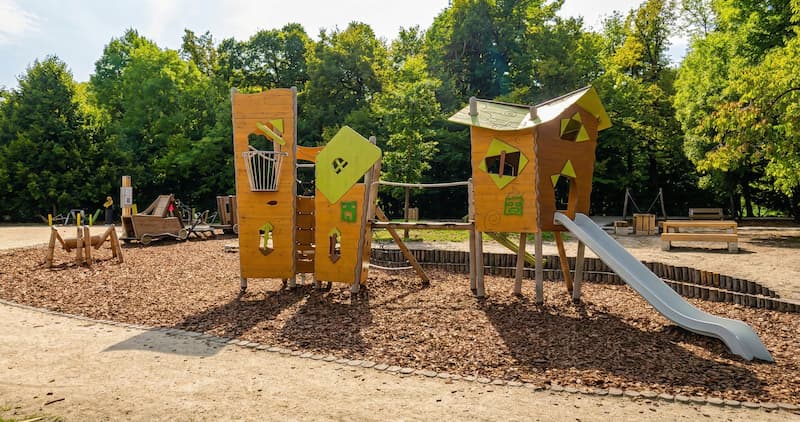
The Anna-rét playground was fully rebuilt in 2015 with 18 wooden play pieces, including three big castles, and soft pine-bark ground. It sits on the edge of a wide meadow with room for ball games, and the toilet and drinking fountain are free. Around Anna-rét there are seven picnic spots, each with a table and two benches. Virágvölgy station on the Children’s Railway is right next to it, with a heated waiting room and, while its toilets are renovated, mobile toilets for now.
If the picnic spots are taken on a warm Sunday, walk on towards the chairlift’s upper station, which has a playground of its own.
Source: Normafa Park, Anna-rét playground, read on 6 October 2026.
Worth the trip from Budapest?
You do not have to leave Budapest at all. Normafa is in District XII, 19 minutes by bus 21 from a metro station on the M2. There is no train to book and no car to hire. Two 500 Ft tickets, about $3 in total, and half a morning are all it takes.
So yes, and it is also the cheapest way to find out whether Hungarian hills are your thing. If a ridge walk and a strudel up here win you over, a longer hiking day in the hills beyond the city will too.
Go in the morning rather than the afternoon. The woods get dark sooner than the city, and the chairlift and the Children’s Railway both finish well before sunset for much of the year.
The verdict
Normafa lost its tower for now, but not its charm. The ridge walk, the fresh air, the chairlift, the strudel counter and the wonderful little railway are all here, and the basic day costs a bus ticket.
Go on a weekday morning if you can: parking is free, the 21 has seats and the strudel queue is short. At the weekend you get the lively Normafa, with pushchairs, dogs, families and the smell of fried dough. Both are worth it.
If you are planning a card-and-transport week, the Budapest Card turns the chairlift into a free ride and covers the bus up too. And for another high view over the city, Gellért Hill and the Liberty Statue is a short climb from the river.
Prices are in HUF, which is what you pay at the counter. Converted at 1 USD = 328 HUF, the ECB rate on 5 October 2026. Rates move, so treat the converted figures as indicative.
Good to know
Can you go up the Elizabeth Lookout right now?
No. The Hegyvidék municipality, which looks after the tower, closed it in February 2026 after render came away from the stonework. The surveys that followed found a structural fault going back about a century, and the expert report recommends taking the top two levels down and rebuilding them with modern waterproofing. The district has said the work will take several years and has asked the state for funding. The clearing at the top of János-hegy, the paths and the woods are open as usual.
How do you get to Normafa from central Budapest?
Bus 21 from Széll Kálmán tér, on metro line M2, reaches Normafa in about 19 minutes, and bus 21A also runs up. Buses 22, 22A and 222 go from Széll Kálmán tér to Szépjuhászné, a forest stop on the far side of János-hegy. Each ride is one 500 Ft BKK ticket, or nothing extra with a travelcard or a Budapest Card. The BKK journey planner has the live timetable.
How much does the Zugliget chairlift cost?
An adult pays 3,000 Ft one way and 4,000 Ft return. Children aged 3 to 14 pay 1,000 Ft one way and 1,500 Ft return, students aged 15 to 25 pay 1,500 Ft and 2,500 Ft, and under-3s ride free. A Budapest Card covers it in both directions. The chairlift is closed for maintenance from 5 to 16 October 2026 and reopens on 17 October.
Is parking at Normafa free?
On weekdays, yes. On weekends and public holidays between 08:00 and 20:00 the Normafa car park costs 440 Ft an hour. District XII residents get 50 percent off when they pay by mobile. Outside those hours parking is free, which makes a weekday morning the easy option.
Is Normafa good for young children?
Very. The main path along the ridge is wide and gentle, the Anna-rét playground has free toilets and a drinking fountain, and Virágvölgy station on the Children's Railway, with a heated waiting room and, while its toilets are renovated, mobile toilets for now, is right next to it. The Tündér-szikla walk is the one to save for older legs, because the way back is all uphill.
Can you ski or sledge at Normafa?
When there is snow, yes. The natural slopes, with Kis-Norma the easiest, have no lift, snowmaking or lighting, and the ski slopes are not for sledges. Sledging belongs on the gentle Anna-rét slope, which has a flat run-out and a free toilet. Beginners can also book lessons at the Normafa Ski School, which teaches on a plastic slope with a tow lift on the roof of the visitor centre.
Book it, skip the counter


Prices checked 2026-10-05. Booking through these links supports the site at no extra cost to you. How this works.