⏱️ TL;DR – The Quick & Dirty
House of Terror Museum (Andrássy út 60)
Rating: 4.5 / 5 — Essential, powerful, but emotionally draining.
Introduction: The Shadow on the Boulevard
If you stand in the middle of Oktogon intersection and look down Andrássy Avenue, you see the Budapest of postcards. You see the grand, tree-lined boulevard that was modeled after the Champs-Élysées in Paris. You see the Neo-Renaissance palaces that were once the homes of bankers, aristocrats, and artists. You smell the exhaust fumes of luxury cars and the faint, sweet scent of chimney cakes wafting from the tourist stalls. It is a place of light, money, and imperial confidence. It is the sort of street where you expect to see ladies with parasols and gentlemen with monocles, or at least digital nomads with MacBooks and overpriced lattes.
But then you walk a few hundred meters, past the burger joints and the currency exchanges, and the atmosphere curdles. You reach Number 60.
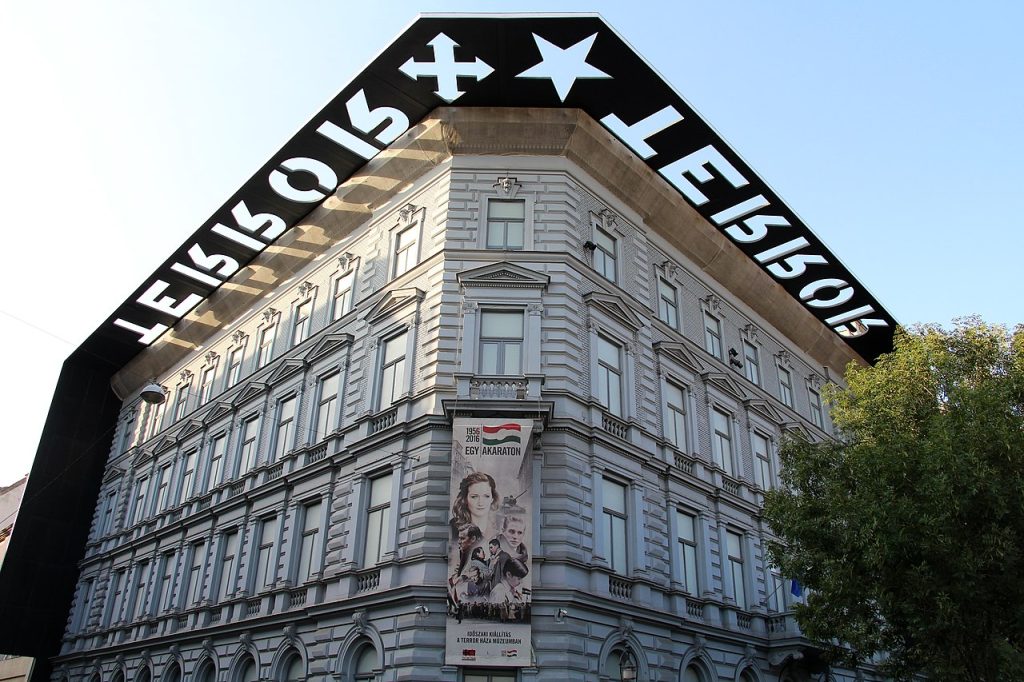
The building stands out like a fresh bruise. It isn’t painted the warm, inviting cream or yellow of its neighbors. It is a pale, ghostly grey, a color that seems to suck the light out of the air around it. And then there is the roof. A jagged, black metal cornice projects from the top of the building, hanging over the sidewalk like a guillotine blade. Cut into this metal are letters, reversed and stark. When the sun hits them at the right angle, they cast a shadow onto the façade of the building, branding it with a single word: TERROR.
Welcome to the House of Terror Museum (Terror Háza).
I have lived in Budapest for years, and I have walked past this building more times than I can count. Yet, every single time I pass it, I feel a distinct drop in temperature. It isn’t just the architecture, though the design by Attila F. Kovács is a masterclass in intimidation. It is the knowledge of what happened behind those walls. For nearly fifty years, while the trams rattled by outside and lovers strolled under the chestnut trees, people were being tortured, interrogated, and executed in the basement of this very building.
Most travel blogs will give you a sterile, sanitized overview. They will tell you it is “moving” and “educational.” They will give you the opening hours and tell you to wear comfortable shoes. That is not what we do here at HungaryUnlocked. I am going to take you by the hand—figuratively, because you really don’t want to touch anything inside—and walk you through the belly of the beast. I want to tell you about the smell of the damp brick in the cellar. I want to tell you about the weird, throbbing industrial music that follows you from room to room. I want to explain why the local historians argue about this place in hushed tones in coffee houses. And, because this is Budapest and we deal with trauma by eating, I am going to tell you exactly where to get a life-affirming plate of chicken paprikash afterwards.
This is not just a museum visit. It is a descent into the nightmare of the 20th century. So, grab a strong coffee—maybe from Ecocafe right across the street, which we will discuss later—and let’s go in.
Insider Narrative: Stepping into the Abyss
Arrival and The Wall of Heroes
I chose a Tuesday morning for my latest visit. My strategy was simple: beat the crowds and avoid the weekend crush. The museum opens at 10:00 AM, and I arrived at 9:50 AM. Even on a gloomy weekday in November, a small line had already formed. This is the first thing you need to know: this place is popular. It draws everyone from school groups on mandatory history trips to stag parties trying to inject a bit of culture into their beer-soaked weekend.
As I stood in line, I spent time studying the building’s exterior. It is a weaponized piece of architecture. The grey paint feels sterile, institutional. But it is the street-level details that ground you. Running along the outer wall, at eye level, are hundreds of small, metallic portraits. These are the Wall of Victims. They aren’t famous generals or politicians. They are the faces of everyday Hungarians. A young woman with a 1940s hairstyle. A man in a worker’s cap. A priest with round spectacles. These are the people who disappeared into the basement of Number 60 and never came out. Looking at them, you realize that terror is not an abstract concept; it is the systematic destruction of individual lives.
First Impressions: The Atrium
Stepping through the heavy doors, you leave the noise of the city behind and enter a different world. The interior courtyard, which would have once been an open-air space for carriages, has been covered with a glass roof, turning it into a soaring, cathedral-like atrium.
The first thing that hits you is the sound. It is a low, rhythmic, industrial drone. It sounds like a heartbeat slowed down to a crawl, mixed with the grinding of heavy metal and the distant slamming of prison doors. This is the soundtrack of the museum, composed by Hungarian musician Ákos Kovács. It is inescapable. It vibrates in your chest. It is designed to make you feel small, anxious, and watched.
Dominating the center of the atrium is a massive Soviet T-54 tank. It isn’t just parked there; it is mounted on a high pedestal, seemingly floating above the floor. But look closer. The tank sits in a shallow pool of black, viscous liquid. It looks like oil, or perhaps blood that has gone bad. The liquid is perfectly still, creating a dark mirror that reflects the underside of the war machine. It is a brilliant, unsettling piece of installation art. It tells you immediately that this regime was fueled by machinery, oil, and force.
Behind the tank, rising four stories high, is the Wall of Victimizers. While the outside wall honors the victims, this inside wall displays the perpetrators. Thousands of small photographs of men and women—the detectives, the torturers, the informants, the executioners. What is chilling is how normal they look. They look like clerks. They look like your uncle. They look like the person stamping your passport at the airport. It is a visual representation of the “banality of evil.”
How Locals Use The Place
For Budapest locals, the House of Terror is a complicated symbol. You won’t find many Hungarians hanging out here for fun. For the older generation, the building is a source of genuine trauma. I have spoken to elderly neighbors who still cross the street to avoid walking directly in front of it. They remember the days when the ÁVH (the communist secret police) commanded this block, and the sight of a black sedan pulling up to the curb meant someone was about to disappear.
However, for the younger generation, it has become a crucial educational site. You will see groups of Hungarian high school students moving through the exhibits, often silent and wide-eyed. It serves as a grim rite of passage, a way of saying, “This is what your grandparents survived.” It is also a political statement. The museum was founded during the first term of the current government and is heavily associated with a specific, right-leaning narrative of Hungarian history—one that emphasizes Hungary as a victim of foreign powers. This makes it a subject of intense debate among intellectuals, but for the average visitor, the sheer emotional weight of the place usually overrides the political nuances.
Detailed Sections: Walking Through the Nightmare
The museum is structured chronologically and thematically, but it is also a physical journey. You take an elevator to the second floor and work your way down, ending in the basement. This descent is literal and metaphorical.
Practical Tips Before You Start
Before you even step into the elevator, you need to make a crucial purchase: the audio guide. The museum is extremely light on written text. The rooms are designed as art installations—moody, dark, filled with objects and video screens. There are plastic information sheets in each room (in English), but reading dense historical text in a dimly lit room while people shove past you is miserable. The audio guide is excellent. It provides a narrative voice that guides you through the emotion and the facts. Without it, you are just looking at a room full of silver bricks and wondering what it means.
One more warning: The museum has a strict No Photography policy. And when I say strict, I mean militant. There are guards in almost every room, often stern older women or bored-looking young men, who watch visitors like hawks. If you pull out your phone to snap a selfie with the tank, you will be yelled at. Loudly. In Hungarian. It breaks the immersion and it’s embarrassing. Just put the phone away. Be present. The images you see here will stay in your head without a JPEG.
Level 2: The Double Occupation
The tour begins with the end of World War II. You step out of the elevator into a corridor that sets the stage for the “Double Occupation.” Hungary, having allied with the Axis powers (a disastrous decision driven by a desire to regain territories lost in WWI), found itself occupied first by the Nazis in 1944 and then by the Soviets in 1945.
The Changing Room: This is one of the most powerful exhibits in the entire museum. You enter a room that looks like a backstage dressing room or a locker room. In the center, rotating mannequins spin slowly. On one side, the mannequin wears the uniform of the Arrow Cross (the Hungarian Nazis). On the other side, the same mannequin wears the uniform of the Communist Political Police. The message is blunt and devastating: the regimes changed, the ideologies shifted, but the terror remained the same. Often, the very same people who tortured for the Nazis simply swapped uniforms and continued their work for the Communists. They were opportunists of violence.
The Arrow Cross Hall: This section deals with the chaotic, bloody rule of the Arrow Cross party in the final months of the war. You see the bizarre “Arrow Cross” symbol—a perversion of the Christian cross—plastered everywhere. You see footage of the “death marches” and the terror on the streets of Budapest. There is a dining table set for a feast, but instead of food, the plates hold maps of a dismembered Hungary. It symbolizes how the country was carved up and consumed by foreign powers and local traitors.
Level 1: The Gulag and the 1950s
Spiral stairs take you down to the first floor, which focuses heavily on the Rákosi era—the “Stalinist” period of the late 1940s and early 1950s. This is often considered the darkest time in peacetime Hungary.
The Gulag Room: This room is carpeted with a gigantic map of the Soviet Union. As you walk across it, you realize you are walking over the locations of the GULAG camps. On the walls, endless scrolling LED text lists the names of the 700,000 Hungarians who were deported to these camps. The sheer scale is overwhelming. You are literally trampling on the geography of their suffering.
The Room of the 50s: This is arguably the creepiest room that isn’t a torture chamber. It depicts the propaganda of the era. The room is filled with statues and artworks made of aluminum and silver paint. It looks cheap, shiny, and fake. It represents the “Silver Age” of forced optimism. You see posters of smiling, muscular workers, happy tractor drivers, and benevolent leaders. It captures the cognitive dissonance of living in a dictatorship where the newspapers say everything is paradise, but your neighbor disappeared last night because he made a joke about the price of bread.
The Justice Room: This room is lined from floor to ceiling with dossiers and files. It represents the judicial terror. The show trials weren’t just random acts of violence; they were highly bureaucratic events. The regime generated mountains of paperwork to justify executing innocent people. The visual impact of those thousands of files is suffocating.
The Basement: The Descent into Hell
This is the part everyone talks about. The part that gives you nightmares.
To reach the basement, you enter a slow elevator. The doors close, the lights dim, and the elevator begins to descend at an agonizingly slow pace. As you stand there, trapped in the box, a video plays on a screen. It is a black-and-white interview with a former guard/executioner. He explains, in a calm, matter-of-fact voice, exactly how they executed prisoners. He describes the “method”—how the rope was tied, how the neck broke, how they cleaned up afterwards. He speaks about it as if he is describing how to change a tire. It is the most chilling thing I have ever heard.
By the time the elevator doors finally open, you are in the basement of 60 Andrássy út. The air down here is different. It smells damp. It smells of old brick and misery. These are not recreations. These are the actual cells.
You walk through a labyrinth of brick corridors.
- The Wet Cell: You peer into a tiny, windowless cell. There is no bed, no chair. Just a floor that was flooded with freezing water. Prisoners were forced to stand here for days until their legs swelled and their will broke.
- The Foxhole: A cell with a ceiling so low that a grown man could not stand up, nor could he lie down fully. He could only crouch in the darkness, like an animal.
- The Treatment Room: This is the torture chamber. You see the instruments. The simple, brutal tools used to extract confessions. The “batons.” The electrodes.
- The Gallows: The execution room. It is stark and empty, save for the noose. It is a space of absolute finality.
I saw a group of usually rowdy study-abroad students walk into the gallows room. They went dead silent. One girl put her hand over her mouth and turned away. The energy in the basement is heavy. It presses on you. It is not just a museum exhibit; it is a graveyard of souls.
The Hall of Tears and The Exit
As you ascend from the basement, the final exhibits try to offer some catharsis, but it is limited. You pass the Hall of Tears, a forest of illuminated crosses commemorating the victims. And then, finally, you walk out past the gallery of the perpetrators—the men and women who ran this house of horrors. Many of them escaped justice. Many lived long, comfortable lives in the apartments nearby, collecting state pensions while their victims lay in unmarked graves. It is a final, bitter pill to swallow before you step back out into the sunlight.
What to Eat & Drink Nearby (Real Food Prices Included)
After two hours in the House of Terror, you are going to feel hollowed out. You will need comfort food. You will need carbohydrates. You will need alcohol. Fortunately, you are in the VI. District, one of the best culinary neighborhoods in the city. Here are my top three recommendations for “aftercare.”
1. The Authentic Cheap Eat: Frici Papa Kifőzdéje
If you want to eat like a Hungarian grandmother is cooking for you, but you are on a budget, go to Frici Papa. It is an institution.
- The Vibe: It feels like a time capsule from the 90s. Checkered tablecloths, fluorescent lighting, and waiters who have seen it all and are impressed by nothing. It is loud, busy, and unpretentious.
- What to Eat: Chicken Paprikash (Csirkepaprikás) with Nokedli (dumplings). It is rich, creamy, and soul-soothing. If you are adventurous, try the Fruit Soup (Gyümölcsleves)—it’s pink, cold, and sweet, essentially a dessert served as a starter.
- Prices: Very cheap. A main course will cost you between 2,500 and 3,500 HUF ($6.50 – $9.00 USD). A large beer is around 900 HUF ($2.30 USD).
- Location: Király utca 55 (a 5-minute walk from the museum).
- Website: Frici Papa – click here.
2. The Best Pizza Slice: Pizzica
If you can’t face a sit-down meal and just need high-quality grease and carbs immediately, run to Pizzica. It is run by an Italian family and serves authentic Roman-style pizza al taglio (by the cut).
- The Vibe: Tiny, hipster, standing-room-only. There is usually good music playing and a mix of Italians and locals arguing about football.
- What to Eat: The Potato and Truffle Oil pizza. It sounds weird (carbs on carbs?), but it is life-changing. The spicy salami is also excellent.
- Prices: You pay per slice. A generous slice is 900 – 1,200 HUF ($2.30 – $3.10 USD). Two slices is a full meal.
- Location: Nagymező utca 21 (a 5-minute walk).
- Website: Pizzica Facebook – click here.
3. The Caffeine Fix: Ecocafe
If you need a minute to decompress after the museum — and trust me, most people do — walk two doors up Andrássy út and slip into Ecocafe. It’s the closest thing the neighborhood has to a relaxed, modern specialty spot now that Flow has closed its doors.
The Vibe:
Eco-minimalist meets warm Scandinavian. Think wooden tables, soft lighting, lots of greenery, and a steady stream of locals grabbing their “I-need-to-function” morning flat whites. It feels cozy, clean, and genuinely welcoming — a gentle reset after the emotional weight across the street.
What to Drink:
Their Flat White is reliably good, and they have a strong focus on organic beans and ethically sourced blends. If you’re into lighter, fruitier profiles, try their filter coffee — they rotate roasts regularly. Oat milk, almond milk, lactose-free… you’re covered.
Prices:
A Flat White is around 1,290–1,450 HUF ($3.40–$3.80 USD).
Filter coffee sits at 1,500–1,700 HUF ($4–$4.40 USD).
They also have solid vegan pastries and light bites.
Location:
Andrássy út 68 — literally a 2-minute walk from the Terror Háza.
Website:
Ecocafe – click here.
When to Go, Safety, and Weather
Best Time to Visit
The absolute best time to visit is Tuesday or Wednesday morning right at 10:00 AM. The museum is closed on Mondays (do not be the tourist who forgets this).
- Avoid: Weekends and national holidays (especially October 23rd, the anniversary of the 1956 Revolution). The lines can stretch down Andrássy Avenue, and the museum employs a “one-way flow” system. If it is crowded, you will be stuck in a human traffic jam, shuffling past torture cells while bumping shoulders with strangers. It ruins the atmosphere.
- Season: The museum is indoors, making it a perfect rainy-day activity. However, in the peak of summer (July/August), the air conditioning can struggle against the body heat of hundreds of visitors. The basement is always cool, but the upper floors can get stuffy.
Safety and Accessibility
- Safety: The VI. District is one of the safest and most upscale parts of Budapest. You are more likely to be overcharged for a coffee than mugged. However, always watch your pockets in the queue.
- Accessibility: The museum is fully wheelchair accessible. There are elevators to all levels, including the basement (separate from the “scary” video elevator).
- Age Appropriateness: I would not recommend this museum for children under 14. The imagery is graphic. There are videos of corpses, executions, and war crimes. It is the stuff of nightmares.
Prices (2025 Update)
Budapest is not as cheap as it used to be — but compared to Western Europe, cultural activities are still reasonably priced.
Full Price Adult
Standard entry ticket
4,000 HUF
~€10
Reduced Ticket
EEA citizens aged 6–25 & 62–70
2,000 HUF
~€5
Audio Guide
Highly recommended — essential
2,000 HUF
~€5
Group Ticket
Per person (minimum 20 people)
3,000 HUF
~€7.50
Budapest Card
WARNING: Usually NOT included for free
0 HUF
Check rules
Family Ticket
2 adults + 2 children (under 18)
Varies
Check at venue
Note: Free admission is available for
EEA citizens over 70 and teachers with a valid international ID card.
Always check the official website for the latest rules.
Getting There + Opening Hours
Address: 1062 Budapest, Andrássy út 60.
Public Transport:
- Metro: Take the M1 (Yellow Line) to Vörösmarty utca or Oktogon. Both are a 2-minute walk. The M1 is an experience in itself—it is the oldest metro line in continental Europe.
- Tram: Take the 4 or 6 Tram to Oktogon. Walk 2 minutes up Andrássy Avenue (away from the river).
- Bus: Bus 105 or 178 stops right in front of the museum (Stop: Vörösmarty utca).
Opening Hours:
- Monday: CLOSED
- Tuesday – Sunday: 10:00 AM – 6:00 PM
- Box Office closes: 5:30 PM.
Local Insider Hacks
- The “Locker Game”: You are not allowed to bring large bags or coats into the exhibition. You must check them. The lockers require a 100 HUF coin to operate (you get it back). If you show up with only a credit card and large bills, you will be the annoying tourist begging strangers for change. Bring a coin.
- The “Free” Peek: If you are traveling on a shoestring budget ($0), you can actually enter the museum lobby without a ticket. From the lobby, you can look into the courtyard and see the T-54 Tank and the Wall of Victims. You miss the exhibits, but you get the architectural vibe for free.
- Toilet Strategy: Use the restrooms in the basement before you start the tour. The museum flow is strictly one-way. If you are on the second floor and realize you need to go, you have to fight your way back against the flow of people, which is a nightmare.
One Realistic Negative
I have to be honest with you: The pacing and crowd control can be frustrating.
Because the museum is designed as a narrative path, you are forced to move at a certain speed. If you are stuck behind a slow-moving tour group of 30 people, you cannot easily pass them. You end up shuffling through corridors, unable to see the exhibits, listening to the chatter of the group ahead of you. It kills the solemn atmosphere.
Furthermore, the controversy is real. Critics argue that the museum equates the Nazi and Communist regimes too simplistically, and that it focuses disproportionately on the Communist crimes while spending less time on the Arrow Cross era. Some historians argue this “whitewashes” the role of the Hungarian state in the Holocaust by portraying the nation solely as a victim of foreign powers. As a visitor, you don’t need to take a side, but you should be aware that the narrative you are seeing is a specific, curated version of history. It is powerful, but it is not the only perspective. For a deeper look at the Jewish tragedy in Hungary, I strongly recommend you also visit the Holocaust Memorial Center on Páva utca.
Summary (with a Twist)
The House of Terror is not a “fun” attraction. You will not leave whistling a happy tune. You will likely leave feeling heavy, sad, and a little bit angry at the capacity of humans to be cruel to one another.
But that is exactly why you must go.
It is a slick, Hollywood-style production of horror that grabs you by the throat and forces you to look at the dark underbelly of this beautiful city. It reminds you that the freedom to sit in a cafe on Andrássy Avenue, drinking a flat white and complaining about the Wi-Fi, is a luxury that was bought at a terrible price.
Go for the tank. Stay for the terrifying reality of the basement cells. And then, seriously, go eat that pizza at Pizzica. You’ve earned it.
FAQ: HungaryUnlocked Style
Q: Can I really not take photos? A: Really. Truly. The guards are like ninjas. They will spot the glow of your screen from across a dark room. It’s not worth the public shaming. Buy a postcard if you want a souvenir.
Q: Is it scary like a haunted house? A: No, there are no jump scares. It is existentially scary. It is the horror of bureaucracy, torture, and state control. It weighs on your soul, not your adrenaline.
Q: Is the audio guide available in languages other than English? A: Yes. German, Spanish, French, Russian, and Italian are usually available.
Q: Can I skip the line? A: Not really. There is no “Fast Pass” system. You can buy tickets online, but you often still have to queue for security and entry. Just arrive early on a Tuesday.
Q: How much time should I budget? A: If you are a history buff and listen to the whole audio guide: 3 hours. If you are a normal person: 1.5 to 2 hours. If you rush: 45 minutes (but don’t do that).