🎯 TL;DR
Barcsi Thermal Bath draws mineral-rich water from 1,317 meters underground in a town most tourists drive past on the way to Croatia. Seven indoor pools, three outdoor pools, saunas, and medical-grade balneotherapy — all for 2,200–2,800 HUF (~$6–7.50) entry. Pair it with Duna-Dráva National Park and a cross-border detour to Croatian spa towns for a proper southern Hungary escape. Plan your visit here.
📋 Barcsi Thermal Bath at a Glance
| Best For | Medical rehabilitation, uncrowded thermal bathing, cross-border wellness trips from Croatia |
| Time Needed | 4–7 hours (full day for wellness package plus nature walk) |
| Cost | 2,200–2,800 HUF (~$6–7.50) entry; treatments priced separately |
| Hours | Summer: daily 9:00–19:00; Winter: Mon–Fri 10:00–18:00, Sat–Sun 9:00–18:00 |
| Getting There | 250km from Budapest (3-hour drive via M7/M0); under 20 min from Virovitica, Croatia |
| Skip If | You want grand Belle Époque architecture, easy Budapest day-trip access, or a party atmosphere |
The Accidental Discovery That Created a Wellness Destination
The story of how Barcs became a thermal town is a classic piece of Hungarian mid-century serendipity: engineers were looking for oil, found hot water instead, and decided the hot water might actually be more useful. This kind of geological miscommunication turned out reasonably well for everyone involved.Oil Drillers Who Found Hot Water Instead
In 1959, a state-sponsored drilling operation in southern Somogy County was probing for oil deposits — a reasonable ambition in postwar Hungary, where energy self-sufficiency was a political priority. The drill hit water instead. Specifically, it hit thermal water at a depth of approximately 1,317 meters, emerging at the surface at around 62–68°C. For an oil company, this was a disappointment. For a town that would eventually build a balneological complex around it, this turned out considerably better. The accidental discovery followed a pattern repeated across Hungary throughout the twentieth century. The Pannonian Basin — the geological formation underlying most of Hungary — sits atop one of Europe’s most productive geothermal zones. Drilling anywhere deep enough in the Great Plain or southern Transdanubia carries a reasonable probability of hitting thermal water, and Hungarian engineers managed this with impressive regularity. Budapest alone sits on more than 100 thermal springs. Barcs joined this network not through ancient tradition but through a drilling rig and a disappointed petroleum geologist.From Industrial Accident to Medical Resource
Once the water was flowing, the question became what to do with it. Hungary’s communist-era health system had an unexpectedly sophisticated answer: thermal water with the right mineral composition could be classified as gyógyvíz — medicinal water — and infrastructure could be built around it for rehabilitation and preventive medicine. The state invested accordingly. The Barcs spring was analyzed and found to contain elevated levels of sodium bicarbonate, along with traces of fluoride, iodine, and dissolved minerals that gave it classification as a sodium-bicarbonate type thermal water. By the 1960s, plans were underway for a proper gyógyfürdő — literally a “healing bath” — that would serve the local population and rehabilitation patients referred from across the region. The facility that opened in subsequent years was modest by Budapest standards but serious in its medical intent: pools, treatment rooms, physiotherapy, physician consultations.How Barcs Became a Thermal Town
The thermal bath became central to Barcs’s identity in a way that went beyond simple tourism economics. In smaller Hungarian towns, the gyógyfürdő functions as infrastructure — somewhere locals go after knee surgery, where pensioners maintain mobility, where rheumatism gets managed through the winter. Barcs developed this relationship with its thermal bath across decades, and it shows in how the place operates: unhurried, functional, oriented toward the person who needs three weeks of daily soaking rather than the day-tripper chasing a wellness trend. The geological origin of the Barcs thermal springs — deep Pannonian Basin water heated by geothermal gradient — means the water is consistently mineral-rich and reliable. Unlike surface water systems that can fluctuate with rainfall and season, water from 1,317 meters underground maintains its temperature and composition year-round. That consistency is part of what makes it medically useful, and part of what keeps locals coming back regardless of what the tourism industry decides to do with it.Pool Facilities: Indoor and Outdoor Options
The Barcsi Gyógyfürdő complex covers approximately three hectares and divides cleanly between a year-round indoor thermal section and a seasonal outdoor section that transforms the place in summer. Understanding which part does what will save you from arriving in February expecting an outdoor pool experience.Indoor Thermal Pools: Year-Round Healing Waters
The indoor section operates regardless of season and contains the core of the bath’s medical offering. The main thermal pool maintains water at approximately 36–38°C — warm enough to encourage genuine muscle relaxation without the light-headedness that comes with hotter pools. The indoor section also includes a cooler pool for contrast bathing, which circulatory-focused therapy protocols tend to recommend. The architecture is functional rather than spectacular: tiled surfaces, natural light through large windows, the ambient smell of mineral water that you either find immediately comforting or slightly alarming depending on your prior thermal bath experience. What the indoor section lacks in grandeur it compensates for in quiet. On a Tuesday morning in October, you share the indoor pool with retired locals, a group of rehabilitation patients doing guided exercises, and the occasional confused tourist who followed a GPS pin. The water-to-person ratio is dramatically better than anything you will encounter in Budapest. If you have come to Barcs for actual hydrotherapy rather than social media content, the indoor section delivers exactly what it promises.Outdoor Pools: Summer Recreation and Relaxation
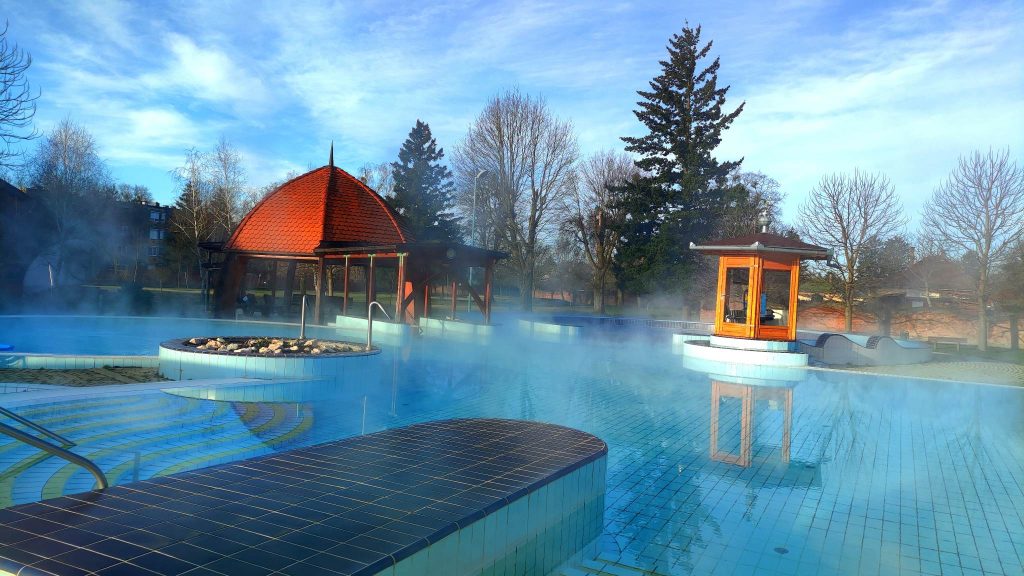
The outdoor complex opens seasonally — typically from late May or early June through September — and changes the character of the bath considerably. Summer brings the recreational crowd: families from Barcs and the surrounding villages, Croatian visitors crossing the border for a day trip, and anyone who has discovered that outdoor thermal bathing in southern Transdanubia in July is a pleasant way to spend an afternoon. The outdoor section includes three pools with varying temperatures and purposes. The largest serves as a general recreational pool — deeper, cooler, suited to actual swimming. A thermal relaxation pool maintains higher temperatures for those who want the soaking experience without going inside. The outdoor areas include lawn space and shading, which matters considerably at peak summer when the complex fills up and finding horizontal surface becomes competitive. Even at its busiest, Barcsi Thermal Bath’s outdoor section operates at a fraction of the density you’d find at any major resort spa.Children’s Pool and Family Zones
The children’s pool operates seasonally in the outdoor section and is the primary reason families with young children should time their visit to summer. The pool is shallow, maintained at a comfortable temperature for younger swimmers, and positioned away from the medical thermal pools where deep soaking is the point rather than splashing. The family zones around the outdoor pools include seating and some covered areas — useful on days when southern Hungary’s sun becomes more aggressive than relaxing. Families visiting outside of summer are dealing with a facility that shifts toward its medical function, and the experience is notably different. The indoor pools are fine for older children who can manage a proper thermal soak, but the complex does not transform itself into a family entertainment center in winter. Manage expectations accordingly and you will be fine; arrive expecting a waterpark and you will be disappointed.Sauna and Steam Facilities
The sauna complex at Barcsi Gyógyfürdő includes a Finnish sauna and steam room, standard equipment for any serious Hungarian gyógyfürdő. The Finnish sauna runs at the expected 80–90°C. The steam room operates at lower temperature and higher humidity, which some people find more tolerable for longer sessions and which the medical literature associates with slightly different respiratory benefits. The sauna rotation — sauna, cool shower or plunge, rest, repeat — is the standard protocol followed by experienced bathers and endorsed by the medical staff. If you have not done this before, the staff can explain it; if you simply want to sit in a hot room until you feel better, that works too. The sauna facilities are included in the general admission at most access levels, though confirm current pricing at entry as package inclusions can change.Medical Treatments: Evidence-Based Hydrotherapy
The medical side of Barcsi Thermal Bath is what separates it from a recreational swimming complex with warmer water. Hungary’s tradition of medical balneology — using thermal mineral water as a clinical treatment rather than just a pleasant soak — is taken seriously here, and the treatment menu reflects it.Balneotherapy: Soaking as Medical Treatment
Balneotherapy is the formal medical term for using mineral water immersion as therapeutic treatment. At Barcsi Thermal Bath, this involves prescribed soaking sessions in the mineral-rich thermal pools, typically as part of a multi-day or multi-week treatment course. The distinction between recreational bathing and clinical balneotherapy is partly administrative — you need a doctor’s consultation and often a referral — and partly practical: therapeutic protocols specify water temperature, duration, frequency, and which pool mineral profile is appropriate for your condition. The conditions most commonly treated through balneotherapy at Barcs include musculoskeletal disorders, chronic joint inflammation, rheumatoid conditions, and post-surgical rehabilitation of limbs and joints. The sodium-bicarbonate mineral profile of the Barcs water is considered particularly well-suited to these applications. Patients on formal treatment courses typically soak for 20–30 minutes per session, once or twice daily, over a course of two to three weeks. This is not a quick-fix model — it’s a sustained treatment approach, which is part of why the bath maintains a different atmosphere from resort spas.Physiotherapy and Movement Rehabilitation
Beyond pool soaking, the bath offers physiotherapy services including hydrotherapy exercises — movement and stretching performed in water, where buoyancy reduces the load on injured or inflamed joints. This is a useful rehabilitation tool for post-operative patients and anyone dealing with chronic joint conditions who needs to rebuild movement without the impact loading that land-based exercise involves. The physiotherapy team works alongside the on-site physicians to design treatment programs. For patients arriving with a GP referral, the intake process typically involves a consultation that reviews the referral, assesses current condition, and designs an appropriate treatment course. Walk-in consultations for visitors who want to explore medical services without a prior referral may be available — confirm directly with the facility as this can depend on staffing and season.Specialist Consultations and Doctor Referrals
The on-site physician at Barcsi Gyógyfürdő can provide consultations for visitors interested in medical treatment. For Hungarian nationals using the state health insurance system (OEP/NEAK), treatment courses can be partially or fully covered through the national insurance framework, which is a significant part of why the bath operates as a medical facility rather than purely a commercial spa. Foreign visitors typically pay privately for medical consultations and treatment courses. If you are visiting specifically for therapeutic treatment rather than recreation, contacting the bath in advance to arrange a consultation appointment is strongly recommended. Arriving without a referral and expecting immediate medical treatment is possible but not guaranteed — the staff will do what they can, but medical capacity is finite and the formal patient system takes priority over walk-ins.Medical Contraindications: Who Should Consult Before Visiting
Thermal bathing is not suitable for everyone without qualification. The standard contraindications for balneotherapy include acute inflammatory conditions (soaking in hot mineral water when you have an active flare-up of an inflammatory condition will not help and may worsen it), uncontrolled cardiovascular disease, certain skin conditions, and pregnancy beyond the first trimester. Individuals with diabetes should monitor their response to thermal immersion carefully as heat affects blood glucose regulation. The practical rule: if you have a significant chronic health condition, discuss thermal bathing with your physician before visiting, not after. The on-site doctors at Barcs can also advise during a consultation if you arrive with relevant medical history. Do not rely on the fact that the water is natural and therefore presumably harmless — mineral-rich thermal water at elevated temperatures is a physiologically active intervention and should be treated as one.The Science: Why These Waters Actually Work
Hungarian thermal bath culture contains a fair amount of tradition, some folklore, and — increasingly — a respectable body of peer-reviewed research. The Barcs water’s therapeutic claims are not just marketing copy; there is legitimate biochemistry involved, and it is worth understanding what the evidence actually says versus what it does not say.Mineral Composition of Barcs Thermal Water
The thermal water at Barcs is classified as sodium-bicarbonate type with secondary mineral content including calcium, magnesium, fluoride, and trace iodine. The total dissolved solids (TDS) content places it in the category of medium-mineralized therapeutic water — enough mineral content to have biological effects without being so concentrated that it becomes an irritant. Sodium bicarbonate is the dominant ion pair, which means the water has a mildly alkaline pH and an effect on the skin and mucous membranes that differs from plain water immersion. The skin-softening effect that bathers notice after extended immersion in sodium-bicarbonate water is real — it reflects genuine ion exchange at the skin surface and mild alkaline hydration of the stratum corneum. This is not cosmetic marketing language; it is straightforward chemistry. Whether it constitutes a medical treatment depends on the condition being treated and the protocol applied.Water Temperature and Its Therapeutic Effects
Temperature is the thermal bath’s most immediately obvious variable, and it does most of the physiological work in a standard relaxation session. Immersion at 36–38°C raises peripheral circulation, reduces muscle tension through thermal relaxation of smooth muscle, and creates a measurable shift in the autonomic nervous system toward parasympathetic dominance — the physiological state associated with rest and recovery. These effects are well-documented and are not specific to mineral water; they occur in plain warm water too. Where mineral water diverges from plain warm water is in the secondary chemical effects: ion absorption through the skin (disputed in magnitude but not in existence), osmotic effects, and the mechanical effects of buoyancy that reduce joint loading during immersion. For rehabilitation patients, this combination — warmth, reduced joint load, mild circulatory stimulation — creates therapeutic conditions that are difficult to replicate outside an aquatic environment.What Peer Research Says About Balneotherapy
The research literature on balneotherapy has expanded considerably since the 1990s. A 2015 systematic review in the Journal of Alternative and Complementary Medicine found consistent evidence that balneotherapy produces statistically significant improvements in pain and function for osteoarthritis, with effect sizes comparable to conventional physiotherapy. A 2018 Cochrane-adjacent review of rheumatoid arthritis treatments found moderate evidence for balneotherapy’s short-term pain reduction effects. The important caveat: the research generally supports balneotherapy as a component of a broader treatment program, not as a standalone cure. The Hungarian medical system applies it this way — as one element alongside physiotherapy, medication where appropriate, and lifestyle modification. The person who comes to Barcs expecting to soak their arthritis away in three days will be disappointed; the person who does three weeks of daily sessions as part of a structured program will likely notice measurable improvement. The distinction matters.Barcs Water Profile vs Typical Hungarian Thermal Springs
Hungary’s thermal springs vary considerably in mineral profile depending on the geological layer they draw from and the mineral deposits those layers contain. The sodium-bicarbonate dominant water at Barcs is common in the southern Pannonian Basin. By contrast, the sulfurous waters of Harkány — about 60 kilometers east — are dominated by sulfur compounds and are prescribed primarily for skin conditions and inflammatory joint disease. Budapest’s Széchenyi and Gellért baths draw calcium-magnesium sulfate water with different therapeutic applications. The Barcs water profile is not uniquely extraordinary, but it is mineral-rich and consistently classified as gyógyvíz by Hungarian health authorities — a designation that requires documented therapeutic mineral thresholds to be met and maintained.What to Bring: The Complete Packing Checklist
First-time visitors to Hungarian thermal baths make predictable packing errors. The most common is arriving with nothing and expecting the facility to supply everything, followed closely by arriving with an enormous bag of things that lockers cannot accommodate. Here is the practical version.Essential Items to Pack
Swimwear is obviously necessary; bring it rather than relying on rental. A pair of plastic sandals or flip-flops is essential — thermal bath floors are wet, the walk between changing rooms and pools involves wet surfaces, and nobody wants to pad barefoot through a communal changing area. Bring a second set of dry clothes for after your visit; the combination of thermal soaking and towel-drying leaves you noticeably more relaxed and slightly less functional than when you arrived, and the drive home is more comfortable in dry clothing. A small waterproof bag or zip-lock pouch for your locker key and any cash you might need inside is useful — locker keys at Hungarian baths are typically worn on a rubber wristband, but having somewhere to put a 1,000 HUF note for a locker deposit or a post-soak coffee is practical. Bring a water bottle. Thermal soaking at 36–38°C causes measurable fluid loss through perspiration and the osmotic effects of mineral immersion. Dehydration is the thermal bath visitor’s most common self-inflicted problem and also the most preventable one.Towel Rental and Locker System
Towel rental is available at Barcsi Gyógyfürdő if you did not bring your own — expect to pay a small additional fee. Bringing your own towel is cheaper and guarantees you get the size and thickness you prefer. A larger beach-style towel doubles as a surface for resting on the outdoor lawn areas in summer. The locker system uses standard numbered lockers with key deposits. Keep your locker key with you throughout the visit — loss fees apply, and navigating a Hungarian bureaucratic exchange about a lost locker key is a low-priority adventure. Lockers fit normal-sized bags; do not bring luggage you are transporting between cities unless you have arranged to leave it in your car.Hungarian Thermal Bath Etiquette for First-Timers
Shower before entering any pool — this is a genuine expectation at Hungarian gyógyfürdő facilities, not a polite suggestion. The pools are medically classified water and the management takes contamination seriously. Keeping noise levels appropriate for the atmosphere is another expectation: the indoor thermal section at Barcsi Gyógyfürdő is closer in atmosphere to a medical facility than a beach resort, and the patients soaking for therapeutic purposes are not there to listen to your phone calls. Save the speakerphone for somewhere with fewer people trying to relax their lumbar spine in peace. Caps are required in some pools — check the signage. A basic silicone swim cap is inexpensive, available at the bath or at any Hungarian sports shop, and saves the awkward conversation at poolside. Photography in changing areas is not permitted. In the pools and outdoor areas, use judgment about photographing other bathers — it is worth asking rather than assuming.What You Can Leave at Home
You do not need an elaborate spa kit. The bath provides basic soap in changing areas. You do not need special thermal bath supplements, mineral additives, or any of the elaborate bathing accessories marketed by wellness retailers. The water does what it does; adding things to it is unlikely to improve the experience. Leave the waterproof Bluetooth speaker at home — the ambient quiet of the indoor thermal section is actually part of what you came for, even if you do not realize it until you are in the pool.Planning Your Visit: Pricing, Hours, and Seasonal Guide
Barcsi Thermal Bath operates on a different seasonal rhythm than resort spas — the medical function continues year-round while the recreational experience expands dramatically in summer. Understanding this rhythm helps you decide when to go and what to expect when you arrive.Ticket Prices: Adults, Children, and Seniors
Adult day tickets run approximately 2,200–2,800 HUF (~$6–7.50) depending on season and access level. Children receive reduced pricing at approximately 1,400–1,800 HUF (~$3.75–5), and pensioners and seniors access reduced rates of approximately 1,600–2,000 HUF (~$4.25–5.50). These prices reflect the bath’s function as local infrastructure as much as a tourism product — Hungarian gyógyfürdő facilities are not operating on resort pricing models, and it shows. For context: an adult full-day ticket at Széchenyi Thermal Bath in Budapest runs 16,000–18,000 HUF (~$43–48). Barcsi Thermal Bath delivers medical-grade thermal water at roughly one-sixth that price, with the significant advantage that you can actually get in the pool without negotiating for lane space. The Széchenyi experience has things Barcs does not — a stunning neo-baroque building, extensive facilities, a Budapest location — but if your objective is therapeutic soaking rather than architectural tourism, the value calculus strongly favors Barcs.Medical Package and Treatment Pricing
Medical treatment packages — including physician consultation, prescribed balneotherapy sessions, and any physiotherapy elements — are priced separately from general admission and depend on the specific treatment course designed for the patient. For Hungarian residents using state insurance, OEP/NEAK coverage may apply to referred treatment courses. For foreign visitors paying privately, contacting the bath in advance to request a treatment package quote is the most reliable approach; package structures and prices are subject to change and are best confirmed directly with the facility.Opening Hours by Season
Summer hours (broadly June through August, sometimes extending into May and September): daily 9:00–19:00 with the full outdoor complex operational. Winter hours: Monday to Friday 10:00–18:00, Saturday to Sunday 9:00–18:00, with indoor pools only. The transition dates vary year to year depending on weather and when the outdoor pools are prepared — checking the facility’s website or calling ahead in May or September is worthwhile if the outdoor pool is a priority for your visit.Best Time to Visit: Crowds, Weather, and Pool Access
The sweet spots are late May/early June and September — outdoor pools are operational, the summer peak crowds have not arrived or have departed, and southern Hungary’s climate is pleasant at these times. July and August bring more visitors, particularly Croatian day-trippers and Hungarian families during school holidays, but the crowd density still does not approach anything like Budapest’s thermal bath scene in peak season. For therapeutic visits — where pool temperature, access to medical staff, and relaxed atmosphere matter more than sunshine — the winter months are actually excellent. The indoor pools are quiet, the medical staff is fully operational, and you are surrounded by people who are there for the same reason you are. November through March is underrated for medical thermal bathing specifically because it filters out everyone who is there for the recreational experience.Parking and Arrival Logistics
The facility has dedicated parking adjacent to the complex on Fürdő utca in Barcs. Parking is free in the immediate facility area. The complex is straightforward to navigate by car — Barcs is a small town and the thermal bath signage appears on entry roads into the town center. Arrival by car is the practical default for most visitors; public transport options exist but involve connections that make same-day travel from Budapest or Pécs significantly more complicated than driving.Getting to Barcs: Transportation Options
Barcs is not especially difficult to reach by car and distinctly inconvenient to reach without one. Southern Somogy County is not the part of Hungary where the rail network shines. Plan accordingly, and if you are arriving from Croatia, the calculus looks considerably better.By Car from Budapest and Pécs
From Budapest, the drive covers approximately 250 kilometers via the M7 motorway toward Balaton followed by roads through Kaposvár or Szigetvár toward Barcs. Journey time is approximately 2.5–3 hours under normal conditions. The route is straightforward; the last section through Somogy County is single-carriageway road that occasionally involves following a truck, but nothing that makes the drive unpleasant. From Pécs — the regional capital of Baranya County and the nearest major city to the area — the drive is approximately 60–70 kilometers and takes around 50–60 minutes. If you are doing a southern Hungary circuit combining Pécs’s cultural sites with a thermal bath day, Barcs is a logical addition that does not require significant detour.Train and Bus Connections to Barcs
Train service connects Barcs to Pécs via a regional rail line, with journey times of approximately 1.5–2 hours and services running several times daily. From Budapest, reaching Barcs by public transport requires a connection in Pécs or Kaposvár, bringing total journey time to 4–5 hours — technically possible as a day trip from Budapest, practically inadvisable unless you have a strong tolerance for regional rail connections and limited return service windows. Regional bus services connect Barcs to Pécs, Kaposvár, and surrounding towns. Menetrendek.hu is the reliable Hungarian public transport planner for bus and rail timetables. For a day visit from Budapest by public transport, the straight up advice is: drive, or combine Barcs with an overnight stay in the region.Arriving from Croatia: The Cross-Border Approach
The Barcs–Terezino Polje border crossing connects Hungary’s Barcs directly to the Virovitica-Podravina County area of Croatia. The crossing is straightforward for EU citizens and takes minutes under normal conditions. From Virovitica, the main Croatian town on this side of the border, Barcs is approximately 15–20 minutes by car. Croatian visitors discovering that Hungarian thermal baths cost roughly half what Croatian spas charge have been making this calculation for years, and the Barcs–Terezino Polje crossing sees regular cross-border day-tripper traffic as a result. Non-EU visitors crossing into Hungary from Croatia should confirm current border requirements and carry appropriate documentation. Within the Schengen Zone, crossing from Croatia to Hungary is seamless for EU citizens; the practical experience is driving through an unstaffed border post without stopping.Parking at the Thermal Bath
Dedicated free parking is available directly adjacent to the Barcsi Gyógyfürdő complex on Fürdő utca. Capacity is adequate for normal visitor volumes; during peak summer weekends you may need to park on adjacent streets, but this is a mild inconvenience rather than a genuine problem. The car park is the obvious place to leave luggage while you soak — do not carry valuables into the complex beyond what fits comfortably in a small locker.How Barcsi Thermal Bath Compares to Croatian Spas Across the Border
Croatia has its own thermal spa tradition — older than Hungary’s in some respects, fed by the same Pannonian geology in the north, and operating at euro prices that create an interesting value comparison for visitors considering which side of the border to soak on. The answer is not simple, because the Croatian facilities are often excellent.Terme Sveti Martin: The Closest Croatian Comparison
Terme Sveti Martin in Sveti Martin na Muri is a modern resort spa complex in the Međimurje region of northern Croatia, approximately 80 kilometers from Barcs. It is a significantly more polished tourist-facing operation than Barcsi Gyógyfürdő — purpose-built resort hotel, multiple pool complexes, wellness packages marketed to international visitors, and infrastructure designed for the day-tripper and weekend break market. Entry runs approximately 17 EUR (~6,800 HUF equivalent, ~$18) for a day ticket. The experience is comfortable, well-managed, and entirely pleasant; it is just priced in euros rather than forints.Daruvar and Lipik: Croatia’s Historic Thermal Towns
Lipik Spa in Lipik has a more complicated recent history — the town was significantly damaged during the 1990s conflict and the spa subsequently rebuilt — but it operates as a functioning thermal wellness facility with medical treatment services and day access. Prices run approximately 12–18 EUR (~4,800–7,200 HUF equivalent, ~$12–18).Varaždinske Toplice: The Grand Historic Option
Varaždinske Toplice in the Varaždin County of northern Croatia is the most historically significant thermal site in the region — active since Roman times, with a medical hospital still operating alongside the spa facilities. The scale and historical depth are impressive. This is a medical thermal destination in the Hungarian sense of the word, with documented treatment programs and a serious clinical operation. Prices and access reflect its dual function as medical facility and tourist destination; day visitor access exists but the facility is primarily oriented toward patients on extended treatment courses.Value Comparison: Hungarian Forint vs Euro Pricing
The arithmetic is straightforward: Barcsi Thermal Bath at 2,200–2,800 HUF (~$6–7.50) versus Croatian alternatives at 10–17 EUR (~$10–18) reflects a real difference in purchasing power across the border. For Croatian residents earning in euros, the Barcs price represents dramatic value. For Hungarian residents, the Croatian spas feel expensive by comparison. For international visitors coming from neither country, the Hungarian pricing is more competitive while delivering comparable thermal water quality. The caveat is that Croatian facilities — particularly Terme Sveti Martin and Daruvar — have invested more heavily in resort amenities, accommodation integration, and the kind of polish that makes facilities easy and pleasant to navigate as a first-time international visitor. Barcs is an excellent medical spa; it is not a luxury resort spa. The distinction is real and matters depending on what you are looking for.Which Side of the Border Should You Choose?
For therapeutic bathing, medical treatment, and value: Barcs. For resort experience, architectural heritage, and more polished tourist infrastructure: the Croatian options depending on budget. For a cross-border itinerary that combines both: the Drava Valley gives you this option in a single two-day trip, and doing Barcs on day one and Daruvar on day two (or vice versa) is a sensible way to experience both traditions. The distance between them is entirely manageable.Cross-Border Day Trip: Combining Barcs with the Croatian Spa Towns
The Drava River forms not just a national border but a natural itinerary spine — follow it and you pass through thermal spa towns on both sides, each with different characters, water profiles, and price points. This is one of Europe’s more underrated cross-border wellness routes.The One-Day Cross-Border Wellness Itinerary
A single-day cross-border version: morning soak at Barcsi Thermal Bath (arrive at opening, three to four hours of indoor and outdoor pool time), late morning departure via the Barcs–Terezino Polje crossing, lunch in Virovitica, and afternoon visit to Daruvar Toplice for a second soak or simply to see a thermal town with a longer historical pedigree. This is roughly 90 minutes of driving total for the day, manageable, and gives you a comparison of Hungarian and Croatian thermal bathing traditions that would take most travelers much longer to construct independently. The principal limitation of this itinerary is that two thermal soaks in a day is, for most people, quite enough. Thermal bathing is physiologically demanding even when it does not feel like it — fluid loss, the cardiovascular work of temperature regulation, the genuine relaxation of muscles that you then have to use to drive home. Schedule a rest period between the two sessions, hydrate aggressively, and do not attempt any strenuous activity in the evening.Barcs–Terezino Polje Border Crossing: What to Know
The Barcs–Terezino Polje crossing is a road border crossing connecting Hungary and Croatia at this section of the Drava. Both Hungary and Croatia are EU member states and Schengen Area members, which means EU citizens can cross without passport control under normal circumstances — drive through without stopping. Non-EU visitors should carry passports and confirm current entry requirements for Croatia and Hungary respectively before travel. The crossing operates as a regular road crossing rather than a major international border point, which means it is quiet, fast, and involves none of the queuing that major highway crossings can produce on summer weekends. Currency changes at the crossing — Hungarian forints on one side, Croatian euro on the other. Bring both or rely on card payments; most Croatian tourist facilities accept cards, and Hungarian thermal baths increasingly do as well.Two-Day Itinerary: Drava Valley Spa Weekend
Day One: Arrive in Barcs, check into the Dráva Hotel or a local guesthouse, morning and afternoon soak at Barcsi Gyógyfürdő with a walk in the Duna-Dráva National Park riverside zone in between. Dinner in Barcs at the Dráva Étterem. Day Two: Cross the border to Croatia via Barcs–Terezino Polje, drive to Daruvar (approximately 60 kilometers), morning at Daruvar Toplice or a walk through the town’s Habsburg-era park, lunch in Daruvar, optional afternoon at Lipik Spa (35 kilometers from Daruvar) before returning north or continuing into Croatia proper. This itinerary gives you two distinct thermal experiences, a river valley landscape, and a sense of how the Pannonian Basin’s geothermal wealth manifests on either side of a political border that the geology itself ignores entirely.Practical Tips for Cross-Border Day Trips
Keep a small amount of both HUF and EUR cash — Croatian spas charge in euros and some smaller Hungarian facilities prefer cash for certain transactions. Check your car insurance covers driving in Croatia (standard EU policies do; confirm if yours is issued elsewhere). Your phone roaming should work seamlessly within the EU. The Barcs–Terezino Polje crossing does not have a fuel station immediately adjacent; fill up in Barcs before crossing or in Virovitica after crossing, rather than assuming availability at the border.Nature Activities in the Dráva Valley to Pair With Your Visit
The Dráva Valley’s natural environment is, without much competition, the best reason to visit this part of Hungary beyond the thermal bath itself. The Duna-Dráva National Park protects one of central Europe’s most intact floodplain ecosystems, and it starts essentially at Barcs’s back door.Duna-Dráva National Park: Hungary’s Wetland Wilderness
The Duna-Dráva National Park covers 49,479 hectares across two river systems — the Danube and the Dráva — and represents one of Hungary’s most significant wetland conservation areas. The Dráva section around Barcs encompasses floodplain forest, oxbow lakes, reed beds, and the river itself, still largely unregulated in this section and maintaining a dynamic natural character that most European rivers have long since lost to embankment and hydropower schemes. The park around Barcs is accessible via marked trails from the edge of town. The ranger station on Széchenyi utca can provide current trail information, guided walk schedules (available seasonally), and maps. Entry to the trail network is free; some specific reserve zones require permits for access.Birdwatching in the Dráva Floodplain
The Dráva floodplain around Barcs is a serious birdwatching destination. The combination of river, wetland, and gallery forest supports populations of white-tailed eagles, black storks, kingfishers, and multiple heron species — the kind of bird list that draws dedicated ornithologists from across Europe. Spring migration (April–May) and the breeding season (May–June) are the peak periods; autumn migration (September–October) adds waterfowl to the roster. Winter brings white-tailed eagles in reliable numbers — they concentrate at the Dráva when ice conditions in the north push them south. The combination of an early morning birdwatching walk in the national park followed by an afternoon thermal soak is, logistically, one of the more sensible ways to spend a day in this region. The walking does not interfere with the soaking; the soaking is an excellent recovery from the walking; and both activities benefit from the quietness that results from being somewhere most people drive through without stopping.Cycling Routes Along the Drava River
The EuroVelo 13 — the Iron Curtain Trail — passes through this region, and sections of the Dráva cycling route follow the river between Hungary and Croatia. The terrain is flat by the river, making it suitable for casual cyclists; the scenery through the national park sections is exceptional, particularly in spring when the floodplain forest is at its most impressive. Bike rental may be available in Barcs or from local accommodations; confirm availability in advance if cycling is a priority, as facilities are not guaranteed.Combining Nature and Wellness: A Full-Day Plan
The practical full-day combination: start at 7:00 with a two-hour walk or cycle in the national park (morning light is best for wildlife, temperature is manageable before southern Hungarian summer afternoon heat), return to Barcs by 9:00–10:00 when the thermal bath opens, soak for three to four hours through the mid-morning, break for lunch in town, afternoon rest, and optional return to the outdoor pools for a late afternoon session. This schedule works the nature and wellness elements without either feeling rushed, and leaves you exhausted in the specific way that fresh air and warm water achieve together.Accommodation Near the Thermal Bath
Barcs is not a major tourist accommodation center, which is mostly a good thing — the lodging options that exist are inexpensive, personal, and often include local knowledge that no hotel chain can replicate. The selection is limited but sufficient for a one or two night stay.Staying in Barcs: Guesthouses and Pensions
Several vendégházak (guesthouses) and pensions operate in Barcs town center, typically priced at 5,000–9,000 HUF per night (~$13–24) for double rooms. These are family-run operations where breakfast is sometimes available and the host can tell you which trail to take for the best birdwatching and where the market sets up on Saturday mornings. The standard is clean, functional, and entirely adequate for a wellness trip where your primary hours are spent soaking or walking. Booking via szallashu.hu or direct contact is more reliable than international booking platforms for smaller guesthouses in this category.Thermal Bath Hotels With Package Deals
The Dráva Hotel on Széchenyi utca is the primary hotel option in Barcs and, depending on current arrangements, may offer packages combining accommodation with thermal bath access. Rates run approximately 8,000–14,000 HUF per night (~$21–37) for a double room. At this price, and given the proximity to both the bath and the national park, it represents reasonable value for a southern Hungary overnight. Confirm current package offerings directly with the hotel, as these arrangements can change seasonally.Staying in Virovitica, Croatia: Cross-Border Option
Virovitica, the Croatian town 15–20 minutes across the border, offers additional accommodation options for cross-border itinerary visitors. Prices in Virovitica are in euros but remain reasonable by Western European standards — typically €30–60 for a double room at local hotels and guesthouses. Using Virovitica as a base for visiting both Barcs and the Croatian thermal towns makes geographical sense if your itinerary is weighted toward the Croatian side of the border.Camping and Nature Lodging Near the Dráva
Camping options exist in the Dráva Valley for visitors who want the nature experience more literally. The national park ranger station can advise on designated camping areas; wild camping in the national park itself is restricted. Summer camping in southern Transdanubia is a pleasant experience — the climate is warm, the insects are manageable with standard precautions, and the dawn birdwatching from a riverside campsite is something hotel rooms cannot offer. If camping is your preferred accommodation style, researching the specific designated sites through the national park directorate before arrival is worthwhile.Where to Eat in Barcs
Barcs is not a culinary destination in the sense that food critics circle it on maps. It is, however, a town where you can eat well if you approach it as a participant in local food culture rather than someone looking for a curated experience. The market, the local restaurants, and the occasional cross-border meal in Croatia round out a coherent food picture.Traditional Hungarian Restaurants in Barcs
Southern Transdanubia has its own culinary character — Slavic and Croatian influences visible in the food vocabulary, fish from the Dráva and Duna, a pork-forward tradition that shares more with Croatian and Serbian kitchens than with the beef-dominated Great Plain. Look for halászlé (fisherman’s soup) made with local river fish, which at its best in this region is different from the Budapest tourist version in ways that are difficult to articulate and easy to taste.Cafes and Light Bites Near the Bath
The thermal bath complex itself has a cafe or snack facility where you can get coffee, soft drinks, and basic food between soaking sessions — useful if you are doing a full-day visit and do not want to leave the complex for lunch. The thermal bath cafe is not going to replace a proper restaurant meal, but the logistics of thermal bathing (wet swimwear, locker keys, reduced coherence from several hours in warm water) make the on-site option convenient at midday.Local Markets and Barcs Weekly Market
The Barcs piac (weekly market) runs on Saturday mornings at the central market square and offers the standard Hungarian provincial market mix: seasonal vegetables, locally grown fruit, dairy products, eggs from local farms, honey, and the occasional stall selling household goods and work clothing at prices that reflect genuine local commerce rather than farmer’s market aesthetics. If you are staying the weekend and your accommodation has any kitchen access, the Saturday market is worth building into your schedule.Cross-Border Dining: Virovitica Restaurants
Virovitica, Croatia, 15–20 minutes across the border, offers an alternative dining option for cross-border day-trippers. Croatian cuisine in this northern interior region is heavily influenced by Hungarian cooking traditions — the shared history of the Austro-Hungarian period left both sides of the border with similar roasted and braised meat traditions — but with distinctly Croatian elements: fresh pasta shapes, local cheeses, and the particular olive oil generosity that distinguishes Croatian food culture from Hungarian even this far north. Prices in Virovitica are in euros but remain moderate by Croatian standards.Who Should Visit Barcsi Thermal Bath
Barcsi Thermal Bath is not the right choice for every thermal bath visitor, and being clear about this saves everyone time. Understanding who benefits most from this specific facility — and how it stacks up against regional alternatives — helps you decide whether it belongs in your itinerary.Medical and Rehabilitation Visitors
This is the facility’s core audience and the context in which it excels. Visitors with musculoskeletal conditions, post-surgical rehabilitation needs, chronic joint or rheumatic conditions, or a physician’s recommendation for balneotherapy will find a functional, medically serious environment with on-site physician consultation, structured treatment options, and mineral water that has been formally classified as therapeutic. The absence of resort frills is a feature rather than a shortcoming for this visitor — it means the medical infrastructure gets the investment.Families With Children
Families are well-served in summer when the outdoor complex and children’s pools are operational. The summer version of Barcsi Thermal Bath is a legitimate family day out — affordable entry, outdoor pools, lawn space, a town with a market and a river nearby. Outside summer, the facility shifts toward its medical character and the family experience is considerably reduced. Families considering an October visit should have a clear-eyed conversation with themselves about whether indoor therapeutic pools are what their children had in mind.Couples and Wellness Weekenders
The combination of thermal bathing, national park nature, and a cross-border excursion to Croatia makes Barcs a reasonable basis for a weekend wellness trip for couples who want activity alongside the relaxation. It requires acceptance that the accommodation and dining options are modest rather than luxurious, and that the wellness experience is about genuine physiological restoration rather than a spa hotel weekend. If those parameters fit, the value-to-experience ratio is strong.Day-Trippers from Croatia and the Border Region
Croatian visitors are a natural audience given the exchange rate advantage and the short drive from Virovitica. Day-tripping from the Croatian border region for Hungarian thermal bathing is an established pattern that makes practical sense — the forint/euro differential means Barcs is substantially cheaper than any Croatian spa facility offering comparable water quality. Croatian visitors arriving by car from Virovitica need minimal advance preparation: a swimsuit, a towel, a locker deposit, and the willingness to navigate a facility where signage is primarily in Hungarian.Barcs vs Szigetvár vs Pécs: How to Choose
Southern Hungary has several thermal bath options and choosing between them is worth a moment. Szigetvár Thermal Bath in Baranya County sits approximately 60 kilometers from Barcs, with adult day tickets around 2,000–2,600 HUF (~$5.50–7) — comparable pricing with a slightly different water profile and the added advantage of visiting the historic Szigetvár fortress where the 1566 siege occurred, which has no bearing on your soaking experience but adds a cultural layer to the day trip. Harkány Thermal Bath — approximately 75 kilometers from Barcs toward the Croatian border near Villány — is Hungary’s premier thermal destination for skin conditions, with sulfurous water classified for dermatological treatment. Harkány gets more visitors than Barcs and has more tourist infrastructure around it; adult day tickets run approximately 2,500–3,200 HUF (~$6.75–8.50). If skin conditions are the specific therapeutic target, Harkány is more appropriate. If musculoskeletal conditions are the concern, Barcs’s sodium-bicarbonate water profile is better matched. If you simply want thermal bathing with nature access and cross-border options, Barcs’s position at the Dráva is unique.Barcsi Thermal Bath Pricing Overview
Position Barcs against the Croatian thermal spa options within 60–90 minutes — Terme Sveti Martin, Daruvar, Lipik, and Varaždinske Toplice. Compare on price (forint vs euro), facilities, crowd levels, and overall value. This cross-border comparison serves travelers already in the region who need to choose between options.💰 Price Comparison: Barcsi Thermal Bath vs Regional Alternatives
| Facility | Ticket Type | Price (HUF) | ~USD |
|---|---|---|---|
| Barcsi Gyógyfürdő | Adult day ticket | 2,200–2,800 HUF | ~$6–7.50 |
| Barcsi Gyógyfürdő | Child day ticket | 1,400–1,800 HUF | ~$3.75–5 |
| Barcsi Gyógyfürdő | Pensioner/senior ticket | 1,600–2,000 HUF | ~$4.25–5.50 |
| Harkány Thermal Bath | Adult day ticket | 2,500–3,200 HUF | ~$6.75–8.50 |
| Szigetvár Thermal Bath | Adult day ticket | 2,000–2,600 HUF | ~$5.50–7 |
| Széchenyi Thermal Bath (Budapest) | Adult full-day ticket | 16,000–18,000 HUF | ~$43–48 |
| Terme Sveti Martin (Croatia) | Adult day entry | ~6,800 HUF equiv. | ~$18 (17 EUR) |
| Daruvar Toplice (Croatia) | Adult day entry | ~4,000–6,000 HUF equiv. | ~$10–15 (10–14 EUR) |
| Lipik Spa (Croatia) | Adult day entry | ~4,800–7,200 HUF equiv. | ~$12–18 (12–17 EUR) |
| Dráva Hotel Barcs | Double room per night | 8,000–14,000 HUF | ~$21–37 |
Prices verified: February 2026. Exchange rates approximate. Confirm current prices directly with each facility before visiting.
Frequently Asked Questions
Is Barcsi Thermal Bath open year-round?
Yes — the indoor thermal pools operate year-round. Winter hours run Monday to Friday 10:00–18:00 and Saturday to Sunday 9:00–18:00. The outdoor pools are seasonal, typically open from late May or early June through September, with exact opening and closing dates varying by year depending on weather. If the outdoor pools are important for your visit, confirm current status directly with the facility before traveling.Do I need a doctor’s referral to use Barcsi Thermal Bath?
No referral is required for general recreational admission — you can buy a day ticket, use the pools, and enjoy the saunas as a regular visitor. Medical treatments and prescribed balneotherapy courses require either a referral from your GP or an on-site consultation with the bath’s physician. Walk-in medical consultations may be available depending on staffing and season; contacting the facility in advance is advisable if you are coming specifically for therapeutic treatment.How much does it cost to enter Barcsi Thermal Bath?
Adult day tickets are approximately 2,200–2,800 HUF (roughly €5.50–7 at current exchange rates). Children pay approximately 1,400–1,800 HUF and seniors 1,600–2,000 HUF. Medical treatment packages are priced separately and depend on the specific treatment course. For context, this is roughly one-sixth the price of a full-day Széchenyi ticket in Budapest and significantly cheaper than comparable Croatian thermal spas charging 10–17 EUR for day entry.Can visitors from Croatia easily reach Barcs thermal bath?
Very easily. The Barcs–Terezino Polje border crossing connects directly to the Virovitica area of Croatia, and the drive from Virovitica is under 20 minutes. Both Hungary and Croatia are in the Schengen Area, so EU citizens cross without passport control. Croatian visitors consistently find Barcs significantly cheaper than Croatian thermal spas due to the forint/euro exchange rate — it is a well-established pattern in this border region for good reason.What conditions is the Barcs thermal water recommended for?
The sodium-bicarbonate rich thermal water at Barcs is formally indicated for musculoskeletal conditions, chronic joint inflammation, rheumatism, post-operative rehabilitation of joints and limbs, and circulation disorders. These indications reflect the water’s mineral classification as gyógyvíz by Hungarian health authorities. Always consult a doctor before using thermal waters specifically for medical purposes, particularly if you have cardiovascular conditions or are managing complex chronic illness.Is Barcsi Thermal Bath suitable for children and families?
Yes, in summer — the dedicated children’s pool and recreational outdoor pools make the summer version of the facility family-friendly. Outside summer, the facility operates primarily as a medical therapeutic bath and the family experience is considerably more limited. Families with children should visit between June and September for the full outdoor complex, and should not bring very young children to the medical thermal pools where the temperatures and atmosphere are not suited to recreational family use.How does Barcsi Thermal Bath compare to Harkány or Szigetvár?
Barcs is smaller and less tourist-oriented than Harkány, which specializes in sulfurous water for skin conditions and attracts more domestic and international visitors. Barcs’s advantages are its quieter atmosphere, lower crowd density, direct proximity to the Duna-Dráva National Park, and its unique position as a cross-border destination for Croatian visitors. If skin conditions are the specific therapeutic priority, Harkány’s water profile is more appropriate. For musculoskeletal conditions in a setting with strong nature access, Barcs offers a combination that is difficult to replicate elsewhere in southern Hungary.Final Thoughts on Barcsi Thermal Bath
Barcsi Thermal Bath does not perform wellness at you. There are no essential oil diffusers, no ambient soundscapes piped through bathroom speakers, no branded robes that cost more than the entry ticket. What it has is mineral water from 1,317 meters underground, a medical staff who treats balneotherapy as a clinical discipline rather than a marketing category, and a location beside one of Hungary’s finest river ecosystems. That combination — functional, quiet, medically serious, ecologically located — makes Barcs one of the more interesting thermal bath destinations in southern Hungary precisely because it has not been shaped by what international visitors expect a spa to look like. The locals who use it for post-surgical rehabilitation and winter joint management are not especially interested in your Instagram; the water is the same regardless of whether you came for a wellness trend or because your doctor said your knee would benefit from three weeks of daily soaking. For visitors willing to drive 250 kilometers from Budapest, or 20 minutes from Virovitica, this is where Hungarian thermal bathing culture still exists in something close to its original form: practical, mineral-rich, and resolutely unimpressed with itself. That is, in its own way, quite rare.📍 Essential Information: Barcsi Gyógyfürdő
| Address | Fürdő utca, Barcs 7570, Hungary |
| Summer Hours | Daily 9:00–19:00 (approximately June–September; confirm annually) |
| Winter Hours | Mon–Fri 10:00–18:00, Sat–Sun 9:00–18:00 |
| Adult Entry | ~2,200–2,800 HUF (~$6–7.50) |
| Child Entry | ~1,400–1,800 HUF (~$3.75–5) |
| Senior/Pensioner | ~1,600–2,000 HUF (~$4.25–5.50) |
| Website | gyogyfurdo-barcs.hu |
| Border Crossing | Barcs–Terezino Polje (to Croatia; ~15 min to Virovitica) |
| From Budapest | ~250km, ~3 hours via M7 |
| From Pécs | ~60–70km, ~55 minutes |
| Parking | Free parking on Fürdő utca adjacent to complex |
Prices verified: February 2026. All prices approximate and subject to change — confirm current rates directly with the facility before visiting.


