🎯 TL;DR
The Chain Bridge Budapest night experience is completely free, open 24 hours, and lit from dusk until midnight. Cross on foot from Széchenyi tér (Pest) to Clark Ádám tér (Buda), photograph it from Gellért Hill or Tram 2, and time your visit 15–20 minutes after sunset for the best light. No ticket required.
📋 At a Glance
| Best For | Night photography, evening walks, panoramic views of Buda Castle and Parliament |
| Time Needed | 30 minutes to cross; 2–3 hours for the full evening itinerary |
| Cost | Free to walk across. Tram 2 costs 350 HUF (~$1.00). River cruises from 5,500 HUF (~$15.50) |
| Hours | Open 24 hours; illuminated dusk until midnight |
| Getting There | Tram 2 to Széchenyi István tér; Metro M1 to Vörösmarty tér then 10-minute walk |
| Skip If | You are travelling exclusively by car and hoping for parking nearby — it does not exist |
Key Takeaways
The Széchenyi Chain Bridge is Budapest’s most photographed structure at night — and unlike most things worth photographing in this city, it costs exactly nothing to experience up close. Pedestrian access is free around the clock. The bridge lights up every evening from dusk until midnight, with the most theatrical window arriving in the 15–20 minutes immediately after sunset. Built in 1849, destroyed in 1945, rebuilt in 1949, and most recently renovated between 2021 and 2023, it connects Pest’s Széchenyi tér to Buda’s Clark Ádám tér. Whether you are asking about Chain Bridge Budapest visiting tips, Chain Bridge opening hours at night, or simply whether is Chain Bridge free to walk — the answers are: bring your camera, sunset to midnight, and yes.
Why Night Is the Best Time to Visit the Chain Bridge
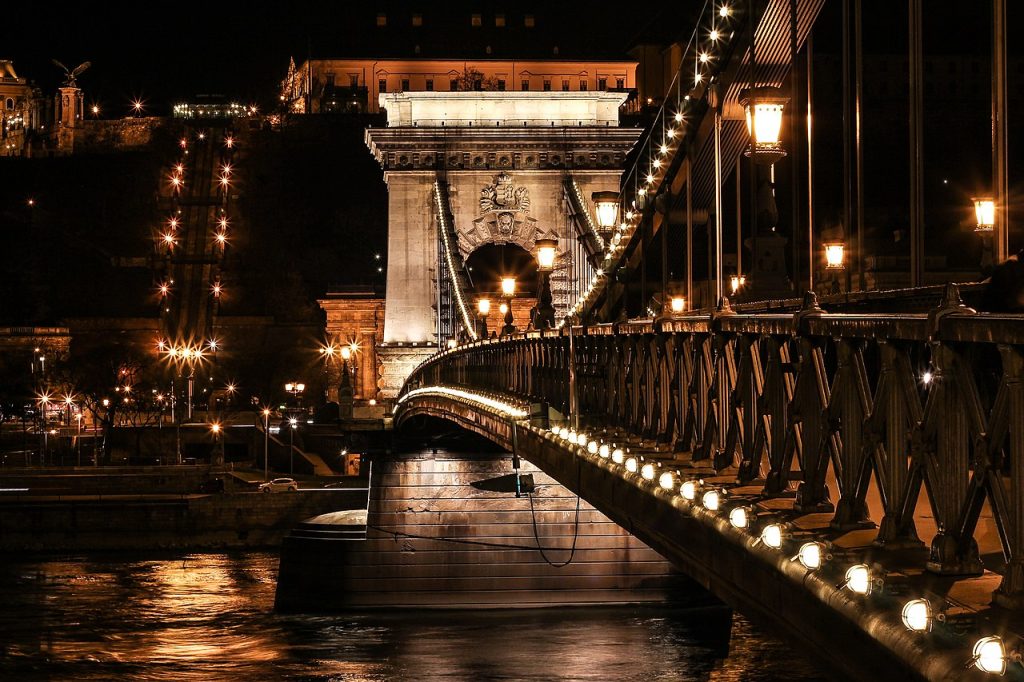
Daytime is fine. Night is something else entirely. When the city’s lighting system flicks on and the Danube turns into a mirror for every warm bulb strung across the pylons, the Chain Bridge stops being a commuter route and becomes the reason you are standing on a riverbank at 9pm with your jaw somewhere near your shoes. The best time to see the Chain Bridge lit up at night is not midnight — it is the brief, glorious transition period just after the sun drops below the Buda hills.
The Golden Window: 15 Minutes After Sunset
Photographers call it blue hour. Locals just call it Tuesday. That 15-to-20-minute period immediately after the sun vanishes is when the bridge lights are already glowing amber while the sky behind Buda Castle still holds a deep cobalt blue. The contrast is extraordinary and it lasts roughly as long as a short espresso. Chain Bridge golden hour photography in Budapest is technically a misnomer — this is blue-hour work — but whatever you call it, set your alarm for sunset and be on the Pest embankment ten minutes early. You will thank yourself for the rest of your life. Or at least until you see your photos and realise you had the lens cap on.
The Full Panorama: Chain Bridge, Parliament, and Buda Castle Together
One of the underappreciated facts about the Chain Bridge Budapest night panorama is that it does not stand alone. From the Pest embankment, looking west, the chain-draped bridge sits perfectly in the middle ground with Buda Castle lit gold on the hill behind it. Turn your head north and Parliament’s neo-Gothic spires are incandescent against the dark. The Danube — normally a muddy, practical river going about its European business — becomes a full-length mirror reflecting the whole theatrical ensemble. It is the kind of view that makes you feel Budapest was designed by someone with an unreasonable amount of ambition and a suspiciously generous budget. Which, given Count Széchenyi’s involvement, is more or less accurate.
What It Actually Feels Like to Walk Across at Night
Walking the Chain Bridge at night experience is quieter than you expect. Daytime brings cyclists, tourists six abreast, and the occasional person inexplicably pushing a suitcase at full speed. After dark, the crowd thins and the bridge becomes something more personal. The lights hum quietly overhead, the river air is cool and carries that particular Danube smell — not unpleasant, just ancient — and from the mid-point of the bridge you have a 360-degree panorama that no viewing platform in the city can replicate. You are standing in the middle of the river, at the centre of a city that has been continuous for over a thousand years. It lands differently at night.
Historical Significance: From 1849 to the 2023 Renovation
The Chain Bridge has been blown up, rebuilt, renovated, and debated by Hungarian politicians more times than seems reasonable for a bridge. Its history is a compressed version of the country’s own — ambition, catastrophe, resilience, and eventually a very long construction closure that irritated everyone commuting between Buda and Pest. Understanding the history makes the night view hit harder.
István Széchenyi and the Vision for a Permanent Crossing
Before the Chain Bridge, crossing the Danube in winter meant waiting for the river to freeze and hoping your horse shared your optimism. Count István Széchenyi — one of the great reformist figures of 19th-century Hungary, a man who made impractical-sounding ideas happen at scale — grew tired of this situation after being stuck on the wrong bank of the Danube for a week in 1820, unable to attend his father’s funeral. That personal frustration became a national infrastructure project. He championed the bridge in the Hungarian parliament, personally financed the early stages, and hired English engineer William Tierney Clark to design it. Adam Clark (no relation) oversaw construction on the ground. The Chain Bridge history Hungarian Revolution 1849 connection is direct: the bridge opened into one of the most turbulent years in Hungarian history.
Opening in 1849: A Wonder of the World
The Széchenyi Chain Bridge opened officially on 20 November 1849, making it Hungary’s first permanent bridge across the Danube. At the time, it was one of the longest suspension bridges in the world. Crowds gathered on both banks. Contemporary accounts describe it as a marvel. It was also, in the grim irony of Hungarian history, completed the same year that the Hungarian Revolution of 1848–49 was suppressed by Austrian and Russian forces. Széchenyi himself, by then suffering a breakdown, never properly celebrated the opening of his greatest project. The bridge, typically, outlasted the politics surrounding it.
Destruction in 1945 and the Post-War Rebuild
In January 1945, retreating German forces detonated charges on every bridge across the Danube in Budapest. The Chain Bridge, along with all its neighbours, collapsed into the river. Only the stone pylons with their lion guardians survived. Post-war reconstruction was a national priority, and the bridge was rebuilt — almost exactly as it had stood — reopening in 1949, precisely 100 years after its original inauguration. That centenary symmetry was not accidental; it was a deliberate statement of continuity from a country that had seen enough discontinuity to last several lifetimes.
The 2021–2023 Renovation: What Changed and What Was Restored
The Chain Bridge Budapest 2023 renovation was the first comprehensive structural overhaul since the post-war rebuild. The bridge closed in March 2021 and did not reopen until August 2023 — a 28-month closure that generated the kind of civic grumbling only a beloved landmark can produce. Structural repairs addressed decades of wear. The lighting system was updated, improving the evening illumination that has since become the defining feature of the bridge’s night-time identity. Decorative elements were restored with careful attention to the original aesthetic. Chain Bridge UNESCO World Heritage Budapest status — the bridge sits within the Budapest World Heritage Zone — meant that every intervention was scrutinised for historical fidelity. The result is a bridge that looks essentially as it did in 1949, but engineered for another century of use.
Lighting Technology: How Budapest Illuminates the Chain Bridge
The warm amber glow that makes the Chain Bridge Budapest night photographs so immediately recognisable is not accidental or magical — it is the result of a considered technical approach that evolved through multiple iterations and landed, after the 2023 renovation, on a system that manages to look both historic and contemporary at the same time.
LED vs. Historical Lighting: The Technology Behind the Glow
Chain Bridge Budapest illumination technology LED is the current standard following the 2023 renovation. The bridge’s earlier sodium-vapour fittings produced the characteristic orange warmth that Budapestians grew up associating with the night skyline. The updated LED system replicates that colour temperature — roughly 2700K, the warm end of the spectrum — while delivering significantly better energy efficiency and more precise directional control. The cast iron chains, the suspension cables, and the arched gateway pylons are all independently illuminated, which means the structure reads in three visual layers as you approach. From the river, this produces a depth that flat-on photographs never quite capture.
Seasonal and Special Event Illuminations
The standard golden lighting gives way to special colour schemes on specific dates. Chain Bridge special lighting national holidays Budapest moments include March 15 (the anniversary of the 1848 Revolution), August 20 (St. Stephen’s Day, the most important national holiday), and October 23 (Republic Day). On these nights the bridge has been illuminated in red, white, and green — Hungary’s national colours — with the Danube picking up the tints across its surface. The effect from Gellért Hill on August 20, with fireworks overhead and the entire riverfront lit in national colours, is the kind of thing that turns even mild-mannered visitors into people who immediately start researching apartments in Budapest.
New Year’s Eve, National Holidays, and Festive Light Shows
The Chain Bridge New Year’s Eve light show is not a formal programmed display in the way some cities operate — Budapest does not have a centralised synchronised bridge-lighting event on 31 December. What it does have is the Danube embankment filling with tens of thousands of people, private fireworks going off from both banks, and the bridge sitting in the middle of the chaos, still and golden, looking entirely unbothered. The midnight countdown happens on and around the bridge with the kind of cheerful pandemonium that makes you very glad you left your tripod at the hotel. Get there early, dress for cold, and stand on the Buda side for a cleaner view of the crowd and the lit-up Pest skyline behind them.
The Lion Statues: Folklore, Legend, and Night-Time Symbolism
Four stone lions guard the Chain Bridge — two on each bank, one facing inward and one outward. They have been there since 1852, they survived the World War II demolition, and they are significantly better at keeping still than most of the tourists photographing them. They also carry one of Budapest’s most charming pieces of civic mythology.
The Legend of the Missing Tongues
Chain Bridge lion statues missing tongues legend goes like this: when sculptor János Marschalkó completed the lions, a Budapest shoemaker’s apprentice noticed that the lions had no visible tongues. He reportedly mocked the sculptor publicly — and Marschalkó, so shamed by the critique, drowned himself in the Danube. The punchline, which everyone in Budapest learns at some point, is that lions’ tongues are not visible from outside their mouths due to feline anatomy; the apprentice was wrong, the lions are anatomically correct, and the sculptor did not drown. Budapest Chain Bridge lion folklore has the structure of a cautionary tale about confidence without knowledge, which the city apparently needed enough to pass down for 170 years. The truth about the Chain Bridge sculptures history Budapest enthusiasts care about: the lions were carved by Marschalkó, who lived a long life and seems to have found the whole thing more amusing than devastating.
How the Lions Look at Night: Shadow, Light, and Drama
At night, the lions reward a close approach. Lit from below and from the sides, they develop deep facial shadows that make them look far more severe than they appear in daylight. The manes throw complex patterns across the pylon surfaces. From the bridge deck, crouching down to frame one of the inner lions against the lit chain spans behind it, you get a composition that looks like it belongs in a different century — which, in a sense, it does. Spend a few minutes with them. They have been watching over Budapest nights since 1852 and they are not in any particular hurry.
Best Vantage Points for the Chain Bridge at Night
Where you stand determines what story the bridge tells you. The best place to photograph Chain Bridge at night in Budapest depends entirely on what you want in the frame — elevation, river reflection, urban context, or the pure pedestrian experience of being on the thing. Here are the locations that consistently deliver, and one that most visitors miss entirely.
Fisherman’s Bastion: Elevated Drama on the Buda Side
Fisherman’s Bastion sits on Castle Hill above the Buda side of the bridge, and from its upper terraces you get a view that puts the Chain Bridge in context with Parliament across the river. The neo-Romanesque towers frame the scene without getting in the way. The courtyard is free to access; tower tickets run 1,500 HUF (~$4.20) during the day but the towers close in the evening, so the free courtyard is your evening option. Fisherman’s Bastion Chain Bridge view at night is one of the most reproduced in Budapest travel photography for a reason: the geometry from up here is just very, very good.
Gellért Hill: The Widest Panorama in Budapest
For the kind of panorama that makes you feel like you are looking at a scale model of a city — Gellért Hill is the answer. The Citadel at the summit sits at 235 metres above the river and is open 24 hours, free of charge. From here, the Chain Bridge is a small lit jewel in a vast necklace of Budapest night landmarks strung along the Danube. You see it all: Parliament, the bridges, Pest’s flat grid of lit streets, Buda’s forested hills. It takes about 30–40 minutes to walk up via the path from the southern end of the Elisabeth Bridge, or you can take a taxi. Gellért Hill night view Chain Bridge is a different experience from being close to the bridge — it is about scale, about understanding where this structure sits in the geography of a city built around a river.
The Pest Embankment: The Classic Postcard Shot
Stand on the Pest embankment, roughly level with the southern end of the Roosevelt tér (now Széchenyi István tér), and face west. This is the composition that ends up on every Budapest travel article written since digital photography became accessible. Tram 2 runs along this embankment all evening, so if you are waiting for a gap in traffic to shoot, that gap comes and goes in cycles. The tram itself, however, is part of the frame — a streak of light in a long-exposure shot with the bridge behind it works beautifully. The embankment is free, open, and accessible at any hour. Bring a jacket because the river wind does not care about your comfort.
Tram 2: A Moving View Along the River
Tram 2 runs along the Pest embankment from Közvágóhíd in the south to Jászai Mari tér in the north, passing directly alongside the Chain Bridge and Parliament. A single BKK ticket costs 350 HUF (~$1.00) and the tram runs until approximately 11:30pm. Sit on the right side heading north for river views. You pass all the major Danube landmarks in about 25 minutes. It is simultaneously the cheapest sightseeing tour in Budapest and the one that most visitors miss because it looks like public transport rather than an attraction. It is both. The tram 2 Budapest embankment Chain Bridge view from the window at night, with the lit facades of Pest sliding past, is one of those experiences that costs almost nothing and lands like something much more expensive.
The Bridge Deck Itself: Standing at the Centre
Walk to the exact midpoint of the bridge and stop. Look north: Parliament. Look south: Gellért Hill and the Citadel. Look west: Buda Castle on its hill. Look east: the lights of Pest. Look down: the Danube, moving dark and quiet beneath the lit chains. This is the one view that no elevated vantage point replicates, because it puts you inside the panorama rather than outside it. There is no entry fee, no queue, no guided tour. It is just you, a 175-year-old bridge, and one of the better views on the continent.
Rudas Baths Rooftop: Budapest’s Hidden Vantage Point
Rudas Baths sits on the Buda bank just south of the Chain Bridge, and its rooftop wellness pool offers a view of the bridge from river level that almost nobody talks about. You are in a warm pool, looking north at the bridge lit up against the Pest skyline, with Parliament in the distance. Wellness entry starts from 5,200 HUF (~$14.50) and the facility is open daily — check the current schedule as wellness and swimming hours vary by day. It is an objectively absurd way to look at a bridge and I cannot recommend it highly enough. Book in advance, particularly on weekends.
Buda Castle Terrace and the Funicular Lookout
The terrace of Buda Castle — reached either by the Budavári Sikló funicular at 1,600 HUF (~$4.50) one way or by walking up through the Castle District — offers a view down onto the Chain Bridge from the west. The funicular runs until 10pm daily, which makes it a viable evening option. From the Castle terrace, you are looking down at the bridge’s back — the Buda pylon, the chains sweeping east across the river, and Pest’s illuminated skyline beyond. It is a different angle from everything else on this list, and the combination of the funicular ride and the Castle terrace view makes for a self-contained 45-minute evening detour that requires minimal effort and pays off immediately.
Walking Across the Chain Bridge at Night
Walking across Chain Bridge Budapest at night is, by general consensus among people who have done it, the correct way to experience the bridge. No cruise, no lookout point, and no amount of zoomed photography quite substitutes for being on it. Here is what that walk actually involves, from one end to the other.
The Pest Side Start: Széchenyi tér and Gresham Palace
The Pest bridgehead sits at Széchenyi István tér (open 24 hours, free), one of the more handsome squares in a city that has quite a few handsome squares. The Four Seasons Gresham Palace looms on the northern side — a gilded Art Nouveau building so elaborately decorated it looks like someone took a normal palace and told it to try harder. Before crossing, look back at this facade, lit at night, with the bridge gates in the foreground. The Chain Bridge pedestrian access Budapest starts through the eastern arch, where you pass between the bridge’s eastern lions. There is no gate, no ticket window, no entry process. You just walk in. The pavement is wide enough for pedestrians and cyclists side by side, though the cyclists will make this your problem rather than theirs.
Mid-Bridge: What to Look For as You Cross
As you pass under the first arch and the city falls away on both sides, the chain links that give the bridge its name become visible overhead — each link roughly the size of a person’s forearm, cast iron, painted black, curving in a shallow catenary above the deck. The lamp posts along the walkway are reproductions of the originals, and their warm light pools on the stone surface in a way that looks almost deliberately cinematic. Stop at the mid-point. This is where the night panorama opens completely in all four compass directions. The Danube moves quickly and silently below, carrying cold air from its Alpine source somewhere in Austria. The whole bridge sways almost imperceptibly in strong winds — not enough to be alarming, but enough to feel it if you are paying attention.
The Buda Arrival: Clark Ádám tér and the Zero Kilometre Stone
Clark Ádám tér (open 24 hours, free) is where the bridge deposits you on the Buda side, at the foot of Castle Hill. Named for the Scottish engineer who oversaw construction, it is a busy roundabout during the day and a pleasantly atmospheric place at night. Look for the Zero Kilometre Stone — a small, somewhat humble-looking sphere on a plinth that marks the point from which all road distances in Hungary are officially measured. Every road in Hungary starts here, conceptually. The funicular station is directly in front of you. Castle Hill is above. The tunnel through the hill — the Buda Castle Tunnel — exits on the other side into residential Buda. Clark Ádám Square Budapest Chain Bridge Buda side is the natural end point of the evening bridge walk, and also the starting point for anyone doing it in reverse.
Accessibility, Safety, and Crowd Levels at Night
The bridge deck is flat and wide, with no steps, making it accessible for wheelchairs and pushchairs on the main walkway. Lighting is good throughout the crossing. Safety on the bridge at night is not a concern — it is a well-lit public thoroughfare used by a steady flow of pedestrians and occasional cyclists throughout the evening. Crowd levels drop significantly after 10pm, which is when the walk is at its most contemplative. Weekend evenings see more foot traffic, particularly in summer and during holidays. The bridge’s pedestrian crossing is not formally closed at any hour, though the surrounding road traffic patterns change late at night when vehicle lanes are adjusted. Common sense applies: mind the cyclists, watch your step at the kerbstones near the pylons, and do not attempt to climb the chains. The lions will judge you.
Photography Guide for the Chain Bridge at Night
Chain Bridge Budapest night photography is one of those subjects that rewards preparation and punishes improvisation. The dynamic range is significant — very bright lamp posts against a dark river sky — and the best compositions are not the ones you find by wandering. Here is what actually works.
Camera Settings: ISO, Aperture, and Shutter Speed for the Bridge
For Chain Bridge Budapest night photography settings on a dedicated camera: shoot in RAW, set your aperture between f/8 and f/11 for maximum sharpness across the bridge span, use ISO 100–400 with a tripod and a longer shutter speed (typically 8–25 seconds depending on ambient light and desired water effect). A slower shutter — 15 seconds or more — will smooth the Danube’s surface into a dark mirror reflecting the bridge lights cleanly. Faster speeds (under 3 seconds) will show the river’s actual movement and texture, which suits a rougher, more dynamic composition. The lamp posts will bloom at most apertures; this is a feature, not a problem. Build your exposure around the mid-tones in the bridge structure itself.
Tripod Spots and Where to Set Up
How to photograph Chain Bridge at night: the flat paved surface of the Pest embankment, between the bridge gate and the Vigadó concert hall to the south, gives you the most stable tripod footing and the most used angle — looking west at the bridge with Buda Castle behind it. The Gellért Hill path above the Rudas Baths offers a raised angle looking down-river with the bridge in mid-ground. The mid-bridge deck itself works for tripod shooting late at night when foot traffic drops — use the stone parapet ledge to stabilise the camera if you did not bring a tripod. On weekends and in summer, the embankment fills with other photographers; arriving 30 minutes before sunset secures a clean spot before the competition arrives.
Smartphone Night Mode Tips for the Chain Bridge
Budapest bridge night photography tips ISO aperture considerations become simpler on a modern smartphone with dedicated Night Mode. Enable Night Mode, brace the phone against a railing or a wall, and let the multi-second exposure stack its frames. Do not move for at least 4–6 seconds after pressing the shutter. The results from current flagship phones — particularly on the Pest embankment looking west — are legitimately impressive, competitive with dedicated camera shots from three or four years ago. The main limitation is the ultra-wide lens distorting the bridge’s architecture at close range; use the standard or portrait lens from further back for more accurate proportions. Avoid digital zoom past 2x; quality degrades sharply and the bridge deserves better than that.
The Five Best Compositions (and One to Avoid)
The five compositions that work reliably: (1) From the Pest embankment at water level, bridge centred, Buda Castle in background — the classic. (2) A single lion statue close, lit bridge chains receding behind — intimate and detailed. (3) Long exposure from mid-bridge looking east toward Parliament — chains in foreground, Parliament lit behind the river. (4) From Gellért Hill above, full Danube panorama with bridge as the focal midpoint. (5) Bridge reflection in the Danube during still water conditions after midnight. The composition to avoid: the bridge shot from directly below the Pest arch, looking straight up. It is architecturally interesting and completely meaningless as a photograph — you lose all context, all light, and all drama in exchange for an angle that looks like a construction inspection document.
Viewing the Bridge from the Danube: River Cruise Perspective
There is one perspective on the Chain Bridge that no embankment or hilltop delivers — the view from water level, moving through the river itself, with the bridge growing larger as you approach and then framing the sky above you as you pass beneath it. Evening Danube cruise Chain Bridge at night is the only way to get it.
Why the River Angle Is Unlike Any Other View
From a boat on the Danube, the bridge does not frame the city — the city frames the bridge. The chains sweep up from the water on both sides simultaneously, the pylons tower directly overhead as you pass beneath, and the warm light reflects in the boat’s wake in a way that is impossible to replicate from any fixed position. Budapest night cruise illuminated bridges seen from the river also gives you a sequenced experience: you approach through Parliament’s reflection, pass under the Chain Bridge, and continue south past the Elizabeth and Liberty bridges, each with its own distinct lighting character. The entire evening Budapest illuminated bridges route covers roughly 11 kilometres of the most architecturally lit riverfront in Central Europe.
Evening Cruise Operators and Timing Tips
Legenda Cruises departs from Vigadó tér Pier 7, with evening departures from 7pm and tickets from 6,900 HUF (~$19.00). It is the longest-running operation on the river and the one most likely to have English commentary included. River Ride Budapest departs from Széchenyi István tér pier with daily evening departures and tickets from 5,500 HUF (~$15.50). For the Chain Bridge passage at its most dramatic, board any cruise departing between 8pm and 9pm in summer — this gives you the last of the blue-hour sky transitioning to full night as you approach the bridge. Book in advance during peak season; walk-up tickets exist but evaporate quickly on summer evenings.
A Budget Evening Itinerary: Chain Bridge and Beyond
The free things to do in Budapest at night centre around the Chain Bridge and its immediate surroundings — which means you can construct a full evening that costs almost nothing if you are selective, or spend freely if you want to eat and drink well along the way. Here is the itinerary I would give a friend arriving in Budapest for the first time.
Dinner on the Pest Side Before the Walk
Two options near the bridge on the Pest side, at different price points. Gresham Kávéház — inside the Four Seasons Gresham Palace — serves coffee from 1,800 HUF (~$5.00) in a setting so lavishly restored you feel like you should be wearing better shoes. It is worth the coffee price for thirty minutes in that interior. For a full meal with river views, Spoon Café & Lounge floats on a boat at Vigadó tér Pier 3, open daily noon to midnight, with mains from 4,500 HUF (~$12.50). It is a step above typical riverside tourist restaurants in both food quality and the experience of eating on the actual Danube with the lit bridge visible from your table.
The Free Walk Across: Budapest’s Best Zero-Cost Experience
Cross the bridge at dusk. This is the core of the evening, costs nothing, and is the Chain Bridge evening itinerary budget Budapest centrepiece. Walk slowly. Stop at the lion statues on both ends. Stop at the mid-point. Look in all four directions. If you have a camera, this is when you use it. If you do not, this is still one of the better 20 minutes available in Central Europe. The Budapest UNESCO World Heritage night walk itinerary officially starts here and continues up Castle Hill on the Buda side.
Drinks on the Buda Side: Clark Ádám tér Area Bars
After crossing, walk up the funicular or the Castle steps and continue into the Castle District for a coffee or glass of wine at Café Miro on Úri utca — open daily 9am to 10pm with coffee from 1,200 HUF (~$3.40). It is a quiet, unpretentious place in the middle of Budapest’s most tourist-dense neighbourhood, which makes it a small act of defiance. For something sweet before or after, Ruszwurm Cukrászda — Hungary’s oldest still-operating pastry shop, open since 1827 — is two minutes’ walk from Fisherman’s Bastion, with cake slices from 950 HUF (~$2.70) and a cabinet of options that changes with the season.
The UNESCO Night Walk: Parliament to Castle Hill
Budapest’s World Heritage Zone connects Parliament on the Pest side, the Chain Bridge, and the Castle Hill complex on the Buda side in a roughly 4-kilometre arc. Walking it at night — Parliament lit from below, Tram 2 running along the embankment, across the Chain Bridge, up through the Castle District — takes about 90 minutes at a relaxed pace and passes through more UNESCO-listed architecture per kilometre than almost anywhere else in Europe. It costs nothing except the 350 HUF (~$1.00) tram ticket if you take Tram 2 back to your starting point. The Budapest UNESCO World Heritage night walk itinerary does not require a guide or a plan. It just requires comfortable shoes and a willingness to move slowly through a very old city.
How to Get to the Chain Bridge for an Evening Visit
Budapest’s public transport connects the Chain Bridge to every major part of the city. Getting there by tram is the scenic option; getting there by metro is the fast one. Both are valid. Here is how to get to Chain Bridge Budapest by tram and by every other available method.
Tram 2: The Scenic Route Along the Pest Embankment
Tram 2 is the answer to most questions about reaching the Pest embankment. Board at Keleti pályaudvar (requires a connection), Blaha Lujza tér, or any stop along the embankment south of the bridge, and ride to the Széchenyi István tér stop directly at the bridge entrance. A single BKK ticket costs 350 HUF (~$1.00). The Chain Bridge Budapest public transport evening option via Tram 2 is also a sightseeing experience in itself — as noted above, the ride along the river at night is worth the journey time even if you are starting nearby. The tram runs until approximately 11:30pm on weekdays and later on weekends.
Metro and Walking from Deák tér
Metro lines M1, M2, and M3 all converge at Deák Ferenc tér, which is roughly 1 kilometre from the Chain Bridge along Vörösmarty tér and the Pest riverbank. The walk takes 12–15 minutes through the city centre and passes Váci utca, Vörösmarty tér, and the Danube embankment — all of which are worth seeing at night. M1 stops at Vörösmarty tér directly, reducing the walk to 5 minutes. Validate your ticket on entry; inspectors do operate on the metro and on trams in the evening hours, and the fine for not validating is substantial enough to be unpleasant.
Arriving from the Buda Side: Bus and Funicular Options
From Castle Hill and the Buda side, the Budavári Sikló funicular descends directly to Clark Ádám tér at the Buda bridgehead — last descent at 10pm, ticket 1,600 HUF (~$4.50) one way. Bus 16 connects Széll Kálmán tér (one of the main Buda transport hubs) to Castle Hill and the funicular upper station. From Széll Kálmán tér, Metro M2 connects directly to Deák tér and the wider Pest network. If you are staying anywhere in the Castle District or Buda’s first district, the bridge is walkable in under 10 minutes via the Castle steps or the funicular.
💰 Prices at a Glance
| What | Details | Price |
|---|---|---|
| Chain Bridge pedestrian crossing | Walking across (pedestrian) | 0 HUF (Free) |
| Tram 2 (BKK single ticket) | Single journey ticket | 350 HUF (~$1.00) |
| Ruszwurm Cukrászda | Slice of cake | 950 HUF (~$2.70) |
| Café Miro | Coffee | 1,200 HUF (~$3.40) |
| Fisherman’s Bastion towers | Tower access ticket (daytime) | 1,500 HUF (~$4.20) |
| Budavári Sikló (Funicular) | One-way ticket up to Buda Castle | 1,600 HUF (~$4.50) |
| Gresham Kávéház | Coffee | 1,800 HUF (~$5.00) |
| Spoon Café & Lounge | Main course | 4,500 HUF (~$12.50) |
| Rudas Baths | Wellness entry (rooftop pool access) | 5,200 HUF (~$14.50) |
| River Ride Budapest | Evening sightseeing cruise | 5,500 HUF (~$15.50) |
| Legenda Cruises | Evening Danube river cruise | 6,900 HUF (~$19.00) |
Prices verified: February 2026
Frequently Asked Questions
These are the questions I get asked most often about the Chain Bridge Budapest FAQ visitors send through — answered without the padding that usually surrounds them on travel sites.
When was the Széchenyi Chain Bridge built and when did it first open?
Main construction took place through the 1840s. The bridge officially opened on 20 November 1849 as Hungary’s first permanent crossing of the Danube. It was designed by English engineer William Tierney Clark, with Adam Clark overseeing construction on-site. At opening it was among the longest suspension bridges in the world. It held that distinction for a very short time before longer bridges started appearing elsewhere, which is the nature of engineering records.
Why is the Chain Bridge named after István Széchenyi?
Count István Széchenyi was the political driving force behind the project — he championed it in the Hungarian parliament, personally financed the initial stages, and spent years pushing it through institutional and financial obstacles. He is one of the most significant reform figures in 19th-century Hungarian history and is still referred to as “the Greatest Hungarian” in the country. The naming was not contractual; it was a recognition of the fact that without Széchenyi’s obsessive persistence, the bridge probably does not get built when it did.
Is the Chain Bridge free to walk across?
Yes. Is Chain Bridge Budapest free — completely, unconditionally, at any hour. Pedestrian access costs nothing. An old reference sometimes circulates about a 1,230 HUF toll; this relates to vehicle traffic, not pedestrians. Walk across as many times as you like. The bridge has no opinion about how many times you cross it.
What are the Chain Bridge illumination hours?
The bridge is illuminated every evening from dusk until midnight. The most dramatic window is in the 15–20 minutes immediately after sunset when the warm amber bridge lighting meets the fading blue sky behind the Buda hills. This transition period is worth planning around specifically — set a sunset alarm for your visit date and be on the Pest embankment ten minutes before it triggers.
What happened to the Chain Bridge during World War II?
In January 1945, retreating German forces systematically detonated every bridge across the Danube in Budapest. The Chain Bridge fell into the river; only the stone pylons and lion statues survived. Post-war reconstruction was both a practical necessity and a symbolic priority. The bridge was rebuilt, reopening in 1949 — exactly 100 years after its original inauguration. That centenary timing was deliberate. Hungary is good at symbolic timing even when things are going badly.
What can you see from the Chain Bridge at night?
From the mid-point of the bridge deck you get a full 360-degree panorama: Parliament illuminated to the north, Buda Castle and the Royal Palace on the hill to the west, Gellért Hill and the Citadel to the south, and the lights of Pest’s flat urban grid to the east. Below, the Danube reflects the entire ensemble. It is, straightforwardly, one of the better views in Europe and it costs nothing to stand there.
Was the Chain Bridge recently renovated, and did anything change?
Yes — the bridge was closed from March 2021 to August 2023 for a comprehensive renovation, the first major structural overhaul since the post-war rebuild. Work included structural repairs, restoration of decorative elements, and an update to the lighting system. The bridge reopened to pedestrians and vehicles in summer 2023. Visually, it looks very close to how it looked before — the restoration prioritised historical fidelity, as required by its position within the Budapest UNESCO World Heritage Zone. The updated lighting is marginally more refined than the pre-renovation system.
📍 Essential Information
| Address | Széchenyi lánchíd, Budapest 1051 (Pest side: Széchenyi István tér; Buda side: Clark Ádám tér) |
| Pedestrian Access | Open 24 hours — Free |
| Illumination Hours | Dusk until midnight, every evening |
| Best Photography Time | 15–20 minutes after sunset (blue hour) |
| Getting There (Pest side) | Tram 2 to Széchenyi István tér; Metro M1 to Vörösmarty tér (10-min walk) |
| Getting There (Buda side) | Budavári Sikló funicular from Clark Ádám tér (7:30am–10pm, 1,600 HUF one way) |
| Nearest Parking | Limited and inconvenient — strongly recommend public transport |
| Accessibility | Flat walkway, accessible for wheelchairs and pushchairs |
| Cost | Free to cross on foot |
Prices verified: February 2026