🎯 TL;DR
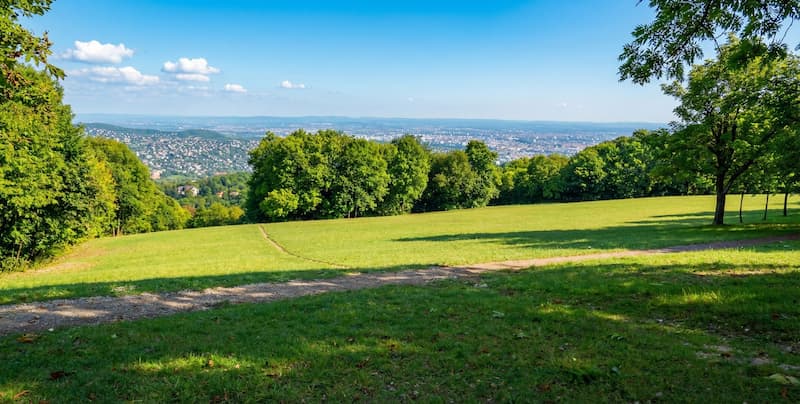
The Buda Hills sit 30 minutes from downtown Budapest with 156 km of marked trails, a vintage children’s railway, limestone caves, and viewpoints that make the city look far more photogenic than it deserves. Free to enter, mostly uncrowded on weekdays, and wildly underused by tourists. Best seasons: Spring and autumn. Budget: 0–10,000 HUF depending on how many things you pay to ride.
📋 Buda Hills at a Glance
| Best For | Hikers, families, mountain bikers, anyone who needs to remember that Budapest has trees |
| Time Needed | Half-day minimum (3–4 hours); full day for the classic loop with trains and chairlift |
| Cost | Trails are free; paid attractions range from ~1,000 HUF (lookout tower) to ~10,000 HUF (Gellért baths) |
| Hours | Trails open 24/7; paid attractions typically 9:00–17:00, seasonal closures apply |
| Getting There | Tram 61 → Bus 291 to Normafa; or Cogwheel Railway (60) from Városmajor to Széchenyi-hegy |
| Skip If | You have under two hours, struggle with steep terrain, or consider “nature” a rooftop bar with a ficus |
The Classic Circle Route: A Full Day in the Buda Hills
If you have one full day and want to see the Buda Hills properly — not just stand at one viewpoint and eat a langos — then the classic locals’ loop is your best option. It strings together the chairlift, the highest point, the social meadow, and the children’s railway into a single logical arc that finishes somewhere useful. It’s roughly 8–12 km depending on which trail variants you take, involves some elevation, and gives you enough variety that you won’t feel you’ve just been walking through trees for six hours, even though technically you have been.Start at Zugliget: Taking the Libegő Chairlift Up
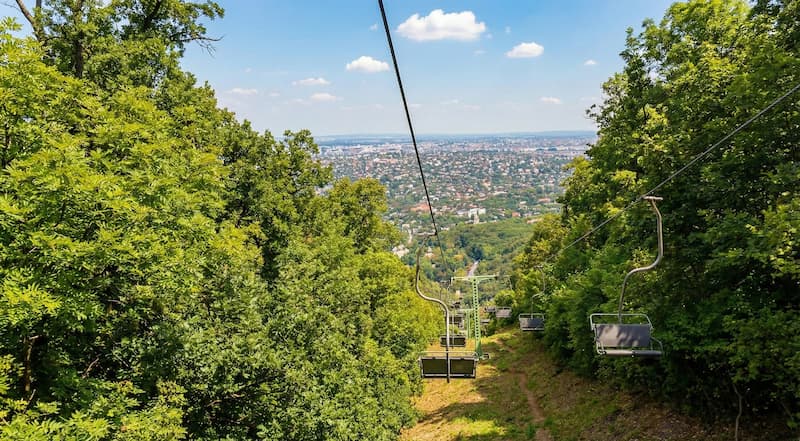
The loop begins at Zugliget, a quiet residential area in the hills that somehow has a bus stop and a chairlift in the same postcode. Bus 291 from Városmajor drops you directly at the chairlift base station on Zugligeti út. The Libegő — that’s the chairlift, named with characteristic Hungarian efficiency — hauls you up 1,040 metres of cable through open forest to János Hill. It takes about 15 minutes, the chairs are single-occupancy and open to the elements, and the views start improving almost immediately. Go on a clear weekday if you can. Weekend queues at the base can test your patience and your relationships.Jánoshegy to Elizabeth Lookout Tower
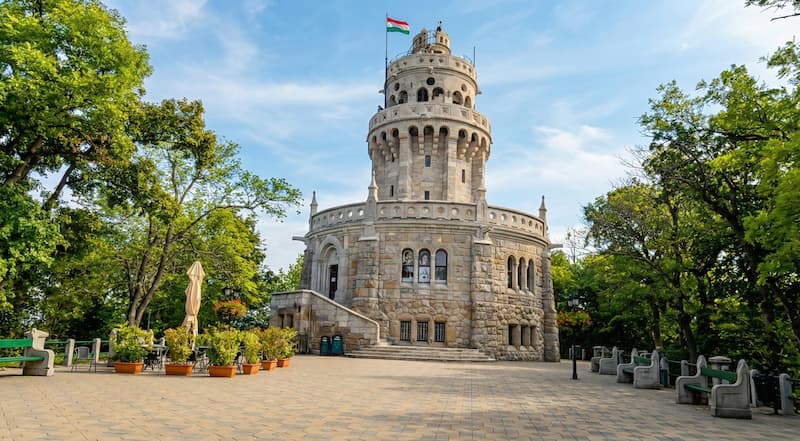
From the chairlift’s upper terminal it’s a short walk to the summit of János Hill and the Elizabeth Lookout Tower, which stands at 527 metres above sea level — the highest point in Budapest, a fact that locals mention with disproportionate civic pride. The tower itself is a handsome neo-Romanesque structure built in 1910, and climbing it rewards you with a 360-degree view that takes in the Danube bend to the north, the Pilis hills beyond, and the city spread out below like someone knocked over a very organised box of buildings. Entry is around 1,000 HUF. It’s worth it.Descending Through Forest to Normafa
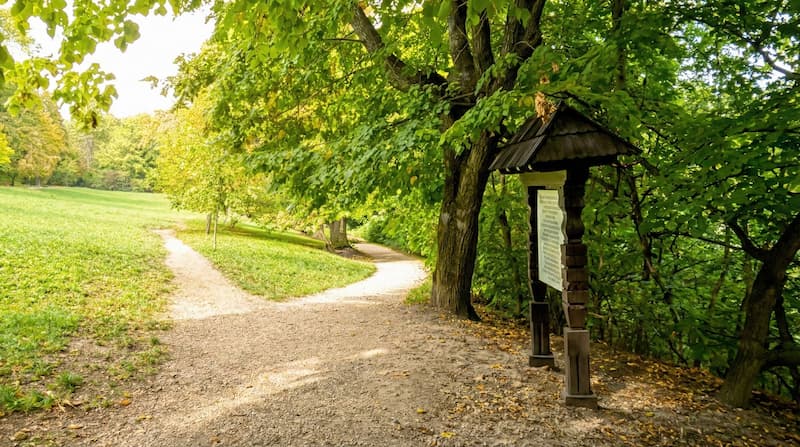
From János Hill, follow the red trail markings southwest through beech forest — this section is lovely in autumn, when the light comes through in that amber way that makes everyone feel they’re in a film they can’t quite name. The descent to Normafa takes 45–60 minutes at a comfortable pace. The trail is well-marked, mostly shaded, and loses elevation gradually enough that your knees won’t complain unless they were already inclined to. Normafa itself is the hills’ main social hub — more on that section later, but expect a café, a meadow, and approximately forty-seven people walking Vizslas.Children’s Railway Back to Széchenyi-hegy
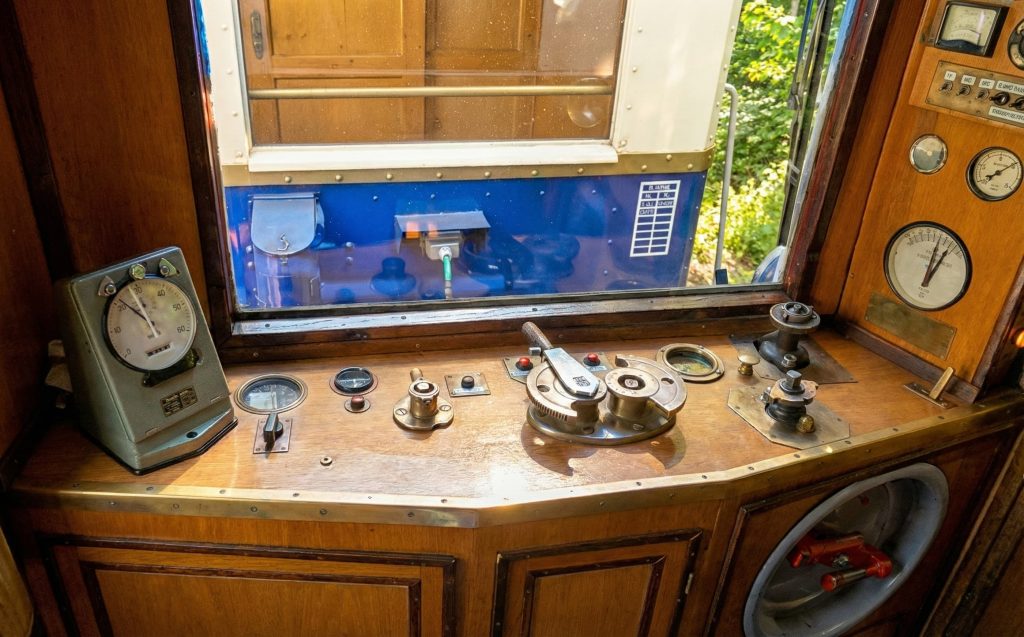
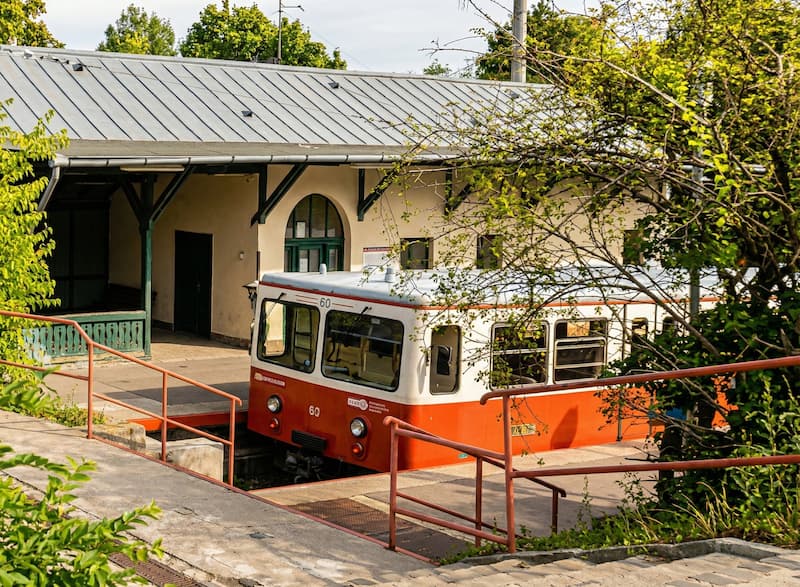
From Normafa, catch the Children’s Railway at the Normafa stop — the train runs between Széchenyi-hegy and Hűvösvölgy, with Normafa as a midpoint stop. To close the circle, take the train back to Széchenyi-hegy and then connect via the cogwheel railway (Fogaskerekű, Line 60) back down to Városmajor and the city. The whole mechanical sequence — chairlift up, legs across, little train sideways, cogwheel down — is one of the more enjoyable bits of urban-adjacent infrastructure in Central Europe.What This Loop Looks Like in Practice
Start by 9:30 AM to beat the Libegő queue. Chairlift up, tower at the top, forest walk to Normafa by lunch, eat something at the buffet or the grass, then the Children’s Railway back to Széchenyi-hegy by mid-afternoon. Total time: 5–7 hours depending on pace and how long you spend staring at the view. Bring layers — the hilltop is several degrees cooler than the city below, which is always slightly startling in summer.Riding the Zugliget Chairlift (Libegő)
The Libegő chairlift has been running since 1970 and has become one of those Budapest institutions that tourists occasionally stumble across and immediately put in their top three experiences, ahead of things they paid five times more for. It’s a single-chair open-air lift strung between Zugliget and the ridge near János Hill, and riding it feels like being gently conveyed through a forest by a very slow, very calm mechanism that has no interest in your schedule whatsoever.What to Expect on the Ride
The chairs hold one person — two if you’re close and neither of you is carrying a large backpack. The ride takes roughly 15 minutes each way and covers about 1,040 metres of cable through open forest. There’s a brief safety bar you pull down, after which you’re essentially sitting in a bucket chair in the sky with your feet dangling above the treetops, which is either meditative or alarming depending on your relationship with heights. The views through the trees open up at intervals. Bring a jacket even in summer — you’re moving through air at speed and it cools down fast.Seasonal Closure Schedule and Alternatives
Here’s the critical information that many visitors discover only after arriving at a closed gate: the Libegő closes for maintenance periods, typically in late winter or early spring, and also shuts down in high winds. The closure schedule varies year to year, so checking bkk.hu before you go is not optional, it’s load-bearing. When it’s closed, the alternative is simply to walk up from Zugliget on the red trail — it takes about 45 minutes and the path is well-signposted. Not glamorous, but functional, and you’ll feel appropriately virtuous at the top.Tips for Visiting on Weekends
On sunny weekend mornings in spring and autumn, the queue at the bottom can stretch to 30–40 minutes or more. Locals go early (before 10:00 AM) or late (after 3:00 PM when the afternoon crowd thins). If you’re visiting with children who have a finite patience window — which is all of them — consider arriving at opening time. Weekdays are a different experience entirely: minimal queue, peaceful ride, forest mostly to yourself. The ticket price is around 3,500 HUF one way — buying a return at the bottom is slightly cheaper than two singles, but verify this at the booth since pricing adjusts periodically.Getting to Zugliget by Public Transport
From central Pest, take Metro Line 2 to Széll Kálmán tér, then Bus 22 or 222 to Zugliget, Libegő stop. Alternatively, Tram 61 from Kelenföld or Városmajor also connects well to the 22 bus. The journey from Széll Kálmán tér takes about 20–25 minutes. There’s a small car park at Zugliget but it fills quickly on weekends — public transport is the better choice here, which is something I don’t say lightly as someone who has circled that car park four times.Elizabeth Lookout Tower and János Hill: Budapest’s Highest Point
János Hill is not a dramatic alpine summit. There’s no glacier, no sheer face, no altitude sickness. What it does have is the best panoramic view in Budapest, a nineteenth-century lookout tower that photographs well in any weather, and the quiet satisfaction of standing at 527 metres above sea level while the city hums far below. It’s the kind of place that earns its reputation not through spectacle but through repetition — people keep coming back because the view, and the forest around it, keeps delivering.Elizabeth Lookout Tower: History and Views
The tower was completed in 1910 and named after Empress Elisabeth of Austria — Sisi, as she’s known in these parts, who had a complicated relationship with Hungary and an enormous posthumous tourist-attraction power. The architect was Frigyes Spiegel, and the neo-Romanesque design has aged far better than most things built in 1910. From the upper viewing platform you can see the Danube bend on clear days, the Pilis hills, the Börzsöny range, and the entire Budapest cityscape laid out in a way that makes the place look considerably more coherent than it feels from street level. Entry is around 1,000 HUF — verify current pricing on-site or via the relevant Budapest parks authority before visiting.Kaán Károly Lookout: The Quieter Alternative
About a 20-minute walk from Normafa, the Kaán Károly Lookout is the version of the János Hill experience that fewer people know exists. It’s a smaller, simpler platform — free to access, no entry fee, no queue — with a southwest-facing view over the forested hills rather than the city. Named after the Hungarian conservationist Károly Kaán, who did more for Hungarian forestry than most people have done for anything, it’s the spot I send friends to when they want a view without the Sunday-morning crowd. It’s not as dramatic as Elizabeth Tower, but the surrounding beech forest makes the walk there worth it on its own terms.Best Time of Day for Views and Photography
Morning is the standard answer — clear air, softer light, fewer people — and it’s correct. Between 8:00 and 10:00 AM on a weekday in spring or autumn, you may have the tower platform essentially to yourself, which is an experience worth engineering your schedule around. Midday in summer can be hazy, particularly in July and August when thermals blur the cityscape. Overcast days often give surprisingly clean views since the diffused light eliminates glare over the Danube, which is the kind of counterintuitive photography tip I’ve learned from standing in a lot of wrong weather.Sunset and Night Hiking from Jánoshegy
Sunset from János Hill is worth doing at least once, but it requires planning — the chairlift stops running in the afternoon (confirm exact last ride time seasonally), so you’ll need to walk down in the dark if you stay for the full show. The trail from the summit back to Zugliget is manageable with a decent torch and takes about 45 minutes. Night hiking here is legal and common among locals — the trails are clear and the forest is not particularly threatening, though a head torch is non-negotiable. The city lights below the tower at dusk are, objectively, very good.The Children’s Railway: A Ride Run by Kids
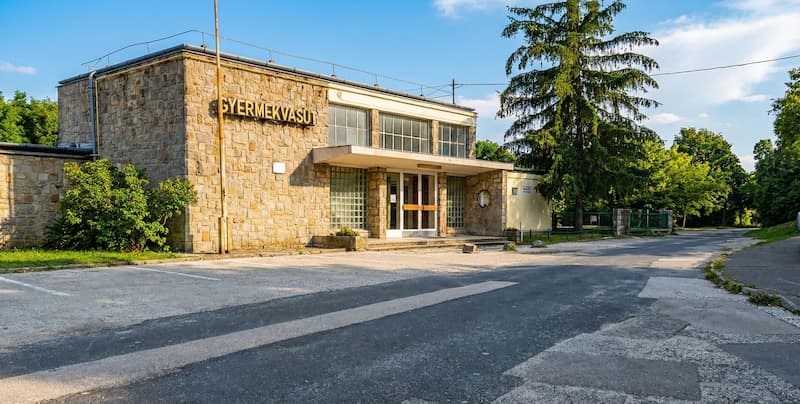
The Children’s Railway is one of those Budapest things that sounds like a novelty for tourists and turns out to be a fully functioning piece of transport infrastructure with a 70-year history and genuine daily commuter use. It runs 11.2 km through the Buda Hills between Széchenyi-hegy and Hűvösvölgy, with stops at useful places along the way, and it is — in the most literal possible sense — operated by children. Children between the ages of 10 and 14. Uniformed ones. With flags.The Pioneer Railway: Communist-Era Origins
The railway was established in 1948 as a Pioneer Railway — part of the Soviet bloc’s programme of training young people in socialist work ethic through the medium of small-gauge trains. The concept was that children would operate stations, wave flags, check tickets, and generally perform the operational duties of a railway under adult supervision. Hungary kept the model after communism ended, retrained it as the Children’s Railway (Gyermekvasút), and it has been running with junior staff ever since. The adult engineers drive the trains; the children handle everything else. It is charming, slightly surreal, and logistically impressive.The Route: All Stops and What to Do at Each
The full journey from Széchenyi-hegy to Hűvösvölgy takes approximately 45 minutes and passes through seven stops. Each has its own character and access to different trail networks. The key stops to know: Normafa (midpoint, picnic access), Jánoshegy (walking distance from the Elizabeth Tower), Virágvölgy (access to quieter valley trails), and Hűvösvölgy at the terminus. You don’t have to ride the full line — boarding or alighting at intermediate stops is perfectly normal and is how most locals use it.Széchenyi-hegy Station: The Starting Point
Széchenyi-hegy is the eastern terminus and the most connected end of the line — it links directly with the cogwheel railway (Fogaskerekű, Line 60) which descends to Városmajor in about 20 minutes. This connection is the reason the classic loop works: you can come up one way and return another without retracing your steps. The station building itself is a pleasingly ornate little structure that seems slightly too grand for an 11-km children’s operation, which is entirely to its credit.Normafa Stop: Midway Picnic Opportunity
The Normafa stop sits right at the edge of the main meadow area, making it the logical point to disembark if you want lunch or a picnic break. The station is a 2-minute walk from the café and buffet at Normafa. If you’re doing the classic loop in reverse — starting from Hűvösvölgy — Normafa is where you get off, eat something, walk to János Hill, then take the chairlift down. The train is frequent enough in season that missing one isn’t a catastrophe; the next one arrives within the hour.Hűvösvölgy: The End of the Line
Hűvösvölgy — which translates as “cool valley,” a name that has aged better than most real estate descriptions — is the western terminus and the quieter end of the route. Tram 56 runs from here back to Széll Kálmán tér in about 20 minutes, making it an easy point to start or end your hills day without any cogwheel complications. The area around the terminus has picnic tables and is a popular spot for local families who board the train for the fun of it rather than to get anywhere in particular.Practical Info: Times, Tickets, and Budapest Card
The railway runs approximately 10:00–15:30 on most days, with reduced service or closure in winter months — check the current timetable at the railway’s official site before arriving. Tickets cost around 1,800 HUF per single journey (verify 2025 pricing). The Budapest Card historically has not covered the Children’s Railway, but discounts may apply — verify against the current card’s benefits list before assuming. Buying tickets at the station is fine; no advance booking is needed for walk-up visitors.Normafa: The Hills’ Social Hub
Normafa is where the Buda Hills concentrate. On a Saturday in October it’s part farmers’ market, part dog park, part outdoor classroom, part neighbourhood canteen — a flat meadow clearing in the hills that has served as the social centre of Budapest’s outdoor life for over a century. If you go anywhere in the hills, go here. If you only go here, that’s already a good decision.The Story Behind the Name: Henrietta Sontag’s Aria
The name “Normafa” — literally “Norma-tree” — comes from an 1840 performance by the German soprano Henrietta Sontag, who reportedly sang an aria from Bellini’s opera Norma under a beech tree at this spot during a picnic. Hungarians were sufficiently impressed to name the clearing after the moment. The tree is long gone, but the name stuck, which says something interesting about what early nineteenth-century Pest society found memorable. I find it a more pleasant origin story than most places I know.Anna Meadow: The Family Picnic Spot
Anna Meadow (Anna-rét) is the open grassy area adjacent to the main Normafa clearing, equipped with picnic tables, a playground, and enough flat ground that you can actually lay out a blanket without immediately rolling downhill. It’s named after another local connection to Hungarian romantic history, which I’ll spare you. The facilities include toilets (seasonal), the playground, wooden picnic structures, and easy access to the trail network in multiple directions. It’s excellent for families with young children who need to run in circles without consequence.Trails Starting from Normafa
Normafa is the trail hub of the hills. From here you can reach János Hill (red trail, ~1 hour), the Kaán Károly Lookout (blue, ~20 minutes), the Széchenyi-hegy railway station (various, ~30 minutes), and longer routes into the quieter southern sections of the hills. The trail markers are painted on trees and rocks in the standard Hungarian system — more on that in the trail-marking section — and are reliable enough that getting lost requires deliberate effort.Weekend Crowds: How to Find Quiet
Normafa on a sunny autumn Sunday is legitimately busy. The car park fills by 10:00 AM, the buffet has a queue, and the meadow becomes a patchwork of picnic blankets. If you want the quieter version, arrive before 9:00 AM, or visit on a weekday when the place reverts to its natural state: a handful of dog walkers, some serious hikers with trekking poles and no interest in small talk, and the occasional runner. The trails leading south and east from Normafa toward Budakeszi see significantly fewer visitors even on peak days.Winter at Normafa: Sledding and Snow
When snow falls — which happens several times a winter in most years, though climate variability means nothing is guaranteed — Normafa becomes the capital’s informal sledding hill. Locals arrive with plastic sleds, cardboard, and occasionally just their trousers, and the main slope below the meadow becomes briefly chaotic. There’s a tradition to this that goes back generations. The buffet stays open, hot drinks are available, and the whole scene has the quality of a city temporarily remembering it has a relationship with winter beyond complaining about it.Navigating the Trail Network: Hungarian Trail Markings Explained
The Hungarian trail marking system is standardised, well-maintained, and once you understand the logic, intuitive. It’s operated by the Hungarian Tourism Federation (OTSZ) and covers not just the Buda Hills but the country’s entire trail network — thousands of kilometres of consistently marked paths. Understanding it before you arrive is the difference between confident navigation and standing at a fork in the forest looking at a painted rock and guessing.How the OTSZ Marking System Works
Trail markers are painted on trees, rocks, and signposts in a simple colour-and-shape system. The four main colours are red, blue, green, and yellow. Each colour indicates a different type of route: red trails are typically the main long-distance routes and ridgelines; blue trails are secondary connectors; green and yellow are local or shorter loops. Within each colour, the shape matters — a solid stripe is the standard trail; a cross means a spur to a specific destination; a circle or triangle indicates a loop or a connection point. Markers appear every 200–400 metres, which is frequent enough to reassure you but not so frequent that the forest looks like it’s been tagged.Trail Difficulty Ratings in the Buda Hills
The Buda Hills don’t use a formal difficulty grading system equivalent to alpine classifications, but trails are broadly understood in local terms: flat valley walks suitable for families with strollers; moderate hill trails with 100–300 metre elevation changes suitable for anyone in reasonable shape; and steeper ridge routes that require some effort but nothing technical. The ridge trails around János Hill and the Hármashatár-hegy (Three Borders Hill) to the north are the most demanding, with loose rock sections in places. Hiking boots are recommended for anything beyond Normafa’s immediate surroundings.Key Trails: Distances and Elevation Profiles
The main routes visitors use: Zugliget to János Hill via the red trail — 3.5 km, ~320 m elevation gain, 1–1.5 hours. Normafa to János Hill via the red trail — 2.5 km, ~180 m gain, 45–60 minutes. Normafa to Kaán Károly Lookout via the blue trail — 1.5 km, minimal elevation, 20 minutes. Full ridge route, Széchenyi-hegy to Hármashatár-hegy — approximately 15 km one way, for the committed. Downloadable GPX tracks are available via the Turistautak.hu platform and various apps.Dog-Friendly Trails and Rules
Dogs are welcome on the vast majority of Buda Hills trails and are part of the local hiking culture — you will meet dogs on the trail. The rules are consistent: dogs must be on a leash in protected nature areas and near picnic facilities; they are not permitted inside the caves or on the Libegő chairlift. Some picnic areas have specific rules posted at entry points. Normafa’s surroundings are among the most popular dog-walking areas in the city, which explains the infrastructure of waste bins along the main paths.Mobile Connectivity and Navigation Apps
Mobile coverage in the Buda Hills is better than you might expect — the ridge areas have decent 4G signal on most Hungarian networks — but drops in the valleys. Download offline maps before you go. The best apps for Hungary are Turistautak.hu (Hungarian-language but intuitive), Maps.me with Hungarian trail overlays, and Komoot for route planning. Google Maps does not reliably show the forest trail network. Alltrails has some Buda Hills routes but coverage is patchy compared to Hungarian-native platforms.Autumn Foraging and Mushroom Picking Culture
From late September through November, the Buda Hills’ beech forests fill with foragers. Mushroom picking is a deeply embedded Hungarian tradition, and the hills are a known spot for porcini, chanterelles, and various other edibles that Hungarians identify with a confidence I can only admire. Foraging is technically legal in Hungary for personal quantities (not commercial amounts), but the rules around protected areas apply — picking is generally not permitted within designated nature reserves. If you’re not experienced with Central European fungi, I would strongly recommend not eating anything you find unless you’ve had it verified. The mushrooms don’t look after you the way a good local does.Underground Budapest: Pálvölgyi and Szemlő-hegy Caves
Underneath the Buda Hills runs one of the most extensive urban cave systems in Europe — over 200 km of mapped passages in the Budapest cave network, of which two are accessible to the public as show caves. They’re not widely marketed outside Budapest, which means they’re consistently undervisited relative to their quality. On a rainy Tuesday in October, going underground is the right answer, and the caves deliver.Pálvölgyi Cave: Stalactites and Bats
Pálvölgyi Cave is the larger and more dramatic of the two show caves, with a tour covering approximately 500 metres of passages through chambers decorated with stalactites, stalagmites, cave coral, and — in the appropriate season — bat colonies. The bats (several species, including Schreiber’s long-fingered bat) are a genuine draw for natural history enthusiasts and a mild surprise for visitors who weren’t expecting to share a cavern. The guided tour takes about 50 minutes and involves some narrow passages and staircases — it’s not accessible for wheelchairs or strollers, and the tour is conducted in Hungarian with some English-language assistance available.Szemlő-hegy Cave: The Therapeutic Alternative
Szemlő-hegy Cave is smaller, calmer, and has a different character entirely. Instead of stalactites, its walls are covered in aragonite cauliflower formations — pale, knobbly, otherworldly — which give the cave a cleaner, almost surreal aesthetic. It was used historically as a therapeutic space for respiratory conditions due to its consistently clean, humid air. The tour is shorter (around 35–40 minutes) and the passages are wider than Pálvölgyi, making it marginally more accessible — though still not stroller or wheelchair friendly. It’s about 2 km away from Pálvölgyi, and combining both on the same day is entirely doable.Comparing the Two Caves: Which Should You Visit?
If you’re choosing one: go to Pálvölgyi for the full cave experience — more formations, more drama, more bats. Go to Szemlő-hegy if you want something quieter, less physically demanding, or simply different. The caves operate on separate tour schedules and are managed by the same organisation (DDHC), so check both timetables when planning. They’re not interchangeable — they look and feel different underground, which is worth remembering if you have time for both.Practical Info: Tours, Tickets, and Accessibility
Tours run at scheduled intervals — typically every hour or two — and spaces are limited, so arriving early or booking ahead is advisable in peak season. Both caves maintain a constant temperature of around 11°C year-round, which means a fleece is mandatory even in August. The caves are not accessible for visitors with significant mobility limitations — there are staircases and narrow sections throughout. Children are welcome; minimum age recommendations may apply for the narrower adventure sections at Pálvölgyi.Rainy Day Strategy: Caves When the Weather Turns
The caves are my first recommendation when the weather in Budapest turns hostile — which in spring and autumn can happen without the courtesy of advance notice. They’re underground (rain irrelevant), temperature-controlled (11°C, always), and provide 45–50 minutes of genuine interest. Combine a cave visit with lunch at a nearby restaurant and you’ve turned a bad weather day into a reasonable one. The bus connections from central Budapest to both caves are straightforward via the 65 and 29 bus routes respectively.Mountain Biking, Cycling, and Active Sports in the Hills
The Buda Hills have a functional mountain biking scene — not Whistler, not Finale Ligure, but enjoyable singletrack and forest roads with enough variety to keep riders of different levels occupied for a full day. The terrain suits cross-country riding more than downhill, though some technical sections exist for those who want them. Cycling culture in Budapest is growing quickly, and the hills have benefited from increased trail maintenance in recent years.Mountain Biking Trails: Grades and Best Routes
The majority of rideable trails in the Buda Hills are blue-grade cross-country — accessible to intermediate riders on hardtail bikes, with some rooty sections and occasional loose surfaces. The ridge trail between Normafa and Széchenyi-hegy is popular and mostly rideable in both directions. For more technical riding, the trails around Hármashatár-hegy in the northern Buda Hills offer steeper, rougher terrain. Designated cycling routes are marked separately from hiking trails — look for cycling-specific signs and avoid hiking-only paths, which are signposted. Bikemap.net and Trailforks both have reasonable Buda Hills coverage for route planning.Where to Rent a Bike Near the Hills
Bike rental directly at Zugliget is limited — the area doesn’t have a large rental infrastructure compared to the city centre. Renting in central Budapest and riding out via the quieter roads along the Danube bank and up into the hills is the standard approach for visitors. The climb from the Danube up to Normafa or Széchenyi-hegy involves serious elevation and isn’t suitable for casual cyclists on city bikes. Several rental shops near Széll Kálmán tér stock mountain bikes seasonally — check availability and current rates directly as pricing varies widely.E-Bike Options for Casual Riders
E-bikes solve the elevation problem neatly. The climb to Normafa that defeats casual cyclists becomes a 45-minute cruise on a good e-bike, and the descents are rewarding in either direction. E-bike rentals are increasingly available in Budapest’s city centre — the MOL Bubi public bike-share system does not cover the hills (the topography makes it impractical), but private rental operators have picked up the gap. Verify availability and condition of rental bikes before committing, as quality varies considerably between operators.Cross-Country Skiing and Snowshoeing in Winter
When snow covers the hills — typically a handful of times between December and February — the forest road network becomes cross-country skiing terrain. No formal ski infrastructure exists: no lifts, no groomed tracks, no rental at the hills. Locals who ski bring their own equipment and use the wider forest roads. Snowshoeing is similarly informal — just show up with snowshoes and walk the trails. These winter experiences are weather-dependent and can evaporate within days as temperatures fluctuate, so they require opportunistic planning rather than booking six weeks in advance.Trail Running and Orienteering
Trail running in the Buda Hills has a strong local following — weekend mornings you’ll encounter runners on every major trail, identifiable by their efficient footwear and expressions of determined enjoyment. The terrain is well-suited to trail running: varied elevation, mostly soft ground, good trail surface. Orienteering events are organised periodically by the Hungarian Orienteering Federation using the hills’ terrain, which is technically excellent for the sport. Check local running club calendars (Futanet.hu is the relevant Hungarian platform) for organised events open to visitors.Family Day Out: Kids’ Activities and Accessible Options
The Buda Hills work well for families — not in a “everything is specially designed for children” way, but in a genuine “children actually enjoy this” way. The Children’s Railway alone justifies the trip for most under-twelves. Add the wildlife park, the playground at Normafa, the ability to run in any direction without hitting traffic, and you have a full day that doesn’t require anyone to look at an audio guide.Stroller-Friendly Trails in the Buda Hills
The flat sections around Normafa and Anna Meadow are stroller-accessible — packed gravel and wide paths that work with most three-wheel designs. The main path between the Normafa bus stop and the meadow is flat enough for a standard pram. Beyond this central area, the terrain becomes uneven quickly — the trails toward János Hill involve roots, rocks, and gradient changes that require a proper hiking pram or a willing carrier. Plan your stroller use realistically: the meadow and immediate surroundings are accessible; the wider trail network is not.Budakeszi Wildlife Park: The Family Add-On
Budakeszi Wildlife Park sits just beyond the hills’ edge in the town of Budakeszi, about 20 minutes’ drive from central Budapest. It’s a native wildlife park — deer, wild boar, foxes, birds of prey, and other animals found in the Hungarian forest ecosystem — rather than an exotic zoo. For children who’ve been walking in forests where animals theoretically live but are never seen, the park delivers the actual animals. It’s a logical add-on to a Buda Hills day if you’re travelling by car, less so by public transport. Verify 2025 entry prices and seasonal opening hours at budakeszivadaskert.hu before visiting.Playgrounds, Picnic Spots, and Facilities
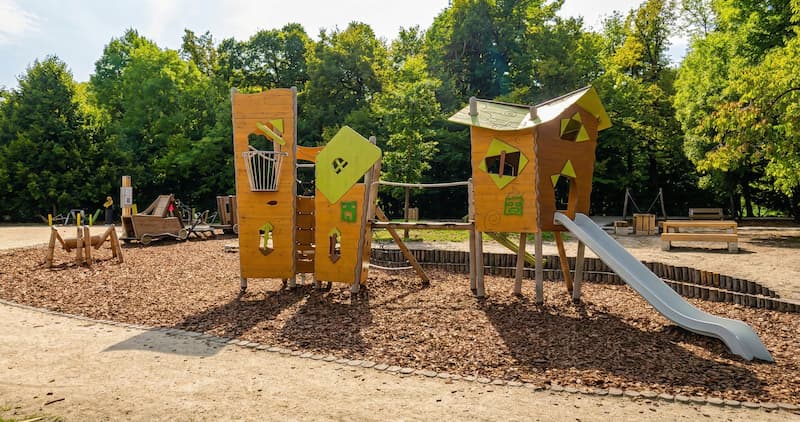
Anna Meadow has a wooden playground with climbing structures suited to younger children, picnic tables, and seasonal toilet facilities. The Normafa buffet is accessible on foot from the meadow in under five minutes. Several other picnic table clusters are dotted along the trails toward Széchenyi-hegy, most in shaded areas that are particularly welcome in summer. Bring your own supplies — the buffet is convenient but limited in range, and the trails don’t have the kind of infrastructure you’d find in a managed country park.Children’s Railway: What Kids Actually Love About It
Children respond to the Children’s Railway in two distinct ways: younger ones are delighted by the small train, the forest views, and the general novelty of being on a proper railway in the woods. Older ones (8–12 range) are fascinated — often visibly surprised — to learn that the station staff are their own age. The uniformed young conductors checking tickets and waving departure flags with complete seriousness is the detail that lands most powerfully. It’s the rare attraction that works on different levels simultaneously and doesn’t condescend to any of them.Accessibility for Visitors with Mobility Limitations
straight up assessment: the Buda Hills are not well-suited for visitors with significant mobility limitations. The trails involve elevation, uneven surfaces, and the main attractions — chairlift, Elizabeth Tower, caves — all have steps or physical barriers to full wheelchair access. The Children’s Railway is one of the more accessible elements, with platform boarding that is manageable for many visitors. The Normafa meadow area itself is flat and accessible from the bus stop. If accessibility is a primary concern, Normafa’s central area offers a pleasant outdoor space without requiring extensive walking, and the Children’s Railway adds a functional transport experience.Wildlife and Nature: What You’ll Actually See in the Hills
The Buda Hills’ wildlife is native, unmanaged, and therefore straight up — you may see plenty or almost nothing, depending on the season, the time of day, and the general inscrutable preferences of the animals involved. The expectations reset required here is: this is not a safari. But with some knowledge of what you’re looking for and when, the hills offer rewarding natural observation.Mammals and Birds: Realistic Sightings by Season
Roe deer are the most reliably sighted mammals — they feed at forest edges at dawn and dusk and are common enough that an early morning walk from Normafa toward the valley trails will often produce a sighting. Wild boar tracks are common; the animals themselves are mostly nocturnal and reclusive, though encounters do occur. Foxes are present throughout. Birds: the beech forests host great spotted woodpeckers and black woodpeckers (audible before visible), various tit species, treecreepers, and raptors including buzzards and sparrowhawks. Spring is the most active season for birdwatching — resident species are joined by migrants from late March through May.Flora Highlights: What’s Blooming When
Spring brings wood anemones, hepatica, and spring snowflakes to the forest floor before the beech canopy closes over — roughly March to April depending on altitude. The meadow areas around Normafa have a good wildflower sequence through May and June: clover, various vetches, orchid species in undisturbed grassland patches. Autumn is all about foliage — the beeches turn gold and copper in October in a way that is worth timing your visit around. The understory includes hawthorn and blackthorn which fruit heavily in autumn and are, yes, foraged by locals.Bat Colonies in the Caves
The Budapest cave system supports significant bat populations — Pálvölgyi Cave in particular is a known roost for several species, with colony counts varying by season. The guided tours are arranged to minimise disturbance, with defined observation areas. Bat activity is highest from spring through autumn when the caves are used as maternity roosts; in winter the bats hibernate deeper in the system and are not visible on standard tours. For the bat-curious, Pálvölgyi offers one of the more reliable urban bat viewing opportunities in Central Europe.Birdwatching Hotspots in the Hills
The Hármashatár-hegy area in the northern Buda Hills is the most productive birdwatching location — the more open, rocky terrain attracts raptors, and the adjacent scrubland supports wheatears, whinchats, and other open-country species during migration. The valley trails between Normafa and Hűvösvölgy are good for forest species. BirdLife Hungary (mme.hu) publishes seasonal trip reports and site guides for the capital’s surrounding areas if you want specifics beyond general exploration.Leave No Trace: Sustainability in the Hills
The Buda Hills see heavy foot traffic and it shows in places — worn trail edges, litter near popular viewpoints, erosion at Normafa’s busiest paths. Designated picnic areas exist precisely to concentrate impact: use them. Fires outside designated areas are prohibited and dangerous in summer. Waste bins are available at main points; carry out everything else. The protected nature reserve areas (Budai Tájvédelmi Körzet) have specific access rules that are posted at entry points — respect the seasonal restrictions on sensitive habitat areas, particularly during bird breeding season in spring.Getting There and Getting Around the Buda Hills
The transport connections to the Buda Hills are one of the strongest arguments for visiting. You can travel from the centre of Pest, cross the Danube, and be standing in a beech forest in under 45 minutes using public transport — and unlike most European cities’ equivalent green belts, the connections work reliably in multiple directions. Here’s what you actually need to know.By Public Transport: Trams, Buses, and the Metro Connection
The key interchange point is Széll Kálmán tér, served by Metro Line 2 (red line) from central Pest. From Széll Kálmán tér you can connect to the cogwheel railway (Line 60), Bus 22 toward Zugliget, Bus 291 toward Normafa, or Tram 61 toward Városmajor. This single interchange handles almost all Buda Hills access routes, which makes planning simple: get to Széll Kálmán tér, then branch toward your destination. Standard BKK transport tickets and passes are valid on all these routes.Tram 61 and Bus 291: The Key Routes
Tram 61 runs from Kelenföld through the southern Buda districts to Városmajor, where you can connect to the cogwheel railway. Bus 291 is the direct route to Normafa from Városmajor — it runs up the hill road, stops at Normafa, and continues to Széchenyi-hegy. Journey time from Városmajor to Normafa is about 15 minutes. Bus 22 connects Széll Kálmán tér to Zugliget. These are the two routes you need to know; the rest of the system fills in around them.By Car: Parking at Normafa and Zugliget
Driving to the Buda Hills is possible and sometimes convenient for families with equipment (bikes, sleds, picnic gear). The car parks at Normafa and Zugliget fill quickly on sunny weekends — by 10:00 AM in peak season, expect full or near-full conditions. Parking fees apply seasonally; exact rates change annually so verify on-site or via the Budapest Parking website. The road up to Normafa is single-lane in sections and can become congested on busy weekend mornings, adding significant time to what looks like a short drive on the map.Budapest Card: What It Covers in the Hills
The Budapest Card covers unlimited public transport — including the trams, buses, and cogwheel railway used to reach the hills — which makes it useful as a transport tool. However, the card historically has not covered the Children’s Railway or the Libegő chairlift, and does not cover cave tours or the Elizabeth Lookout Tower entry. Discounts may apply at some venues — verify against the current Budapest Card benefits list at budapestcard.com before assuming any specific attraction is included. The card’s value for Buda Hills visitors depends heavily on how much other city transport and attraction use you’re combining it with.Combining the Hills with a Thermal Bath Visit
The logical pairing: hike the Buda Hills in the morning, recover in a thermal bath in the afternoon. The combination works geographically — Széchenyi Bath is accessible from Városmajor via a short tram ride, or Rudas Baths sit by the Danube just south of the bridge. For a Buda-side sequence, the Lukács Baths near Margit körút are the most convenient post-hills option and significantly less crowded than Széchenyi. Book thermal bath entry in advance for weekend visits — Budapest’s baths have filled up in the post-COVID years and walk-in availability can be limited.2025 Prices, Tickets, and Practical Tips
Prices in Hungary have moved around over the past few years as inflation worked through the economy, and some Buda Hills attractions updated their fees in 2024 and 2025. The table below reflects the best available figures as of early 2026 — verify all prices on-site or via official websites before visiting, because these things change and I’d rather you double-check than blame me for a 500 HUF discrepancy at a ticket booth.💰 2025 Buda Hills Price Table
| Attraction | Ticket Type | Price (HUF) | Price (USD approx.) |
|---|---|---|---|
| Zugliget Chairlift (Libegő) | One-way ticket | ~3,500 HUF | ~$9.50 |
| Children’s Railway | Single journey | ~1,800 HUF | ~$5.00 |
| Elizabeth Lookout Tower | Tower entry | ~1,000 HUF | ~$2.75 |
| Pálvölgyi Cave | Guided tour | ~3,000 HUF | ~$8.25 |
| Szemlő-hegy Cave | Guided tour | ~3,000 HUF | ~$8.25 |
| Gellért Thermal Baths | Day ticket | ~10,000 HUF | ~$27.50 |
| Budakeszi Wildlife Park | Adult entry | Verify 2025 at budakeszivadaskert.hu | |
| Nancsi Néni Restaurant | Main course (approx.) | 4,000–8,000 HUF | ~$11–$22 |
| Normafa Buffet | Snack / coffee | ~1,000–2,000 HUF | ~$2.75–$5.50 |
| Kaán Károly Lookout | Access | Free | |
| Anna Meadow (Anna-rét) | Picnic area access | Free | |
| Cave Church (Gellért Hill) | Entry | Fee applies — verify 2025 | |
All prices approximate. Verify current rates on-site or via official websites before visiting. USD conversions at approximately 365 HUF/$1.
Budget Breakdown: A Full Day in the Hills
A complete classic loop day — chairlift up, Elizabeth Tower, Children’s Railway back, lunch at Normafa buffet — costs approximately 8,300–10,000 HUF per person (Libegő one-way + tower + railway + buffet lunch). If you substitute the chairlift with walking up, the cost drops to roughly 4,800 HUF. The trails, meadows, and viewpoints are free. A full day with both caves added runs around 14,000–16,000 HUF. By central Budapest standards, the hills are affordable, particularly given the time they can absorb.Safety Tips for Solo Hikers
Solo hiking in the Buda Hills is safe and common — the trails are well-used and mobile coverage is adequate on the ridges. Basic precautions apply: tell someone your planned route, carry water (there are no reliable water sources on the trails), download offline maps before leaving the city, and don’t attempt unfamiliar ridge routes after dark without a torch. The main risks are twisted ankles on uneven ground and dehydration in summer — neither is dramatic, but both are inconvenient. Emergency number in Hungary is 112.What to Wear and Bring by Season
Spring (April–May): Layers — mornings cool, afternoons warm, showers possible. Waterproof jacket. Hiking boots. Summer (June–August): Sunscreen, more water than you think you need, a light layer for the hilltop and the caves. Start early to avoid midday heat on exposed trails. Autumn (September–October): Best season — mild temperatures, stable weather, incredible foliage. Bring a windproof layer for the viewpoints. Winter (November–March): Proper insulation, waterproof boots, traction aids if snow is forecast, and realistic expectations about which attractions are open. The caves are open year-round; most other attractions run reduced or closed schedules.Mobile Data and Navigation App Tips
Download your maps before leaving the city — this is non-negotiable advice rather than a polite suggestion. Turistautak.hu offers the most complete Hungarian trail overlay; Komoot is useful for route planning with elevation profiles; Maps.me with offline Hungary data is a reliable backup. The GPS signal in the Buda Hills forest is generally good, though deep valleys can cause drift. Carry a portable battery charger if you’re out all day — using GPS navigation drains a phone significantly faster than normal use.Where to Eat and Refuel in the Buda Hills
The food infrastructure in the Buda Hills is deliberately limited — this is part of its charm and also occasionally its frustration. Bring snacks. That said, there are several solid options ranging from a post-hike restaurant that has been feeding hungry Budapesters for decades to a meadow buffet that does exactly what it needs to do.Nancsi Néni: The Classic Post-Hike Restaurant
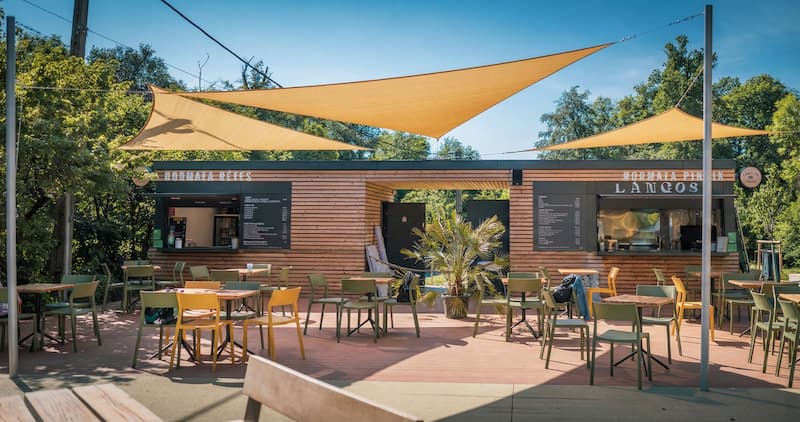
Nancsi Néni — “Aunt Nancy” in loose translation — is a Buda Hills institution on Ördögárok út that has been serving traditional Hungarian food to post-hike Budapesters for longer than most of its current customers have been hiking. The menu is Hungarian home cooking: paprikash, stuffed cabbage, roasted meats, seasonal soups. It’s not fashionable, it’s not trendy, and it charges reasonable money for food that actually restores you after a morning in the forest. Main courses run 4,000–8,000 HUF. Seasonal hours apply; it can be fully booked on sunny weekend lunchtimes, so calling ahead is sensible. The buffet at Normafa is not gastronomy. It is a functional outdoor café that sells hot drinks, langos (fried dough), sausages, and simple snacks from a counter, with picnic table seating outside. On a cold autumn morning after two hours of walking, it delivers exactly what the situation requires. Prices are modest — coffee around 600–800 HUF, langos from 1,000 HUF — and the atmosphere is pure local Saturday morning. It operates seasonally and may be closed on weekdays in low season; the adjacent meadow has picnic tables regardless.Picnic Spots: The Best Locations to Bring Your Own
The best picnic in the Buda Hills is the one you make yourself. Anna Meadow is the obvious choice: flat, facilities nearby, good views of the surrounding trees. The clearing near the Kaán Károly Lookout has a couple of benches and a view worth sitting still for. The meadow near Széchenyi-hegy railway station has picnic tables in a shaded spot. For privacy and quiet, the small clearings along the valley trails south of Normafa provide natural picnic spots with minimal passing traffic. Carry out all waste — there are bins at main points but not on the trail network.Seasonal Closures and What to Expect Off-Peak
In winter and early spring, the Normafa buffet is often closed on weekdays and sometimes entirely. The Children’s Railway runs a reduced schedule. The Libegő may be undergoing maintenance. Plan accordingly — in off-peak periods, bring your own food and expect to eat it in colder, quieter conditions with the forest largely to yourself. This is, I would argue, a good trade. The hills in February with light snow and no queues at anything are worth the closed buffet.Gellért Hill: The Gateway to the Buda Hills
Gellért Hill sits at the southern edge of Buda, rising sharply above the Danube with the kind of dramatic profile that makes it visible from most of central Pest. It’s not technically part of the Buda Hills trail network, but it functions as the city’s gateway to the hills experience — a dramatic limestone shoulder offering city views, historical depth, and two attractions that are worth your time. It’s also the starting point for walking north and west into the wider Buda nature belt.The Citadella: Renovation Status in 2025
The Citadella — the nineteenth-century Austrian fortress that crowns Gellért Hill — has been under renovation for years. As of early 2026, verify the current access status before visiting; parts of the complex have reopened in phases and the situation has been evolving. The exterior terrace and surrounding area remain accessible as a public viewpoint. The views from the hill itself, Citadella open or not, are among the best in the city — the Danube, the bridges, both banks of the capital laid out in one sweep.Liberty Statue and Panoramic Views
The Liberty Statue — the large bronze female figure with the palm branch, visible from most of the city — stands on Gellért Hill’s southern summit. It was erected in 1947 and has survived several political reinterpretations with its position intact. The viewing platform around the statue offers the most comprehensive panoramic view of central Budapest available from any publicly accessible point: the Parliament building, the Chain Bridge, the Buda castle, the city stretching north and south along the Danube. Free to access, no ticket required.The Cave Church: A Hidden Sacred Site
Built into the hillside rock at the base of Gellért Hill, the Cave Church (Sziklatemplom) is a functioning Pauline monastery church established in a natural cave system in the 1920s. It was sealed during the communist period and reopened after 1989. The interior is small, atmospheric, and entirely unlike any other religious site in Budapest — stone walls, dim lighting, and an altar set against the natural rock. Entry is by ticket, limited hours apply, and the atmosphere inside is contemplative regardless of your religious orientation. Check current opening hours before visiting as they are restricted.Frequently Asked Questions
These are the questions I get asked most consistently about the Buda Hills, with answers that reflect how the place actually works rather than how it’s supposed to work in theory.How do I get to the Buda Hills from central Budapest?
Metro Line 2 to Széll Kálmán tér, then Bus 291 to Normafa, Bus 22 or 222 to Zugliget, or Cogwheel Railway (Line 60) from Városmajor to Széchenyi-hegy. All routes take 20–35 minutes from the metro station. By car, park at Normafa or Zugliget — seasonal fees apply, and weekend morning parking can be very tight. The public transport route is the better option on most days.Does the Budapest Card cover the Children’s Railway or chairlift?
Historically, the Budapest Card has not included the Children’s Railway or the Libegő chairlift as free attractions. Discounts may apply at some venues, but don’t assume — verify the current attractions list at budapestcard.com before your visit. The card’s main value in the hills context is unlimited public transport access, which does cover the buses, trams, and cogwheel railway used to reach the area.What is there to do in the Buda Hills on a rainy day?
The two show caves — Pálvölgyi and Szemlő-hegy — are the best rainy day option: completely underground, guided tours, 11°C regardless of what’s happening above. The Children’s Railway runs in light rain (check timetable). Nancsi Néni restaurant is a warm, reliable fallback. The Cave Church on Gellért Hill is covered. For heavy rain days, the city’s thermal baths are always the right answer.Are the Buda Hills suitable for families with young children?
Yes — particularly the Children’s Railway (the highlight for most children), the Anna Meadow playground at Normafa, and the flat picnic areas. Several trail sections are stroller-accessible near Normafa. Budakeszi Wildlife Park nearby is excellent for younger children who want to see the animals that are theoretically in the forests. The caves work well for children aged 6 and up who are comfortable in confined, dark spaces.What are the opening hours and ticket price for the Zugliget chairlift?
The approximate 2025 one-way price is ~3,500 HUF — verify at bkk.hu before visiting as prices update annually. The chairlift runs seasonally and closes for maintenance (typically in late winter) and during high winds. Check the current operating schedule online before making it the centrepiece of your day — there are reliable reports of visitors arriving to find it closed, which is avoidable with five minutes of advance checking.Can I bring my dog to the Buda Hills?
Yes — dogs are welcome on most open trails on a leash. They are not permitted inside the caves (Pálvölgyi, Szemlő-hegy) or on the Libegő chairlift. Some picnic areas have specific rules posted at entry points. The forest trails around Normafa are among the most popular dog-walking routes in Budapest — expect to meet many other dogs on any weekend morning, which is either charming or logistically complicated depending on your dog’s personality.What is the best season to visit the Buda Hills?
Autumn (September–October) is the peak season for foliage and mushroom walks, with stable mild weather. Spring (April–May) brings wildflowers, bird activity, and the first warm hiking days. Summer is busy — go early morning to beat crowds at Normafa and the chairlift. Winter works if you’re strategic about which attractions are open and you’re comfortable with the cold; the hills in snow are a different and worthwhile experience.📍 Essential Info: Buda Hills Budapest
| Zugliget Chairlift (Libegő) | Zugligeti út 97, Budapest | Seasonal — check bkk.hu | ~3,500 HUF one way |
| Elizabeth Lookout Tower | Jánoshegy, Budapest | Daily (seasonal hours) | ~1,000 HUF |
| Children’s Railway (Széchenyi-hegy) | Széchenyi-hegy, Budapest | Approx. 10:00–15:30 seasonal | ~1,800 HUF |
| Children’s Railway (Hűvösvölgy) | Hűvösvölgy, Budapest | See gyermekvasut.hu | ~1,800 HUF |
| Normafa Park | Normafa, Budapest | Open 24/7 | Free |
| Anna Meadow (Anna-rét) | Normafa area, Budapest | Open 24/7 | Free |
| Kaán Károly Lookout | Near Normafa, Buda Hills | Open access | Free |
| Pálvölgyi Cave | Szépvölgyi út 162, Budapest | Check ddhc.hu | ~3,000 HUF approx |
| Szemlő-hegy Cave | Pusztaszeri út 35, Budapest | Check ddhc.hu | ~3,000 HUF approx |
| Budakeszi Wildlife Park | Budakeszi | See budakeszivadaskert.hu | Verify 2025 |
| Nancsi Néni Restaurant | Ördögárok út 80, Budapest | Seasonal — call ahead | Mains 4,000–8,000 HUF |
| Normafa Buffet | Normafa, Budapest | Seasonal | Snacks from ~1,000 HUF |
| Cave Church (Sziklatemplom) | Gellért Hill, Budapest | Limited hours | Fee applies — verify 2025 |
| Citadella | Citadella sétány, Budapest | Check current reopening status | Verify 2025 |
| Gellért Thermal Baths | Kelenhegyi út 4, Budapest | Daily | From ~10,000 HUF |
Getting There: Metro Line 2 → Széll Kálmán tér → Bus 291 (Normafa), Bus 22 (Zugliget), or Cogwheel Railway Line 60 (Széchenyi-hegy). Emergency: 112.
Prices verified: February 2026. All prices approximate — verify on-site or via official websites before visiting.