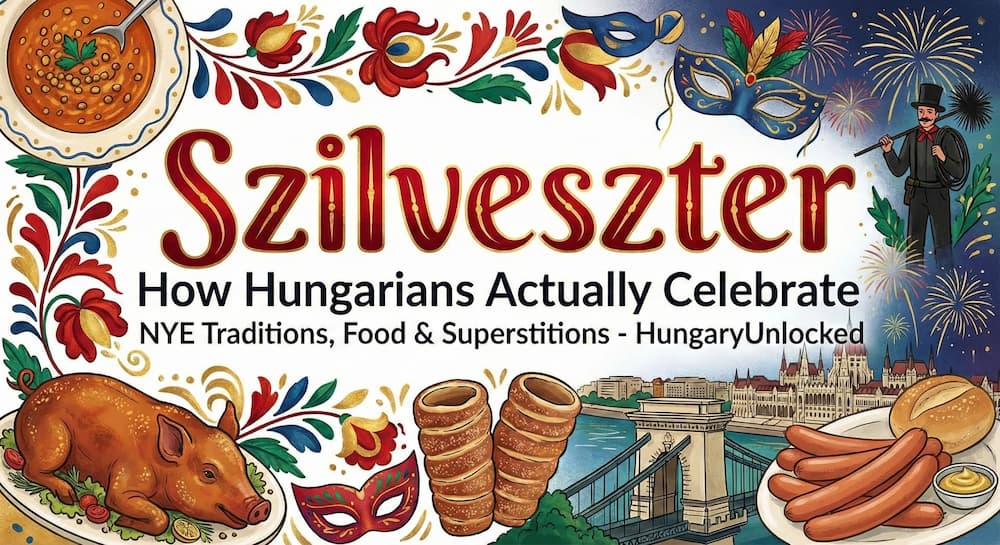
⏱️ TL;DR – Hungarian New Year’s Eve (Szilveszter)
The Strange, Superstitious, Loud New Year Hungarians Love
💰 Prices: Restaurant Szilveszter menu 15,000–25,000 HUF (€38–€63) • Supermarket virsli 400–600 HUF (€1–€1.50)
Why Everything You’ve Read About Hungarian New Year’s Eve Is Probably Wrong
Here’s the thing about Szilveszter in Hungary that most travel blogs won’t tell you: there are no official fireworks in Budapest. I know, I know—you’ve seen those gorgeous photos of the Parliament Building illuminated against a backdrop of pyrotechnics. What you’re actually seeing is the combined chaos of thousands of Hungarians launching their own amateur fireworks from rooftops, balconies, bridges, and pretty much anywhere they can find a flat surface.
And honestly? It’s better this way.
I’ve spent more than four decades celebrating Szilveszter in Budapest, and I can tell you that the absence of a coordinated government display creates something far more magical than London’s Thames spectacular or Sydney’s harbor show. Standing on the Margit híd at midnight, you’re not watching a single choreographed performance—you’re witnessing an entire city simultaneously deciding to set the sky on fire. Explosions erupt from Buda Castle, from the apartment blocks of Újlipótváros, from the ruin bar courtyards of District VII. It’s chaotic, slightly dangerous, and absolutely unforgettable.
But the fireworks are just the finale. The real story of Hungarian Szilveszter lies in the superstitions, the symbolic foods, and the traditions that most visitors never discover. This is what actually happens when Hungarians ring in the new year—not the sanitized version you’ll find in tourist brochures, but the real deal, complete with forbidden foods, weather-predicting garlic, and the one household chore that could literally kill your grandmother (according to my nagymama, anyway).
Arriving in Budapest on December 31st: What to Expect When the City Transforms
The transformation begins around mid-afternoon on December 31st. If you’re walking through the city center—say, along Váci utca or around Vörösmarty tér where the Christmas market is winding down—you’ll notice the energy shifting. Shop owners start closing early. The grocery stores become battlegrounds as Hungarians make their final desperate grabs for virsli, lencse (lentils), and bottles of Törley pezsgő.
I remember one Szilveszter eve standing in a Spar on Király utca around 4 PM, watching a middle-aged Hungarian woman physically wrestle a package of premium juhbeles virsli (sheep-casing frankfurters) from another shopper’s basket. “Ez az utolsó!” she shouted—”This is the last one!” The other woman looked genuinely devastated. This is how seriously we take our New Year’s sausages.
By 6 PM, the streets feel different. Restaurants that aren’t hosting special Szilveszter dinners have closed. Most families are already home, preparing for the evening’s festivities. If you’re out walking, you might catch glimpses through apartment windows: dining tables set with white tablecloths, children in their good clothes, bottles of sparkling wine waiting to be opened at midnight.
The sounds are what really mark the transition. Around 10 PM, the first fireworks start—individual rockets launched by impatient teenagers who can’t wait for midnight. By 11 PM, it’s a steady crescendo. And then, at midnight, the entire city erupts. Car alarms go off everywhere. Dogs bark. Church bells ring. And from every direction, the boom and crackle of a thousand private celebrations.
The smell is gunpowder mixed with cold winter air. If you’re near a ruin bar or restaurant, add grilled meat and the sharp tang of mustard. Budapest on Szilveszter night smells like celebration—slightly dangerous, utterly festive.
What Hungarians Actually Eat on Szilveszter Night (And Why It Matters More Than You Think)
The Holy Trinity: Virsli, Lencse, and Pezsgő
Let me be absolutely clear about this: food on Szilveszter is not merely tradition—it’s prophecy. What you eat (and don’t eat) in the hours surrounding midnight will determine your fortune for the entire coming year. At least, that’s what Hungarian grandmothers have insisted for centuries, and I’m not about to argue with a magyar nagymama.
The virsli (frankfurter) situation requires some explanation for foreigners. This isn’t just any hot dog—it’s a specific type of pork sausage, ideally in natural sheep casing (juhbeles), served at midnight alongside mustard and fresh bread. The virsli tradition actually comes from Germany (we borrowed it sometime in the 20th century), but Hungarians have embraced it so thoroughly that 40% of all December virsli sales happen between Christmas and New Year’s.
At the supermarket, you’ll find virsli ranging from 350-600 HUF ($0.90-$1.50) for a standard pack to 1,200-1,800 HUF ($3-4.50) for premium varieties with higher meat content. My advice? Spend the extra few hundred forints for the good stuff—look for “80% hústaralom” (80% meat content) or higher on the package. The cheap versions are mostly water and questionable filler.
Lentils (lencse) are the main event on January 1st. Their coin-like appearance makes them symbols of wealth and prosperity. The traditional preparation is lencsefőzelék—a thick lentil stew made with roux, sour cream, and a touch of paprika. Your first meal of the new year absolutely must include lentils if you want money in your pocket for the next twelve months. A 500g bag of dried lentils costs about 500-800 HUF ($1.30-$2), making financial fortune surprisingly affordable.
For pezsgő (sparkling wine), the most popular choice is Törley Gála Sec, running 2,500-3,500 HUF ($6.50-9) per bottle. It’s perfectly acceptable—sweet enough for midnight toasting, cheap enough to buy several bottles. If you want to impress locals, spring for Kreinbacher from the Somló region (8,000-15,000 HUF / $20-40), which genuinely rivals French champagne.
For more details on where to celebrate and what events are happening, check out my complete guide to New Year’s Eve in Budapest.
The Pork Principle: Why Pigs Root Forward Into Fortune
Pork dominates the Hungarian Szilveszter table, and the reasoning is wonderfully literal: pigs root forward with their snouts, symbolizing progress and the ability to “dig up” good fortune. The entire animal represents moving ahead into the new year.
Traditional preparations include:
Malac (suckling pig) with the ears and tail still attached—the whole animal roasted until the skin crackles. This is the centerpiece of wealthy Hungarian tables.
Csülök (pork knuckle) slow-roasted with sour cabbage (savanyú káposzta)—hearty, rich, and absolutely perfect for a cold December night.
Kocsonya—and here’s where foreign visitors usually get nervous—is a cold jellied pork dish made from trotters and knuckles. The collagen-rich broth is simmered for hours with garlic, then chilled until it sets into a wobbly, translucent jelly with chunks of meat suspended inside. It’s an acquired taste, I’ll admit. But it’s authentically Hungarian, and your próbálja meg (give it a try) will earn you serious respect from locals.
Hungarian sources reveal an important timing distinction: pork eaten on December 31st “pushes away” the old year’s troubles, while pork on January 1st “digs up” new luck for the coming year. So really, you should eat pork on both days. Doctor’s orders (well, nagymama’s orders).
The Forbidden Foods: What You Absolutely Cannot Eat
This is where things get serious. Eating the wrong food on Szilveszter can doom your entire year. I’m not exaggerating—Hungarian superstition is extremely specific about what must be avoided:
Chicken and all poultry are strictly forbidden. Why? Because chickens scratch backward. Eat chicken, and you’ll spend the year scratching away your good fortune instead of moving forward. This applies to turkey too (also considered hot-headed, prone to causing arguments throughout the year).
Fish is controversial. In most of Hungary, fish is banned because your luck will “swim away”—slippery creatures carry your fortune downstream. However, in river towns like Szeged, where fishing has been central to the economy for centuries, they argue the opposite: fish scales resemble coins, so halászlé (fish soup) brings wealth. This is the one regional exception, and frankly, I’d trust a Baja local on this one.
I once watched an American tourist order csirkepaprikás (chicken paprikash) at a Budapest restaurant on New Year’s Eve. The waiter’s face was a study in horror. He didn’t refuse to serve it—he’s a professional—but you could tell he wanted to. Don’t be that tourist.
Superstitions That Govern the Hungarian New Year Transition
Why Midnight Is Considered Sacred (And Dangerous)
Hungarians treat the moment between years as szakrális időszak—a sacred gap when the boundary between the ordinary and supernatural becomes thin. This is when evil spirits are most likely to slip through, which explains the noise-making traditions: fireworks, banging pots and pans, the historical use of bullwhips with crackers. All of it serves to frighten away malevolent forces.
Modern revelers participate in this noise-making without consciously thinking about its protective origins. But the tradition persists. At midnight, Budapest sounds like a war zone—and that’s exactly the point.
Opening windows at midnight is another widespread custom. The idea is to let the old year out and the new year in, along with fresh air and fresh possibilities. In my family, we always opened every window in the apartment for exactly one minute, regardless of how cold it was outside. The sharp December air rushing through the rooms felt like cleansing.
The First Visitor Rule: Who Crosses Your Threshold Matters
This superstition remains surprisingly strong even among younger Hungarians. The first person to enter your home on January 1st determines your luck for the year:
A male visitor brings good fortune. Families still arrange for male friends or neighbors to be the first through the door after midnight.
A female visitor first… well, let’s just say it’s considered less auspicious. I have friends who wait until a man happens to drop by before letting any women into their apartments on New Year’s Day.
If you encounter a chimney sweep on January 1st—those rare creatures who still exist in Hungary—you’ve hit the jackpot. Touch their coat buttons or smudge yourself with their soot for guaranteed good fortune. (This dates from when chimney sweeps protected homes from fires, the most devastating household catastrophe.)
January 1st Prohibitions: What You Must Not Do
The list of banned activities on New Year’s Day is extensive, and I cannot stress enough how seriously many Hungarians take these:
No sweeping or cleaning. You’ll sweep away all your good luck for the year.
No laundry. Specifically, no teregetés—hanging clothes to dry. This is associated with death in Hungarian folk belief. Hanging laundry on January 1st means someone in the family could die that year. My grandmother would have had a genuine heart attack if anyone suggested doing laundry on New Year’s Day.
No taking out the trash. Same principle—you’re throwing away your fortune.
No lending money or items. Lend something on January 1st, and you’ll be in debt all year.
No visiting doctors. If you see a physician on New Year’s Day, you’ll be sick throughout the year. (Obviously, ignore this if you have an actual emergency. Superstition has limits.)
No using scissors. You’ll “cut off” your luck.
No quarreling. Whatever happens on January 1st repeats throughout the year, so keep the peace at all costs.
I’ve seen Hungarian families tiptoe around each other on January 1st, speaking in careful tones, avoiding any topic that might cause disagreement. The tension can be almost comical—everyone desperately nice to each other for exactly 24 hours.
Regional Traditions That Most Tourists Never Discover
The Fire Wheel Ritual of Transylvania
English-language content focuses almost exclusively on Budapest, but Hungarian Szilveszter traditions vary dramatically across regions—especially in Transylvanian villages where Hungarian communities have preserved customs for centuries.
In villages like Csáváson, the tüzeskerék-engedés (fire wheel ritual) sees straw-wrapped wheels set ablaze and rolled down hillsides at midnight. The burning wheels symbolically connect the old year to the new, carrying away negativity and lighting the path forward. Village elders walk through the streets singing farewell songs while young people manage the burning wheels on the hills.
The Kalotaszeg region preserves the practice of drawing aranyosvíz (golden water) from wells at dawn on January 1st. Whoever draws water first receives year-long luck. Families would wake before sunrise to compete for this honor.
The Whip-Cracking Boys of Marosszéki Mezőség
In the Marosszéki Mezőség area, adolescent boys crack whips at midnight while shouting traditional herding calls. The noise drives prosperity into each household while frightening away evil spirits. It’s a peculiar cacophony—whip cracks mixed with teenage voices attempting to sound commanding—but it’s been happening for generations.
The Garlic Calendar Weather Prediction
This is my favorite obscure tradition. The fokhagyma naptár (garlic calendar) involves salting 12 garlic cloves—one for each month—on New Year’s Eve. By morning, you examine each clove: moist cloves predict rainy months, while dry cloves indicate drought.
Hungarian farmers genuinely relied on this for crop planning well into the 20th century. I’ve seen my own relatives perform this ritual, though these days it’s more ceremonial than agricultural. Still, there’s something satisfying about arranging 12 garlic cloves in a row and pretending you can predict the weather.
What Happens at Midnight: The Hungarian New Year Ritual
Standing for the Himnusz
When Hungarian state television broadcasts the countdown (and virtually every Hungarian household has the TV on), the moment immediately following midnight is dedicated to the Himnusz—Hungary’s national anthem. And I mean dedicated: everyone stands. In homes, in restaurants, in bars. Even drunk people at ruin bar parties attempt to get to their feet.
The Himnusz is unusual among national anthems. Written in 1823 by Ferenc Kölcsey with music by Ferenc Erkel (added in 1844), it’s essentially a prayer—a melancholy plea to God to bless the Hungarian people after centuries of suffering. The opening line, “Isten, áldd meg a magyart” (“God, bless the Hungarian”), sets the tone. It’s not triumphant or martial; it’s sorrowful and beautiful.
During communism, the anthem was played without lyrics because of its religious content. It only became fully official in 1989. Standing for the Himnusz at midnight—hand over heart, often with tears in older Hungarians’ eyes—is a moment of genuine national unity.
The Dinner for One Phenomenon
Here’s something that will confuse British visitors: Hungarians have adopted “Dinner for One” (also called “Der 90. Geburtstag” or “The 90th Birthday”) as a beloved New Year’s Eve television tradition. It’s an 18-minute British comedy sketch filmed for German TV in 1963, featuring Miss Sophie’s 90th birthday celebration with butler James progressively getting drunk while impersonating her deceased guests.
The sketch is virtually unknown in Britain but absolutely beloved across Central Europe. Hungarians watch it every single year, often multiple times on different channels. The catchphrase “Same procedure as last year, Miss Sophie?” has entered Hungarian popular culture.
If you’re at a Hungarian house party and someone quotes this line, just nod and laugh. Trust me.
Where to Celebrate: Budapest Szilveszter Options
Option 1: The Classic House Party (What Most Hungarians Actually Do)
Here’s the truth that tourism websites don’t emphasize: most Hungarians over 25 spend Szilveszter at private house parties. Forum discussions consistently show that the typical Hungarian New Year’s involves gathering at someone’s apartment with family and friends, eating virsli and lentils at midnight, watching the Himnusz on TV, then continuing with food, drink, and conversation until the early morning hours.
One local described it perfectly: “My last NYE in Budapest was a private party of creative types in a decaying Baroque villa in the Buda hills… getting back past 1 AM to my aunts’ and uncles’ party with great food and hard alcohol into early hours.”
If you’re lucky enough to score an invitation to a Hungarian house party, accept immediately. Bring a bottle of good pezsgő and prepare for a genuine cultural experience.
Option 2: Restaurant Szilveszter Dinners
Many Budapest restaurants offer special Szilveszter menus—typically a multi-course dinner with champagne toast at midnight. These range widely in price and quality:
Budget traditional restaurants: 15,000-20,000 HUF ($38-50). Expect solid Hungarian food, virsli at midnight, pezsgő included, and a festive atmosphere without too much formality.
Mid-range options (like Hungarikum Bisztró): 24,800 HUF + 13% service. Better quality ingredients, more elaborate courses, possibly live music.
Upscale (like ÉS Bisztró at Hotel Kempinski): 65,000 HUF + 15% service. Multi-course tasting menus, premium champagne, elegant surroundings.
Luxury experiences (like AGOS Restaurant): 99,990 HUF with optional wine pairing. This is Budapest at its finest—expect impeccable service, creative Hungarian-influenced cuisine, and a genuinely memorable evening.
Critical advice: Book restaurants weeks in advance. Popular spots sell out by mid-December. Check availability now—don’t wait until you arrive.
For specific restaurant recommendations that are open during the holidays, see our guide to Budapest restaurants for Christmas and New Year.
Option 3: River Cruises on the Danube
Watching the amateur fireworks display from a boat on the Danube is genuinely spectacular. The city reflects in the water, the Parliament Building glows, and explosions erupt from both banks simultaneously.
Budget sightseeing cruises: from €65-77. These typically include a few drinks and snacks but are primarily about the views.
NYE boat parties (5 hours, open bar): around €200. More festive atmosphere, unlimited drinks, usually includes dinner.
Several companies offer these cruises—book early as they sell out.
Option 4: Thermal Bath Parties
The famous Széchenyi Bath hosts a legendary party on December 30th (not the 31st—take note). Picture this: outdoor thermal pools steaming in the cold night air, DJ music echoing off neo-baroque architecture, hundreds of partygoers bobbing in 38°C water while snow possibly falls around them.
Tickets run €59-139 depending on the package. It’s become somewhat touristy over the years, but it remains uniquely Budapest.
For everything you need to know about thermal baths in general, check out our Budapest thermal bath guide.
Option 5: Free Outdoor Celebrations
If you’d rather celebrate without spending much money, several areas become natural gathering points:
Vörösmarty tér – The Christmas market stays open until 3 AM on New Year’s Eve. Grab some kürtőskalács (chimney cake), hot wine, and watch the countdown on the big screen.
Deák Ferenc tér – The main countdown location in the city center. Crowded, loud, and very much a young backpacker scene.
The Danube bridges – My personal favorite. Find a spot on Margit híd or Szabadság híd, and you’ll have 360-degree views of amateur fireworks erupting across both Buda and Pest.
Option 6: Ruin Bars and Clubs (District VII Nightlife Chaos, Upgraded)
If you want the full Budapest New Year’s Eve mayhem, District VII is where the city collectively forgets its own bedtime. But here’s the insider truth: not every famous ruin bar is actually open on December 31 — so choose wisely.
Szimpla Kert – closed on New Year’s Eve
Official website – click here
The legendary OG ruin bar, yes. The chaotic fever dream of mismatched furniture and bathtub seating, yes. But open on NYE? Nope. Szimpla traditionally shuts its doors on December 31, leaving thousands of confused tourists refreshing Google Maps like it’s a stock market crash. Great place on any other night, but NYE? Forget it.
Instant–Fogas – very open, very packed
Official website – click here
This is the seven-dance-floor hydra of Budapest nightlife — a sprawling, neon-lit labyrinth where you will absolutely lose at least one friend and possibly your sense of direction. Instant–Fogas is open for NYE and usually goes until sunrise. Expect 8,000–20,000 HUF ($20–50) entry for big New Year’s parties, plus drink prices that rise in direct correlation with bass levels. Crowded? Yes. Ridiculous? Also yes. Worth it? If you’re under 35 or pretending to be.
Mazel Tov (NYE Dinner Option) – classy, not chaotic
Official website – click here
Not a ruin bar, but since you’re in the neighborhood: this atmospheric courtyard filled with string lights offers a more civilized entry into the new year. Think Mediterranean dinner, cocktails, and vibes that say I like nightlife, but also chairs and conversation.
Kisüzem – hipster dive that stays open late
Facebook page – click here
A local favorite: smoky, cramped, full of artists, writers, off-duty bartenders, and people who claim they “don’t go out anymore.” Expect cheap drinks, no entry fee, and an atmosphere that feels like a house party where everyone has excellent taste in music.
If you want folk music instead of electronic bass:
Fonó Budai Zeneház – authentic Hungarian folk & world music
Official website – click here
This is where Budapest hides its real folk culture. Think live cimbalom, Transylvanian dance circles, pálinka-fueled shouting, and zero tourist-trap energy. It’s warm, intimate, and wildly alive — the exact opposite of the District VII techno chaos.
Giero Pub – the retro living room locals adore
Facebook page – click here
Tiny, charming, and filled with mismatched furniture that looks like it was rescued from someone’s grandmother’s attic. Locals describe it as “a living room with better drinks”. Not a NYE hotspot, but an atmospheric escape if your resolution is to avoid 10,000 drunk Erasmus students.
Practical Information: What You Actually Need to Know
Weather on Szilveszter Night
Budapest in late December typically ranges from -2°C to +4°C (28-39°F), but wind chill—especially near the Danube—can make it feel significantly colder, potentially reaching -5°C or below. Snow is possible but not guaranteed.
What to wear: Heavy winter coat, hat, gloves, scarf, and waterproof boots if you plan to be outdoors. Layering is essential if you’ll be moving between heated indoor spaces and cold streets. Hand warmers are not a bad idea.
Public Transport Runs All Night (But There’s a Catch)
Budapest’s BKK operates extended service on Szilveszter night:
Metro lines M1-M4 run all night with increased frequency. This is your most reliable option for getting around.
Trams 4-6 along the Grand Boulevard operate every 3-4 minutes until 2 AM, then every 5 minutes through the night. This is the route that circles the city center and remains packed with revelers.
Night buses increase their frequency significantly.
The catch: Taxis become nearly impossible to find. Waiting times extend to 20-30 minutes via apps, and unlicensed “hiéna” (hyena) taxis prowl tourist areas looking for victims. These unofficial cabs will quote you astronomical prices or “forget” to use the meter.
My strong advice: Use only app-based services like Bolt or City Taxi. Budapest has regulated taxi pricing with no surge fees, making legitimate app-based rides safe and predictable. Download the apps before New Year’s Eve.
If you’re planning your overall trip logistics, our guide to getting around Budapest covers everything you need to know.
Safety Considerations
Budapest is generally safe on New Year’s Eve, but common sense applies:
Watch for amateur fireworks. Hungarians launch rockets from balconies, rooftops, and street corners with varying degrees of skill and sobriety. Keep your eyes up, and don’t stand directly beneath anyone setting off explosives.
Broken glass covers many sidewalks by 1 AM—both from champagne bottles and from firework debris. Watch your step.
Pickpockets work the crowded areas around Deák tér and Vörösmarty tér. Keep valuables secure.
The ruin bar area can get extremely crowded. If claustrophobia is an issue, avoid the indoor spaces and stick to outdoor terraces.
Insider Hacks and Local Tips That Will Make You Look Like a Regular
Learn to say “BÚÉK!” This is the Hungarian equivalent of “Happy New Year!”—it’s actually an abbreviation of “Boldog Új Évet Kívánok” (I wish you a happy new year). Pronounce it roughly like “BOO-ayk.” Hungarians will be genuinely delighted if you use this.
Buy your virsli and pezsgő by December 30th. Seriously. The December 31st supermarket rush is not for the faint of heart, and popular items sell out.
If someone offers you pálinka at a house party, accept it. Refusing Hungarian fruit brandy is mildly insulting. Take a small shot, say “Egészségedre!” (to your health, pronounced “egg-esh-shay-ged-reh”), and prepare for your throat to catch fire.
Don’t try to make restaurant reservations on December 31st. The good places booked out in November. Your options are either pre-booked special menus or wandering the streets hoping to find an open kitchen (you won’t).
The best fireworks viewing requires elevation. Gellért Hill, the Fisherman’s Bastion area, or any rooftop bar will give you views of displays erupting across the entire city. Street level is atmospheric but limiting.
Bring your own snacks to outdoor celebrations. Food vendors exist but lines are long and prices are inflated. A thermos of hot tea and some kolbász (sausage) from home will serve you well.
The One Realistic Negative: Managing Expectations
I need to be honest about something: Budapest Szilveszter can disappoint visitors who expect a polished, organized spectacle.
Because there’s no official fireworks display, the midnight moment can feel anticlimactic if you’re in the wrong location. The amateur fireworks are incredible from certain vantage points but can seem sparse and random from others. If you’re standing on a random side street at midnight, you might see a few rockets go up, hear distant explosions, and wonder what all the fuss was about.
The crowds at tourist hotspots (Deák tér, Vörösmarty tér) can also become unpleasant—too many people, too much alcohol, occasional aggression. It’s not dangerous, exactly, but it’s not the romantic Budapest experience either.
And the weather genuinely matters. A cold, rainy New Year’s Eve—which happens more often than not—can make outdoor celebrations miserable. Those dreamy photos of midnight on the Danube look a lot less appealing when you’re soaked and freezing.
The solution: Temper your expectations for spectacle and embrace the authenticity. The best Szilveszter experiences happen at house parties, at mid-range restaurants with locals, or at viewpoints away from the main tourist crush. Go for the culture, not the Instagram moment.
Summary: Why Hungarian Szilveszter Is Worth Your Time (Despite the Missing Official Fireworks)
So here’s the deal with Szilveszter in Hungary: it’s not about what you watch, it’s about what you do. Eat lentils for money, pork for forward progress, and absolutely avoid chicken unless you want to scratch away twelve months of good fortune. Stand for the national anthem at midnight—yes, actually stand—and feel a moment of unexpected emotion as an entire country pauses together. Toast with pezsgő, bite into a steaming virsli, and make enough noise to frighten away any evil spirits lurking at the boundary between years.
Skip the laundry on January 1st. Trust me on this one.
The absence of official fireworks creates something more valuable than any choreographed display: authenticity. When thousands of Hungarian families simultaneously launch rockets from their balconies, you’re not watching entertainment—you’re participating in a communal act of celebration that hasn’t changed much in decades. It’s messy, slightly chaotic, and probably a fire hazard. It’s also genuinely Hungarian.
As one local told me years ago, standing on the Margit híd with firework debris raining down: “This is how we do it. Everyone joins in. No one just watches.” That, right there, is Hungarian Szilveszter in a single sentence.
Boldog Új Évet! Now go buy some lentils.
Frequently Asked Questions About Hungarian Szilveszter
Why is Hungarian New Year’s Eve called Szilveszter? It’s named after Saint Sylvester I, a Pope who died on December 31st, 335 AD. His feast day falls on the last day of the year, and Hungarians (along with Germans, Austrians, and others) adopted his name for the holiday. So when you say “Szilveszter,” you’re basically saying “Saint Sylvester’s Day.” The saint himself had nothing to do with partying or fireworks—that part we added ourselves.
Are there official fireworks in Budapest on New Year’s Eve? Nope. Zero. Zilch. Budapest has no official NYE fireworks display. The city’s fireworks happen on August 20th (St. Stephen’s Day). What you’ll see on December 31st is thousands of private citizens launching their own amateur displays from every available surface. It’s chaotic, uncoordinated, and honestly more impressive than most official shows I’ve seen. Just keep your head on a swivel to avoid incoming rockets.
What should I eat (and avoid) for Hungarian New Year’s luck? Eat: Lentils (wealth—they look like coins), pork (progress—pigs root forward), virsli/frankfurters (tradition), anything with garlic or paprika. Avoid at all costs: Chicken, turkey, any poultry (they scratch backward = scratching away your luck), and fish in most regions (your fortune swims away). Exception: In Szeged and river towns, fish scales = coins, so fish is acceptable. When in doubt, eat pork.
Is public transport running on New Year’s Eve in Budapest? Yes! BKK extends service on Szilveszter night—metros run all night, trams 4-6 run every few minutes until late, and night bus frequency increases. Getting around by public transit is easy. Getting a taxi, however, is nearly impossible. Download Bolt or City Taxi apps beforehand, and prepare for 20+ minute waits. Avoid any unmarked “taxi” that approaches you on the street—those are scam artists with creative pricing.
Can I do laundry on January 1st in Hungary? Technically, yes, you physically can. But should you? Absolutely not. Hanging laundry to dry (teregetés) on New Year’s Day is associated with death in Hungarian folk belief—it could cause a family member to die during the year. Even if you don’t believe in superstitions, your Hungarian hosts definitely might. Just wait until January 2nd. Your dirty socks can survive another 24 hours.
What’s a realistic budget for celebrating Szilveszter in Budapest? You can do it cheap or expensive: Budget (house party style): Virsli pack (500 HUF/$1.30) + lentils (700 HUF/$1.80) + decent pezsgő (3,000 HUF/$7.70) = under 5,000 HUF ($13) for the essentials. Mid-range restaurant dinner: 20,000-35,000 HUF ($50-90) per person including drinks. Upscale restaurant: 65,000-100,000 HUF ($165-255) per person. River cruise: €65-200 depending on the package. Whatever you choose, book restaurants and cruises in advance—December 31st is too late.


