Museum of Illusions Budapest: Your Brain Will Thank You (Then Hate You)
On this page
- 📋 Museum of Illusions at a Glance
- What the Museum of Illusions Actually Is
- Where It Is, and How to Get There
- What’s Inside: The Rooms That Matter
- The Illusion Rooms
- The Installations
- The Images
- Tickets, Hours and Timing
- When to go
- How long to allow
- Is It Worth It?
- Fitting It Into a Budapest Day
- How it sits against Budapest’s other attractions
- Photo Tips That Actually Change the Shot
- Frequently Asked Questions
- The Verdict
- 📍 Museum of Illusions Budapest, essential info
Closed for renovation. The museum is shut for renovation work and no reopening date has been announced. Check illuziokmuzeuma.hu before you build a day around it. Everything below describes the museum as it operates when the doors are open, with the tariff and hours the museum publishes. For a compact, hands-on indoor stop that is open right now, the Pinball Museum fills the same slot in a day.
Budapest’s most Instagram-friendly attraction, where nothing is what it seems, including your sense of direction.
📋 Museum of Illusions at a Glance
| Status | Closed for renovation, no reopening date announced |
| Best for | Families with kids, photo hunters, a rainy afternoon |
| Time needed | About 90 minutes by the museum’s own reckoning |
| Adult ticket | 5,400 HUF (~$17) |
| Hours | Sun to Thu 10:00 to 19:00, Fri to Sat 10:00 to 20:00 |
| Getting there | Metro M1, M2 or M3 to Deák Ferenc tér, under 5 min on foot |
| Skip if | You hate crowds, want deep intellectual stimulation, or get motion sick easily |
What the Museum of Illusions Actually Is
An interactive attraction built out of optical illusions, mind-bending rooms and perspective-warping installations, packed into a compact exhibition space near Deák Ferenc tér. The concept came from two Croatian architects, Roko Žaja and Tomislav Pamuković, who opened the first one in Zagreb in 2015: take the illusions that live in psychology textbooks and make them walk-in. It became a franchise. Budapest’s branch opened in December 2021.
Let’s get this out of the way: it is not the Louvre. It is not even the Hungarian National Museum. It is a commercial entertainment attraction in an educational wrapper, built to make you question your spatial awareness and produce photos that confuse your followers. That is completely fine.
The premise does hold up. Your visual system takes shortcuts, because it has to. When you walk into a room, your brain assumes the corners are square, the floor is level and parallel lines stay parallel. Most of the time those assumptions serve you. Every exhibit here is a room built to break one of them, so you get to watch your own perception being provably wrong while you stand in it.
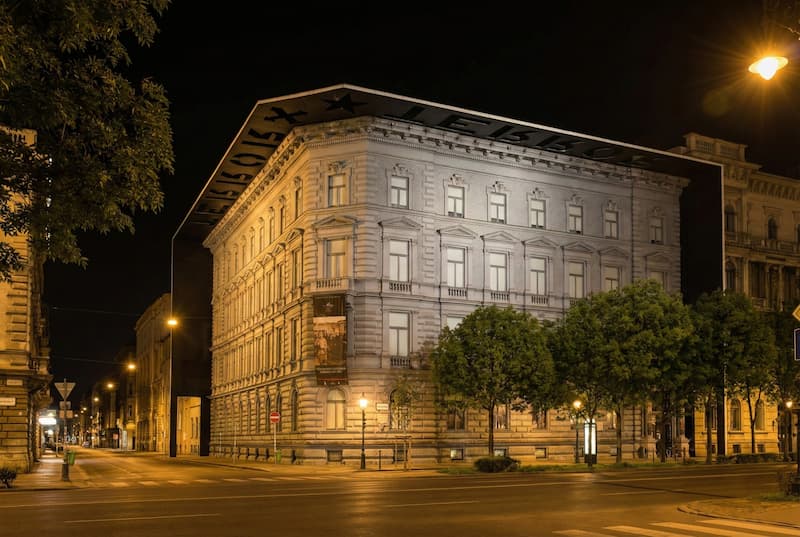
The House of Terror, the kind of heavy Budapest museum the illusions are a break from
Budapest is stacked with heavy-hitting history. You have the House of Terror documenting political oppression, Memento Park and its field of communist statues, and roughly seventeen ways to confront the darkest chapters of Hungarian history. Sometimes you want to walk into a room that makes you look tiny, take a stupid photo and leave without being emotionally flattened.
Where It Is, and How to Get There

St. Stephen’s Basilica, a ten-minute walk from the museum
The address is Bajcsy-Zsilinszky út 3, 1065 Budapest, which means nothing until you know it is under five minutes on foot from Deák Ferenc tér, the one square where all three metro lines meet.
📍 Getting There
- Metro: M1, M2 or M3 to Deák Ferenc tér
- Bus: plenty of lines stop at Deák Ferenc tér
- On foot: 10 min from St. Stephen’s Basilica, 15 min from the Danube
- By car: street parking here is scarce and expensive. The museum points drivers at the Erzsébet and Bazilika garages.
The entrance sits on a busy main street and is easy to walk straight past. Look for the signage at street level.
The central address is a blessing and a curse. Blessing: it drops into any itinerary without planning gymnastics. Curse: it knows it is on prime real estate and prices accordingly. You are steps from Vörösmarty tér, the Gerbeaud, Fashion Street and endless shopping, which makes this a pit stop rather than a destination.
What’s Inside: The Rooms That Matter
The exhibits split into three groups: illusion rooms, installations and images. Here is what to expect, and which ones earn the queue.
The Illusion Rooms
The Tilted Room. The museum’s bread and butter. The whole room is built on an angle, and your brain, pattern-seeking traitor that it is, insists on reading it as level. You feel like you are defying gravity standing still. Water appears to run uphill, balls roll the wrong way, and photos make it look like you are about to slide off the floor. It is one of the most popular rooms and it holds a limited number of people, so this is where the bottleneck forms.
The Vortex Tunnel. You cross a stationary bridge while a cylinder painted with spirals rotates around you. The floor does not move. Your brain reads the spinning walls as motion anyway and decides the ground is turning under you. Some people love the head rush. Others get out fast.
⚠️ Motion Sensitivity Warning
The Vortex Tunnel triggers real dizziness and nausea in people prone to it. If boats or spinning rides get you, skip this one or go slowly with both hands on the rails. Everything else in the museum is stationary.
The Reversed Room. Furniture bolted to the ceiling, so that photographed from the right angle you appear to be standing on it. A classic that never stops producing good photos. It lives or dies on camera position, and the staff know the angle.
The Ames Room. Named after Adelbert Ames Jr., and one of the most famous illusions there is. The room is built with distorted proportions that read as normal from one specific viewpoint. Put two people in opposite corners and one becomes a giant while the other shrinks to doll size. It is a genuinely good demonstration of how much your brain assumes about room geometry before it judges size, and the photos are ridiculous.
The Infinity Room. Mirrors, more mirrors, and lighting that turns them into a space with no end. Beautiful, mildly disorienting, extremely photogenic, and usually quicker to clear than the interactive rooms because people shoot and move on.
The Installations
Forced-perspective seats. The Beuchet Chair and the oversized chair setup work the same trick from different angles: strategic placement makes one person tiny and another enormous. Simple, effective, fast.
Anti-gravity corner. Balls roll uphill and water goes where it should not, while your eyes and inner ear file conflicting reports.
Clone Table. Mirrors that multiply your head around a single table, so you appear to be chairing a meeting with yourself. Quirky, photogenic, rarely a queue.
True Mirror. A regular mirror shows you reversed. This one shows you as everyone else sees you, and for most people that is quietly unsettling. It is the one exhibit that makes you think more than photograph, and it is also the one people walk past assuming it is an ordinary mirror.
Holograms and puzzle tables. The holographic displays are look-and-learn rather than hands-on, and carry the science behind the spectacle. The puzzle tables near the entrance and exit are included in the ticket and are the sleeper hit: they are where groups lose twenty minutes without noticing, and they are the obvious place to park while a popular room clears.
The Images
Classic flat illusions of the kind you have met in textbooks: pictures that appear to move while standing still, drawings that flip between two readings, size tricks, and colour illusions where your brain fills in what is not there. Rubin’s Vase is here too, the vase that is also two faces in profile, which helped found Gestalt psychology. They explain the principles behind the big rooms, and almost everyone walks past them.
Tickets, Hours and Timing
💰 Ticket prices
| Ticket | Price | Approx. USD |
|---|---|---|
| Adult | 5,400 HUF | ~$17 |
| Student or senior | 3,900 HUF | ~$12 |
| Family (2 adults + 2 children) | 17,100 HUF | ~$55 |
| Visitor with special needs | 3,900 HUF | ~$12 |
| Child under 5 | free | free |
The reduced rate for visitors with special needs requires ID at the door. Children aged 14 and under have to be with an adult.
🕐 Opening hours
| Days | Hours |
|---|---|
| Sunday to Thursday | 10:00 to 19:00 |
| Friday to Saturday | 10:00 to 20:00 |
You can buy at the door, but a booked time slot is what gets you past the line, and the museum does not promise immediate entry to walk-ins. A booked slot can be moved to a different time up to 24 hours beforehand.
When to go
Best: weekday mornings, Tuesday to Thursday, at the 10:00 opening. The rooms are empty and the popular ones do not have a queue yet. Fine: weekday afternoons and Sunday mornings. Avoid: Saturday afternoons and school holidays, when families, tourists and weekend crowds arrive at once and half your visit becomes waiting.
How long to allow
The museum puts the exhibition at about 90 minutes, and nobody is timing you. That figure assumes you read the explanations, try the puzzles and shoot each room more than once. Move briskly and skip the reading and you are out in 30 to 45 minutes, which is exactly how the people who call it overpriced experienced it.
Is It Worth It?
At 5,400 HUF for the 90 minutes the museum describes, you are paying around 60 HUF a minute. Rush it in 45 and that doubles to 120. That gap is the whole argument about this place: the price is fixed and the value is entirely set by how slowly you are willing to go.
What it does well. It is genuinely entertaining if you arrive wanting a fun hour rather than a cultural experience. The photos are unlike anything you will take at a church or a bath. Kids love it, and the interactive format holds attention spans that collapse in traditional museums. Every illusion comes with an explanation of the science, whether or not anyone reads it. And it is indoor, which matters more than people expect in a city where the weather turns without warning.
What it does badly. It is small, and if you move fast you will feel the price. At peak times a real share of your visit is spent waiting for the Tilted Room to clear. Much of the value is photographic, so if you are not shooting, you lose half of it. And the franchise is standardized: if you have done one in Zagreb or Vienna, you have essentially done this one.
Best value: families with school-age kids, anyone building photo or video content, and first-timers who have never seen these illusions in person. Worst value: solo travellers who do not care about photos, repeat visitors of the franchise, and anyone on a tight budget, where 5,400 HUF buys a lot more elsewhere in this city.
The verdict is simple. This is a supplement, not a destination. Add it to a day where you have already seen the serious sights and want something light. Do not build a trip around it.
Fitting It Into a Budapest Day
The location makes combinations easy.
Basilica then illusions. Start at St. Stephen’s Basilica ten minutes away, climb to the dome for the view, then switch registers completely at the museum. Finish with coffee in one of Budapest’s historic cafés. Four to five hours, and the pace never drags.
The rainy day. Museum of Illusions for an hour and a half, then a covered walk to the Central Market Hall, then somewhere with a roof and a pastry. You stay dry and the day survives.
The family day. Museum in the morning while the kids still have fuel, lunch nearby, then City Park for the zoo, Vajdahunyad Castle or the playground. More family-friendly programmes here.
The pre-night-out. The Jewish Quarter and its ruin bars are a 10 to 15 minute walk. Do the museum late afternoon, then walk into the evening.
💡 Pro Tip: Strategic Scheduling
Slot this into dead time rather than prime sightseeing hours. Between checkout and an afternoon plan, or the gap before a dinner reservation, is exactly where it earns its keep.
How it sits against Budapest’s other attractions
| Attraction | Time needed | Cost | Vibe |
|---|---|---|---|
| Museum of Illusions | ~90 min | 5,400 HUF | Fun, light, interactive |
| House of Terror | 2-3 hours | 4,000 HUF | Heavy, emotional, historical |
| Hungarian National Museum | 2-3 hours | 3,200 HUF | Traditional, educational |
| Széchenyi Baths | 3-4 hours | 13,200+ HUF | Relaxing, unique |
| Hungarian Parliament | 45 min tour | 6,000 HUF (EU) | Grand, historical |

Széchenyi Baths, a completely different Budapest at a completely different price
The niche is specific: short, high-entertainment, low emotional investment. It is not competing with the city’s serious institutions, it is giving you somewhere to go between them.
Photo Tips That Actually Change the Shot
Bring someone. Half the illusions need a second person behind the camera at a specific spot. Solo travellers should just ask another visitor, because everyone in the room is doing the same thing.
Shoot in burst. The Tilted Room and Vortex Tunnel produce moving poses, and one frame in eight is the good one.
Take the staff’s advice. They have watched thousands of attempts in these rooms and know the angle that makes the trick work.
Be quick when there is a queue. Get your shots and move rather than holding a room hostage.
Shoot video too. Several illusions read far better in motion than as stills.
Frequently Asked Questions
Is it suitable for young children?
Yes, though under-fives will not follow the illusions conceptually and can still enjoy running between them. Children aged 14 and under must be accompanied by an adult. The Vortex Tunnel can be too intense for small or easily spooked children.
Do I need to book in advance?
You can buy at the door, but the museum does not guarantee immediate entry to walk-ins. A booked time slot is what lets you skip the line, and it can be changed up to 24 hours before.
How long does the visit take?
The museum puts the exhibition at about 90 minutes and does not police how long you stay. Skip the reading and the puzzles and you will be through much faster.
How accessible is it?
The museum describes itself as accessible to the whole community, with the design built around the elderly, people with strollers and people living with a disability, and it sells a reduced ticket for visitors with special needs on presentation of ID. Walking through the Vortex Tunnel does require mobility. For anything specific, contact them before you travel.
Is photography allowed?
Yes, and it is the point. The whole place is built for it.
Are there guided tours?
It is self-guided. Staff are around to explain exhibits and help with photos, but there is no tour format. Groups and school visits can be arranged directly with the museum.
Is it the same as a selfie museum?
Different concept. Selfie museums are photo backdrops. Here every illusion comes with an explanation of the mechanism behind it, which is what makes it edutainment rather than a set of walls. The photos are still the main draw for most visitors.
Can I hold an event there?
Yes. The museum takes private, corporate and cocktail-style bookings, from birthdays to product launches. Pricing goes through them directly.
Is there a café inside?
No food service in the museum. You are in the middle of the city with a hundred options within five minutes.
How does it compare to an escape room?
Completely different. An escape room is timed problem-solving. This is exploration with a camera, and there is nothing to solve.
What age range gets the most out of it?
Roughly 6 to 14. Younger kids miss the concept but enjoy the rooms. Teenagers tend to find it touristy unless they are shooting content.
The Verdict
The Museum of Illusions Budapest is exactly what it says on the door: optical illusions and interactive exhibits built to entertain, confuse and produce shareable photos. It is not trying to be a cultural institution and judging it as one is unfair to everybody.
Approach it as a light hour and a half between heavier experiences and you will leave happy. Expect it to change your understanding of perception, or to rival the city’s great sights, and you will not.
Go on a day with flexible timing when you could use something silly. Skip it if your Budapest time is short and the major sights are still unseen. Your brain may hate you on the way out of the Vortex Tunnel, but it will be a fun kind of hatred.
📍 Museum of Illusions Budapest, essential info
- Status: closed for renovation, no reopening date announced
- Address: Bajcsy-Zsilinszky út 3, 1065 Budapest
- Tickets: 5,400 HUF adult | 3,900 HUF student, senior or special needs | 17,100 HUF family of four | under 5 free
- Hours: Sun to Thu 10:00 to 19:00 | Fri to Sat 10:00 to 20:00
- Getting there: Metro M1, M2 or M3 to Deák Ferenc tér, under 5 minutes on foot
- Time needed: about 90 minutes
- Website: illuziokmuzeuma.hu
Pro tip: arrive at opening on a weekday. The Vortex Tunnel and the Tilted Room are where the queues form, and they form early on weekends.
Closure, ticket tariff, opening hours, address and visit duration verified on the museum’s own site, illuziokmuzeuma.hu, 5 September 2026. Prices are in HUF, which is what you pay at the counter. Converted at 1 USD = 313 HUF, the ECB rate on 4 September 2026. Rates move, so treat the dollar figures as indicative, and confirm the reopening before you plan around a visit.
Related articles:
– Family-Friendly Programmes in Budapest – Budapest Pinball Museum: Nostalgic Fun – 3 Days in Budapest: The No-BS Local’s Itinerary – House of Terror: The Museum That Stays With You
Book it, skip the counter


Prices checked 2026-10-05. Booking through these links supports the site at no extra cost to you. How this works.