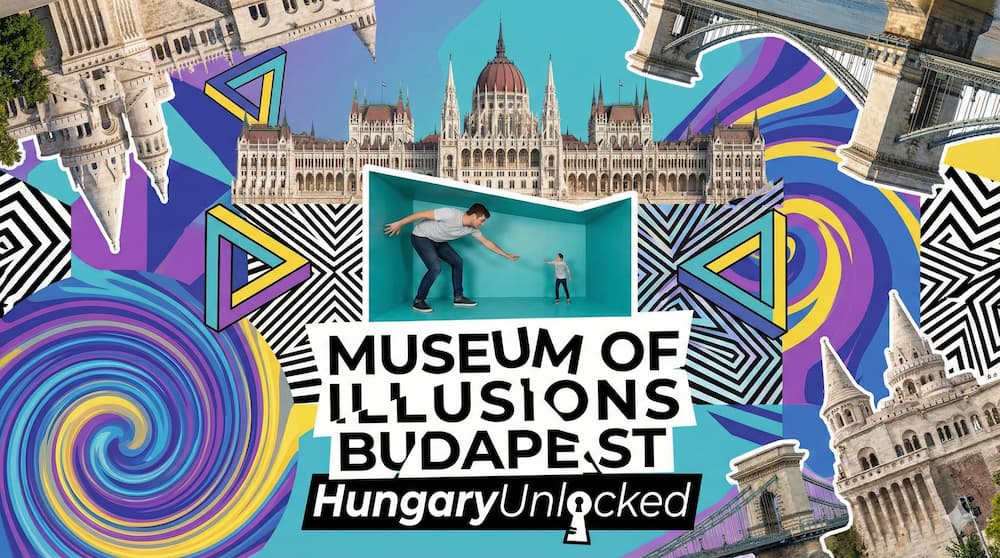
Your comprehensive guide to Budapest’s most Instagram-friendly attraction where nothing is what it seems, including your sense of direction.
🎯 TL;DR
The Museum of Illusions is a compact but entertaining brain-bender near Deák Ferenc tér that’ll have you questioning reality for about an hour. Entry costs around 5,000 HUF (~$13 USD), it’s incredibly Instagram-friendly, and works for families, couples, and anyone who enjoys feeling slightly disoriented. Not a full-day activity, but a fun add-on when you need a break from Budapest’s heavier historical attractions.
📋 Museum of Illusions at a Glance
| Best For | Families with kids, Instagram enthusiasts, rainy day activity |
| Time Needed | 45–90 minutes |
| Cost | ~5,000 HUF (~$13 USD) adult |
| Hours | Daily 10 AM – 7/8 PM (extended Fri-Sat) |
| Getting There | Metro M1/M2/M3 to Deák Ferenc tér, 3-min walk |
| Skip If | You hate crowds, need deep intellectual stimulation, or get motion sick easily |

The Science of Why Your Brain Falls for This Stuff
Before we dive into what you’ll actually see inside, let’s talk about why optical illusions work in the first place. Your brain is essentially running on pattern recognition software that was optimized for survival on African savannas, not for navigating rooms specifically designed to trick it.
Every second, your visual system processes approximately 10 million bits of information. That’s way more than your conscious mind can handle, so your brain takes shortcuts. It makes assumptions. When you look at a room, your brain assumes the corners are 90 degrees, the floor is level, and parallel lines don’t converge. Most of the time, these assumptions serve you well.
The Museum of Illusions is essentially a collection of spaces designed to exploit these assumptions. By carefully manipulating perspective, geometry, and visual cues, the exhibits create situations where your brain’s “common sense” interpretations are provably, demonstrably wrong.
This is why the museum genuinely does have educational value. Every time you feel disoriented in the Vortex Tunnel or can’t believe your eyes in the Ames Room, you’re experiencing firsthand proof that perception isn’t passive observation—it’s active interpretation. And interpretation can be wrong.
The cognitive science behind this is fascinating. Our visual processing involves both bottom-up signals (what our eyes actually detect) and top-down processing (what our brain expects to see based on experience). Optical illusions occur when these two systems conflict, and usually, our expectations win—even when they’re incorrect.
Some researchers argue that experiencing controlled perceptual errors like those in the Museum of Illusions can actually make you more aware of cognitive biases in general. When you viscerally experience how wrong your automatic assumptions can be, you might become slightly more skeptical of your snap judgments in other contexts too.
Or you might just take funny photos for Instagram. Either outcome is valid.
What Even Is the Museum of Illusions?
The Museum of Illusions Budapest is an interactive attraction featuring optical illusions, mind-bending rooms, and perspective-warping installations spread across a compact exhibition space. Created by Croatian architects, this franchise has locations in over 40 cities worldwide—but Budapest’s version holds its own with a 4.4-star rating from nearly 5,000 Google reviews.
The concept was created by Roko Žaja and Tomislav Pamuković, Croatian architects who opened the first Museum of Illusions in Zagreb in 2015. Their idea: take the optical illusions typically found in psychology textbooks and make them walk-in experiences. The franchise exploded. As of 2026, there are over 40 Museum of Illusions locations worldwide, from Dubai to Toronto to Tokyo.
Budapest’s version opened in December 2021, relatively late to the party but well-positioned to capture the city’s growing tourism market. Located in a building near Deák Ferenc tér, it benefits from extremely high foot traffic and a central position that makes it easy to stumble upon.
Let’s get this out of the way: this is not the Louvre. It’s not even the Hungarian National Museum. It’s a commercial entertainment attraction wrapped in an “educational” wrapper, designed primarily to make you question your spatial awareness and produce photos that’ll confuse your Instagram followers. And you know what? That’s completely fine.
Budapest is absolutely stacked with heavy-hitting historical attractions. You’ve got the House of Terror documenting political oppression, Memento Park with its communist statues, and about seventeen different ways to confront Hungarian history’s darkest chapters. Sometimes, you just want to walk into a room that makes you look tiny, take a funny photo, and leave without feeling emotionally devastated.
The Museum of Illusions delivers exactly that promise: an hour of harmless fun where the biggest challenge is keeping your balance in the Vortex Tunnel.
The Location: Prime Real Estate for Tourist Attractions

The museum sits at Bajcsy-Zsilinszky út 3, which means absolutely nothing to you until I tell you it’s approximately a three-minute walk from Deák Ferenc tér—Budapest’s most central metro hub where all three metro lines converge.
📍 Getting There
- Metro: M1, M2, or M3 to Deák Ferenc tér (2-3 min walk)
- Bus: Multiple lines stop at Deák Ferenc tér
- On foot: 10 min from St. Stephen’s Basilica, 15 min from the Danube
The entrance is on a main street but can be easy to miss—look for the signage at street level.
This prime central location is both a blessing and a curse. Blessing: you can easily slot it into any Budapest itinerary without major planning gymnastics. Curse: it knows it’s in a premium spot and prices accordingly.
The surrounding area is peak tourist Budapest—you’re steps from Vörösmarty tér (home to the famous Christmas Market), the Gerbeaud Café, Fashion Street, and endless shopping opportunities. This makes the Museum of Illusions an easy pit stop rather than a destination you need to plan your day around.
One fair warning from multiple visitor reviews: the entrance isn’t always obvious from the street. You’re looking for signage on Bajcsy-Zsilinszky út, but several visitors have mentioned walking past it initially. Keep your eyes peeled, or you might end up illusion-hunting before you even get inside.
What’s Actually Inside: A Room-by-Room Breakdown
The museum divides its exhibits into three main categories: Illusion Rooms, Installations, and Images. Let me walk you through what to expect so you can manage your expectations (and your Instagram poses) accordingly.
The Star Attractions: Illusion Rooms
These are the rooms that make everyone’s Instagram Reels and TikToks. They’re designed to mess with your sense of perspective, gravity, and spatial awareness.
The Tilted Room
This is the museum’s bread and butter. The entire room is built at an angle, but your brain—being the pattern-seeking traitor it is—tries to interpret it as level. The result? You feel like you’re defying gravity just by standing there. Water appears to flow uphill, balls roll in the “wrong” direction, and photos make it look like you’re about to slide off the floor.
Pro tip: this is one of the most popular rooms, so expect a queue during busy periods. The room can only hold so many people at once, which creates bottlenecks.
The Vortex Tunnel
This is where things get physically challenging. You walk through a stationary bridge while a cylinder painted with spiraling patterns rotates around you. Despite the floor being completely stable, your brain interprets the spinning visual information as movement, making you feel like the ground itself is spinning.
⚠️ Motion Sensitivity Warning
The Vortex Tunnel can trigger motion sickness, dizziness, or disorientation. If you’re prone to these issues, you might want to skip this particular exhibit or proceed very slowly while gripping the handrails firmly. Several visitors have reported feeling genuinely unwell.
Fair warning: if you’ve ever gotten motion sick on a boat, in a car, or on basically any spinning ride, the Vortex Tunnel might not be your friend. The effect is genuinely disorienting—some visitors love the head-rush feeling, while others have to exit immediately.
The Reversed Room (Upside Down Room)
Exactly what it sounds like: a room designed with furniture attached to the ceiling, creating the illusion that you’re standing on the ceiling when photographed from the right angle. It’s a classic photo op that never fails to produce entertaining images.
The trick here is all about camera positioning. The staff typically know the best angles and can help you capture the illusion effectively.
The Ames Room
Named after American scientist Adelbert Ames Jr., this is one of the most famous optical illusions in existence. The room is constructed with distorted proportions that appear normal from one specific viewpoint. When two people stand in opposite corners, one appears to be a giant while the other looks like they’ve shrunk to doll-size.
It’s a fantastic demonstration of how our brains make assumptions about room geometry and use those assumptions to judge relative size. Plus, the photos are genuinely hilarious.
The Infinity Room
Mirrors. Lots of mirrors. Strategic lighting. The result: an endless visual space that seems to stretch into infinity in all directions. It’s beautiful, slightly disorienting, and extremely photogenic.
This room tends to be less crowded than the interactive rooms since most visitors take their photos and move on relatively quickly.
Installations and Interactive Exhibits
Beyond the main rooms, the museum features various interactive installations and puzzles:
The Chair Illusion
A forced-perspective setup where you can pose in an oversized chair to look miniature, or in a tiny chair to look like a giant. It’s simple but effective.
Anti-Gravity Room
Balls roll uphill. Water flows in unexpected directions. Your eyes and inner ear send conflicting signals to your brain. Welcome to the anti-gravity experience.
Hologram Displays
The museum includes various holographic images and displays demonstrating different aspects of visual perception. These are more “look and learn” than interactive, but they provide some of the scientific context behind why optical illusions work.
Puzzle Tables
Near the entrance/exit area, you’ll find tables with physical puzzles and brain teasers. These are included with admission and provide additional entertainment while you wait for busy rooms to clear.
Clone Table
A clever installation that uses mirrors to create the illusion of multiple copies of your head on a single table, as if you’re attending a meeting with yourself. It’s quirky, photogenic, and usually doesn’t have long waits.
True Mirror
Unlike regular mirrors which show a reversed image, this special mirror shows you as others actually see you. For most people, this is subtly unsettling—our brains are so accustomed to seeing our reversed reflection that the “true” version looks somehow wrong. It’s one of those exhibits that makes you think more than photograph.
Rubin’s Vase Display
The classic psychological image that can be seen either as a vase or two faces in profile, depending on whether you focus on the foreground or background. Simple but foundational—this image helped establish the field of Gestalt psychology.
Beuchet Chair
A forced-perspective photography setup where strategic placement creates impossible-seeming scale relationships. Similar to the Ames Room but in a different format. Great for photos where one person looks tiny and another looks enormous.
Images and Visual Illusions
The museum also features classic optical illusion images—the kind you’ve probably seen in psychology textbooks or internet compilations. Things like:
– Images that seem to move despite being static
– Drawings that can be interpreted multiple ways (old woman or young woman?)
– Perspective tricks that mess with size perception
– Color illusions where your brain “fills in” information incorrectly
These are educational and help explain the scientific principles behind the more spectacular room-based illusions.
The Honest Assessment: Is It Worth the Money?
Here’s where I have to be straight with you, because reviews on this place are genuinely mixed.
💭 The Real Talk
- Positive reviews: “Fun for all ages,” “Great photos,” “Worth the money and time”
- Negative reviews: “Overpriced for what it is,” “Too crowded,” “Finished in 30 minutes”
- Reality: Both camps have valid points
Arguments FOR visiting:
1. It’s genuinely entertaining. If you approach it with the right expectations—a fun hour of interactive entertainment, not a profound cultural experience—you’ll probably enjoy yourself.
2. The photo opportunities are unmatched. If you or your travel companions enjoy creative photography, this place delivers. The Ames Room, Tilted Room, and Upside Down Room all produce images that look impossible.
3. It’s great for families. Kids absolutely love this place. The interactive nature keeps them engaged, and there’s enough variety to hold attention spans.
4. Educational value exists. Each illusion comes with explanations about the science behind it. Whether visitors actually read these explanations is another matter, but they’re there.
5. Weather-proof activity. Budapest weather can be unpredictable. Having an indoor attraction that doesn’t involve churches or museums of suffering is valuable.
Arguments AGAINST visiting:
1. The size. Multiple reviewers describe finishing the entire museum in 30 minutes or less if it’s not crowded. At ~5,000 HUF, that works out to roughly 170 HUF per minute of entertainment.
2. Crowd issues. During peak times, you’ll spend a significant portion of your visit waiting for access to popular rooms. This extends your time in the museum but not necessarily your enjoyment.
3. Photography dependence. Much of the value comes from taking photos. If you’re not interested in that aspect, you lose a significant portion of the appeal.
4. Repetition. If you’ve visited a Museum of Illusions in another city, you’ll recognize most of the exhibits. The concept is standardized across locations.
The Value Breakdown:
Let’s do some quick math. At ~5,000 HUF for a 60-minute visit, you’re paying roughly 83 HUF per minute of entertainment. For context:
– A movie ticket in Budapest runs about 2,500-3,000 HUF for 90-120 minutes (around 25-30 HUF/minute)
– An hour at an escape room costs 4,000-6,000 HUF per person (similar range)
– Széchenyi Baths at 13,200 HUF for a 3-hour average visit works out to about 73 HUF/minute
So the Museum of Illusions isn’t dramatically overpriced compared to similar entertainment options—it just feels expensive because the experience is shorter than expected. The key is managing that expectation upfront.
The Verdict:
The Museum of Illusions works best as a supplementary activity—something you add to a day when you’ve already seen the main attractions and want something lighter. It’s not worth making a special trip to Budapest for, but it’s a legitimate way to spend an hour if the conditions are right.
Who Gets the Best Value:
1. Instagram content creators: The unique photo opportunities have monetizable value if that’s your thing.
2. Parents of school-age kids: The “educational” wrapper makes it easier to justify than purely entertainment attractions.
3. First-time Budapest visitors: If you haven’t seen these illusions before, the novelty factor is genuine.
4. Photography enthusiasts: The creative possibilities justify the entry fee.
Who Gets the Worst Value:
1. Solo travelers who don’t care about photos: You lose half the appeal.
2. Been-there-done-that visitors: If you’ve seen other Museum of Illusions locations, skip it.
3. Budget travelers: That 5,000 HUF goes further elsewhere.
Practical Information: Everything You Need to Plan Your Visit
💰 Ticket Prices (2026)
- Adults: ~5,000 HUF (~$13 USD)
- Students/Seniors: ~4,000 HUF (~$10 USD) with valid ID
- Children (5-14): ~3,500 HUF (~$9 USD)
- Family packages: Available (check website)
- EYCA cardholders: 5% discount
Prices may vary. Book online to potentially save or guarantee entry during busy periods.
🕐 Opening Hours
- Monday–Thursday: 10:00 AM – 7:00 PM
- Friday–Saturday: 10:00 AM – 8:00 PM
- Sunday: 10:00 AM – 7:00 PM
Last entry: Approximately 45 minutes before closing.
Best Times to Visit
Optimal: Weekday mornings, especially Tuesday through Thursday. The museum opens at 10 AM, and arriving close to opening gives you the best chance of experiencing popular rooms without significant waiting.
Decent: Weekday afternoons and Sunday mornings.
Avoid if possible: Saturday afternoons and any time during school holidays. The combination of families, tourists, and weekend visitors creates the most crowded conditions.
How Long to Allocate
Budget 60–90 minutes for a comfortable visit that includes:
– Waiting time at popular exhibits
– Time to actually read the educational explanations
– Multiple photo attempts to get that perfect shot
– Browsing the gift shop on your way out
If it’s completely empty (unlikely), you could theoretically rush through in 30 minutes. But why would you?
Who Should (and Shouldn’t) Visit
Perfect For:
Families with children (ages 5+)
Kids absolutely love this place. The interactive nature, the “wow” factor of the illusions, and the relatively short attention-span-friendly duration make it ideal for young visitors. Children under 5 might not fully grasp the illusions but can still enjoy running around. For more family activities, check out our Budapest with Kids guide.
Instagram/TikTok enthusiasts
Let’s be real: if your travel style involves curating a visually interesting social media presence, this museum delivers content opportunities that most traditional museums can’t match.
Couples looking for fun date activities
The interactive exhibits encourage cooperation (someone needs to take the photo), create shared experiences, and provide plenty of opportunities for laughter. It’s a refreshing change from walking through galleries in respectful silence.
Groups of friends
The competitive element of puzzle tables, the collaborative nature of group photos, and the general silliness factor make this work well for friend groups.
Rainy day visitors
When the weather turns, indoor options become precious. The Museum of Illusions provides entertainment without requiring the emotional investment of heavier historical attractions.
Skip If:
You’re on a tight budget
At ~5,000 HUF for potentially 30-60 minutes of entertainment, this isn’t the best value proposition in Budapest. That same money could buy entry to multiple significant historical sites or several excellent meals.
You get motion sick easily
The Vortex Tunnel can genuinely trigger nausea in susceptible individuals. While you can skip that particular exhibit, it’s one of the highlights.
You’ve visited a Museum of Illusions elsewhere
The franchise is standardized. If you’ve experienced one in Zagreb, Vienna, or any other location, you’ve essentially seen this one.
You hate crowds
Popular times bring lines for the main attractions. If waiting irritates you, this might not be your scene.
You’re seeking deep cultural experiences
This is entertainment, not education. If your Budapest trip is focused on understanding Hungarian culture and history, your time is better spent elsewhere.
Combining with Nearby Attractions
The central location makes the Museum of Illusions easy to combine with other attractions. Here are some logical combinations:
Morning at the Basilica, Afternoon Illusions
Start your day at St. Stephen’s Basilica (10 minutes walk), climb to the dome for panoramic views, then head to the Museum of Illusions for a change of pace. Finish with coffee at one of Budapest’s historic cafés.
Total time: ~4-5 hours
Cost: ~10,000-12,000 HUF for Basilica entry + Museum + coffee
The “Rainy Day” Itinerary
Budapest’s weather can turn quickly. If rain ruins your outdoor plans, pivot to:
1. Museum of Illusions (1 hour)
2. Walk through the underground passages to reach nearby attractions
3. New York Café (15 min walk) for the most over-the-top coffee experience
4. Central Market Hall (covered) if you want to keep exploring
This keeps you mostly dry while salvaging the day with interesting indoor activities.
The Family Day
For visitors traveling with children, combine:
1. Museum of Illusions (morning, when kids are energetic)
2. Lunch at Time Out Market (15 min walk, kid-friendly options)
3. City Park activities (Zoo, Vajdahunyad Castle, or the playground)
This spreads activities across the city but keeps the pace manageable for small legs.
Shopping and Illusions
The museum is steps from Fashion Street and the pedestrian shopping area around Vörösmarty tér. Combine retail therapy with reality-bending entertainment.
Ruin Bar Pre-Game
The Jewish Quarter and its famous ruin bars are a 10-15 minute walk away. Visit the museum in the late afternoon, then continue to Szimpla Kert or other ruin bars as evening approaches.
💡 Pro Tip: Strategic Scheduling
Book the museum for a slot when you’d otherwise have dead time in your itinerary. Between checkout and your afternoon plans? Perfect. Killing time before a dinner reservation? Ideal. Avoid using prime sightseeing hours on this attraction.
Insider Tips from Visitor Reviews
Having analyzed hundreds of visitor reviews, here are the patterns that emerge:
What Repeat Visitors Say
“Went twice—once rushed on a busy Saturday, once relaxed on Tuesday morning. Completely different experiences. The weekday visit was genuinely fun; the weekend visit was frustrating.”
“The staff make or break it. When they’re engaged and helping with photos, the experience is way better.”
“Don’t underestimate the puzzle tables. We killed 20 minutes there and it was honestly the most engaging part.”
Common Complaints and How to Avoid Them
“It was too crowded”
Solution: Weekday mornings. Seriously. Tuesday-Thursday, 10-11 AM is optimal.
“We finished too fast”
Solution: Actually read the explanations. Try every puzzle. Take multiple photos from different angles. Don’t rush.
“Not enough variety”
Solution: Adjust expectations. This is a focused experience, not an all-day destination.
“Expensive for what it is”
Solution: If budget is a concern, skip it. There’s no magic answer here—either the price works for you or it doesn’t.
Things Most Visitors Miss
1. The mirror that shows your “true” image – many people walk past this thinking it’s a regular mirror.
2. Reading the scientific explanations – they actually enhance the experience if you engage with them.
3. The puzzle tables near the exit – often overlooked in the rush to leave.
4. Asking staff for photo tips – they know the best angles and are usually happy to help.
Photography Tips: Getting the Best Shots
Since a significant portion of this museum’s appeal is photographic, let me share some strategies for maximizing your visual output:
Bring a friend (or make one)
Many illusions require someone else to take the photo from a specific angle. Solo travelers: don’t be shy about asking other visitors for help. Everyone’s doing it.
Use burst mode
The Vortex Tunnel and Tilted Room create dynamic poses. Taking multiple shots in quick succession increases your chances of capturing a good one.
Follow staff guidance
The museum employees have seen thousands of photos taken in these spaces. When they suggest a pose or angle, listen.
Consider the queue
If a popular room has a long line and you want multiple shots, be respectful. Get your photos efficiently and move on rather than monopolizing the space.
Video works too
Some illusions are more impressive in motion than still images. Don’t forget to record some clips for your Stories.
The Gift Shop Situation
Yes, there’s a gift shop. No, you don’t have to buy anything. But if you’re curious:
Expect the usual museum merchandise: postcards, puzzles, optical illusion toys, books about perception, and branded items. Several reviewers have noted the gift shop could have more variety, particularly items specific to the Budapest location.
The shop is positioned at the exit, naturally, because this is how all museum retail works.
Comparison with Other Budapest Attractions
Let me contextualize the Museum of Illusions within Budapest’s broader attraction landscape:
| Attraction | Time Needed | Cost | Vibe |
|---|---|---|---|
| Museum of Illusions | 1 hour | ~5,000 HUF | Fun, light, interactive |
| House of Terror | 2-3 hours | 4,000 HUF | Heavy, emotional, historical |
| Hungarian National Museum | 2-3 hours | 3,200 HUF | Traditional, educational |
| Széchenyi Baths | 3-4 hours | 13,200+ HUF | Relaxing, unique |
| Hungarian Parliament | 45 min tour | 6,000 HUF (EU) | Grand, historical |

The Museum of Illusions occupies a specific niche: short-duration, high-entertainment, low-emotional-investment. It’s not competing with Budapest’s major cultural institutions; it’s complementing them.
Frequently Asked Questions
Is the Museum of Illusions suitable for young children?
Yes, though children under 5 might not fully appreciate the illusions. The interactive nature keeps kids engaged, and families generally report positive experiences. Some exhibits (like the Vortex Tunnel) might be too intense for very young or easily frightened children.
Can I visit without booking tickets in advance?
Usually yes, but during peak periods (weekends, holidays), advance booking guarantees entry and might offer a slight discount. Walk-ins are generally possible but might involve waiting.
How accessible is the museum for visitors with mobility issues?
The museum is on one level and should be accessible, but some exhibits (like walking through the Vortex Tunnel) require mobility. Contact the museum directly for specific accessibility questions.
Is photography allowed?
Absolutely—it’s encouraged. The entire museum is designed with photography in mind. Flash is generally acceptable, and there are no restrictions on camera types.
Can I re-enter after leaving?
Typically no. Plan to see everything in one visit. If you’re unsure about a particular room, revisit it before exiting.
Is there somewhere to store bags?
There are usually lockers or a designated area for larger bags. Small backpacks and purses can be carried through the exhibits.
Are there guided tours?
The museum is self-guided. Staff are available throughout to explain exhibits and assist with photos, but there’s no formal tour format.
Is the Museum of Illusions the same as Selfie Museum or similar attractions?
Different concept. Selfie museums focus purely on photo backdrops without the educational/scientific element. The Museum of Illusions includes explanations of why each illusion works, making it more of an “edutainment” experience. That said, the photo opportunities are definitely a major draw.
Can I celebrate a birthday or event here?
Yes! The museum offers private event rentals and can accommodate birthday parties, team building events, and corporate functions. Contact them directly for pricing and availability.
Is there a café or restaurant inside?
No—the museum itself doesn’t have food service. However, you’re in central Budapest with countless dining options within a 5-minute walk.
How does it compare to escape rooms?
Different experience entirely. Escape rooms are time-pressured problem-solving challenges; the Museum of Illusions is passive exploration with active photo-taking. There’s no “solving” involved—you’re experiencing pre-built illusions rather than cracking codes.
What’s the best age range for kids?
Sweet spot is probably 6-14. Younger kids (under 5) might not grasp the illusions conceptually but can still enjoy running around. Teenagers might find it “too touristy” unless they’re into content creation.
Do they offer any combination tickets with other attractions?
Check the website for current promotions. Museum franchises occasionally partner with other local attractions for bundle deals, though this varies by season.
How far in advance should I book during peak season?
During summer months and holiday periods, booking 1-2 days ahead is wise for weekend visits. Weekday visits rarely require advance booking.
How It Stacks Up Against Similar Attractions Worldwide
If you’re a seasoned traveler, you might wonder how Budapest’s Museum of Illusions compares to similar attractions elsewhere. Here’s a quick comparison:
vs. Vienna’s Museum of Illusions
Very similar—same franchise, similar exhibits. Choose one based on which city you’re visiting; don’t do both on the same trip.
vs. Prague’s Museum of Senses
Prague offers a broader sensory experience (smell, touch, etc.) while Budapest focuses more specifically on visual illusions. Different vibes, both worthwhile if you’re into this kind of thing.
vs. Barcelona’s Museu de les Il·lusions
Same franchise as Budapest. The Barcelona location is slightly larger, but the core experience is comparable.
vs. Tokyo’s TeamLab Borderless
Not even close—TeamLab is in a completely different league (and price bracket). If you have the chance to experience TeamLab, do that instead. But they’re not really competing for the same market.
vs. 3D Galleries/Trick Art Museums in Asia
Asia has numerous “trick art” museums that focus more on painted backdrops for photos. Budapest’s Museum of Illusions is more focused on genuine optical/spatial illusions rather than flat photo ops.
The takeaway: Museum of Illusions Budapest is a solid mid-tier option in the global “interactive illusion attraction” category. It’s not revolutionary, but it’s competently executed.
Final Thoughts: Managing Expectations
The Museum of Illusions Budapest is exactly what it advertises: a collection of optical illusions and interactive exhibits designed to entertain, confuse, and produce shareable content. It’s not trying to be a profound cultural institution, and judging it by those standards would be unfair.
If you approach it as a fun hour of entertainment—a palate cleanser between heavier experiences—you’ll probably leave satisfied. If you expect it to transform your understanding of perception or rival Budapest’s major attractions, you’ll be disappointed.
The price-to-time ratio is debatable. At ~5,000 HUF for roughly an hour, it’s not cheap entertainment. But compare it to the cost of a mediocre meal that takes the same time, and it becomes more reasonable.
My recommendation: visit on a day when you have flexible timing and could use something light-hearted. Skip it if your Budapest time is limited and you haven’t yet seen the major historical attractions.
Your brain might hate you by the time you leave the Vortex Tunnel, but it’ll be a fun kind of hatred.
📍 Museum of Illusions Budapest – Essential Info
- Address: Bajcsy-Zsilinszky út 3, 1065 Budapest
- Tickets: ~5,000 HUF adult | ~4,000 HUF student | ~3,500 HUF child
- Hours: Mon-Thu 10 AM – 7 PM | Fri-Sat 10 AM – 8 PM | Sun 10 AM – 7 PM
- Getting There: Metro M1/M2/M3 to Deák Ferenc tér, 3-minute walk north
- Time Needed: 45-90 minutes
- Website: illuziokmuzeuma.hu
- Contact: info@illuziokmuzeuma.hu
Pro tip: Arrive early on weekdays for the shortest waits at popular exhibits. The Vortex Tunnel and Ames Room draw the biggest crowds.
Prices verified: January 2026
Related articles:
– Budapest with Kids: Top 15 Family-Friendly Attractions
– Budapest Pinball Museum: Nostalgic Fun
– 3 Days in Budapest: The No-BS Local’s Itinerary
– House of Terror: The Museum That Stays With You
Got questions about visiting the Museum of Illusions or other Budapest attractions? Drop a comment below—I read everything.


