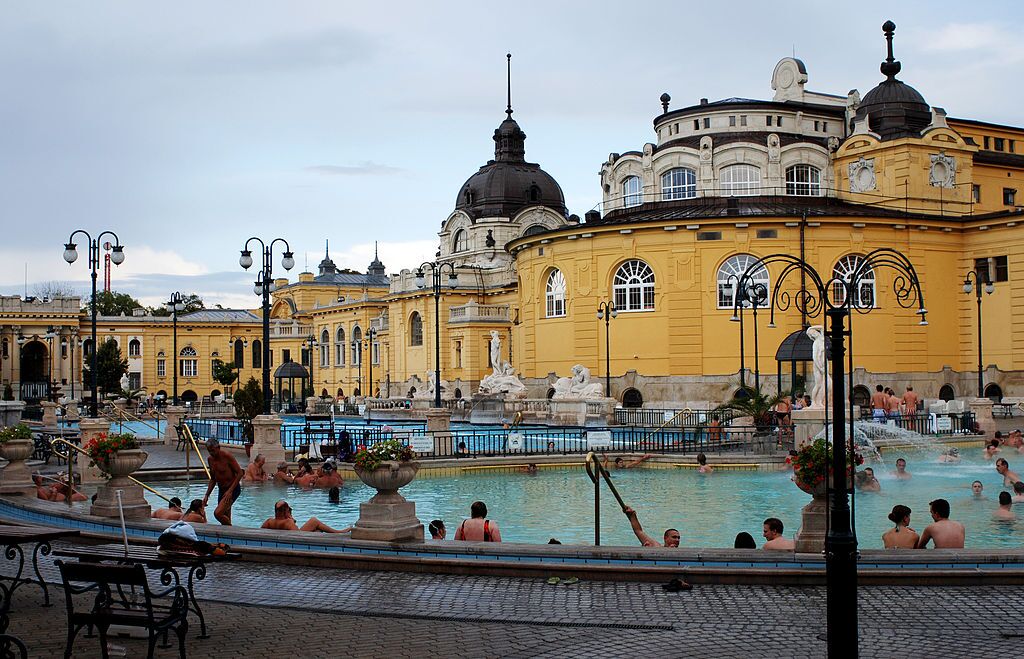
Steam rises from turquoise water into the cold January air, curling past the yellow Neo-Baroque columns like some theatrical fog machine set to “Budapest mood.” An elderly man in the corner plays chess on a floating board, completely unbothered by the tourist next to him attempting a selfie at an angle that says “I’m cultured and also European now.” Welcome to Széchenyi Thermal Bath, the 113-year-old spa complex that manages to be simultaneously a UNESCO-adjacent architectural marvel, a physiotherapy clinic, a social club for retired Hungarian gentlemen, and the most Instagrammed swimming pool in Central Europe.
Here’s the thing about Széchenyi in 2026: it’s more essential than ever. With Gellért Bath shutting its doors in October 2025 for a renovation that won’t wrap up until 2028, and Király Bath also closed, Széchenyi has gone from “the most popular bath” to “basically the only major historic bath tourists can visit.” The queues have gotten longer. The chess players remain unbothered. And this guide exists to make sure you navigate all of it like someone who actually knows what they’re doing.
This is everything you need to know about visiting Széchenyi Bath in 2026 — from verified prices and pool temperatures to timing tricks and the best post-soak meal within walking distance. No fluff, no recycled information from 2019, and absolutely no suggestion to “just go with the flow.”

Why Széchenyi Bath Matters More Than Ever in 2026
Széchenyi Thermal Bath is now Budapest’s undisputed top thermal bath destination following the closure of Gellért Bath in October 2025 for renovation until 2028 and Király Bath’s simultaneous closure. With 18 pools across 6,220 square meters and a new 14+ age restriction since August 2025, it operates as the city’s largest and most accessible historic spa for international visitors.
If you’d asked any Budapest local in 2024 which bath tourists should visit, you’d have gotten a split vote between Széchenyi and Gellért. Gellért had the Art Nouveau glamour, the wave pool, and the Buda-side mystique. Széchenyi had the outdoor chess players, the City Park location, and the sheer scale that makes you feel like you’ve accidentally wandered into a Roman emperor’s personal wellness retreat.
That debate is now settled — not by preference, but by construction scaffolding. Gellért’s extensive renovation means it won’t reopen until 2028 at the earliest, and Király Bath on the Buda side is similarly wrapped in renovation fencing. For the next two to three years, Széchenyi stands essentially alone as Budapest’s grand thermal bath experience for tourists.
What does this mean for your visit? Expect larger crowds, particularly from mid-morning through early afternoon. The bath management has been adjusting — they’ve added more staffing and improved the digital ticketing system — but the fundamental reality is that more people are funneling into one location. This makes timing your visit absolutely critical, something we’ll cover in detail below.
One other major change: since August 1, 2025, Széchenyi Bath enforces a strict 14+ age restriction. No exceptions, no workarounds. If you’re traveling to Budapest with younger children and had thermal baths on the itinerary, you’ll need to look at alternatives like Palatinus on Margaret Island (summer only) or Dagály Aquapark for family-friendly swimming.
Arriving at the Yellow Palace: What First-Timers Actually Experience
Széchenyi Thermal Bath sits in Budapest’s City Park (Városliget) at Állatkerti krt. 9-11, District XIV. Built in 1913 in Neo-Baroque style, the iconic yellow building spans over 6,220 square meters. The M1 Metro (Yellow Line) stops at Széchenyi fürdő station, placing you a 90-second walk from the main entrance.
You’ll see the building before you fully comprehend it. The sunshine-yellow facade stretches wide, its columns and arched windows designed by architect Győző Czigler to make you feel like you’re about to enter a palace rather than a place where strangers soak in hot mineral water together. The Neo-Baroque exterior has that particular kind of grandeur that Budapest does better than almost any European city — not sterile and renovated to within an inch of its life, but lived-in, slightly weathered, and radiating character from every ornamental detail.
There are two entry points, which confuses approximately 40% of first-time visitors. The main entrance faces Állatkerti körút (the street), while the secondary entrance opens toward City Park on the Kós Károly sétány side. If you’ve purchased a Fast Track online ticket, you’ll enter from the park-facing side. Regular tickets purchased at the cashier use the main street entrance. This is the kind of detail that saves you a fifteen-minute confused lap around a very large building.
Once inside, you’ll receive a waterproof wristband — a watch-like device that functions as your key to the turnstiles, your locker or cabin lock, and essentially your identity for the duration of your visit. Don’t take it off. Don’t lose it. If you do lose it, the replacement fee will remind you why people in Budapest lock things carefully.
The Three Outdoor Pools That Made Széchenyi World-Famous
Széchenyi’s three outdoor pools are the complex’s most photographed feature, offering a 38°C thermal pool, a 30-34°C activity pool with a whirlpool current, and a 26-28°C lap pool. The outdoor pools operate year-round and create the iconic steam-rising-over-yellow-architecture scene that has defined Budapest tourism photography since the invention of Instagram.
Walking out from the changing rooms into the outdoor courtyard is one of those travel moments that genuinely delivers on its promise. The courtyard opens up around you — a grand rectangle of yellow colonnades framing three distinct pools, each serving an entirely different purpose and attracting an entirely different crowd.
The 38°C thermal pool is the soul of Széchenyi, and it is exactly where you should start. This is the pool where legends are made and where the famous chess-playing retirees hold court. The water comes from the St. Stephen Well, a source drilled 1,246 meters deep into the earth, where it emerges at a scalding 76°C before being cooled to something your skin can actually tolerate. The mineral composition — calcium, magnesium, hydrogen carbonate, sulfates, and fluoride — gives the water a soft, slightly silky feel that’s distinctly different from ordinary heated pool water. In winter, with cold air hitting the 38°C surface, the steam billows dramatically. It’s genuinely magical. In summer, the pool is still wonderful, but expect shoulder-to-shoulder company because everyone and their travel blog has recommended this exact spot.
The activity pool, sitting at a more moderate 30-34°C, is where things get playful. Its signature feature is a powerful whirlpool current that grabs you and sends you spinning in a large circle with other laughing visitors. It is impossible to maintain any sense of adult dignity in this current. You will spin. You will laugh. The German tourist next to you will also laugh. It’s a shared human experience orchestrated by hydrodynamics, and it is peak Széchenyi.
The third outdoor pool is a serious 50-meter lap pool maintained at a cooler 26-28°C. This is the one pool in the entire complex where a swimming cap is mandatory — no cap, no swimming, no negotiation. If you forgot yours, caps are available for purchase inside. The lap pool attracts a mix of locals doing their daily exercise routine and tourists who feel guilty about the amount of lángos they consumed at the Central Market the previous day.

The Indoor Labyrinth: 15 Pools and 10 Saunas Most Visitors Never Fully Explore
Széchenyi’s indoor section contains 15 thermal pools ranging from 20°C to 40°C, plus 10 saunas and steam rooms including Finnish, Volcano, Aroma, and Salt Inhalation chambers. The maze-like layout, original to the 1913 design, connects multiple wings through corridors that even regular visitors occasionally navigate incorrectly.
Stepping from the outdoor courtyard into the indoor section of Széchenyi is like entering a different building entirely — one designed by someone who believed that logical floor plans were overrated. The layout is famously confusing, a network of corridors, arched doorways, and staircases that connect different wings of the complex in ways that defy spatial reasoning. My sincere advice: stop trying to understand the floor plan and start treating it as an exploration. Every wrong turn reveals another pool, another steam room, another corridor lined with tiles that have been here since the Austro-Hungarian Empire was still a going concern.
The indoor pools span a temperature range that allows for genuine contrast therapy — the local tradition of alternating between hot and cold water that leaves your skin tingling and your circulation performing at levels it hasn’t reached since your last cardio session. Start with something warm (the 36-38°C pools are numerous), then work your courage up to the plunge pool at a bracing 20°C. The sharp intake of breath when you submerge in cold water after soaking in heat is a sensation that redefines what your body considers “refreshing.” It’s a one-second experience of absolute clarity followed by the overwhelming desire to get back to the warm pool immediately.
Among the 10 saunas and steam rooms, the Finnish sauna offers intense dry heat, while the Volcano sauna takes things up another notch for those who believe suffering is a wellness strategy. The Aroma sauna provides a gentler experience with pleasant essential oil scents, and the Salt Inhalation steam cabin is genuinely beneficial for your airways — locals recovering from winter colds are frequent visitors. The indoor pools tend to be significantly less crowded than the outdoor ones, particularly during the tourist-heavy summer months. This is one of those rare cases where the less Instagrammable option is actually the better experience.
Medical-Grade Healing Waters and Proven Wellness Benefits
Széchenyi’s thermal waters are classified as medicinal by Hungarian authorities and recommended by doctors for degenerative joint diseases, chronic arthritis, herniated discs, osteoarthritis, and post-surgical rehabilitation. The mineral-rich water from the St. Stephen Well at 1,246 meters depth contains calcium, magnesium, sulfates, bicarbonates, fluoride, and metaboric acid.
This is the part where Széchenyi transcends its Instagram fame and reveals something genuinely meaningful. These aren’t just warm pools — they’re medically recognized therapeutic waters that Hungarian doctors actually prescribe. The concept is called balneotherapy, and while it might sound like something invented by a wellness influencer, it’s been practiced in Hungary for centuries and is backed by peer-reviewed clinical research.
Regular visitors come for relief from lower back pain, knee osteoarthritis, and chronic joint inflammation. Rehabilitation patients recovering from orthopedic surgeries use these pools as part of their prescribed recovery program. The water isn’t just warm — its specific mineral composition interacts with your body in ways that regular heated water simply doesn’t. The calcium and magnesium content supports muscle relaxation, the sulfates contribute anti-inflammatory properties, and the hydrogen carbonate helps with skin conditions.
There’s also something most tourists don’t know about: the thermal drinking water available on-site. Széchenyi has designated drinking fountains where you can consume the mineral water directly. It’s prescribed for chronic gastritis, digestive tract inflammation, kidney and bile duct conditions, and metabolic disturbances. The taste is… distinctive. Think of it as “eau de geological formation” — not something you’d order at a bar, but something your gastroenterologist might approve of. The elderly locals who line up at these fountains each morning aren’t doing it for the flavor; they’re doing it because decades of experience have taught them it works.
Current Széchenyi Bath Prices and Ticket Options for 2026
Széchenyi Bath’s 2026 standard entry costs 13,200 HUF (~$34) for a weekday locker ticket and 14,800 HUF (~$38) for weekends. Cabin tickets add 1,000 HUF. Good Morning tickets (check-in before 9 AM) start at 10,500 HUF (~$27). Fast Track online tickets cost 15,200 HUF (~$39). All prices verified January 2026 from the official szechenyibath.com website.
Let’s talk money. Széchenyi has a tiered pricing system that rewards early risers and weekday visitors, while charging a reasonable premium for weekend and skip-the-line convenience. Here’s the full breakdown, with everything you might spend at the bath laid out clearly so there are no surprises when you’re standing at the cashier in your street clothes wondering why there are seven different ticket options.
| Ticket / Service | Weekday (Mon-Thu) | Weekend (Fri-Sun) | Approx. USD | Notes |
|---|---|---|---|---|
| Full Day — Locker | 13,200 HUF | 14,800 HUF | ~$34 / ~$38 | Standard at-the-door price |
| Full Day — Cabin | 14,200 HUF | 15,800 HUF | ~$36 / ~$41 | Private changing cubicle. Worth every forint. |
| Good Morning — Locker | 10,500 HUF (Mon-Thu) | 11,800 HUF (Fri only) | ~$27 / ~$30 | Check in before 9 AM. At cashier only. |
| Good Morning — Cabin | 11,500 HUF (Mon-Thu) | 12,800 HUF (Fri only) | ~$30 / ~$33 | Best value in the entire bath system. |
| Fast Track — Locker | 15,200 HUF | ~$39 | Skip the queue. Buy online. | |
| Fast Track — Cabin | 16,200 HUF | ~$42 | The premium no-hassle option. | |
| Cabin Upgrade | 1,000 HUF | ~$3 | If you bought locker, upgrade at entry. | |
| 20-min Massage | 11,800 HUF | ~$30 | Book online in advance. Bath ticket required separately. | |
| 45-min Massage | 19,000 HUF | ~$49 | Aroma or Refreshing options available. | |
| Towel (purchase only) | From 6,900 HUF | ~$18 | No rental. Bring your own or buy a Széchenyi-branded one. | |
| Swimwear (purchase) | 6,300 HUF | ~$16 | Emergency option. Style not guaranteed. | |
| Sparty Bath Party (Sat) | From €59 | ~$64 | Saturday nights 9:30 PM – 2 AM. | |
Prices verified: January 2026 from szechenyibath.com. Prices may increase throughout the year. USD conversions are approximate at ~390 HUF/$1.
A note on the online versus cashier price gap: buying a Fast Track ticket online through the official site costs more than the standard cashier price, but it includes queue-skipping privileges. During peak season (June through September) and on weekends year-round, the Fast Track premium pays for itself in saved time and reduced frustration. During quiet weekday mornings in the off-season, save your money and buy at the door.
One final money tip: the Budapest Card gives you a 20% discount on standard entry prices at the cashier — but only at the cashier, not online. If you already have a Budapest Card for your Budapest itinerary, this makes the weekday locker price drop to around 10,560 HUF, which is extremely competitive. More on whether the Budapest Card is worth it in our comprehensive cost analysis.
The Timing Strategy That Separates Great Visits From Mediocre Ones
The optimal time to visit Széchenyi Bath is weekday mornings before 9 AM using the Good Morning ticket (10,500 HUF), or weekday evenings after 4 PM when crowds thin significantly. Summer weekends between 10 AM and 3 PM represent peak crowds. Winter visits offer the most atmospheric experience with the lightest attendance.
Timing is the single most important variable in your Széchenyi experience, and it’s the one thing most guides handwave with “try to go early.” So let me be specific: arriving at 7:00 AM on a Tuesday in November and arriving at 11:30 AM on a Saturday in July are two categorically different experiences at the same physical location. One involves meditative soaking in near-solitude; the other involves negotiating for space in warm water with what feels like the entire population of a mid-sized European city.
The Good Morning ticket — valid if you check in before 9 AM — represents the sweet spot of value and experience. At 10,500 HUF for a weekday locker (compared to 13,200 HUF for the standard ticket), you save 2,700 HUF and get the pools at their most peaceful. The outdoor thermal pool at 7:30 AM, with morning light hitting the yellow facade and steam forming clouds above the water, is the Széchenyi that travel photographers dream about. By 10 AM, that same pool will have an entirely different energy — louder, more crowded, and with a much higher ratio of waterproof phone cases to actual relaxation.
Seasonal considerations matter too. Budapest locals overwhelmingly agree that winter is the most atmospheric time for the outdoor pools. The contrast between cold air (sometimes below freezing) and 38°C water creates billowing steam that makes the entire courtyard look like a scene from a period drama with better special effects. The downside: walking from the changing rooms to the outdoor pool in cold weather requires a brief sprint of genuine discomfort. Your feet will be cold. Your body will protest. And then you’ll sink into the water and understand why people have been doing this for over a century.
Summer brings longer hours, warmer approaches to the pool, and substantially heavier crowds. If you must visit on a summer weekend, aim for either the first hour of opening or the last two hours before closing, when day-trippers have largely departed and the evening light softens everything beautifully.
Essential Preparation and the Locker-vs-Cabin Decision
Visitors must bring swimwear and waterproof sandals (mandatory hygiene rule). Towel rental is not available — bring your own or purchase one for 6,900 HUF. The cabin upgrade (1,000 HUF over locker price) provides a private changing cubicle and is strongly recommended for anyone carrying bags, traveling as a couple, or preferring privacy.
The single most common regret among first-time Széchenyi visitors? Not springing for the cabin. The price difference is just 1,000 HUF — roughly $3 — yet the experience difference is enormous. With a locker, you change in a communal area that offers approximately the same level of privacy as a packed subway car. The lockers themselves are fine, reasonably spacious, and secured by your wristband. But the changing situation ranges from “slightly awkward” to “I’m now making eye contact with a stranger while hopping on one leg trying to remove wet swimwear.”
A cabin gives you a small private cubicle. It’s not spacious — don’t expect a luxury changing room — but it’s yours, it locks with your wristband, and it transforms the beginning and end of your visit from a logistical challenge into a calm, private experience. If you’re traveling with a partner, you can technically share a cabin, though “share” is generous for the available space. Two people of average European dimensions will manage, but there will be elbow negotiations.
For your packing list: swimwear is absolutely non-negotiable (this is not a nude bath, despite what one Reddit user discovered when accidentally entering a designated swimwear-free steam room). Waterproof sandals or flip-flops are mandatory for hygiene — the bath enforces this. A towel is essential since rental services are suspended; bring your own or resign yourself to purchasing a Széchenyi-branded towel for 6,900 HUF, which at least gives you a souvenir that’s more useful than a fridge magnet. A reusable water bottle is highly recommended because thermal bathing dehydrates you faster than you’d expect. And if you plan to use the lap pool, bring a swimming cap or buy one on-site.
Optional but smart additions: a waterproof phone case (the outdoor pools demand photography), a bathrobe for winter visits (the walk between indoor and outdoor areas is cold), and a good book. There’s something deeply civilized about reading a paperback while soaking in 113-year-old medicinal water. Several locals I know consider this the actual purpose of the entire complex.

Where to Eat and Drink Before, During, and After Your Soak
Széchenyi’s on-site cafeteria serves functional but overpriced food best avoided for anything beyond emergency snacking. The bath’s City Park (Városliget) location places you within walking distance of excellent restaurants including Városliget Café for classic Hungarian fine dining, Robinson for a lakeside splurge, and Pántlika for casual craft beer and burgers.
Let’s address the on-site food situation with the diplomatic candor it deserves: the self-service cafeteria inside Széchenyi exists, and that is the most positive thing that can be said about it. It serves greasy sausages, passable burgers, and beverages at prices that assume you’re a captive audience, which, to be fair, you are — you’re in a swimsuit and your street clothes are locked three corridors and two stairwells away. If you’re genuinely about to faint from hunger, it will prevent that outcome. As a dining experience, it falls somewhere between a motorway service station and a hospital canteen, without the charm of either.
The far better strategy is to plan your meal around the excellent restaurants in and around City Park. This is one of Széchenyi’s underappreciated advantages — the bath sits in one of Budapest’s most restaurant-rich park areas.
Városliget Café (varosligetcafe.hu) occupies the historic City Park Ice Rink building and delivers Belle Époque elegance with views of Vajdahunyad Castle across the lake. The classic Hungarian dishes here are genuinely excellent — think perfectly executed traditional Hungarian cuisine in a setting that matches the grandeur of the bath you just left. Perfect for a more refined post-soak meal or a romantic lunch.
Robinson Restaurant (robinsonrestaurant.hu) sits on its own small island on the park’s lake and has been a Budapest institution for decades. It’s a high-end steakhouse that has served everyone from Arnold Schwarzenegger to David Bowie — the kind of place where you celebrate something, or where you convince yourself that “I survived the 20°C plunge pool” counts as something worth celebrating. Reservations recommended.
Pántlika (reservours.com) is the laid-back counterpoint — excellent burgers, a solid craft beer selection, and a retro-futuristic architectural vibe that attracts as many locals as tourists. This is the spot for a casual post-bath bite where you sit with slightly damp hair and a deep sense of physical contentment, reviewing your photos and deciding which one makes the outdoor pool look most like the cover of a travel magazine.
There’s also a Beer Spa experience inside the bath complex — 45 minutes soaking in a wooden tub filled with thermal water infused with malt, hops, and yeast extracts, with an unlimited beer tap next to your tub. It’s a novelty experience, fun to try once, and currently priced at €111 including a full-day bath ticket and cabin. Whether unlimited beer while sitting in beer-infused water counts as “drinking responsibly” is a philosophical question the Beer Spa declines to answer.
Sparty: Budapest’s Legendary Saturday Night Pool Party
Sparty (the Széchenyi Bath Party) transforms the thermal bath into a nightclub every Saturday from 9:30 PM to 2 AM, February through December. Tickets start from €59 and include DJ sets, light shows, and access to the outdoor pools. The event attracts over 50,000 visitors annually, making it Hungary’s fifth-largest event series.
If you’ve been to a nightclub and thought “this is great, but what if everyone was in swimwear and the dance floor was a thermal pool,” then Sparty has been waiting for you. Every Saturday night, Széchenyi undergoes a remarkable transformation. The daytime chess players and therapeutic soakers vanish, replaced by a sound system, professional DJs, elaborate light installations, and a crowd that has decided a 113-year-old Neo-Baroque bath complex is the ideal venue for a pool party.
The event runs from 9:30 PM to 2:00 AM. Tickets start at €59 and should be purchased in advance from the official Sparty page, as popular dates sell out. The experience includes access to the outdoor pools (the indoor sections are typically closed during parties), bars serving cocktails and beer, and what can only be described as a nightlife experience that is impossible to replicate anywhere else on Earth.
A word of practical wisdom: Sparty is not for everyone. If your ideal thermal bath experience involves meditative silence and the gentle sound of water, Saturday night is categorically not your night. But if the idea of dancing in warm mineral water under a light show projected onto century-old architecture sounds like exactly your kind of absurd and wonderful, then this is one of Budapest’s most unique nightlife experiences. Note that Sparty is strictly on Saturdays only — weeknight visitors looking for nightlife should explore Budapest’s famous ruin bars instead.
A Full Day in Városliget: Attractions Worth Combining With Your Bath Visit
Széchenyi Bath sits in Budapest’s Városliget (City Park), home to Heroes’ Square (UNESCO), Vajdahunyad Castle, the Museum of Fine Arts, the House of Music Hungary, and Budapest Zoo. The M1 Metro connects City Park to the city center in 8 minutes, making it easy to combine a bath visit with major attractions.
Széchenyi’s location in Városliget means your bath visit naturally slots into a full day of exploration that would cost you a separate trip to reach from any other starting point. The park has been undergoing a massive revitalization project, and the concentration of world-class attractions here is genuinely impressive.
Start at Hősök tere (Heroes’ Square), the UNESCO World Heritage site that serves as the park’s grand entrance. The colonnades feature statues of Hungarian kings and national leaders, with the Archangel Gabriel towering above the central column. It’s one of those public spaces that was explicitly designed to make you feel the weight of history, and it succeeds. The Museum of Fine Arts flanks one side, housing an extraordinary collection of European art from Egyptian antiquities to Raphael and El Greco.
Deeper into the park, Vajdahunyad Castle is the architectural fever dream you didn’t know Budapest had — a fantastical complex combining Romanesque, Gothic, Renaissance, and Baroque elements from buildings across Hungary into one impossibly romantic structure reflected in the park’s lake. In winter, the lake becomes an ice rink. In summer, it’s surrounded by rented rowing boats and people eating ice cream with the focused determination that summer in Budapest demands.
The House of Music Hungary, designed by Sou Fujimoto, is one of Budapest’s newest architectural landmarks. Its undulating, perforated roof dissolves the boundary between building and park in a way that makes you stop and stare even before you go inside. The museum itself is an immersive journey through the history of music, and it’s worth visiting even if your musical knowledge stops at “that one Liszt piece from the piano scene.”
For the practical route: walk Andrássy Avenue from the city center to Heroes’ Square (a UNESCO-listed boulevard that takes about 40 minutes on foot), explore the square, wander through the park to the bath, soak for 2-4 hours, then finish with dinner at one of the park restaurants mentioned above. It’s a perfect Budapest day that combines culture, architecture, wellness, and food — essentially everything this city does brilliantly.
Ideal Visitors and When to Consider Alternatives
Széchenyi Bath is ideal for couples, solo travelers, friend groups, and anyone seeking Budapest’s quintessential thermal bath experience. It is not suitable for children under 14 (entry prohibited since August 2025), visitors seeking a quiet luxury spa atmosphere, or those uncomfortable with communal bathing environments.
Széchenyi is the right choice for the vast majority of Budapest visitors. It’s the thermal bath experience that defines the city — the architecture, the outdoor pools, the cultural immersion of bathing alongside locals, and the sheer variety of pools and saunas that keeps a 3-hour visit from ever feeling repetitive. Solo travelers will feel completely at home (many locals visit alone), couples will find romance in the steam and the surroundings, and friend groups will discover that the activity pool whirlpool is an excellent equalizer of all social pretensions.
That said, Széchenyi is not for everyone, and there’s no point pretending otherwise. If you’re traveling with children under 14, the strict age restriction means you’ll need to look at alternative bathing options. Palatinus on Margaret Island is the best family-friendly option in summer, and Dagály Aquapark operates year-round with proper children’s facilities.
If you’re expecting a sleek, modern wellness center with minimalist design and cucumber water at reception, Széchenyi will confuse you. This is a century-old public bath complex. The beauty is in the architecture and the tradition, not in contemporary spa aesthetics. For a more modern thermal experience, consider Lukács Bath, which offers a more local, less tourist-heavy atmosphere and was recently renovated.
And if you have severe mobility challenges, it’s worth noting that while Széchenyi has made accessibility improvements, the 1913 building’s multi-level layout with stairs between sections can present challenges. Contact the bath directly before your visit to discuss specific accessibility needs.
The Imperfections That Add Character (and the Ones That Don’t)
Széchenyi’s main challenges include peak-season overcrowding (especially the outdoor pools from 10 AM–3 PM on summer weekends), a confusing indoor layout with poor signage, the dated on-site cafeteria, and some worn interior surfaces reflecting the building’s 113 years. None of these diminish the core experience, but managing expectations improves enjoyment.
No guide worth reading skips the rough edges, so here they are. The most significant issue is crowding. On a sunny Saturday in July, the outdoor thermal pool can feel less like a therapeutic soak and more like a very warm music festival with no music. This isn’t a design flaw — it’s a popularity problem amplified by the Gellért and Király closures. The mitigation strategy is timing (early morning, late afternoon, or weekday visits), but if your only option is a summer weekend midday, calibrate your expectations accordingly.
The indoor layout’s confusing navigation, charming in concept, becomes genuinely frustrating when you’re trying to find your way back to your cabin after exploring the interior for two hours. Signage exists but tends toward the minimally helpful. First-time visitors regularly report feeling turned around. The pragmatic solution: note your cabin number, pay attention to the wing (there are separate wings for men’s and women’s changing areas), and accept that one or two wrong turns are part of the authentic experience.
Some interior areas show their age in ways that go beyond “charming patina.” Certain tile work is worn, some corridors feel more institutional than palatial, and the gap between the building’s magnificent exterior promise and some of its interior reality can surprise visitors accustomed to modern spa standards. Online reviewers have compared certain indoor sections to “an old sports centre,” which is ungenerous but not entirely wrong. The key is understanding what you’re visiting: a living historical monument, not a newly built wellness resort. The imperfections are part of its century-old soul, and once you accept that framing, they become details rather than disappointments.
Local Insider Tips That Actually Help
Budapest locals save money by visiting weekday mornings with the Good Morning ticket, bring their own towels and flip-flops, head straight to the indoor pools to avoid crowds, and always choose a cabin. The wristband system means you need no cash or phone poolside — everything is tied to your band.
After dozens of visits and conversations with fellow Széchenyi regulars, here are the tips that genuinely make a difference rather than the recycled advice you’ll find on every generic travel blog.
First: head indoors before you go outdoors. The natural tourist instinct is to rush to the famous outdoor pools, which means the indoor section is significantly quieter during the first two hours after opening. Explore the indoor labyrinth first, try the contrast therapy between hot and cold pools, hit the saunas, and then move to the outdoor courtyard once you’ve had your fill. By the time you reach the outdoor pools, the initial rush has settled and you’ll have a better experience.
Second: the wristband system means you need nothing poolside — no wallet, no phone, no room key. Use this freedom. Leave everything in your cabin and simply exist in the water without the usual accessories of modern life. It’s surprisingly liberating, and it’s one of the reasons locals value their bath visits as genuine mental health breaks rather than just physical ones.
Third: if you’re visiting in winter, wear a bathrobe between the indoor and outdoor areas. The walk is short but exposed, and the temperature difference between a warm interior and a potentially freezing exterior in December is no joke. Many locals bring a robe specifically for this transition. Your towel works too, but a robe is warmer and more dignified than the “wet towel wrapped around shoulders while speed-walking” approach that tourists tend to adopt.
Fourth: the drinking fountains dispensing thermal mineral water are located near some of the indoor pools. Locals drink this water for digestive health. It tastes like the earth it came from — minerally, warm, and distinctly medicinal. Try a small cup. If nothing else, it’s a story, and it’s free in a city where very little else is.
Fifth: massage appointments sell out quickly, especially on weekends. If a massage is part of your plan, book it online at least 48 hours in advance. Walk-in availability is rare and hoping for a spot is a strategy that rarely rewards optimism. Massages are for ages 18+ only and require a separate bath ticket.
Széchenyi Bath at a Glance
| Address | Állatkerti krt. 9-11, 1146 Budapest (District XIV) |
| Hours | Daily 6:00 AM – 10:00 PM (indoor pools close 8:00 PM, saunas 9:00 PM) |
| Entry (2026) | From 10,500 HUF (~$27) Good Morning to 16,200 HUF (~$42) Fast Track cabin |
| Age restriction | 14+ only (enforced since August 2025) |
| Getting there | M1 Metro (Yellow Line) to Széchenyi fürdő station — 90-second walk |
| Time needed | 2–4 hours (3 hours ideal for full exploration) |
| Book ahead? | Recommended for weekends, essential for Sparty and massages |
| Official site | szechenyibath.com |
Last verified: January 2026
The Final Verdict on Budapest’s Greatest Bath
Széchenyi Thermal Bath remains Budapest’s single most essential experience in 2026, combining 113 years of history, medically recognized healing waters, and architectural grandeur that no other European spa matches. At 13,200 HUF (~$34) for standard weekday entry, it offers extraordinary value for an experience that will likely become your trip’s highlight.
Széchenyi is not a perfect place. The food is forgettable, some corners show their age, and on crowded days the “wellness” component gives way to “we’re all just warm and slightly squished together.” But here’s the thing: perfection was never the point. Széchenyi is a place where a century of Budapest life has soaked into the walls — where generations of locals have come to heal aching joints, debate politics in warm water, play chess on floating boards, and simply exist in a way that modern life rarely allows.
What makes it extraordinary isn’t any single pool, sauna, or architectural detail. It’s the totality: the sensory experience of hot mineral water in cold air, the sound of multiple languages echoing off Neo-Baroque walls, the sight of steam rising past yellow columns into the sky. It’s the kind of place that makes you understand why Budapestians consider thermal bathing not a luxury but a fundamental part of civilized life.
Go early, bring a towel, spring for the cabin, explore the indoor pools that everyone walks past, and leave time for dinner in City Park afterward. Your body will thank you. Your Instagram followers will be impressed. And somewhere in the 38°C thermal pool, an elderly Hungarian man will glance up from his chess game, nod in your general direction, and return to his match — completely unbothered, as always.
Frequently Asked Questions About Széchenyi Bath
How much does Széchenyi Bath cost in 2026?
Standard weekday entry with a locker costs 13,200 HUF (~$34) at the cashier in 2026. Weekend locker tickets are 14,800 HUF (~$38). Cabin tickets add 1,000 HUF to either option. The best value is the Good Morning ticket at 10,500 HUF (~$27) for weekday locker entry before 9 AM. Fast Track online tickets with queue-skipping start at 15,200 HUF (~$39).
Are children allowed at Széchenyi Bath in 2026?
No. Since August 1, 2025, Széchenyi Bath enforces a strict 14+ age restriction with no exceptions. The high mineral content and temperature of the thermal waters are not recommended for younger visitors. Families with children under 14 should visit Palatinus Strand on Margaret Island (summer) or Dagály Aquapark as alternatives with dedicated children’s facilities.
Do I need to bring a towel to Széchenyi Bath?
Yes, bringing your own towel is strongly recommended. Towel rental is not available at Széchenyi Bath. If you forget, you can purchase a Széchenyi-branded towel on-site for 6,900 HUF (~$18), which doubles as a souvenir. You also need to bring swimwear (no nudity) and waterproof sandals or flip-flops, which are mandatory for hygiene reasons.
Is a swimming cap required at Széchenyi Bath?
A swimming cap is only required for the 50-meter outdoor lap pool. You can freely use all 17 other thermal and activity pools — both indoor and outdoor — without a cap. If you plan to swim laps and don’t have a cap, they’re available for purchase on-site.
What happened to Gellért Bath? Is Széchenyi the best alternative?
Gellért Thermal Bath closed in October 2025 for a comprehensive renovation and is not expected to reopen until 2028. Király Bath is also currently closed. Széchenyi is now Budapest’s primary historic thermal bath for tourists and offers the largest pool complex in the city. For a less crowded alternative, Lukács Bath on the Buda side is excellent and popular with locals.
How long should I spend at Széchenyi Bath?
Plan for 2-4 hours. Three hours is the sweet spot that allows you to explore the outdoor pools, venture through the indoor labyrinth, try at least two saunas, and still have energy for the walk to dinner. Under 90 minutes feels rushed, and over 4 hours can leave you feeling dehydrated and overly pruned. If you’ve booked a massage or plan to try the Beer Spa, add an extra hour.
Is the Széchenyi Bath Party (Sparty) worth it?
Sparty is a unique nightlife experience unlike anything else in Europe — a pool party in a Neo-Baroque thermal bath with DJs and light shows every Saturday night from 9:30 PM to 2 AM (February through December). Tickets start from €59. It’s absolutely worth it if you enjoy nightlife and novelty experiences. Skip it if you prefer the traditional, peaceful bath atmosphere. Sparty is loud, crowded, and gloriously bizarre.
Contact & Booking
Széchenyi Thermal Bath
📍 Állatkerti körút 9-11, 1146 Budapest
📞 +36 1 363 3210 (general) | +36 1 452 4569 (customer service)
✉️ info@budapestspas.hu
🌐 szechenyifurdo.hu

