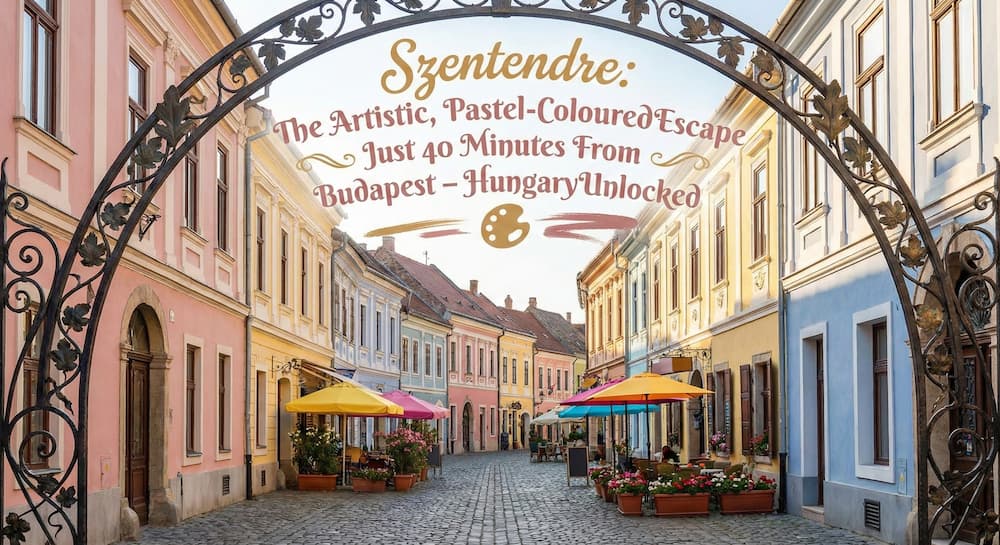
But here is the twist, and the reason I am writing this massive guide: despite the crowds, despite the souvenir magnets that cost more than a decent bottle of wine, and despite the occasional feeling that you’ve walked into a Disney set designed by a Baroque architect with a fondness for ochre paint, you absolutely must go.
Why? Because underneath the thick layer of tourism varnish lies a town with a history so weird and a vibe so distinct that it genuinely feels like you’ve left Hungary entirely. It doesn’t look like the rest of the country. It smells like roasted paprika, Danube river mud, and damp cellar galleries. It sounds like church bells—seven of them, to be exact, ringing in a chaotic harmony that reminds you of the Serbian refugees who built this place centuries ago.
I’ve been to Szentendre a hundred times. I went on mandatory school trips where we were forced to look at ceramics until we cried. I went on dates where we tried to look sophisticated in art galleries we didn’t understand. I’ve taken cynical American friends there who wanted “authentic culture,” and I’ve gone alone just to eat a lángos that was so greasy it could lubricate a tank engine. This isn’t a generic listicle written by someone who spent two hours there and took a selfie with a marzipan Michael Jackson. This is the HungaryUnlocked deep dive. I’m going to tell you how to dodge the tourist traps, where the locals actually drink their fröccs (wine spritzer), and how to survive the public transport system without getting fined into oblivion by ticket inspectors who can smell fear.
The Great Migration: Getting There Without Losing Your Mind
Most guidebooks will breezily tell you, “It’s just 40 minutes from Budapest!” They conveniently leave out the part where those forty minutes can be a delightful scenic journey or a sweat-drenched nightmare depending entirely on your choices and your ability to navigate the labyrinthine logic of Hungarian ticketing systems.
The HÉV Experience (The Green Caterpillar)
This is how 90% of people get there, and honestly, it is the most authentic way to do it. You will be taking the H5 Suburban Railway.

The HÉV (Helyiérdekű Vasút) is not a modern European train. Do not expect the silent glide of a Swiss rail car. The HÉV is a green, rattling time capsule from the socialist era. It is loud. It is bouncy. The seats are a unique shade of brown that hides a multitude of sins. In the summer, the air conditioning is usually a system I like to call “open all the windows and pray for a breeze while the train screams through the tunnel.” But it is reliable, it is frequent, and it is incredibly cheap.
Your journey starts at Batthyány tér, on the Buda side, right directly opposite the Parliament. You’ll go underground to the HÉV platform. You cannot miss the trains; they are unmistakably green and look like they have seen things.
The Trap (Please Read This): Here is where tourists get destroyed, and I want to save you the 12,000 HUF fine. Your standard Budapest travel pass (or single ticket) is only valid until the city border. The stop is called Békásmegyer. Szentendre is outside Budapest. If you stay on the train past Békásmegyer without the extension ticket, the inspectors—who are notorious for having zero sense of humor—will fine you. They do not care that you are a confused tourist. They will fine you.
If you have a Budapest Pass or Travelcard, you need to buy a Suburban Railway Extension Ticket (Kiegészítő jegy) from Békásmegyer to Szentendre. You buy this at the purple BKK machines at Batthyány tér before you board. Select “Szentendre” as your destination and “Békásmegyer” as your start point if you have a pass. If you have nothing, you need two tickets: a standard BKK single ticket for the Budapest section, and the extension ticket for the outside section.
The Journey Narrative: You roll out of the tunnel at Batthyány tér. You rattle past the Margaret Bridge, giving you a fleeting view of the island. You pass the Roman ruins of Aquincum—look left, and you’ll see ancient pillars standing awkwardly next to a busy road. You pass the concrete jungle of Békásmegyer, which looks like a dystopian sci-fi set. Then, the scenery changes. Trees appear. The Danube glimmers on your right. The air gets a little cleaner. You arrive at the Szentendre terminus about 40 minutes later.
Official Schedule and Info – click here https://bkk.hu/en/timetables/
The Boat Option (The Romantic/Expensive Route)
If you have cash to burn and want to feel like a 19th-century aristocrat (or just avoid the rattle of the train), you can take the boat. The main operator is Mahart PassNave.
This is a slower, more deliberate way to travel. You cruise up the Danube Bend, fighting the current, which means the trip there takes about 1.5 hours. The return trip is faster because you are going with the flow. The boat usually departs from Vigadó tér on the Pest side.
The Reality Check: It is scenic, absolutely. You see the Parliament from the water, you see the bridges, and you see the transition from city to nature. But it is pricey compared to the train, and it only runs during the “season” (typically May to September/October, though they sometimes have Advent cruises in winter). Also, on a hot day, if you don’t get a seat on the open deck, you are stuck inside a cabin that can get stuffy. My advice? Take the boat to Szentendre in the morning when you have energy and romantic notions. Take the HÉV back when you are tired, sweaty, and just want to get to your hotel bed as fast as humanly possible.
Official Boat Schedule – click here https://mahartpassnave.hu/en/

Insider Narrative: The Arrival and The Walk In
You get off the HÉV. You look around. You are confused. You are not in a cute village. You are in a concrete transport hub that smells faintly of diesel, stale beer, and lángos grease. There is a busy four-lane road (Route 11) screaming with traffic in front of you. Do not panic. This is the test.
To get to the pretty part, you have to walk through a subterranean underpass that goes beneath the road. It’s a rite of passage. You emerge on the other side, walk past a few dubious-looking shops selling cheap clothes, and then, you reach the Bükkös Brook (Bükkös-patak).
This little stream is the borderline. It is usually lined with ducks who look like they’ve been fed too much pastry and have given up on migrating anywhere. Once you cross the small bridge over this stream, the architecture changes instantly. The brutalist blocks vanish. The houses become small, colorful, and impossibly close together. The ground turns to cobblestone that will punish you if you wore high heels (seriously, do not wear high heels).
The “Mediterranean” Atmosphere: Hungarians love to call Szentendre “Mediterranean.” Is it? Well, technically we are in Central Europe, and the winters here are brutal. But the history here is Serbian. In the late 1600s, thousands of Serbs fled the Ottoman Empire and settled here, invited by the Habsburgs. They brought their architecture, their red-tiled roofs, their icon-heavy churches, and their narrow, winding alleyways designed to confuse the wind.
The light hits differently here. The walls are painted in ochre, terracotta, sunshine yellow, and deep oxblood red. It feels like a movie set, but people actually live here—mostly up the hill, as the center is almost entirely shops and galleries now. You smell the river water, mixed with the scent of roasting coffee from the dozen cafes, and occasionally the sharp tang of paprika from the souvenir shops.

Detailed Guide: What to Actually Do (Beyond Buying Magnets)
1. Fő Tér (Main Square): The Center of the Universe
You cannot miss it. All roads lead here. In the center stands the Plague Cross (built in 1763 by the Merchant’s Guild to give thanks that the plague avoided the town). It’s ironic, considering the square is now usually plagued by tour groups following someone holding a folded umbrella.
What to do: Stand in the middle. Spin 360 degrees. Take the photo. The architecture is stunning—Baroque merchant houses leaning against each other like drunk friends. What NOT to do: Do not eat at the restaurants directly on the square unless you enjoy paying double for Goulash that was likely microwaved. The view is free; the food markup is astronomical.
2. The Umbrella Street (Bercsényi utca)
If you have Instagram, you know this street. It is a narrow alleyway covered in floating, colorful umbrellas suspended from wires. The Reality: It is pretty. It is also usually packed with people doing peace signs and “candid” walking poses. Insider Tip: Go early (before 10:00 AM) if you want a photo without a stranger’s selfie stick in your ear. It’s located near the main square; just follow the crowd of teenagers holding iPhones.

3. Church Hill (Templom tér): The Best Free View
Find the narrow stairs leading up from the Main Square (look for the lane next to the lángos shop). Climb them. You’ll emerge at the Catholic Church of St. John the Baptist. This is the highest point in the immediate center.
The View: This is the best free view in town. You look down over the red-tiled roofs, the other church towers, and the sweep of the Danube. It feels ancient up here. The Vibe: It’s usually quieter here than the main square. There’s often a small market of local artisans selling paintings and handmade jewelry—often higher quality than the mass-produced junk in the main shops.

4. The Museum Marathon
Szentendre is the “Town of Painters.” In the 20th century, artists flocked here for the light. Now, it boasts more museums per capita than arguably anywhere else in the country.
The Big One: Kovács Margit Ceramic Museum If you see one art museum, make it this one. Margit Kovács was a genius ceramicist. Her work is weird, elongated, emotional, and very Hungarian. It’s not just “pots.” It’s figures of mourning women, folklore scenes, and haunting faces. The building itself is an old 18th-century salt house. Tickets: ~3,000 HUF. Why go: It’s the most “legitimate” art experience in town.
The Sweet One: Szamos Marzipan Museum Let’s be honest, this is a tourist trap, but it is a delicious one. The Reality: You walk through glass cases containing a life-sized Michael Jackson made of marzipan, a Parliament building made of sugar, and various Disney characters that look slightly terrifying in almond paste form. The Smell: The air smells like almond extract and sugar. It is intoxicating. The Shop: You will buy marzipan at the end. Resistance is futile. Try the orange-chocolate coated marzipan; it changes lives. Open: Daily 10:00 – 18:00.

The Tiny One: Micro Art Museum (Mikro Csodák Múzeuma) What is it: Art so small you need a microscope to see it. We are talking about a chessboard on the head of a pin, or a camel in the eye of a needle. My Verdict: It sounds gimmicky, but it’s actually mind-blowing. The artist, Mykola Syadristy, had to time his brushstrokes between his heartbeats to avoid his hand shaking. The sheer patience required to make these things makes me anxious just thinking about it, but it is fascinating to watch. Tickets: ~2,000 – 3,000 HUF.
The Cool One: Retro Design Center The Vibe: 1970s Communist Hungary nostalgia explosion. What you see: Trabant cars you can sit in, old televisions playing fuzzy broadcasts, and the specific ugly orange kitchenware that every Hungarian grandmother owned. Why go: It’s interactive, funny, and gives you a real sense of what life was like behind the Iron Curtain, but in a kitschy, tangible way. It’s located slightly outside the main center, near the HÉV station end.
5. The Beast: The Skanzen (Open Air Ethnographic Museum)
If you have a full day, or if you hate crowds and prefer walking, you must go to the Skanzen. But be warned: It is huge.
What is it? The Skanzen is a massive 46-hectare park where they have physically transported authentic old houses, windmills, barns, and churches from all over Hungary and reassembled them brick by brick. It is divided into regions (Transylvania, Great Plains, Bakony, etc.).
How to get there: It is not in the town center. It is about 3km away. Do not walk; it’s a long, boring uphill trudge along a busy road. Take the local bus (Volánbusz) from the HÉV station (look for signs saying “Skanzen”) or grab a taxi.
The Experience: It’s like time travel. You walk into a peasant house from 1850. The table is set. The bed is made with straw. There are sheep wandering around. They have a bakery baking fresh bread in traditional ovens—eat the bread. It is dense, salty, and warm, the best bread you will likely have in your life. There is even an old steam train that loops around the museum, which I highly recommend because your feet will be screaming after two hours of walking.
Official Skanzen Website – click here https://skanzen.hu/en
6. The Hidden Sanctuary: The Japanese Garden
Here is a genuine hidden gem that 95% of tourists miss because they never leave the main shopping street. The Japánkert (Japanese Garden) is located near the Danube, in the Czóbel Park area.
The Vibe: It is tiny, silent, and incredibly peaceful. It was built by local enthusiasts and contains a pond, a teahouse, and carefully pruned vegetation. Cost: Usually free. During specific festivals (like the Tanabata festival or Sakura bloom), there might be a small fee (~2,000 HUF), but on a random Tuesday, you just walk in. Why go: If the crowds in the main square are making you feel homicidal, come here. Look at the pond. Breathe. Reset.

What to Eat and Drink: Surviving the Tourist Menus
Szentendre has a lot of “Tourist Menu” places. You know the type: massive laminated boards with photos of the food, a guy standing outside begging you to come in, and “Goulash” translated into six languages. Ignore them. Here is where you should actually eat.
The Lángos Situation
You cannot come to Hungary and not eat Lángos (deep-fried dough with garlic, sour cream, and cheese). It is the national street food.
The Spot: Álomlángos (Dream Lángos).1
Location: It’s in a small, slightly dark alleyway (Váralja lépcső) leading from the main street up towards the church hill. It is literally a hole in the wall.
The Vibe: There are no seats. You stand in the alley, grease running down your arm, fighting off wasps in the summer.
The Price: ~1,900 HUF (approx. $5.30 USD) for the classic Cheese & Sour Cream (Sajtos-Tejfölös).
Verdict: It is widely considered the best in the region. The dough is fluffy, not oily. The garlic is aggressive—you will not be kissing anyone for two days. It is perfection.
The Modern Hungarian: Teyföl
If you want something sit-down but cool, go to Teyföl.
The Concept: “Teyföl” is a phonetic spelling of “Tejföl” (Sour Cream). They do modern twists on Hungarian classics.
The Food: Imagine Chicken Paprikash that doesn’t look like a cafeteria mess, but rather a composed dish with sous-vide chicken and perfectly whipped sour cream foam.
Price: Mains around 4,000 – 7,000 HUF ($11 – $19 USD).
Vibe: Hipster, relaxed, with a great inner courtyard that feels miles away from the souvenir shops.
The River Chill: Kacsakő Bisztró
This is my personal favorite summer spot.
Location: Right on the Danube bank, slightly south of the boat station.
The Vibe: It’s barely a building. It’s mostly deckchairs, pebbles, fairy lights, and a campfire.
What to order: A Fröccs (wine spritzer) or a craft beer. They have simple food (burgers, grilled sausages).
Why: You sit in a deckchair, watch the barges float by, and skip stones (Kacsakő literally means “duck stone” or skipping stone). It is unpretentious and lovely.
Price: Beer ~1,000 – 1,500 HUF.
The “Fancy” Option: Aranysárkány (Golden Dragon)
A legend in town, but opinions are mixed lately.
The Vibe: Old school. Red checkered tablecloths (sometimes). Very traditional.
The Reality: Some locals say the quality has dipped and it’s a bit of a rip-off now. Others swear by it. It’s expensive compared to the others.
Price: Mains 5,000 – 9,000 HUF.
My Advice: Check the recent Google Reviews before committing. If you want a guaranteed good meal, Teyföl is safer.
Prices: Budgeting Your Trip (2025 Update)
Hungary is not as cheap as it used to be — inflation hit hard. Here’s what you can realistically expect to pay in 2025:
HÉV Ticket (One Way)
City ticket + Extension
~900 HUF
~$2.50
Boat Ticket (One Way)
Seasonal price
4,500 HUF
~$12.50
Lángos (Classic)
Cheese & Sour Cream
1,900 HUF
~$5.30
Coffee (Cappuccino)
Specialty coffee prices
1,200 HUF
~$3.30
Museum Entry
Varies by museum
1,500 – 3,000 HUF
~$4 – $8
Main Meal
Restaurant prices
4,500 – 7,000 HUF
~$12 – $19
Beer (0.5L)
Depends on the place
1,000 – 1,500 HUF
~$2.70 – $4
Public Toilet
Bring coins!
300 – 400 HUF
~$1.00
Note: USD prices are approximate based on a ~360 HUF/USD exchange rate. Always check the current rate.
Getting There: Accessibility & Opening Hours
Accessibility:
Is Szentendre wheelchair friendly? Yes and No.
- The Promenade (Duna Korzó): Yes. Flat, paved, lovely.
- The Main Square (Fő tér): Doable, but bumpy cobblestones.
- The Side Streets/Church Hill: Nightmare. Steep, uneven, ancient stones.
- The HÉV: The older green trains have high steps. It is a struggle with a stroller or wheelchair. You often have to ask for help or wait for the newer low-floor carriages (which are rare on this line).
Opening Hours:
- Shops: Most open around 10:00 AM and close by 6:00 PM.
- Museums: Almost all are CLOSED ON MONDAYS. Do not go on a Monday if you want culture. You will only find locked doors.
- Restaurants: Open daily, usually until 10:00 PM.
Local Insider Hacks
- The Water Hack: There are public drinking fountains (ivókút) in the town, often shaped like decorative pumps or lions. The water is safe, cold, and delicious. Bring a refillable bottle. Do not pay 800 HUF for a bottle of warm mineral water.
- The “Postás” Beach: If it’s a scorching hot day, bring swimwear. There is a designated sandy beach area called “Postás Strand” just north of the town center (walk along the river past the boat station). It’s free, locals love it, and yes, you can swim in the Danube here (the current isn’t too strong, but be careful).
- The Winter Visit: Come in December. The Christmas market in Szentendre is, in my controversial opinion, better than the one in Budapest. It’s smaller, cozier, smells of mulled wine, and the lights on the small streets are magical. Plus, the huge Vörösmarty Square crowds aren’t there.
- The Toilet Situation: Public toilets are scarce and usually cost money. The most reliable one is near the Main Square (behind the church) or at the HÉV station (which is grim). My strategy: buy a coffee at a nice place like Parti Kávézó and use their facilities. It’s worth the price of the espresso.
The Realistic Negative
I promised you honesty. Here it is. The “Disneyfication.”
In the middle of the day, specifically between 11:00 AM and 3:00 PM on weekends, the main street (Bogdányi utca) can feel soulless. It transforms into a conveyor belt of souvenir shops selling “Hungarian” paprika that was probably packaged in a factory nowhere near here, lavender bags that smell like old soap, and magnets. The crowds can be overwhelming. You might feel like you are just a wallet with legs.
The Solution: Walk two streets back. If you leave the main shopping drag and go into the residential cobblestone alleys (like Szamárhegy), the silence returns. The locals emerge to walk their dogs. The magic comes back. You remember that this is a real town with real history, not just a gift shop.
Summary: The Final Verdict
Is Szentendre a tourist trap? Yes. Is it also a beautiful, historic, charming, and delightful place to spend a day? Also yes.
It is a paradox. If you go expecting a deserted, authentic village untouched by time, you will be angry. If you go expecting a lively, artistic, colorful town with great fried dough, stunning river views, and a lot of marzipan, you will have a fantastic time.
Just remember: Validate your HÉV ticket, eat the Lángos in the alley, ignore the magnets, and for the love of God, don’t buy the “authentic” Matyó embroidery unless you know what you’re looking for.
Viszlát in Szentendre!
FAQ (HungaryUnlocked Style)
Q: Can I drive to Szentendre? A: You can, but why do you hate yourself? Road 11 is a parking lot on weekends. Parking in town is expensive and impossible to find. Take the HÉV. Drink the wine. Be happy.
Q: Can I pay with Euros? A: You can, but the exchange rate the souvenir shops give you will be criminal. You’ll pay 20% more. Use Forint (HUF) or just tap your card (Visa/Mastercard works almost everywhere).
Q: How much time do I need? A: Half a day (4-5 hours) is perfect for the town. Full day (8 hours) if you include the Skanzen.
Q: Is it safe at night? A: Yes, incredibly. The biggest danger is tripping on a cobblestone after too many fröccs.
Q: Do they speak English? A: Yes. Since the 1980s, the primary industry here has been “Talking to Tourists.” You will have zero issues communicating.


