Introduction: Welcome to the Paprika Republic
To step into the culinary landscape of Hungary in 2025 is to enter a world where the distinction between a soup and a stew is not merely a matter of viscosity, but a question of national identity. For the uninitiated traveler, the word “Goulash” often conjures vague images of a thick, brown, cafeteria-style sludge served over noodles in a damp European autumn. This perception, cultivated by decades of canned imitations and international misinterpretations, is a tragedy that the Hungarian kitchen fights against with every ladle of bright, rusty-red broth it serves.
Welcome to the “Paprika Republic,” a land where the bogrács (the iron cauldron) is a sacred vessel, where onions are used with a reckless abandon that would frighten a French chef, and where the “Holy Trinity” of Gulyás, Pörkölt, and Paprikás defines the rhythm of daily life.
This report is not a polite travel brochure. It is a deep-dive, insider manifesto designed to dismantle the myths surrounding Magyar cuisine. It explores the molecular gastronomy of the pörkölt base, the sociopolitical implications of the nokedli dumpling, and the precise economic reality of dining out in a post-inflationary Budapest. Written from the perspective of a local who has weathered the meat sweats and the “grumpy waiter” stares, this guide offers the unvarnished truth about what to eat, where to eat it, and how to survive the experience without offending your host or your arteries.
The Taxonomy of Red Gold
Before we embark on the sensory narrative, we must establish the ground rules. The confusion among visitors is pervasive, but the taxonomy is rigid. To call a Gulyás a “stew” in Budapest is to invite a polite but firm correction—or a look of deep pity.
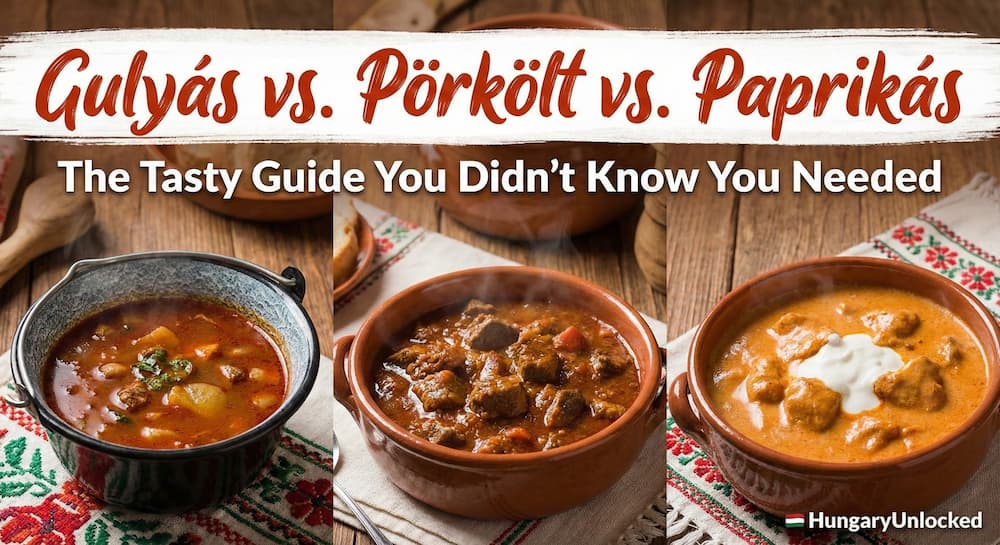
1. Gulyás (The Soup): Let us be clear: Gulyás is a soup. It is liquid. It is rich, yes, and hearty, but it is fundamentally a broth-based dish. Originating from the herdsmen (gulyás) of the Great Hungarian Plain, it was functional fuel cooked in a single cauldron over an open fire. It contains beef (never chicken), potatoes, carrots, parsnips, and csipetke (pinched pasta). If your spoon stands up in it on its own, you are not eating Gulyás; you are eating a tourist fabrication.

2. Pörkölt (The Stew): This is what the world thinks Goulash is. Pörkölt is the true stew. It is boneless meat (beef, pork, chicken, game, or even rooster testicles) cooked in its own juices with a massive ratio of onions to meat. It has a thick, naturally reduced sauce known as szaft. There is no flour used for thickening; the viscosity comes solely from the collagen of the meat and the breakdown of the onions. It rarely contains vegetables other than onions and peppers. It is dark, intense, and serious.

3. Paprikás (The Creamy Cousin): Paprikás is the refined, city-dwelling cousin of the rustic Pörkölt. It starts with the same onion-paprika-fat base but is finished with sour cream (tejföl) and often a thickening agent (flour) to create a silky, sunset-orange sauce. Chicken and veal are the primary proteins here. It is almost strictly served with nokedli (egg dumplings). It is the comfort food of the Hungarian childhood.

Insider Narrative: A Sensory Journey Through the Grease and Glory
Arrival: The Olfactory Landscape of District VII
The journey into authentic Hungarian cuisine often begins in the sensory overload of Budapest’s 7th District (Erzsébetváros). Stepping off the tram at Wesselényi utca, the air changes. It is not just the exhaust of the city; it is the scent of hagymás zsír—onions frying in lard. This is the foundational perfume of the Magyar kitchen, a smell that permeates the coats of grandmothers and the curtains of historic vendéglő (restaurants) alike.
Entering a place like Gettó Gulyás or the venerable Rosenstein, one is immediately struck by the acoustic landscape. There is no hushed reverence here. The sound of Hungarian dining is the clatter of heavy steel cutlery against ceramic, the aggressive clinking of beer glasses (a taboo that has largely faded, though some older locals still avoid clinking beer due to the 1849 execution of Hungarian generals by Austrians), and the distinct lack of background music. The focus is entirely on the plate.
The aesthetic of 2025 dining in Budapest is a collision of eras. In the Jewish Quarter, “ruin bar” chic—exposed brick, corrugated metal, industrial lighting—dominates spots like Gettó Gulyás. Conversely, in the deeper recesses of District VIII or the hills of Buda, the aesthetic remains stubbornly 1980s: lace doilies, dark wood paneling, and waiters in waistcoats who look like they have seen empires rise and fall and remain unimpressed by your dietary restrictions.
The Gulyás Revelation: It’s a Soup, Dammit
The first encounter with a proper Gulyás often dismantles a lifetime of misconceptions. It arrives not on a plate, but in a deep bowl or, in more performative establishments, a miniature red enamel cauldron (bogrács) suspended over a tealight candle.
The visual is striking: a vibrant, rusty red liquid shimmering with “gold coins”—droplets of paprika-infused fat floating on the surface. This is not grease to be skimmed; it is flavor to be cherished. The spoon dips into a broth that is savory and intense, flavored with caraway seeds (kömény) and the sweetness of root vegetables.
The beef—usually shank or shoulder—is tender to the point of disintegration. The texture is the key revelation. It is a soup, undeniably. There is no floury sludge here. The “thickness” comes solely from the collagen of the meat and the chemical reaction between the onions and the paprika. It is often spicy, but the heat is usually optional, added at the table via fresh peppers or pastes.
Eating it is a ritual. You break off a chunk of fehér kenyér (white bread) with a crust thick enough to cut the roof of your mouth. You dip it. You eat. You realize that for years, you have been lied to by cafeteria ladies.
The Pörkölt Experience: The Science of Szaft
If Gulyás is the soul, Pörkölt is the muscle. Ordering a Marhapörkölt (beef stew) brings a plate dominated by meat. There are no peas, no carrots, no celery stalks to distract you. This is a carnivorous meditation on the “Four Pillars” of Hungarian cooking: Fat, Onion, Paprika, and Salt.
The magic of Pörkölt lies in the szaft. This untranslatable word refers to the thick, gelatinous sauce that forms when onions are cooked down for hours in lard until they essentially liquefy, then emulsify with the meat juices and paprika. It is dark, viscous, and concentrated.
At a place like Gettó Gulyás, which brands itself as a “Pörkölt Manufaktúra” (Stew Manufactory), the varieties can be intimidating. There is the standard beef (marha), the lighter pork (sertés), and the gamey venison (szarvas). And then, for the brave, there is Kakashere Pörkölt—Rooster Testicle Stew.
- The Kakashere Experience: Visually, they resemble small, pale sausages or large beans in a bright red sauce. The texture is surprisingly creamy, almost like a firm tofu or a sweetbread, popping slightly when bitten. They are mild, absorbing the ferocious flavor of the paprika sauce. It is a dish that separates the tourists from the travelers.
Paprikás and the Nokedli Embrace
Csirkepaprikás (Chicken Paprikash) is the visual opposite of the dark Pörkölt. The sauce is a brilliant, sunset orange, brightened by the emulsion of sour cream. It is velvety, coating the chicken—usually bone-in legs and thighs, as the bone adds essential depth, though tourist-friendly spots may offer breast meat, which is generally drier and less flavorful.
The essential partner to Paprikás is Nokedli (often called Galuska on menus, though technically galuska can be larger). These are not pasta in the Italian sense. They are soft, irregular egg drop dumplings, made by pushing a wet dough through a grate into boiling water. They are bland on their own, designed specifically to be the vehicle for the sauce. They are the sponge of the Hungarian table.
A bite of Paprikás is a study in textures: the fibrous tenderness of the chicken, the soft chew of the nokedli, and the silky, tangy richness of the sauce. It is the culinary equivalent of a warm blanket.
The Pickle Counterpoint: Acid as a weapon
No narrative of these dishes is complete without the Savanyúság (pickles). The richness of the stews demands an acidic counterweight to cut through the fat. You do not simply get “pickles.” You get a menu of them.
- Kovászos Uborka: These are large, cloudy, fermented cucumbers made in the summer sun with bread and dill. They are sour, funky, and effervescent—probiotics in a jar.
- Csalamádé: A fermented slaw of sliced cabbage, peppers, onions, and cucumbers. It smells pungent but tastes crisp and tart.
- Ecetes Almapaprika: Apple peppers (round, yellow peppers) pickled in vinegar. They look innocent but can pack a surprising heat. The acidity cleanses the palate, allowing the diner to persevere through a portion size that was originally designed for a field worker burning 4,000 calories a day.
Practical Tips: Etiquette, Survival, and “Strong Steve”
The Etiquette of Heat: Erős Pista and the Chili Game
A common misconception is that Hungarian food is inherently scorching hot. It is not. The paprika used in cooking is primarily “Sweet” (Édes) or “Noble Sweet” (Csemege). It provides flavor and color, not fire. The heat is a personal choice, added at the table, a democratic approach to spiciness.

When your soup or stew arrives, you will likely find a small glass jar or a plastic pot on the table containing a bright red paste. This is Erős Pista (“Strong Steve”).
- What it is: Coarsely minced hot paprika preserved in heavy salt.
- How to use it: Take a teaspoon (or less) and stir it into your Gulyás or Pörkölt.
- The Warning: Erős Pista is incredibly salty. Always taste your food before adding it. If you add salt to your soup and then a spoonful of Steve, you will ruin the dish.
- The Upgrade: In better restaurants, you might be offered fresh hegyes erős (spicy green peppers) or dried red chilies. These are superior to the paste as they add heat without the sodium bomb.
Bread is a Utensil (Tunkolni)
Do not be shy about the bread basket. In a Pörkölt or Gulyás scenario, bread is a tool. Tunkolni—the act of sopping up the remaining sauce on the plate with a piece of bread—is not just accepted; it is a compliment to the chef. Leaving perfectly good szaft (sauce) on the plate is considered wasteful and tragic. In casual kifőzde, you will see locals wiping their plates clean until they shine.
The “Service Charge” vs. Tipping Trap
Tipping in Budapest in has become a minefield for the unwary traveler. The rules have shifted, and nuances matter.
- Szervizdíj (Service Fee): Most reputable restaurants (and many tourist traps) now automatically add a 10% to 15% service fee to the bill. This must be listed on the menu and the receipt.
- The Rule: If Szervizdíj is included, you are not required to tip extra. It is the tip.
- The Gesture: However, if the service was exceptional, locals often round up the bill or leave a small amount (500-1000 HUF) as a gesture of goodwill, but it is not mandatory.
- The Scam: Some waiters may bring the bill, point to the total, and ask “Service is not included, how much would you like to add?” even if the fee is technically on the menu in fine print. Always check the receipt for the word Szervizdíj or Szerviz before tapping your card. If it’s there, do not feel pressured to add another 15%.
2025 Prices: The Cost of Goulash Economics
Inflation has hit Hungary hard in recent years (“The Forint Struggle”), and prices in 2025 reflect a new reality. The days of the $2 hearty meal in the city center are largely gone, though value can still be found if you know where to look.
Comparative Price Guide (Spring 2025)
The following table provides realistic expectations for a main course of Gulyás (Soup), Pörkölt, or Paprikás in Budapest. Exchange rate estimated at ~370-380 HUF = 1 USD for context.
How Much Does Gulyás *Actually* Cost? (2025 Reality Check)
From old-school canteens to Michelin darlings (and the inevitable Váci utca tourist traps), here’s what you’ll really pay for gulyás, pörkölt/paprikás and a drink in Budapest.
Budget / Canteen
Frici Papa Kifőzdéje
Gulyás (soup): 1,800–2,500 HUF (~€5–€7)
Pörkölt / Paprikás: 2,800–3,500 HUF (~€7–€9)
Beer / wine (glass): 800–1,200 HUF (~€2–€3)
Typical total: 5,400–7,200 HUF (~€14–€19)
Mid-Range Bistro
Gettó Gulyás
Gulyás (soup): 3,200–4,000 HUF (~€8–€11)
Pörkölt / Paprikás: 4,500–6,500 HUF (~€12–€17)
Beer / wine (glass): 1,500–2,500 HUF (~€4–€7)
Typical total: 9,200–13,000 HUF (~€24–€34)
Upscale / Traditional
Rosenstein Vendéglő
Gulyás (soup): 4,500–5,500 HUF (~€12–€14)
Pörkölt / Paprikás: 7,500–9,500 HUF (~€20–€25)
Beer / wine (glass): 2,000–3,500 HUF (~€5–€9)
Typical total: 14,000–18,500 HUF (~€37–€49)
Michelin Recommended
Stand25 Bisztró
Gulyás (soup): 5,900 HUF (~€16)
Pörkölt / Paprikás: 8,900–10,900 HUF (~€23–€29)
Wine (glass): 3,000+ HUF (~€8+)
Typical total: 17,800–19,800 HUF (~€47–€52+)
Tourist Trap (Avoid)
Váci Street Venues
Gulyás (soup): 6,000+ HUF (~€16+)
Pörkölt / Paprikás: 8,000+ HUF (~€21+)
Beer / wine (glass): 3,500+ HUF (~€9+)
Typical total: 17,500+ HUF (~€46+) — often for worse quality.
Takeaway: A great bowl of gulyás should cost 3,000–4,500 HUF (~€8–€12). If you’re paying Váci utca prices for canteen quality – you’re doing Budapest wrong.
Key Menu Examples (2025 Data):
- Stand25 Bisztró: Goulash Soup: 5,900 HUF ($16). Wild Boar Cheek Stew: 8,900 HUF ($24).
- Gettó Gulyás: Chicken Paprikash: ~4,500-5,000 HUF ($12-13.50). Beef Stew (Pörkölt): ~5,500 HUF ($15).
- Rosenstein: Catfish Paprikash: ~8,900 HUF ($24). Goulash Soup: ~4,500 HUF ($12).
- Goulash & Langosh Bar: Beef Goulash Soup: 5,990 HUF ($16) – Note: This is priced for tourists near Váci street, significantly higher than local spots for a simple soup.
Getting There: Where the Locals Actually Eat
Finding the best version of these dishes requires navigating a city bifurcated by the Danube and stratified by tourism. Here are the distinct “personas” of Budapest dining.
1. Rosenstein Vendéglő (The Legend)
- Location: Mosonyi u. 3, District VIII (near Keleti Railway Station).
- The Vibe: Tucked away in a grittier part of District VIII, this family-run institution feels like a secret club. The decor is understated, the service is courtly, and the owner, Tibor Rosenstein, is often seen greeting guests. It is the intersection of Hungarian and Jewish cuisine.
- The Food: This is widely considered the best traditional food in the city. Their Vadpörkölt (Venison Stew) served with croquettes and berry jam is legendary. The Catfish Paprikash with túrós csusza (cottage cheese noodles) is a masterpiece of texture.
- Insider Note: Start with the “Jewish Egg Spread” or the Goose Cracklings. Leave room for Flódni (a layered cake of apple, walnut, and poppy seed). Reservations are mandatory, often days or weeks in advance.
2. Gettó Gulyás (The Hipster Traditionalist)
- Location: Wesselényi u. 18, District VII (Jewish Quarter).
- The Vibe: Located in the heart of the party district, this place rejects the “street food” trend to focus on slow-cooked stews. The interior is industrial-chic with corrugated metal walls, but the menu is fiercely traditional.
- The Food: They brand themselves as a “Pörkölt” specialist. They offer 14 types of stew. Their Chicken Paprikash is textbook perfection—rich, creamy, and served with excellent nokedli. For the adventurous, the Rooster Testicle Stew is prepared with the same care as the beef.
- Insider Note: It’s a “Stewery.” Do not come here looking for a light salad. The túrógombóc (cottage cheese dumplings) for dessert are rolled in breadcrumbs and served with sour cream—a non-negotiable finish to the meal.
3. Stand25 Bisztró (The Michelin Casual)
- Location: Attila út 10, District I (Buda side).
- The Vibe: Modern, sleek, open kitchen. Run by star chefs Tamás Széll and Szabina Szulló, this is the casual sibling of their Michelin-starred Stand.
- The Food: This is where you go to see how traditional peasant food can be elevated to fine dining without losing its soul. The Goulash Soup here is famous—lighter, cleaner, yet incredibly deep in flavor, lacking the grease slick of lesser versions. Their Pörkölt often uses premium cuts like wild boar cheek.
- Insider Note: It is pricier, but the “Goulash PhD” experience is worth it. It proves that Hungarian food doesn’t have to be heavy to be authentic.
4. Frici Papa Kifőzdéje (The Budget Time Capsule)
- Location: Király u. 55, District VII.
- The Vibe: Fast, loud, cheap. Shared tables, grumpy service, fluorescent lights. It feels like a school canteen from the 1980s.
- The Food: Simple, honest, mass-produced. A plate of Chicken Paprikash or Marhapörkölt costs a fraction of the price elsewhere.
- Insider Note: Do not expect a smile. Expect to be fed quickly. It is a survival spot for students, budget travelers, and locals who just need calories. The food is decent, but the atmosphere is the real attraction—a glimpse into everyday Budapest life.
Local Hacks: Surviving the Paprika Republic
1. The Fröccs Equation: Drink Like a Local
You cannot eat this heavy food with just water. Soft drinks are too sweet. Beer is acceptable, but the true Hungarian pairing is Fröccs (wine spritzer). It is not just wine and soda; it is a mathematical language and a cultural institution. The carbonation cuts through the fat of the Pörkölt, cleansing the palate.
- The Rules: Never use high-end wine, but never use rotgut. The water must be szikvíz (soda water from a siphon), not just sparkling mineral water.
- The Ratios (Wine : Soda):
- Kisfröccs (Small): 1dl wine + 1dl soda.
- Nagyfröccs (Large): 2dl wine + 1dl soda.
- Hosszúlépés (Long Step): 1dl wine + 2dl soda (The standard summer hydrator).
- Házmester (Caretaker): 3dl wine + 2dl soda.
- Viceházmester (Vice-Caretaker): 2dl wine + 3dl soda.
- Sportfröccs: 1dl wine + 4dl soda (basically flavored water for hydration).
- Krúdy Fröccs: 9dl wine + 1dl soda. Named after writer Gyula Krúdy, who famously said the water is only there to “make the wine laugh”.
2. The “Napi Menü” (Daily Menu) Hunt
On weekdays, almost every restaurant (even some fancy ones) offers a Napi Menü (Daily Menu) between 11:30 AM and 2:00 PM. This usually consists of a soup and a main course (and sometimes water/dessert) for a fixed price, typically 2,500 – 4,000 HUF ($7 – $11).
- The Hack: This is the cheapest way to eat high-quality food. The dishes are often traditional items that aren’t on the regular à la carte menu, like Főzelék (vegetable stews) or fruit soups. Look for chalkboards on the sidewalk or ask “Van napi menü?” (Is there a daily menu?).
3. Buying Paprika: Don’t Buy the “Tourist Bags”
You will see cute little cloth bags of paprika in souvenir shops on Váci street. Do not buy these. They are often old, flavorless, and overpriced.
- Where to go: Go to the Great Market Hall (Nagyvásárcsarnok) or Lehel Market.
- What to buy: Look for “Kalocsai” or “Szegedi” paprika.
- The Types:
- Édes (Sweet): The standard cooking paprika. Deep red.
- Csemege (Delicacy): Mild, noble sweet.
- Csípős (Hot): Spicy.
- Füstölt (Smoked): Becoming more popular, but traditional Hungarian dishes use unsmoked sweet paprika.
- Freshness: Paprika oxidizes and turns brown/bitter over time. Buy tins, not clear bags, if possible, and store them in the dark.
Realistic Negative: The Dark Side of the Stew
To maintain the “HungaryUnlocked” honesty, we must address the cons. This is not a cuisine for the faint of heart or the weak of stomach.
1. The “Meat Sweats” and Digestion: Hungarian cuisine is heavy. It relies heavily on pork fat (zsír), red meat, and carbohydrates (potatoes, bread, dumplings). It is not spa food. A full meal of Gulyás soup followed by Pörkölt and a dessert like Somlói Galuska (sponge cake trifle) contains enough calories to power a small village. The digestion process is slow and arduous. The “food coma” is real.
- Solution: Plan a long walk along the Danube after lunch. Do not attempt to climb the Citadella immediately after eating.
2. The Sodium Warning: Between the salted cured meats, the Erős Pista, and the liberal seasoning in the stew base, the sodium content in traditional meals is sky-high. Travelers with sensitivity to salt should be vigilant and drink massive amounts of water (or Fröccs).
3. The “Grumpy” Service Myth: The concept of “service with a smile” is an imported Americanism that has not fully taken root in traditional Hungarian establishments. Waiters can be direct, unsmiling, and efficient to the point of curtness.
- Reality: They are not mad at you; they are just working. This is the local baseline. Efficiency is valued over fake cheerfulness. However, genuine rudeness or dismissiveness (ignoring you for 20 minutes, throwing menus) is a sign of a tourist trap or a bad day. In 2025, labor shortages mean staff are often overworked.
4. The Vegetarian Void: If you are a vegetarian, the “Traditional” section of the menu is a minefield. While Gomba Pörkölt (mushroom stew) and Lecsó (pepper stew) are delicious options, the cuisine is overwhelmingly carnivorous.
- Warning: Even “vegetable” dishes like Rakott Krumpli (layered potatoes) often contain hidden layers of sausage or bacon fat. Always ask “Van benne hús?” (Is there meat in it?).
Summary
Exploring Gulyás, Pörkölt, and Paprikás is more than a caloric intake exercise; it is an engagement with Hungarian history and identity.
- Gulyás tells the story of the nomadic herdsmen, the open plains, and the ingenuity of the one-pot meal.
- Pörkölt reflects the village life, the slow cooking over fires, and the deep, savory reliance on pork fat and onions.
- Paprikás showcases the Austro-Hungarian influence, the desire to refine the rustic stew with cream and flour, creating something elegant enough for Sunday lunch.
Budapest offers the full spectrum of these dishes. You can eat a 10,000 HUF venison stew on a white tablecloth at Rosenstein, or a 2,500 HUF pork stew at a standing counter in a market hall. Both are authentic. Both are valid. The key is to know the difference, to respect the paprika, to order the right Fröccs, and to never, ever call Gulyás a stew in front of a local.
Enjoy the grease. Respect the onion. Welcome to Hungary.
FAQ: Quick Hits for the Hungry Traveler
Q: Is Goulash gluten-free? A: Traditional Gulyás (soup) and Pörkölt (stew) should be gluten-free, as they are naturally thickened by the reduction of onions and collagen, not flour. However, Paprikás almost always uses flour as a thickener, and the accompanying Nokedli are made of wheat flour. Always ask the chef (“Lisztmentes?” – Flour-free?) to be sure, as some cheaper kitchens might use flour to thicken a thin Pörkölt quickly.
Q: Can I drink the tap water in Budapest? A: Yes, the tap water is safe and generally high quality. However, in restaurants, asking for “water” will usually result in a bottle of mineral water (sparkling or still) being opened and charged to your bill. You must specifically ask for csapvíz (tap water), though some upscale places may refuse to serve it in favor of bottled water.
Q: What is the difference between Nokedli and Galuska? A: In common parlance, they are often used interchangeably for the small egg dumplings. Technically, Galuska can refer to slightly larger dumplings, but if you see either on a menu with stew, you are getting the classic egg-flour-water drop noodles. Csipetke are the harder, smaller, pinched noodles found specifically in Gulyás soup.
Q: Do I really need to tip if there is a service fee? A: Legally and socially, no. If the menu says “Service Charge Included” (Szervizdíj), the staff is already getting their cut (theoretically). Don’t let a pushy waiter guilt you into double-tipping. If there is no service charge, a 10-15% tip is standard.
Q: Where can I find vegan Goulash? A: It is rare, but Goulash & Langosh Bar offers a vegan version, and Kozmosz Vegan Étterem makes excellent plant-based versions of Hungarian classics using seitan or beans.


