🎯 TL;DR
The Hungarian National Gallery (Magyar Nemzeti Galéria) houses Hungary’s largest collection of Hungarian art—from medieval altarpieces to 20th-century masterpieces—across four wings of Buda Castle. Entry costs 5,400 HUF (~$14), or FREE with Budapest Card. Open Tuesday-Sunday 10:00-18:00, closed Mondays. Must-sees: Munkácsy’s dramatic canvases, Csontváry’s visionary landscapes, the Dome viewpoint, and the Habsburg Crypt (by appointment). Allow 2-3 hours.
Most visitors to Buda Castle walk past the Hungarian National Gallery without realizing what’s inside. They photograph the Danube view, pose at the lion statues, maybe visit Fisherman’s Bastion, and then head back down the hill. Their loss.
The Magyar Nemzeti Galéria is where you’ll discover the artists who shaped Hungarian visual culture—painters who won international fame in Paris and Munich, sculptors who defined public spaces across the country, and visionaries whose work defies easy categorization. This isn’t a collection of dusty provincial art. It’s a world-class museum that happens to focus on one nation’s extraordinary artistic output.
If the Museum of Fine Arts at Heroes’ Square shows how Hungary collected international art, the National Gallery shows what Hungarian artists created. Together, they tell the complete story of art in Hungary. This guide focuses on the National Gallery—how to visit, what to prioritize, and why it deserves more attention than it typically receives.
📋 Hungarian National Gallery at a Glance
| Best For | Art lovers, Hungarian culture enthusiasts, Buda Castle visitors |
| Time Needed | 1.5-2 hours (highlights) | 3-4 hours (comprehensive) |
| Cost | 5,400 HUF (~$14) | Concession: 2,700 HUF |
| Budapest Card | FREE entry to permanent exhibitions |
| Hours | Tuesday-Sunday 10:00 AM – 6:00 PM | Monday CLOSED |
| Getting There | Funicular, Bus 16, or walk up Castle Hill |
| Skip If | You have zero interest in art and only came for the castle views |
Why the Hungarian National Gallery Matters
The Hungarian National Gallery is the largest public collection of Hungarian art in the world, spanning medieval religious art to 20th-century avant-garde movements. Established in 1957, it occupies buildings A, B, C, and D of Buda Castle—the former Royal Palace rebuilt after World War II destruction.
The collection includes over 100,000 works: 6,000 paintings, 2,100 sculptures, 3,100 medals, 11,000 drawings, and 5,000 prints. But numbers don’t capture what makes this museum special. What matters is the quality—works by artists who achieved international recognition while remaining distinctly Hungarian in vision and subject matter.
The gallery answers a question many visitors don’t think to ask: What does Hungarian art look like? The answer, as you’ll discover, is more varied and compelling than you might expect.
The Collection: What You’ll Actually See
The gallery organizes its permanent collection chronologically and by medium, spread across multiple floors of the castle wings.
Medieval and Renaissance Art (Ground Floor & First Floor)
The earliest works date from the 11th century and include some of Central Europe’s finest Gothic altarpieces. These weren’t created for museum display—they were functional religious objects, and seeing them up close reveals details invisible from church pews.
Key pieces include:
- Gothic wooden altarpieces from Upper Hungary (now Slovakia), featuring intricate carved panels and gold leaf
- Panel paintings from the 14th-15th centuries showing the international Gothic style adapted to Hungarian contexts
- Medieval stone carvings rescued from destroyed churches
For many visitors, this section provides unexpected highlights. The craftsmanship of medieval Hungarian workshops rivals anything in Western European collections, yet receives far less attention.
Baroque Art (First Floor)
The 17th and 18th centuries brought Hungarian art into conversation with broader European movements. Baroque paintings here include religious works for churches and monasteries, portraits of aristocrats, and historical scenes celebrating Hungarian identity.
The Austrian Maulbertsch’s influence appears throughout this section, but Hungarian painters like Ádám Mányoki developed distinctive approaches to portraiture that balanced European sophistication with local character.
19th-Century Hungarian Painting (Second Floor)
This is where the collection becomes unmissable. The 19th century saw Hungarian painting achieve international recognition, with artists working in Vienna, Munich, Paris, and Rome while maintaining connections to Hungarian themes and patrons.
Mihály Munkácsy (1844-1900) dominates the collection and deserves the attention. His massive canvases—particularly the Christ trilogy—demonstrate why he was one of the most celebrated painters in 19th-century Europe. “Christ Before Pilate” alone justifies the museum visit: a monumental work of psychological drama that drew crowds across Europe and America.
Munkácsy’s non-religious works are equally compelling: Hungarian landscapes, scenes of peasant life, and genre paintings that capture 19th-century social conditions with both sympathy and unflinching observation.
🎨 Must-See Works
- Mihály Munkácsy – Christ Before Pilate (1881) – The centerpiece of the collection
- Tivadar Kosztka Csontváry – Ruins of the Greek Theatre at Taormina – Visionary landscape
- Pál Szinyei Merse – Picnic in May (1873) – Hungarian Impressionism precursor
- József Rippl-Rónai – Woman with a Birdcage – Art Nouveau elegance
- Károly Ferenczy – October – Naturalism at its finest
- Gothic altarpieces – Especially from Lőcse and Bártfa
László Paál brought the Barbizon school’s approach to Hungarian landscapes, creating atmospheric forest scenes that influenced generations. Pál Szinyei Merse anticipated Impressionism with light-filled outdoor scenes painted years before the movement crystallized in Paris.
The Visionary: Tivadar Kosztka Csontváry
Csontváry deserves special mention because he defies categorization. A pharmacist who began painting at 41 after a mystical experience, he created monumental landscapes of almost hallucinatory intensity. His Mediterranean scenes—particularly the famous Taormina theatre—combine precise observation with a visionary quality that has drawn comparisons to Van Gogh and Blake.
Whether Csontváry was a genius, an outsider artist, or simply unique is debated. What’s not debated: his paintings stop visitors in their tracks. You may love them or find them strange, but you won’t forget them.
Early 20th Century and Modern Art (Third Floor)
The collection continues through Hungarian modernism, including:
- József Rippl-Rónai—Hungary’s Art Nouveau master, with decorative paintings and intimate domestic scenes
- The Eight (A Nyolcak)—Hungarian expressionists who brought avant-garde movements to Budapest
- Lajos Tihanyi—portraits and compositions that bridged expressionism and abstraction
- Photography—including works by Brassaï (Gyula Halász), who later became famous in Paris
Sculpture Collection
Throughout the gallery, sculpture complements the paintings. Key sculptors include:
- István Ferenczy—neoclassical works that established Hungarian sculpture as a serious discipline
- Miklós Izsó—Romantic nationalism in bronze, including genre scenes of peasant life
- János Fadrusz—monumental public sculpture
The Setting: Buda Castle as Museum
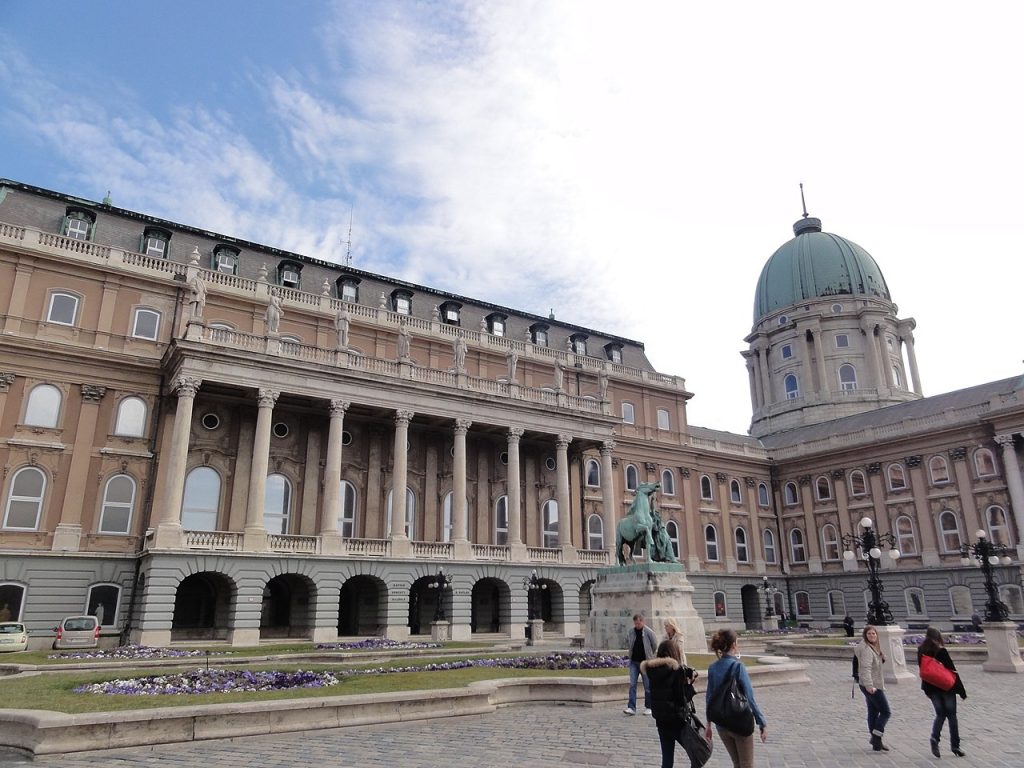
The gallery occupies the Royal Palace of Buda Castle—but not the historical palace. The original was destroyed in the 1945 Siege of Budapest, one of the war’s most devastating urban battles. What you see today is a reconstruction, completed in the 1960s, designed to house cultural institutions rather than recreate royal apartments.
This history shapes the visitor experience. The interiors are modern museum spaces within a historic shell—clean, well-lit galleries rather than period rooms. Some visitors find this disappointing; others appreciate the focus on the art rather than architectural distraction.
The building does offer one spectacular feature: the Dome. Accessible with your museum ticket (weather permitting), the Dome terrace provides panoramic views over the Danube, Pest, and the surrounding hills. It’s one of the best viewpoints in Budapest and often overlooked by visitors who don’t realize it exists.
🏛️ The Dome Viewpoint
The gallery’s Dome (kupola) offers one of Budapest’s best panoramas—and it’s included with your museum ticket!
- Access: Top floor, follow signs to “Dome”
- Hours: 10:00-17:00, weather permitting (closes if wet/icy)
- Views: 360° panorama including Parliament, Danube, Gellért Hill, Pest skyline
- Tip: Less crowded than Fisherman’s Bastion, better 360° views
The Habsburg Palatine Crypt
Beneath building C lies a hidden attraction: the Habsburg Palatine Crypt, final resting place of several members of the Hungarian branch of the Habsburg family, including Palatine Joseph and his family members.
The crypt requires advance booking and a guided tour—you can’t simply wander in. Contact the museum at least one week ahead to arrange a visit. It’s a somber, atmospheric space that connects directly to Hungarian royal history.
Practical Information: Tickets and Hours
💰 Hungarian National Gallery Prices (2026)
- Permanent exhibitions: 5,400 HUF (~$14)
- Concession (students, seniors 62-70): 2,700 HUF (~$7)
- Under 6 / Over 70 (EU): FREE
- Budapest Card: FREE (permanent exhibitions only)
- HNG Annual Ticket: 9,000 HUF (unlimited visits for 1 year)
- Audio guide: 1,200 HUF (available in English, German, French, Italian)
- Children’s audio guide: 500 HUF
- Masterpieces guide (print): 300 HUF
Temporary exhibitions may require additional tickets.
🕐 Opening Hours
- Tuesday-Sunday: 10:00 AM – 6:00 PM
- Monday: CLOSED
- Last entry: 5:00 PM
- Exhibition halls close: 5:30 PM (starting from top floor)
- Dome: 10:00 AM – 5:00 PM, weather permitting
- Museum Shop: 10:00 AM – 5:45 PM
- Museum Café: 10:00 AM – 5:45 PM
Note: Check annual holiday closures—the gallery closes on Easter, Pentecost, December 24-25.
🎫 Budapest Card Tip
The Budapest Card provides free entry to the permanent exhibitions—a 5,400 HUF value. Since you’re already at Buda Castle and the card covers the funicular too, this can represent excellent value for culture-focused visitors.
How to Get There
📍 Hungarian National Gallery – Essential Info
- Address: Szent György tér 2, Budapest 1014 (Buda Castle, Buildings A-B-C-D)
- Main entrance: Building B, at the Lion Courtyard
- Funicular: From Clark Ádám tér to Castle Hill (1,400 HUF one way)
- Bus: Line 16 from Deák Ferenc tér or Széll Kálmán tér
- Walk: 15-20 minutes uphill from Clark Ádám tér via stairs
- Hours: Tue-Sun 10:00-18:00 (last entry 17:00)
- Tickets: 5,400 HUF / 2,700 HUF concession / Free with Budapest Card
- Time needed: 1.5-2 hours (highlights) | 3-4 hours (comprehensive)
- Website: en.mng.hu
The gallery sits within the Buda Castle complex. Getting to Castle Hill requires either:
- The Funicular (Budavári Sikló): Scenic 90-second ride from Clark Ádám tér. Costs 1,400 HUF one way, 2,500 HUF round trip. Most visitors ride up and walk down.
- Bus 16: Runs from Deák Ferenc tér through Buda to Castle Hill. Free with Budapest Card or public transport tickets.
- Walking: Several staircases lead up from the Danube embankment. Free but requires effort. The stairs near the funicular provide the most direct route.
Once on Castle Hill, the gallery entrance is in the central Royal Palace building—look for the green dome. Enter through the Lion Courtyard.
Visiting Strategy
The gallery’s size and depth reward thoughtful planning. Here’s how to approach your visit based on available time and interests.
If You Have 1.5-2 Hours
Head directly to the 19th-century collection on the second floor. See Munkácsy’s Christ paintings—they’re impossible to miss and genuinely impressive regardless of religious interest. Explore Csontváry’s visionary landscapes in the adjacent galleries. Catch highlights of the period collection, including Szinyei Merse’s colorful scenes. If time permits, climb to the Dome for panoramic views that rival Fisherman’s Bastion. Skip the medieval and modern sections unless they’re specific interests—you can always return.
If You Have 3-4 Hours
Add the medieval collection—the Gothic altarpieces are surprisingly compelling even for visitors who usually skip religious art. The intricate carving, preserved gold leaf, and dramatic painted panels reward close attention. Progress through the Baroque galleries for context, then spend extended time on the 19th and early 20th centuries.
Don’t rush past Rippl-Rónai’s Art Nouveau works or the Hungarian avant-garde experiments. Take proper time with the sculpture galleries, where you’ll recognize styles you’ve seen in public spaces throughout Budapest. End at the Dome—the views are spectacular, and you’ve earned them. This pace allows for actual contemplation rather than exhausted rushing.
If You Have Multiple Visits
The Annual Ticket (9,000 HUF) makes sense for serious art lovers or Budapest residents. It allows unlimited visits for a year—meaning you can focus on one section per visit without feeling pressured to see everything. Some visitors use their first visit for the 19th century, return for medieval and Gothic, and make a third trip for modern works and temporary exhibitions.
This approach also allows you to revisit favorite works. Munkácsy’s Christ trilogy, in particular, rewards multiple viewings—you’ll notice details on your third visit that you missed on your first. The relationship between the three paintings becomes clearer with time. And seeing how the natural light changes throughout the day affects how the paintings appear.
Audio Guide?
The audio guide (1,200 HUF) provides context for major works and is available in English, German, French, and Italian. It’s particularly useful for the 19th-century collection, where understanding Hungarian historical context enhances appreciation—knowing that Munkácsy painted “Christ Before Pilate” while living in Paris as an international celebrity adds dimension to viewing. The guide covers approximately 50 works across the permanent collection.
Not essential if you’re happy reading wall texts, but worthwhile if you want deeper engagement. The children’s audio guide (500 HUF, Hungarian and Italian) provides age-appropriate commentary that makes the museum more accessible for younger visitors.
Combining Your Visit
The gallery integrates naturally with other Castle District attractions, though trying to see everything in one visit leads to exhaustion.
The Art Day
Hungarian National Gallery (morning/afternoon) + Museum of Fine Arts at Heroes’ Square (afternoon/evening). This pairs Hungarian art with the international collection, providing a complete picture of art in Budapest. Ambitious but rewarding.
The Castle Day
National Gallery + Fisherman’s Bastion + Castle District walking + Matthias Church. Add the Budapest History Museum if energy permits. This covers most of Castle Hill’s highlights.
The Views Day
Combine the gallery’s Dome viewpoint with Fisherman’s Bastion and the Castle ramparts. If you’re primarily interested in panoramas, the Dome alone justifies museum entry—and you’ll see some art along the way.
For complete itineraries, see our 3 Days in Budapest guide or First Time in Budapest overview.
Hungarian National Gallery vs. Museum of Fine Arts
Visitors often confuse Budapest’s two major art museums or wonder which to prioritize. The difference is straightforward:
Hungarian National Gallery (Buda Castle):
- Hungarian artists only
- Medieval through 20th century
- Munkácsy, Csontváry, Rippl-Rónai, Ferenczy
- Free with Budapest Card
- Combined with Castle District visit
Museum of Fine Arts (Heroes’ Square):
- International art (non-Hungarian)
- Ancient through 19th century
- Raphael, El Greco, Goya, Rembrandt
- Free with Budapest Card
- Combined with City Park visit
Recommendation: If you have time for only one and prefer established European masters, choose Fine Arts. If you want to understand Hungarian culture through its visual art, choose the National Gallery. Ideally, visit both—they complement rather than compete.
What Visitors Say
Visitor reviews consistently highlight the quality and depth of the collection, the beautiful setting within Buda Castle, and the relative lack of crowds compared to other major European galleries.
What people love:
- “A real highlight of our visit to Budapest—art was really interesting and varied”
- “It took us 3+ hours to get through”—testament to the collection’s depth
- “Well set up with lots of explanations in English”
- “On the top floor you can even go up on the roof”—the Dome surprise
- “Superbly curated, and the variety of works—paintings to sculptures—is truly remarkable”
What to know:
- The building is large—wear comfortable shoes
- Some temporary exhibitions require separate tickets
- The café is convenient but basic
- Don’t forget the Dome access—many visitors miss it
- Monday closure means planning required
The Artists You’ll Discover
Mihály Munkácsy (1844-1900)
The collection’s star. Born in poverty, orphaned young, apprenticed as a joiner before art training, Munkácsy became one of Europe’s most celebrated painters. His Christ trilogy—Christ Before Pilate, Golgotha, and Ecce Homo—toured internationally to enormous crowds. The realist-dramatic style, massive scale, and psychological intensity created an immediacy that still works today.
Beyond religious works, his genre scenes of Hungarian peasant life combine social observation with painterly virtuosity. Look for “The Last Day of a Condemned Man” and “Woman Carrying Firewood.”
Tivadar Kosztka Csontváry (1853-1919)
The visionary outsider. Csontváry believed he was destined for greatness—after a mystical experience at age 27, he received what he understood as a prophetic calling. He trained formally but developed a completely individual style: monumental landscapes of almost hallucinatory intensity, rendered in distinctive oranges, yellows, and blues.
His Taormina painting shows the ancient Greek theatre beneath a sky that seems to vibrate with energy. The cedars of Lebanon become supernatural presences. Whether genius or madness drove his vision, the results are unforgettable.
József Rippl-Rónai (1861-1927)
Hungary’s Art Nouveau master brought Parisian Nabis influences home and created a distinctive Hungarian decorative style. His intimate domestic scenes—women reading, interiors with patterned wallpapers, quiet moments of bourgeois life—combine visual sophistication with genuine warmth.
The Nagybánya School
A colony of Hungarian painters formed in Nagybánya (now Baia Mare, Romania) around 1896, dedicated to plein air painting and bringing Impressionist light to Hungarian subjects. Károly Ferenczy led the group; his “October” demonstrates their achievement—natural light, outdoor settings, and a freedom from academic constraints that opened new possibilities for Hungarian painting.
Other key Nagybánya painters include István Réti, János Thorma, and Béla Iványi-Grünwald. Their collective influence shaped Hungarian painting for decades.
Bertalan Székely and Károly Lotz
These two painters dominated Hungarian historical and decorative painting in the late 19th century. You’ll encounter their work throughout Budapest—Székely painted ceiling frescoes in the Opera House; Lotz decorated the Parliament. The gallery holds their easel paintings and studies, offering intimate views of artists whose public works define Hungarian national spaces.
The Sculptors
Hungarian sculpture developed later than painting but achieved notable results. István Ferenczy (1792-1856) is considered the founder of Hungarian sculpture proper—his neoclassical works established standards for subsequent generations. Miklós Izsó brought Romantic nationalism to bronze, creating genre figures of peasant life that influenced Hungarian self-image.
Later sculptors like János Fadrusz and György Zala created the monumental public sculptures you see throughout Budapest—the gallery provides context for understanding their achievement.
Frequently Asked Questions
Is the Hungarian National Gallery free?
Not entirely. General admission is 5,400 HUF, with concessions available. However, it’s FREE with a Budapest Card (permanent exhibitions only). Under-6s and EU citizens over 70 enter free.
How long do I need?
The museum suggests 1.5-3 hours for the permanent collection. Plan 2 hours minimum to see highlights properly, 3-4 hours for comprehensive exploration. Reddit visitors report 3+ hours going through everything.
Is it worth it if I don’t know Hungarian artists?
Absolutely. The quality stands on its own—these artists achieved international recognition for good reason. The gallery provides English explanations, and unfamiliar names become memorable faces by the end of your visit.
Can I visit the Dome?
Yes, included with your museum ticket. Open 10:00-17:00, weather permitting—it closes if conditions are unsafe (rain, ice). One of Budapest’s best viewpoints.
What about the Habsburg Crypt?
The Palatine Crypt requires advance booking and a guided tour—you can’t simply buy a ticket. Contact the museum at least one week ahead at info@mng.hu to arrange a visit. The crypt contains the tombs of Palatine Joseph (1776-1847), his three wives, and several of their children—the Hungarian branch of the Habsburg family who ruled as representatives of the Austrian emperors.
Is there a good route through the galleries?
Start at the second floor for 19th-century highlights if you’re short on time. If you have longer, begin chronologically on the first floor with medieval and Gothic art, progress through Baroque, then spend extended time on the 19th and early 20th centuries. End at the Dome for views. The museum map (available free at the entrance) helps orientation.
Are there guided tours?
The gallery offers guided tours for groups—contact them in advance to arrange. For individual visitors, the audio guide (1,200 HUF) provides structured commentary on major works. The printed Masterpieces guide (300 HUF) offers a portable reference.
Can I buy a combined ticket with other museums?
The Budapest Card provides the most practical combination—free entry to the National Gallery, Museum of Fine Arts, and many other museums. Dedicated combined tickets with specific museums aren’t currently offered, but check the website for current promotions.
Is photography allowed?
Generally yes in permanent exhibitions (no flash). Temporary exhibitions may have restrictions. Check signage at each gallery.
Is it wheelchair accessible?
Yes. The museum has elevators and accessible facilities. The main challenge is getting to Castle Hill—the funicular is accessible, and Bus 16 provides an alternative.
What’s the best day to visit?
Weekday mornings are quietest. Weekend afternoons see higher visitor numbers, though never as crowded as major Western European galleries. Avoid Mondays (closed).
A Floor-by-Floor Guide
The gallery’s layout can feel confusing at first—four connected castle wings across multiple floors. Here’s how to navigate efficiently.
Ground Floor (Wing B)
Medieval stone carvings and early sculpture. This floor sets the historical stage, displaying architectural fragments and sculptural works rescued from churches and public buildings destroyed over centuries of warfare. The quality of medieval Hungarian stonework often surprises visitors expecting to find provincial work.
Skip if: You’re short on time and more interested in painting. These works reward specialists but aren’t essential for a first visit.
First Floor (Wings C and D)
Gothic and Renaissance art. The famous wooden altarpieces live here—complete altar structures with painted panels and carved figures, displayed to approximate their original church settings. The altarpieces from Lőcse (Levoča), Bártfa (Bardejov), and other Upper Hungarian towns represent the finest surviving examples of late Gothic art from the region.
Baroque painting and sculpture fills adjacent galleries—portraits, religious works, and the beginnings of secular Hungarian painting.
Must-see: The Gothic altarpieces. Even if you rush through other sections, these are worth your time.
Second Floor (Wings B and C)
19th-century Hungarian painting—the collection’s heart. This is where Munkácsy’s Christ trilogy dominates dedicated galleries. The surrounding rooms present the full range of Hungarian 19th-century achievement: historical painting, landscape, portraiture, and genre scenes.
Highlights:
- Munkácsy’s entire gallery—take time with each work
- Szinyei Merse’s “Picnic in May”—Hungarian proto-Impressionism
- László Paál’s Barbizon-influenced landscapes
- Viktor Madarász’s historical paintings
- Miklós Barabás portraits—the faces of 19th-century Hungary
Time allocation: If you have 2 hours total, spend at least 1 hour on this floor.
Third Floor (Wing C)
Late 19th and early 20th-century art. This floor bridges the academic tradition and modernism, including:
- The Nagybánya School painters
- József Rippl-Rónai’s Art Nouveau works
- Csontváry’s visionary paintings
- Hungarian expressionism and early avant-garde
Don’t miss: Csontváry. His paintings divide viewers—some find them transcendent, others bizarre—but nobody forgets them.
The Dome (Wing E)
Access from the third floor leads to the Dome terrace. Open weather permitting until 5 PM, this offers panoramic views that rival—and in some ways exceed—Fisherman’s Bastion. The 360° vista includes Parliament, the Danube bridges, Pest’s skyline, and Gellért Hill. Being included with museum admission, it’s one of Budapest’s best-value viewpoints.
The Museum’s History
The Hungarian National Gallery was established in 1957, consolidating Hungarian art collections previously scattered across multiple institutions. But the museum’s story connects to deeper Hungarian cultural history.
During the 19th century, as Hungarian national consciousness grew under Habsburg rule, collecting and displaying Hungarian art became politically significant. Art demonstrated that Hungary possessed a distinct cultural identity worthy of nationhood. Museums served nationalist purposes alongside aesthetic ones.
The current building—Buda Castle’s Royal Palace—gained this function after World War II. The original palace, rebuilt multiple times over centuries, was largely destroyed during the 1945 Siege of Budapest, one of the war’s bloodiest urban battles. The Communist government reconstructed the palace in simplified form, stripping away Habsburg royal associations and converting it to cultural institutions: the National Gallery, the Budapest History Museum, and the National Széchényi Library.
This history means the building itself represents loss and reconstruction. Walking through modern gallery spaces within castle walls, you’re experiencing both Hungarian art and Hungarian historical experience—the constant rebuilding that defines Central European history.
Temporary Exhibitions
The gallery hosts rotating temporary exhibitions alongside its permanent collection. These often focus on single artists, artistic movements, or thematic presentations of works from the collection.
As of early 2026:
Current exhibitions include retrospectives of Adolf Fényes (1867-1945) and Lajos Tihanyi (1885-1938), plus contemporary installations. Check en.mng.hu before your visit for current offerings.
Temporary exhibitions sometimes require separate tickets beyond permanent collection admission—another reason to check current information rather than relying solely on guidebook prices.
Practical Tips for Different Visitors
For Art History Students
The gallery provides research-level depth impossible to absorb in one visit. The Annual Ticket (9,000 HUF) allows unlimited access for sustained study. The library and archives support serious research with advance arrangement.
For First-Time Budapest Visitors
Integrate the gallery into your Castle District exploration rather than treating it as a separate destination. The Dome viewpoint alone justifies entry if you’re already on Castle Hill. Allow at least 90 minutes to see highlights properly.
For Families
The children’s audio guide (500 HUF, Hungarian and Italian only) helps engage younger visitors. The galleries are spacious enough to accommodate strollers. The museum café provides a convenient break. That said, this is a traditional fine art museum—children who enjoy art museums will appreciate it; those who don’t may prefer the playgrounds in City Park.
For Photography Enthusiasts
Photography is generally permitted (no flash) in permanent exhibitions. The Munkácsy gallery provides dramatic subjects, and the Dome offers panoramic shots. Temporary exhibitions may have restrictions—check signage. Tripods are not permitted.
For Rainy Day Visitors
The gallery provides an excellent rainy day option within the Castle District. It’s large enough to fill several hours, and the café offers refuge. The main challenge: getting up Castle Hill in rain. Bus 16 is more practical than the funicular in bad weather.
The Museum Shop and Café
MúzeumShop: Located near the main entrance, the shop offers art books, reproductions, postcards, and design items. Quality is generally high—this is a proper museum shop rather than a tourist trap. Open Tuesday-Sunday 10:00-17:45, accessible without museum entry.
Museum Café: Simple café with coffee, pastries, light meals. Convenient for a break during your visit but not a dining destination. Open Tuesday-Sunday 10:00-17:45.
Hidden Details and Secrets
The Lion Courtyard: The main entrance is through the Lion Courtyard—named for the lion statues guarding the gates. These are reconstructions; the originals were damaged in 1945.
The Matthias Well: On the castle’s western side, a decorative fountain depicts King Matthias Corvinus hunting. It’s one of the few pre-war decorative elements to survive the siege.
Collection Storage: Only a fraction of the gallery’s 100,000+ works can be displayed at any time. Rotating exhibitions and focused presentations bring stored works into public view periodically.
The “Christ Before Pilate” Story: Munkácsy’s masterpiece traveled to America for exhibition, where it was displayed for paying crowds in multiple cities. At one point, it was among the most viewed paintings in the world—a 19th-century blockbuster exhibition before the concept existed.
Final Thoughts
The Hungarian National Gallery sits in plain sight yet remains overlooked by visitors who came for the castle views. That’s unfortunate, because this museum offers something genuinely valuable: an introduction to a national artistic tradition that produced world-class work while remaining distinctly Hungarian.
Munkácsy’s massive canvases demonstrate why he was one of the 19th century’s most celebrated painters. Csontváry’s visionary landscapes create an experience unlike anything else in European art. The medieval altarpieces rival anything in better-known collections. And the Dome provides a panorama that competes with—and arguably exceeds—Fisherman’s Bastion.
If you’re visiting Buda Castle anyway, the gallery deserves your time. If you’re interested in understanding Hungarian culture beyond thermal baths and ruin bars, it’s essential. And if you simply love art, you’ll find works here that stay with you long after you’ve descended the hill.
The entry fee includes the Dome access. The Budapest Card makes it free. And the artists inside deserve to be known far better than they are. Give them a chance to prove it.
For too long, Hungarian art has remained a secret even to visitors who appreciate art elsewhere. Munkácsy achieved fame comparable to any 19th-century painter, yet his name draws blank looks outside Hungary. Csontváry created visions as individual as Van Gogh’s, yet remains almost unknown internationally. The Gothic altarpieces rival anything in German or Austrian collections, yet guidebooks barely mention them.
The Hungarian National Gallery exists to correct this imbalance—not through propaganda but simply by presenting the work and letting it speak. What visitors consistently report is surprise: surprise at the quality, surprise at the depth, surprise at discovering artists who deserve far wider recognition.
Maybe your visit will be the same. You’ll climb Castle Hill for the views, wander into the gallery because your Budapest Card includes it, and emerge hours later wondering why you’d never heard of these artists before. That’s not a failure of the museum. It’s an invitation to discovery.
Accept it. And when you’re standing before a Munkácsy canvas that’s larger than your living room wall, watching light play across centuries-old altarpiece gold, or gazing from the Dome over a city that has rebuilt itself countless times—you’ll understand why this museum matters. Not just to Hungary, but to anyone who cares about art, history, and the stories that paintings tell.
Prices verified: January 2026