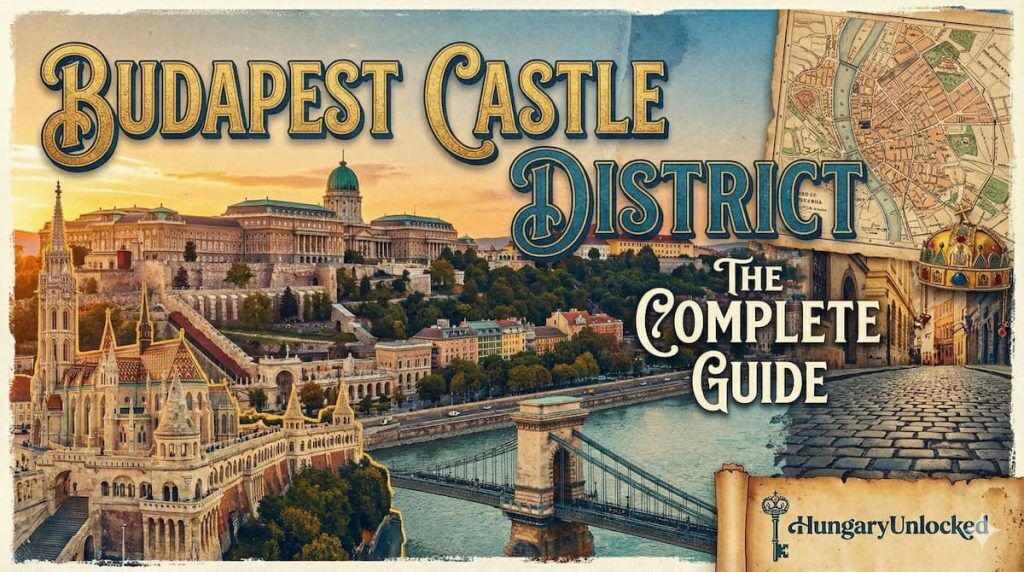
Everything you need to know about Buda’s hilltop wonderland—without the tourist trap BS

There’s a universal truth about the Castle District: everyone goes, everyone photographs the same view of Parliament, and almost nobody ventures beyond Fisherman’s Bastion. That’s a shame, because the real magic hides in the crooked side streets, the underground caves, and the tiny cafés where tourists rarely wander.
The Castle District sits on top of Castle Hill on the Buda side of the Danube. It’s UNESCO World Heritage, incredibly photogenic, and genuinely historic—not the “we rebuilt this in 1995 but made it look old” kind of historic, but the “this has survived Mongol invasions, Turkish occupation, and Soviet artillery” kind. Most of what you see today is a postwar reconstruction, true, but the bones are medieval.
If the Castle District were a person, it would be that impossibly elegant grandmother who survived more drama than a telenovela but somehow still has impeccable taste and only mild opinions about your life choices.
Getting Up the Hill
Castle Hill rises about 170 meters above the Danube. You have options for conquering it, and your choice says more about you than any personality quiz.
The Funicular: For the Romantics and the Tired
The Budavári Sikló is the scenic, Instagram-worthy, “we’re on vacation” option. Built in 1870, destroyed in WWII, lovingly rebuilt in 1986, this little wooden cable car takes 90 seconds to travel what would take you 15 minutes on foot. Through the windows, you get a postcard view of the Chain Bridge and Parliament that somehow never gets old.
Is it worth the money? That depends on how much you hate walking uphill and how much you love the idea of a 19th-century cable car. Most visitors ride up and walk down, which is honestly the smart play—you get the experience without paying twice. We’ve written a complete funicular guide if you want all the details.
Funicular Practical Info
📍 Clark Ádám tér (lower) → Szent György tér (upper)
🎫 One-way: 3,000 HUF (~€7.50) | Round-trip: 5,000 HUF (~€13)
🎫 Children 3-14: 2,000 HUF | Under 3: Free
🕐 Daily 7:30 AM – 10:00 PM
⚠️ NOT included in Budapest Card or BKK passes
The Castle Bus: For the Practical Minded
Buses 16, 16A, and 116 will get you up the hill for a fraction of the funicular price. Bus 16 runs between Deák tér in Pest (where all three metro lines meet) and the Castle District, stopping at several points along the way. It’s how locals would do it, if locals ever went to the Castle District voluntarily.
The 16A is particularly useful because it runs through the district itself, stopping at Vienna Gate, Kapisztrán tér, and Szentháromság tér before ending at Dísz tér near the Royal Palace. If you have a Budapest Card or any BKK travel pass, the bus is “free” in that you’ve already paid for it.
Walking: For the Stubborn and the Scenic
The steps next to the funicular are free, scenic, and a solid workout. About 15 minutes of climbing through interesting old streets, and you’ll arrive at the top feeling accomplished and slightly sweaty. The Király lépcső trail on the north side takes longer but feels less like cardio.
Here’s the insider move: take the bus up, then walk down. Your legs will thank you on the way up, and you’ll earn those calories back on the way down without the knee-punishing descent.
Fisherman’s Bastion: Worth the Hype?
Let’s address the elephant in the room. Fisherman’s Bastion looks like something Disney designed after watching too many period dramas. The white stone towers, the fairy-tale turrets, the sweeping Danube views—it’s almost suspiciously photogenic.
Here’s the secret: it was never actually a fortification. Frigyes Schulek designed it between 1895 and 1902 as a decorative terrace and lookout, built on the site where medieval fishermen allegedly defended this stretch of wall. The seven towers represent the seven Hungarian tribes that settled the Carpathian Basin in 895. It’s a monument to national mythology disguised as a castle, which is very Hungarian.

The views genuinely deliver. Parliament across the river, the Danube bridges stretching into the distance, and on clear days, the Buda Hills rolling away behind you. Sunrise and sunset turn the whole scene golden, and the crowds thin after dark when the towers glow with atmospheric lighting.
The Money Situation
The lower terraces are always free, and they offer almost the same views as the paid upper section. You can wander around, take photos, and enjoy the architecture without spending a forint. The upper towers cost 1,700 HUF for adults, half that for students and seniors, and free for kids under 6.
Here’s the local trick: the upper section is free before 9 AM, after 7 PM (or 9 PM in summer), and on Hungarian national holidays. Show up at sunrise for empty terraces and free access. You’ll feel like a genius.
Fisherman’s Bastion Practical Info
📍 Szentháromság tér, 1014 Budapest
🎫 Lower terrace: Free | Upper towers: 1,700 HUF adults
🕐 Lower: 24/7 | Upper: 9 AM – 7/9 PM (season dependent)
🆓 Free before 9 AM, after closing, and on March 15, Aug 20, Oct 23
Matthias Church: The Real Jewel

If Fisherman’s Bastion is the pretty face of Castle Hill, Matthias Church is its soul. Officially called the Church of Our Lady, everyone calls it Matthias Church because King Matthias—Hungary’s most beloved medieval ruler—held both his weddings here. The building’s history reads like a crash course in Hungarian trauma: founded in the 13th century, expanded by King Matthias, converted to a mosque by the Ottomans, reclaimed by the Habsburgs, bombed in WWII, rebuilt, and still standing.
Step inside and you’ll find something unexpected. Despite the Gothic exterior, the interior feels almost Byzantine—rich wall paintings, geometric patterns, and an atmosphere that suggests this building has witnessed things it will never discuss. The Turks whitewashed the Christian decorations during their 150-year occupation; when the Habsburgs reclaimed the church, workers discovered fragments of the original medieval frescoes beneath the plaster. Those fragments informed the current decorative scheme, which makes the whole interior feel like a palimpsest of Budapest’s complicated history.
The acoustics are famous. If you catch a concert here, you’ll understand why—the sound fills the space in a way that modern concert halls spend millions trying to replicate. Concerts happen regularly, especially around holidays.
Matthias Church Practical Info
📍 Szentháromság tér 2, 1014 Budapest
🎫 Adults: 1,400 HUF (~€3.50) | Students: 1,000 HUF | Under 6: Free
🕐 Mon-Fri 9-5, Sat 9-1, Sun 1-5
🔗 matyas-templom.hu
💡 Pro tip: The bell tower is climbable—197 steps to a lookout at 47 meters
The Royal Palace: Museums, Views, and Mild Confusion
The massive building dominating the southern end of Castle Hill is the Royal Palace, but if you’re expecting a Versailles-style tour through royal bedrooms, prepare for disappointment. There’s no “palace experience” in the traditional sense—the building now houses museums, the national library, and a lot of impressive courtyards.
The Hungarian National Gallery occupies wings B, C, and D, showcasing Hungarian art from medieval to contemporary. If you’ve never heard of Hungarian painting, this is your education—the Munkácsy and Csontváry rooms alone justify the visit. The Budapest History Museum in Wing E takes you through the city’s story from Roman times to the present, including genuinely interesting medieval palace ruins in the basement. Both are included with certain Budapest Card tiers.
The courtyards and terraces are free to explore, and the views toward the Buda Hills rival anything Fisherman’s Bastion offers with a fraction of the crowds. The Matthias Fountain—an ornate sculptural fountain depicting a hunting scene—sits in the main courtyard and is probably the most photographed water feature in Hungary.
Royal Palace Museums
📍 Szent György tér 2, 1014 Budapest
🎫 National Gallery: 3,200 HUF | History Museum: 2,400 HUF
🕐 Both: Tue-Sun 10 AM – 6 PM (Closed Monday)
The Streets Nobody Talks About
The tourists concentrate around Szentháromság tér and Fisherman’s Bastion. Walk five minutes in any direction and you’ll find the Castle District that actually lived here for 800 years.
Úri utca is the longest street in the district and possibly the most beautiful. Baroque townhouses, medieval cellars converted into wine bars, and that particular silence you only get when cars are banned. Look for the iron loops embedded in some doorways—medieval hitching posts for horses. Look up and you’ll see Gothic window frames hidden behind Baroque facades, remnants of the neighborhood’s medieval incarnation.
Fortuna utca feels like a film set, but people actually live here. The houses lean slightly toward each other across the narrow street, their facades painted in faded pastels. Halfway down, a tiny doorway leads to one of the castle’s cave entrances—the whole hill is honeycombed with tunnels.
Táncsics Mihály utca holds the medieval Jewish prayer house at number 26, a remnant of the community that lived here before the Turkish occupation. The quiet courtyard feels detached from the tourist bustle just a block away.
Pro tip: Come early morning or late afternoon. The side streets transform when the tour groups clear out, and you can actually hear the pigeons.
Underground: Caves, Bunkers, and Buried History
Castle Hill isn’t solid rock—it’s a labyrinth. Approximately 10 kilometers of caves, cellars, and tunnels riddle the interior, formed by thermal springs and expanded by humans over centuries. Wine storage, emergency shelters, WWII bunkers, Cold War secrets—everything happens underground in Budapest.
Hospital in the Rock
Hidden beneath the Castle District, a secret hospital operated during the 1944-45 siege, treating wounded soldiers and civilians in conditions that make your worst hospital experience look luxurious. After WWII, the complex was upgraded into a nuclear bunker, classified top secret until 2002.
Today the Sziklakórház is a museum preserving the original hospital setup, complete with 200 wax figures recreating the harrowing conditions. It’s not a fun experience in the traditional sense, but it’s one of the most powerful museums in Budapest. The Cold War-era additions—decontamination chambers, radiation suits—add an extra layer of historical dread. We’ve covered this in depth in our WWII Castle District guide.
Hospital in the Rock Practical Info
📍 Lovas út 4/c, 1012 Budapest
🎫 Adults: 24 EUR / 7,500 HUF (donation) | Students: 17 EUR
🕐 Guided tours only—book at sziklakorhaz.eu
⚠️ Not recommended for children under 12
The Labyrinth
For something less heavy but equally underground, the Buda Castle Labyrinth offers about 1.5 kilometers of accessible caves and tunnels. The exhibitions lean tourist—”Dracula’s Chamber” commemorates Vlad the Impaler’s alleged imprisonment here by King Matthias, and the atmosphere aims for spooky rather than historical. After 6 PM, they turn off the lights and hand you oil lamps, which children find terrifying in the best way.
The labyrinth entrance on Úri utca 9 is easy to miss if you’re not looking. Bring a jacket—it’s 14°C down there regardless of the season above.
Labyrinth Practical Info
📍 Úri utca 9, 1014 Budapest (wheelchair access: Lovas út 4/A)
🎫 Adults: 2,500 HUF | Students: 2,000 HUF | Children: 600 HUF
🕐 Daily 10 AM – 7 PM
What to Skip
Not everything in the Castle District deserves your precious vacation time.
The restaurant directly on Szentháromság tér—you know the one with the terrace seating and the “Hungarian specialties” menu printed in twelve languages—charges three times what you’d pay 200 meters away for half the quality. If the menu has photos, walk away. If the waiter hands you an English menu without asking, consider whether you’re being sorted into the tourist track.
The Fisherman’s Bastion restaurant offers great views and mediocre food at absurd prices. Have a coffee on the terrace if you must; eat dinner literally anywhere else.
The tourist shops selling “traditional” Hungarian goods—paprika in ornate boxes, embroidered tablecloths, wooden toys—price everything for impulse buyers who won’t comparison shop. The same items cost half as much in the Central Market Hall or at shops in Pest.
When to Visit
The Castle District transforms dramatically depending on timing.
Early morning—before 9 AM—gives you empty streets, free Fisherman’s Bastion access, and that golden light photographers obsess over. You’ll share the cobblestones with dog walkers and delivery people, not tour groups.
Golden hour in the evening brings the best photos and decent crowd levels. The tourists clear out as restaurants fill up, and the district takes on a romantic glow that almost justifies the overpriced wine.
Weekdays beat weekends, always. Summer weekends between 11 AM and 4 PM approach insufferable unless you actively enjoy shuffling through crowds.
If you can time your visit to avoid cruise ship days—typically mid-morning to early afternoon—your experience improves dramatically. The big ships dock, disgorge passengers into waiting buses, and those buses head straight for Castle Hill.
Staying in the Castle District: The Airbnb Situation
Here’s something most travel guides won’t tell you: finding short-term rental accommodation in the Castle District is getting increasingly difficult—and that’s by design.
Budapest has been cracking down on Airbnb-style rentals for years, and the Castle District is ground zero for the latest restrictions. As of January 2026, a city-wide moratorium effectively freezes new short-term rental licenses, and District I (the Castle District) is now considering a full ban on apartment hotels, following the model already implemented in neighboring Terézváros (District VI).
According to Daily News Hungary, Deputy Mayor Csilla Fazekas has initiated talks with surrounding districts about coordinated restrictions. The data supports the policy: in Terézváros, where the ban took effect in January 2026, rental supply jumped 28% while median rents actually dropped 1%—rare good news for anyone trying to live in central Budapest.
For the Castle District specifically, property portal ingatlan.com reports that median monthly rents hit 300,000 HUF (~€784) in January 2026—a 4% increase year-over-year. Property prices per square meter rose 15% to roughly 1.9 million HUF (~€4,966). This is one of Budapest’s most expensive neighborhoods, and it’s getting pricier.
What this means for visitors:
- Traditional hotels remain your most reliable option in the Castle District—we’ve reviewed the best ones
- Existing Airbnb listings may still operate, but expect fewer options and higher prices
- Consider staying in Pest and visiting the Castle District as a day trip—it’s what most visitors do anyway
- If you find a Castle District rental, verify it’s legally operating (licensed hosts will have registration numbers)
The upside? Fewer short-term tourists means the residential character that makes the Castle District special might actually survive. Sometimes regulation works.
How to Do This Right
Here’s how we’d spend a day in the Castle District if we had to design the perfect visit:
Arrive early, before 9 AM, via the stairs next to the funicular. Walk directly to Fisherman’s Bastion while it’s still free and empty. Take your photos without strangers’ heads in frame.
When Matthias Church opens at 9, you’re first in line. Spend 45 minutes with the interior, climb the bell tower if you’re feeling ambitious, then exit as the first tour groups arrive.
Wander the side streets while the crowds concentrate on the main square. Úri utca, Fortuna utca, Országház utca—get lost on purpose. Find a tiny café for coffee and cake.
Mid-morning, head to the Budapest History Museum or National Gallery—whichever suits your interests. The medieval ruins beneath the History Museum are genuinely fascinating and almost always empty.
Lunch at one of the restaurants a block off the main drag. Baltazár on Országház utca delivers quality without the tourist markup.
Afternoon: choose your underground experience. Hospital in the Rock for heavy history, the Labyrinth for lighter exploration. Either one takes about an hour.
Walk down via the Várkert Bazár terraces for different views and architecture. End at the riverbank as the city starts glowing. If you still have energy, consider a thermal bath to soak away the cobblestone miles.
The whole thing takes 5-6 hours if you’re thorough, 3-4 if you’re efficient. Either way, you’ll have actually experienced the Castle District rather than just photographing it.
Related Guides
Looking for more Castle District content? Check out:
– The WWII History of Castle Hill — Bunkers, bullet holes, and buried stories
– Budapest Funicular Complete Guide
– Castle Labyrinth Review
– Parliament Building Tour Guide
– Budapest Card: Worth It?
Last updated: January 2026


