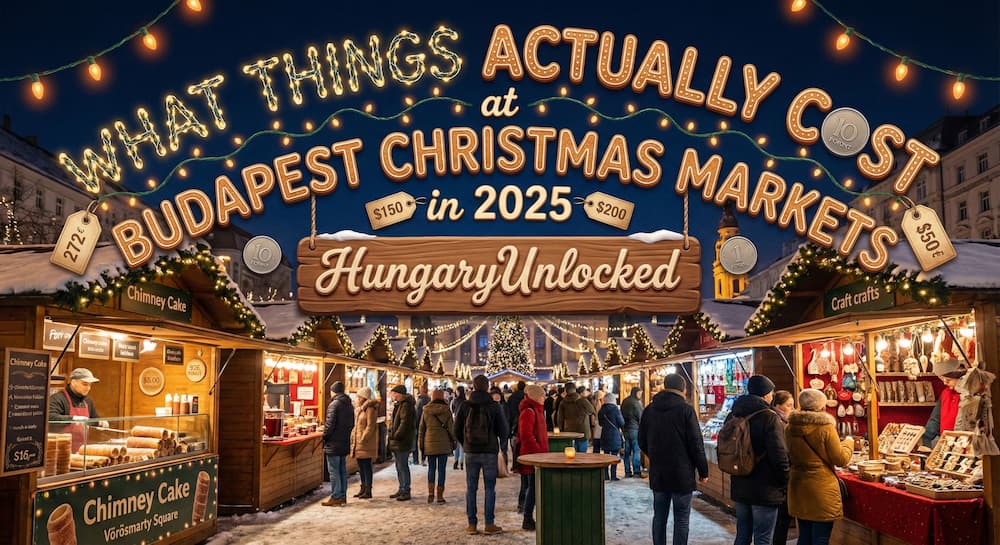
TL;DR – The Quick Budget Breakdown
Budget visit (1 person): 10,000-12,000 HUF ($26-31) – Fixed-price meal, 2 mulled wines, kürtőskalács, and change for a small souvenir.
Comfortable experience: 15,000-20,000 HUF ($39-52) – Proper meal like goulash or stuffed cabbage, premium drinks, dessert, and browsing money.
“I’m on vacation” splurge: 30,000+ HUF ($78+) – Roasted goose, alcoholic hot chocolate, fancy chimney cake, multiple drinks, and actual Christmas shopping.
The secret hack: Every large food stall must offer at least one dish at the fixed price of 1,600 HUF ($4.15). You just have to ask for it.
Let me be completely honest with you: I’ve lived in Budapest for over four decades, and every November I tell myself I won’t get sucked into the Christmas market hype. And every November, sometime around mid-November when the lights go up and the first whiffs of cinnamon-spiked mulled wine drift through the cold air, I find myself standing in Vörösmarty Square with a paper cup warming my hands, wondering how I got there again.
The Budapest Christmas markets have won “Europe’s Best Christmas Market” for four consecutive years now. That’s not nothing. But here’s what those shiny awards don’t tell you: the prices at these markets have evolved to match their Instagram fame. What was once a charming local tradition has become a slickly organized tourist operation—beautiful, yes, but priced accordingly.
This guide exists because I’m tired of watching visitors’ faces fall when they see a 6,700 HUF ($17.40) price tag on two pieces of stuffed cabbage. I’m tired of reading TripAdvisor reviews from people who felt ripped off because nobody told them the rules of the game. And I’m especially tired of generic travel blogs that say “expect to spend €50-100” without telling you what that actually buys.
So here’s everything you need to know about what things really cost at Budapest’s Christmas markets in 2025—and how to enjoy yourself without needing a second mortgage.

Arriving at the Markets: What to Expect When You Step Off the Metro
I walked out of the Vörösmarty tér metro station on a Tuesday evening in mid-November, and the transformation was already complete. The elegant square that normally hosts outdoor cafés and the occasional demonstration had become a glittering wonderland of wooden stalls, fairy lights, and the kind of atmospheric fog that either comes from the cold meeting warm breath or from some very clever event organizers.
The smell hits you first. It’s layers of scent that have become almost clichéd in their Christmas-market-ness: roasted chestnuts, caramelizing sugar from the kürtőskalács stands, the warm spice of forralt bor (mulled wine), and underneath it all, the savory promise of grilled sausages and paprika-laced stews. It’s manipulative and it works. Within thirty seconds, you’re hungry for something you weren’t thinking about when you left your hotel.
The sound is a low hum of multilingual chatter—I counted English, German, Spanish, and what I think was Korean within my first five minutes—punctuated by the occasional burst of traditional Hungarian folk music from the stage. There’s a Christmas carol playing from somewhere, but it’s competing with about three other audio sources, creating that slightly chaotic audio landscape that’s either charming or headache-inducing depending on your tolerance.
The crowds in mid-November are manageable. Come back on a Saturday in December, and you’ll be shuffling shoulder-to-shoulder through what feels like half of Europe’s tourist population. The difference between “pleasantly festive” and “sweaty nightmare” is about two weeks and 48 hours.
Here’s what I noticed locals doing versus tourists: locals grab their mulled wine and keep moving. They meet friends, do a lap, maybe buy one or two things, and leave within an hour. Tourists set up camp at the standing tables, work through the food options systematically, and stay for the evening. Neither approach is wrong, but the first one is significantly cheaper.

The Complete 2025 Christmas Market Food Price Guide
Let me give you the actual numbers I photographed from menu boards in November 2025. These are real prices from real stalls—not estimates, not averages, not “approximately.”
Lángos (Deep-Fried Dough)
Lángos is Hungary’s gift to carbohydrate-lovers everywhere. It’s a disc of deep-fried dough that’s crispy on the outside and pillowy within, traditionally topped with sour cream and cheese. At the Christmas markets, you’ll find it in variations that would make my grandmother weep.
Plain lángos (sima): 2,000-2,400 HUF ($5.20-6.25)
With sour cream and cheese (tejfölös-sajtos): 3,000-3,200 HUF ($7.80-8.30)
With garlic butter: 2,400-2,800 HUF ($6.25-7.30)
“Dubai chocolate” lángos: 4,700-4,900 HUF ($12.20-12.75)
Nutella-filled monstrosities: 4,500-4,900 HUF ($11.70-12.75)
My recommendation? The tejfölös-sajtos version is the only one worth ordering. The sweet versions have been described by a Hungarian food critic in terms so devastating that I can’t improve on the original sentiment: basically, they’re an insult to the concept of lángos. The cheese version is what you came for. Everything else is Instagram content masquerading as food.

Kürtőskalács (Chimney Cake)
This Transylvanian sweet bread is rolled around a wooden spit, coated in sugar, and roasted over charcoal until the outside caramelizes into a crispy shell while the inside stays soft and yeasty. It’s one of the few genuine Hungarian traditions at these markets, and when done right, it’s transcendent.
Traditional flavors (cinnamon, vanilla, walnut, cocoa): 2,800 HUF ($7.30)
Premium/filled versions (Oreo, Nutella, ice cream): 4,500 HUF ($11.70)
Gluten-free versions (at Vitéz Kürtős, Tuesdays and Wednesdays only): 3,200 HUF ($8.30)
The stall called Vitéz Kürtős gets consistently good reviews for properly soft dough with crispy exteriors. They’re one of the few who seem to actually care about quality control. Look for them.
Main Dishes (Where Your Wallet Starts to Sweat)
This is where things get genuinely expensive, and where knowing the rules matters most.

Grilled sausage (sült kolbász) with bread: 5,500-5,700 HUF ($14.30-14.80)
Debreceni sausage pair with mustard/horseradish: 5,400 HUF ($14.05)
Beef goulash in bread bowl (marhapörkölt): 5,700 HUF ($14.80)
Stuffed cabbage (töltött káposzta), 2 pieces: 5,500-6,700 HUF ($14.30-17.40)
Székelykáposzta (Transylvanian cabbage stew): 5,700-6,500 HUF ($14.80-16.90)
Roasted goose thigh (sült libacomb): 7,400 HUF ($19.25)
BBQ beef rib (30cm): 8,300 HUF ($21.60)
Pulled pork sandwich: Up to 8,100 HUF ($21.05)
Beef stew with potatoes: 6,500-9,000 HUF ($16.90-23.40)
Let me put this in perspective: a proper sit-down meal at a good Budapest restaurant costs about the same as a single main dish at these markets. You’re paying a 100-200% markup for the privilege of eating standing up in the cold.

The 1,600 Forint Fixed-Price Secret
Here’s the hack that will save you actual money, and that almost nobody knows about: every large food stall at the main markets is required to offer at least one full-portion dish at the fixed price of 1,600 HUF ($4.15).
This isn’t some sad appetizer portion. These are legitimate meals:
- Székelykáposzta (Transylvanian pork and cabbage stew)
- Paprikás krumpli (paprika potatoes with sausage)
- Kolbászos lecsó (sausage stew with peppers)
- Single portion of stuffed cabbage
The catch? They don’t advertise it prominently. One Hungarian food journalist reported that only one stall in the entire market had the discounted price visibly written out. You have to ask: “Van 1600 forintos menü?” (Is there a 1,600 forint menu?). The longest queues you’ll see are often at stalls where locals have figured out which ones have the good fixed-price options.
This system exists because the market organizers wanted to keep things accessible to actual Hungarians, not just tourists with strong euros. Use it.
Desserts and Snacks
Strudel (rétes): 1,900-2,000 HUF ($4.95-5.20)
Roasted chestnuts (100g): 2,500-2,800 HUF ($6.50-7.30)
Mézeskalács (gingerbread): 1,500-3,000 HUF ($3.90-7.80) depending on size
Flódni (Jewish layered cake): 1,800-2,200 HUF ($4.70-5.70)
The rétes (strudel) is usually a safe bet—hard to mess up apple or túró (curd cheese) wrapped in phyllo. The chestnuts are atmospheric but overpriced compared to buying a bag from a street vendor elsewhere in the city.

Drink Prices: Mulled Wine, Punch, and the Alcoholic Hot Chocolate Trap
Drinks are where the markets actually approach reasonable pricing—at least for the basics.
Mulled Wine (Forralt Bor)
Standard mulled wine (3 dl): 1,500 HUF ($3.90)
This price is standardized across all the official “forróital-pont” (hot drink) stands. It’s actually cheaper than what you’d pay at British or German Christmas markets—roughly equivalent to £3.50, compared to the £7+ you’d spend in London.
Premium mulled wine (DiVino stand): 2,150 HUF ($5.60)
DiVino uses actually good wine and vermouth in theirs. Worth the extra two dollars if you care about what you’re drinking.

Punch (The Trap)
Non-alcoholic punch: 1,500-1,560 HUF ($3.90-4.05)
Alcoholic punch (rum, tequila, etc.): 3,200-4,500 HUF ($8.30-11.70)
Here’s where people get surprised: the base price advertised is usually for the non-alcoholic version. Adding alcohol more than doubles the cost, and several visitors have reported confusion when their bill arrived significantly higher than expected. Always clarify whether you’re ordering the boozy version.
Hot Chocolate and Other Drinks
Basic hot chocolate: 1,700-1,900 HUF ($4.40-4.95)
Alcoholic hot chocolate: 3,500-6,800 HUF ($9.10-17.70)
Hot tea: 900-1,300 HUF ($2.35-3.40)
Coffee (regular stands): 1,100-1,250 HUF ($2.85-3.25)
Coffee (%Arabica specialty stand): 1,600-2,200 HUF ($4.15-5.70)
If you want actually good coffee, seek out the %Arabica stand—it’s an Asian specialty coffee chain with their first Hungarian location, and they roast their own beans at their Király utca shop. It shows.

The Best and Worst Times to Visit Budapest Christmas Markets
Least Crowded (Best for Actually Enjoying Yourself)
Weekday afternoons, 2-5pm, especially Monday through Wednesday. The stalls are open, the lights start coming on around 4pm, and you can actually move without being elbowed by someone’s selfie stick.
Opening time on any day works if you want crowd-free photos but don’t mind missing the evening atmosphere.
Most Atmospheric (But Also Most Crowded)
Evenings after 5pm when all the lights are blazing, the Basilica light show is running, and the decorated Christmas trams are glowing along the Danube. This is what you came for. It’s just that everyone else came for it too.
Avoid at All Costs
Friday and Saturday evenings from 6-9pm, especially during the first two weekends of December. This is shoulder-to-shoulder, queue-for-everything, can’t-see-the-stalls chaos. Weekend afternoons are manageable; weekend evenings are not.
Weather and What to Wear (Honest Edition)
December in Budapest averages 3-5°C (37-41°F) during the day and drops to -1 to -2°C (28-30°F) at night. That’s cold, but it’s not the bone-chilling Arctic experience that first-timers sometimes expect.
Snow is possible but no longer guaranteed—climate change has made white Christmases increasingly rare. A light dusting is more likely than a winter wonderland. One visitor I spoke with had rain on 5 of their 7 days in late November.
What to actually wear:
- Layers. The markets have heated areas, indoor warming tents, and the body heat of a thousand tourists, so you’ll be peeling things off periodically.
- A waterproof jacket. Not because it will definitely rain, but because when it does, you don’t want to leave.
- Warm, waterproof boots. Not sneakers. The cobblestones get slippery, and standing on cold stone for hours will make you miserable.
- Gloves you can take off easily. You’ll need your fingers for food, photos, and payments.
- A hat. Heat escapes from your head. Don’t be proud.
Cheaper Local Alternatives: Where Budapestians Actually Go
The uncomfortable truth about Vörösmarty Square and St. Stephen’s Basilica: they’re priced for tourists. The prices I listed above are typically 2-3x what you’d pay at a normal Budapest restaurant for similar dishes.
But Budapest has other Christmas markets where actual locals shop:
Óbuda Christmas Market (Fő tér)
Dates: November 28 – December 23, 2025
This is where locals go because, as one resident put it, “locals would riot” at tourist prices. Free ice skating, free concerts, puppet shows for kids. The vibe is authentically Hungarian rather than performing Hungarianness for tourists—you’ll hear more Magyar than English, which is always a good sign.
Getting there: Metro M2 to Batthyány tér, then the HÉV suburban rail to Árpád híd.
Ferenc Tér Market
Organized by the Pancs farmers’ market crew who deliberately keep prices accessible. Cash only (which keeps the €8 mulled wines away). It’s got village fête energy with actual neighborhood residents.
Getting there: Tram 4-6 to Ferenc körút.
Városháza Park (City Hall Park) Winter Market
Dates: November 14 – January 10, 2026
Strikes a middle ground—centrally located but more family-focused and budget-friendly than the two famous markets. The ice rink here costs 2,500 HUF ($6.50) entry plus 2,000-2,500 HUF ($5.20-6.50) for skate rental.
Official website – click here
The Two-Minute Walk That Saves You 50%
This is the single most useful piece of advice I can give you: walk two minutes away from any Christmas market and your food costs drop by half.
Retró Lángos Büfé near Arany János metro (M2 line) sells sour cream and cheese lángos for 750 HUF ($1.95) compared to the 3,000+ HUF at the markets. It’s an 8-minute walk from the Basilica market.
Lehel Market (three stops on M3 from Deák Ferenc tér) has lángos vendors inside the colorful market hall at genuinely local prices.
The metro station stands at Deák Ferenc tér and Nyugati Pályaudvar sell kürtőskalács for around 350 HUF ($0.90)—compared to 2,800-4,500 HUF at the Christmas markets.
The Great Market Hall (Nagyvásárcsarnok) at the southern end of Váci Street has authentic food at local prices year-round. It’s not Christmas-themed, but a Wiener schnitzel with vegetables runs about 3,000 HUF ($7.80) instead of the €20+ equivalent at market stalls.
For more about Budapest’s food markets, check out our guide to Budapest’s best markets.
Market Dates, Opening Hours, and Getting There
Vörösmarty Square Christmas Market
Dates: November 14, 2025 – December 31, 2025
Opening Hours:
- Monday – Thursday: 11:00 – 21:00
- Friday – Saturday: 11:00 – 22:00
- Sunday: 11:00 – 21:00
- December 24: 10:00 – 14:00
- December 31: 11:00 – 03:00 (yes, 3am)
IMPORTANT: This market is CARD ONLY. No cash accepted anywhere. Make sure your card works internationally and has no foreign transaction fees.

Getting there: Metro M1 (yellow line) to Vörösmarty tér—the station exit is literally in the square.
Official website – click here https://vorosmartyclassicxmas.hu/en/
St. Stephen’s Basilica Christmas Market (Advent Bazilika)
Dates: November 14, 2025 – January 1, 2026
Opening Hours:
- Sunday – Thursday: 10:00 – 22:00
- Friday – Saturday: 10:00 – 23:00
The 3D light show on the Basilica facade runs every 30 minutes from 4:30pm–10pm. It’s free and genuinely spectacular—one of the things that earns this market its awards. Free 3D glasses available at stalls.

Ice skating is free for children under 14. Adult skate rental: 1,950 HUF ($5.05) plus deposit.
Payment: Both cash and card accepted (unlike Vörösmarty Square).
Getting there: Metro to Deák Ferenc tér (M1/M2/M3 intersection), then a 5-6 minute walk north on Bajcsy-Zsilinszky út.
Fun fact: The two markets are about a 10-minute walk from each other, connected by the beautifully lit Fashion Street (Deák Ferenc utca). Do both in one evening.
Official website – click here https://adventbazilika.hu/en
For a complete guide to visiting both markets and other Christmas activities, see our full Budapest Christmas Markets guide.
Local Insider Hacks (Some Silly, Some Actually Useful)
The mug deposit game: When you order mulled wine, you’ll pay a deposit of around 1,000-1,500 HUF for the ceramic mug. Return it and get your deposit back, or keep the mug as a souvenir. Here’s the hack: mugs from previous years are sold on Jófogás (Hungarian eBay) for 500-800 HUF. If you want a collection, that’s cheaper than keeping multiple deposits.
The heat lamp hierarchy: The best standing tables are the ones with overhead heat lamps. Locals know this, which is why they’re always taken. Arrive early or hover politely.
The bathroom situation: There are free public toilets in both market areas, but the queues can be brutal. The Gerbeaud café on Vörösmarty Square has bathrooms, as does the Basilica itself (small donation expected). Several visitors have learned this the hard way.
The secret warm-up: The Basilica offers organ concerts most evenings during Advent. It’s warm inside, the acoustics are extraordinary, and tickets start at around 4,000 HUF. Better use of your money than standing in the cold eating your third kürtőskalács.
The photographer’s hour: The 30 minutes right after the Basilica light show starts are when everyone’s watching the show, not shopping. This is when to grab your photos of the stalls without human obstructions.

The weekday wine hack: Tuesday and Wednesday evenings have the best ratio of atmosphere-to-crowds. Friday-quality lights, Monday-quality elbow room.
The Honest Negatives (Because Every Review Needs Them)
I wouldn’t be doing my job if I didn’t tell you the downsides. Here’s what might disappoint you:
The Food Quality Is Inconsistent
Some stalls serve lukewarm goulash that’s been sitting too long. The kürtőskalács at the wrong vendor is dense and undercooked. Several TripAdvisor reviewers mentioned receiving stale bread. At these prices, “inconsistent” stings more than it would at a cheap street food stall.
The Crowds Are Genuinely Difficult
On weekend evenings, you will queue 15+ minutes for popular food stalls. You will get jostled. The “intimate market atmosphere” promised in brochures becomes “packed like a Tokyo subway” between 6-9pm on Saturdays. If you have mobility issues or claustrophobia, weekday afternoons are your only realistic option.
It’s Not the Best Christmas Market in Europe
Multiple visitors who’ve done the Christmas market circuit have ranked Budapest below Nuremberg, Munich, Vienna, and Kraków for actual Christmas market experience. “Less impressive Christmas decor” is a common theme. If you’re coming specifically for the markets and have already experienced the German originals, calibrate your expectations. Budapest wins awards for atmosphere and the Basilica light show—not for being a superior traditional Christmas market.
Some Pricing Practices Are Frustrating
I’ve seen the TripAdvisor horror stories: “£52 for two bread buns with stew,” “€29 for a sausage sandwich that was advertised at €11.” What’s actually happening: some stalls list base prices then charge separately for toppings, sauces, or bread. A kolbász at 5,500 HUF became 8,000 HUF for one visitor who didn’t realize the flatbread was extra. Always ask for the total price before ordering. Always check the payment terminal before tapping.
Summary: How to Do Budapest Christmas Markets Right
Here’s the condensed version of everything I’ve learned from decades of grudging Christmas market attendance:
Do go. Despite the prices and crowds, the Basilica light show alone is worth the trip, and the atmosphere on a crisp December evening is genuinely magical.
Don’t eat dinner there. Have the mulled wine, share a kürtőskalács, maybe try the 1,600 HUF fixed-price option for a snack. Then walk ten minutes to any restaurant in the Jewish Quarter and eat actual Hungarian food at actual Hungarian prices.
Go on a Tuesday or Wednesday evening for the best balance of atmosphere and sanity.
Budget 10,000-15,000 HUF ($26-39) per person for a comfortable experience that doesn’t feel like robbery.
Explore the local markets if you want to see how Hungarians actually celebrate the season. Óbuda won’t win any European awards, but it’ll warm your soul in ways that tourist-priced stuffed cabbage cannot.
And remember: every local standing in that market with you paid the same prices. We just complain about it more colorfully.
Happy holidays, and may your lángos always be crispy.
FAQ: Your Budapest Christmas Market Questions, Answered
Q: Is it true that Vörösmarty Square is card-only?
A: Yes, completely. As of 2025, the entire Vörösmarty Square Christmas Market operates on card payments only—no cash accepted at any stall. St. Stephen’s Basilica market still accepts both. Make sure your card works for international transactions and ideally has no foreign transaction fees. Some visitors have been caught off guard by this.
Q: What’s the 1,600 forint thing everyone keeps mentioning?
A: Every large food vendor at the main markets is required to offer at least one full-portion meal at the fixed price of 1,600 HUF (~$4.15). These are legitimate dishes—stuffed cabbage, Transylvanian cabbage stew, paprika potatoes—not sad appetizer portions. The trick is that they’re not prominently advertised. You have to ask: “Van 1600 forintos menü?” Most vendors look slightly annoyed when you do this. That’s how you know it’s working.
Q: Which market is better—Vörösmarty Square or St. Stephen’s Basilica?
A: St. Stephen’s Basilica is more spectacular (the 3D light show, the ice rink, the sheer visual impact of the illuminated church), but it’s also more crowded and slightly more expensive. Vörösmarty Square has a more traditional “market” feel with arguably better food variety. My advice: do both. They’re a 10-minute walk apart, and the evening stroll along Fashion Street is part of the experience.
Q: How cold does it actually get?
A: December averages highs of 3-5°C (37-41°F) and lows of -1 to -2°C (28-30°F). That’s chilly, not Arctic. Dress in layers, wear proper boots, and you’ll be fine. Snow is possible but not guaranteed—white Christmases are increasingly rare in Budapest.
Q: Can I visit the markets on Christmas Day?
A: No. Vörösmarty Square closes at 2pm on December 24th and stays closed December 25-26. St. Stephen’s Basilica typically closes for December 25th as well but reopens December 26th. If you’re in Budapest on Christmas Day itself, plan for a quiet day of thermal baths and hotel restaurants.
Q: Are the markets wheelchair accessible?
A: Mostly, yes. Both main markets are on paved squares with no steps to access. However, the crowds on weekend evenings make wheelchair navigation very difficult. Weekday daytime visits are much more accessible. Some stall counters are quite high, which can be challenging.