🎄 TL;DR
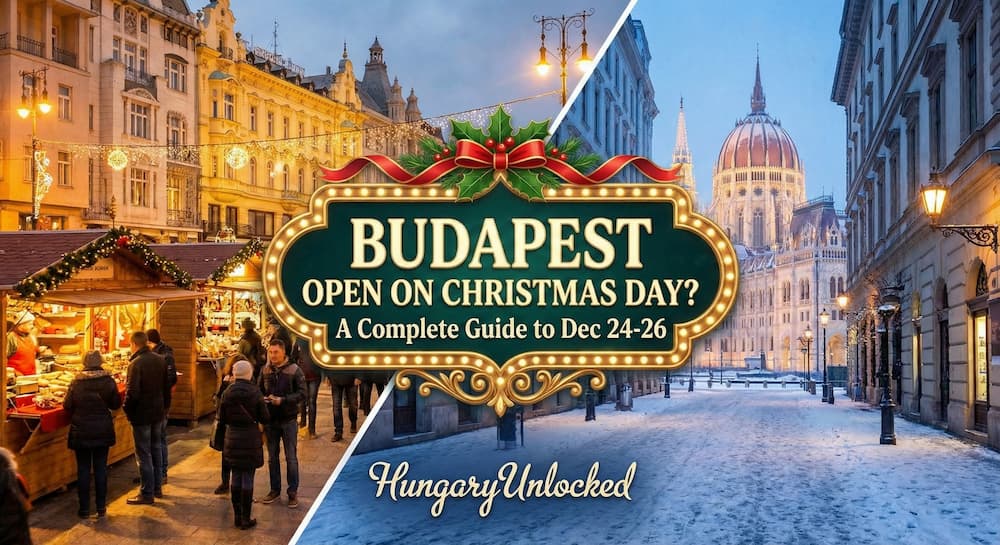
Is Budapest Open on Christmas Day?
✓ Do This
Thermal baths, markets, Danube cruise, Opera Nutcracker, illumination walks
✗ Avoid
Expecting shops open, Gellért Bath (closed until 2028), no dinner reservation
💰 Prices: Bath entry ~15,000 HUF ($38) • Mulled wine ~1,500 HUF ($4) • Chimney cake ~2,800-3,300 HUF ($7-8.50)
Let me be brutally honest with you right from the start: Budapest doesn’t really “do” Christmas the way you might expect. If you’re picturing bustling markets, packed restaurants, and a city alive with holiday cheer on December 25th, I’m about to save you from a very quiet, potentially hungry, reality check.
Here’s what every travel guide conveniently glosses over: Hungarians celebrate Christmas on the evening of December 24th, not December 25th. By 2pm on Christmas Eve, this city of nearly two million people essentially disappears indoors for intimate family gatherings. December 25th is the quietest day you’ll ever experience in a European capital. And December 26th? That’s when things slowly start waking up again.
The good news? Budapest IS open during Christmas — just not in the way most travel guides suggest. The city operates under dramatically different rules from December 24th through 26th, and understanding these rules is the difference between a magical holiday experience and three days of eating convenience store sandwiches while questioning your life choices.
I’m going to walk you through exactly what happens each day, what’s actually open (with real prices, not vague estimates), and how to turn what could be a disappointing ghost-town experience into something genuinely memorable. Because here’s the secret: Christmas in Budapest can be absolutely magical — but only if you know what you’re getting into.
Why Budapest Goes Silent on Christmas Eve (And What That Actually Looks Like)
Walk through central Budapest around 3pm on December 24th and you’ll feel like you’ve stumbled into an alternate dimension. The transformation is jarring. One moment you’re surrounded by Christmas market crowds sipping mulled wine, and ninety minutes later, you could fire a cannon down Váci utca without hitting anyone.
The smell hits you first — or rather, the absence of it. Those enticing aromas of kürtőskalács (chimney cake) and sizzling sausages that had been filling the air since mid-November? Gone. The market stalls at Vörösmarty Square, which close around 2pm on Christmas Eve, take all that sensory magic with them. What replaces it is something different: cold, crisp December air, the distant sound of church bells, and an almost reverent silence that settles over the city.
Here’s what most tourists miss: this quietness isn’t a bug, it’s a feature. Hungarians guard their Christmas Eve (we call it Szenteste) fiercely. Families gather after the first star appears in the evening sky, the Christmas tree is decorated ON December 24th (not before — that’s considered bad luck), gifts are exchanged, and then many attend midnight mass. The streets empty because everyone is exactly where they want to be: home with family.
Understanding this transforms your expectations. You’re not being shut out of Christmas — you’re witnessing a culture that takes the holiday so seriously that they actually stop everything to celebrate it properly.
December 24th in Budapest: The Day the City Shuts Down by Lunchtime
Let me paint you an hour-by-hour picture of what Christmas Eve actually looks like, because timing is everything on this day.
Morning (6am – 12pm) feels almost normal. Supermarkets open early — Tesco and Spar typically operate from 6am until noon — and you’ll find Hungarians doing frantic last-minute shopping for ingredients they forgot. The Christmas markets are still running, though with a slightly manic energy as vendors prepare for their final hours. This is your last chance to grab that chimney cake or pick up handcrafted souvenirs.
Early afternoon (12pm – 2pm) is when the shutdown begins. Supermarkets close their doors (and note: Lidl stays closed the entire day), shopping malls wind down, and the Christmas markets at Vörösmarty Square serve their final cups of forralt bor (mulled wine) around 2pm. The Basilica market usually stretches until 3pm, but don’t count on it.
Mid-afternoon onwards (2pm+) is when Budapest transforms. The thermal baths — Széchenyi closes at 1pm, Rudas at 1pm — have already emptied. Public transport begins reducing frequency, and by 3-4pm, the metro essentially switches to night service. By 6pm, you’re looking at a city that has collectively decided Christmas has officially begun.
What actually stays open on December 24th evening? Honestly? Not much. Your best bets are hotel restaurants (which I’ll cover in detail below), some ethnic restaurants that don’t observe Hungarian Christmas traditions, and a handful of venues in the Gozsdu Courtyard. The ruin bars? Szimpla Kert sometimes opens for a few evening hours, but don’t bet your dinner on it.
The key insight here: December 24th morning is your window. If you want market food, bath time, or any shopping whatsoever, you need to be out the door early. By the time most tourists finish their hotel breakfast and wander out around 10am, they’ve already lost half their opportunities.
December 25th: The Quietest Day in Any European Capital (And Why That’s Actually Amazing)
This is important to understand: December 25th is a legal public holiday in Hungary, and the law requires most shops to close. This isn’t a suggestion or a tradition that some businesses ignore — it’s enforced. Supermarkets? Closed. Shopping malls? The shops inside are closed (though cinemas and some restaurants might operate). Museums? Every single one is closed, no exceptions.
So what IS open? Here’s where it gets interesting.
The Christmas markets continue operating, typically from 10am to 6pm or 8pm, making them one of your best activity options. The crowds are significantly thinner than on regular December days, which means you can actually see the stalls, take photos without elbowing strangers, and enjoy a leisurely lángos without feeling like you’re in a rugby scrum.
Thermal baths are open and absolutely magical on December 25th. Széchenyi, Rudas, and Lukács all operate from around 10am to 8pm. Picture this: you’re soaking in 38°C water while steam rises around you, the grand Neo-baroque architecture of Széchenyi glowing in the winter light, possibly snowflakes (though let’s be realistic — snow is increasingly rare) drifting down onto the water’s surface. It’s the most Budapest Christmas experience you can have.

However — and this is crucial — expect queues of 30 to 90 minutes at Széchenyi on Christmas Day. The combination of “everything else is closed” plus “tourists heard the baths are open” plus “limited staff on a holiday” creates a perfect storm. My advice: arrive right at 10am opening or wait until mid-afternoon when the morning rush has soaked itself out.
Restaurant options exist but require advance planning. Hotel restaurants are your safest bet — the Corinthia, Marriott, and various other upscale hotels offer Christmas Day dining with advance reservations. Some restaurants in the Gozsdu Courtyard stay open, primarily the casual Italian and pizza places rather than traditional Hungarian spots. Ethnic restaurants — Lebanese, Indian, Chinese — often operate as their staff don’t observe Hungarian Christmas traditions.
The Danube river cruises run on December 25th, and honestly? This might be the best day to take one. The quiet streets mean the riverbanks are peaceful, the Parliament and Chain Bridge illuminations are spectacular, and you’re not sharing your boat with maximum-capacity crowds.
For a detailed breakdown of all the Christmas market locations, opening hours, and what to expect at each one, check out my comprehensive guide to Budapest’s Christmas Markets which includes current food and drink prices at every major market.
December 26th: When Budapest Starts Breathing Again
By the second day of Christmas (yes, Hungarians get two public holidays), you’ll notice the city beginning to stir. It’s still officially a public holiday, so supermarkets remain closed and many businesses stay shuttered, but some attractions start reopening their doors.
Museums selectively return to operation. The Hungarian National Gallery in Buda Castle, the Museum of Fine Arts, and the quirky Hospital in the Rock all typically open from 10am to 6pm on December 26th. After two days of closures, having access to world-class art collections feels like a gift itself.
The Opera House tours resume, usually at 2pm, 3pm, and 4pm. If you’ve been wanting to see the stunning interior of one of Europe’s most beautiful opera houses without committing to a full performance, December 26th is your day. Even better? The Nutcracker performances often run on December 26th, and multiple travelers have called this one of the highlights of their entire trip.
The Christmas markets hit their stride again with full hours (typically 11am to 8pm or later), and the thermal baths continue operating. The queues tend to be slightly shorter than December 25th as some tourists have moved on to their next destination.
This is the day to book that special restaurant dinner. While December 24th and 25th limit you to hotel dining or whatever’s open by chance, December 26th sees more traditional Hungarian restaurants reopening. If you’ve been craving a proper töltött káposzta (stuffed cabbage) or halászlé (fish soup) experience, your chances improve dramatically.
What to Eat and Drink During Budapest Christmas (Real Prices Included)
Let’s talk about the thing that matters most: food and drink prices, because the Christmas markets have developed a reputation for wallet-emptying that rivals airport restaurants.
At the main tourist markets — Vörösmarty Square and St. Stephen’s Basilica — here’s what you’ll actually pay based on current 2025 prices. A kürtőskalács (the iconic hollow chimney cake coated in sugar and various toppings) runs between 2,800-3,300 HUF ($7-$8.50 USD). Basic lángos (fried dough) starts at 2,000-3,200 HUF ($5-$8 USD), but the moment you add sour cream, cheese, and garlic, you’re looking at 3,200-3,900 HUF ($8-$10 USD). A cup of forralt bor (mulled wine) typically costs 1,500-1,600 HUF ($3.80-$4 USD), and a bowl of proper gulyás (goulash soup) will set you back 4,500-5,500 HUF ($11-$14 USD).
I’ll be honest with you: these prices are steep for Budapest. Multiple visitors on Reddit and TripAdvisor have pointed out that Budapest’s Christmas markets sometimes cost more than Vienna’s, which seems backwards given Hungary’s generally lower cost of living. One traveler reported a sandwich going from an advertised 11 euros to 29 euros after the vendor added sauces and sauerkraut without clearly stating the extra charges. Always confirm prices before ordering, and keep an eye on the amount charged if paying by card.
Here’s the local hack that nobody mentions in guidebooks: the smaller, less-touristy markets offer dramatically better value. The Christmas fair at Óbuda’s Fő tér, the market at Ferenc tér in the 9th district, and the Városháza Park (City Hall Park) market all run 30-50% cheaper than the main tourist spots. The atmosphere is arguably better too — more Hungarian families, fewer selfie sticks, and food that’s prepared for people who’ll come back next week, not tourists who’ll never return.
Money-saving tip: Every kitchen at the main markets offers a fixed-price basic menu for around 1,600 HUF ($4 USD) with rotating dishes like Székelykáposzta (Transylvanian cabbage stew), sausage with sides, or stuffed cabbage. Same quality, smaller portion — perfect for trying multiple dishes without going broke. Most tourists miss this completely.
If you’re looking for more affordable eating options throughout your Budapest trip, my guide to budget-friendly restaurants covers everything from market halls to local favorites that won’t destroy your travel budget.
Thermal Baths During Christmas: Your Best Activity Option (With Current 2025 Prices)
If there’s one thing you should absolutely do during a Budapest Christmas, it’s visit a thermal bath. This is what locals genuinely recommend to tourists during the holiday period, and for good reason. The experience of soaking in naturally heated water while cold December air nips at your face is quintessentially Budapest.
Critical update: Gellért Thermal Bath closed on October 1, 2025 for major renovation and will not reopen until 2028. Many travel guides still recommend Gellért without mentioning this closure, leaving tourists showing up to locked doors. Don’t be one of them. If Gellért was on your bucket list, redirect your plans to the alternatives below.
For a complete comparison of your options, including atmosphere, facilities, and detailed pricing, check out my guide to Budapest’s Big Bath Battle: Széchenyi vs. Gellért vs. Rudas.
Széchenyi Thermal Bath remains the grand dame of Budapest bathing and operates throughout the Christmas period. During the festive season (December 19 – January 6), holiday pricing applies:
Széchenyi Christmas Period Prices (Dec 19 – Jan 6):
- Day ticket with locker: 15,000 HUF ($38 USD)
- Fast Track online ticket with locker: 17,000 HUF ($43 USD)
- Cabin upgrade: +1,000 HUF ($2.50 USD)
- 20-minute aroma massage: 10,800 HUF ($27 USD)
- 45-minute aroma massage: 18,000 HUF ($46 USD)
- Towel (purchase): 6,600 HUF ($17 USD)
- Slippers (purchase): 4,000 HUF ($10 USD)
Rudas Thermal Bath offers a dramatically different experience — Ottoman-era architecture, a stunning rooftop pool with Danube views, and a more local atmosphere.
Rudas Christmas Period Prices (Dec 19 – Jan 6):
- Day ticket to all zones: 15,000 HUF ($38 USD)
- Fast Track ticket to all zones: 18,000 HUF ($46 USD)
- 20-minute aroma massage: 9,000 HUF ($23 USD)
- 45-minute aroma massage: 14,000 HUF ($36 USD)
Lukács Thermal Bath is the locals’ alternative that most tourists overlook. Less crowded than Széchenyi, with a more authentic neighborhood feel, it’s an excellent choice if you want to avoid the Christmas Day queues at the more famous baths.
A few important things to know: children under 14 are not permitted in thermal baths as of August 2025. If you’re traveling with kids who were hoping for a bath experience, check out my family-focused guide to Budapest thermal baths for kids which covers the swimming pools and water parks that do welcome younger visitors. Also note that the Budapest Card provides a 20% discount at the ticket counter, so if you’ve purchased one, bring it along.
For the full rundown on what to expect, including locker room etiquette, what to bring, and how to avoid the most crowded times, my complete guide to Széchenyi Thermal Baths covers everything.
December 24th Christmas Eve Hours: What Closes When
Understanding the specific closing times on December 24th can save your trip. Here’s the reality, broken down clearly.
Supermarkets and grocery stores operate from early morning (around 6am) until noon. Tesco and Spar follow this pattern, but Lidl remains closed the entire day — don’t show up expecting emergency groceries. If you need supplies, stock up on December 23rd or get to a store by 11am on the 24th at the latest.
Christmas markets at Vörösmarty Square run until approximately 2pm (craft vendors close at 10am-2pm, food/drinks until 5am on Jan 1), while the Basilica market typically extends until 3pm. Smaller markets may close even earlier.
Thermal baths close early: Széchenyi operates 7am to 1pm, Rudas similar hours. If you’re hoping for a Christmas Eve soak, you need to arrive first thing in the morning.
Museums are completely closed on December 24th. No exceptions, no special hours, nothing. Don’t plan any cultural sightseeing for this day.
Shopping malls (WestEnd, Arena, Mammut) wind down with shops closing between noon and 2pm. Cinemas inside the malls may continue operating for afternoon and evening screenings, which explains why some tourists report malls being “open” — the building might be accessible, but the stores aren’t.
Public transport begins reducing service around 3pm and essentially switches to night bus schedules by 6pm. The metro closes earlier than usual, and night buses take over. The BudapestGO app (official transport app) is essential for checking real-time schedules.
Getting to the City from the Airport on Christmas Day
If your flight lands on December 25th (or late on Christmas Eve), you’ll be relieved to know that airport transport continues operating throughout the holiday period.
The 100E Airport Express bus runs on Christmas Day with enhanced holiday frequency — buses depart every 6-10 minutes at peak times. The route goes Airport → Kálvin tér → Astoria → Deák Ferenc tér, with a journey time of approximately 35-40 minutes depending on traffic (which will be minimal on Christmas Day, so probably closer to 30 minutes). The ticket costs 2,200 HUF ($5.60 USD) and requires a special airport bus ticket — your regular Budapest transport pass won’t work for this service.
The budget alternative is the 200E bus to Kőbánya-Kispest metro station, then the M3 metro into the center. This uses regular tickets at approximately 450 HUF ($1.15 USD) each, but takes longer and requires a transfer.
Taxis remain available at the airport throughout Christmas. The official airport taxi service, Főtaxi, operates fixed rates to the city center starting at around 9,900 HUF ($25 USD). Be cautious of unmarked vehicles offering rides — stick with the official taxi rank.
What Locals Actually Do During Christmas (And Why Understanding This Matters)
Here’s the cultural context that explains everything: Hungarian Christmas is intensely private and family-centered. Understanding this isn’t just interesting background information — it’s the key to enjoying your visit rather than feeling frustrated by closures.
On December 24th evening, Hungarian families gather after the first star appears in the sky (typically around 5pm in late December). The Christmas tree, which has been hidden from children all day, is revealed fully decorated — parents often tell small children that angels or the “Jézuska” (Baby Jesus) brought and decorated the tree. Gifts are exchanged, a festive meal is served, and many families attend midnight mass.
The traditional December 24th evening meal varies by family but often includes halászlé (a rich, paprika-spiced fish soup that’s the most iconic Christmas dish), töltött káposzta (cabbage rolls stuffed with meat and rice), various cold cuts and salads, and bejgli (rolled pastries filled with walnut or poppy seed). Traditionally, Catholic families fasted during the day, making the evening meal a genuine feast.
Szaloncukor — fondant candies wrapped in shiny paper — hang from the Christmas tree as both decoration and treats. These aren’t just for display; part of the holiday tradition involves children (and adults) gradually eating the tree decorations throughout the Christmas season.
December 25th and 26th are for continued family visiting, rest, and enjoying leftover food. The quietness of the streets isn’t abandonment — it’s Hungarians doing exactly what they believe Christmas should be: spending time with family rather than with commerce.
For more context on Hungarian holidays throughout the year and how they affect visitors, my guide to public holidays in Hungary explains what to expect during every major celebration.
The Best Things to Actually Do December 24-26
Now that you understand what’s closed, let’s focus on what makes these days genuinely special.
Walk the city at night. Budapest’s Christmas illuminations are spectacular, and you’ll never have better conditions to photograph them than during these three days. The Chain Bridge glowing against the dark Danube, the Parliament building lit up like a Gothic palace, the Basilica with its 3D light show projecting every 30 minutes after sunset (until around 10pm) — all of this is best experienced without fighting through crowds. My guide to the best Christmas lights in Budapest maps out the most impressive displays and the optimal walking route to see them all.
Attend The Nutcracker at the Opera House. This consistently ranks as a trip highlight in traveler reviews. The Hungarian State Opera House is one of Europe’s most beautiful theaters, and seeing a holiday classic performed there is genuinely magical. Tickets tend to sell out, so book in advance through the official website — click here. https://www.opera.hu/en/
Take a Danube river cruise. Several operators run cruises on December 25th, and the reduced crowds mean better views and more relaxed boats. Evening cruises showcasing the illuminated riverbanks are particularly memorable.
Visit the Christmas markets strategically. The markets at Vörösmarty Square and St. Stephen’s Basilica are open December 25th and 26th. For a complete rundown of every market, including the less-crowded local alternatives, check my Budapest Christmas Markets guide.
Soak in a thermal bath. As discussed above, this is THE activity that makes Budapest Christmas unique. Few other cities offer world-class thermal bathing as your default holiday activity. For specific winter bathing tips (including what to do if it’s actually snowing), see my guide to magical winter bathing in Budapest.
Attend midnight mass. Even if you’re not religious, the Christmas Eve masses at Matthias Church in the Castle District and St. Stephen’s Basilica are atmospheric and moving experiences. Both churches are architecturally stunning, and the music programs are typically excellent.
If you’re traveling with children, the Christmas period presents unique challenges but also genuine opportunities. My Budapest Christmas survival guide for families covers everything from kid-friendly thermal pool alternatives to activities that will keep smaller travelers entertained when museums are closed.
Weather and What to Pack for Budapest in Late December
Let me set realistic expectations: you probably won’t see a white Christmas. While the imagery of snow falling on Budapest’s Christmas markets is enchanting, the reality is that snow has become increasingly uncommon in late December. The city averages only 4-6cm of snowfall for the entire month, and late December often sees rain rather than picturesque flurries.
Typical late December weather means daytime highs of 1-5°C (34-41°F) and nighttime lows of -3 to 0°C (27-32°F). Expect mostly cloudy skies, occasional rain or sleet, and approximately 8.5 hours of daylight — sunrise around 7:30am and sunset by 4pm, which means late afternoons get dark quickly.
Essential packing list: Bring a warm, waterproof coat (emphasis on waterproof), thermal underwear or base layers, warm waterproof boots with good grip (cobblestones get slippery when wet), a warm hat that covers your ears, insulated gloves, and an umbrella or hood. For the thermal baths, bring flip-flops and a quick-dry towel — or be prepared to buy a towel on-site for around 6,600 HUF ($17 USD).
The darkness is worth noting for planning purposes. If you want daylight photos of attractions, you need to be out and about by early afternoon at the latest. Evening activities — including the Christmas markets, river cruises, and illumination walks — work well precisely because the darkness showcases Budapest’s spectacular holiday lighting.
Practical Safety and Emergency Information
Budapest is generally very safe during the Christmas period, with the main concern being pickpockets at crowded Christmas markets. The crush of people at Vörösmarty Square creates ideal conditions for opportunistic theft. Keep valuables in front-closing bags, don’t flash expensive phones or cameras, and be especially vigilant in any crowded situation.
24-hour pharmacies that operate through Christmas include Teréz Patika at Teréz körút 41 in District VI (near Oktogon station), telephone +36-1-311-4439.
Emergency numbers: The universal emergency number 112 connects to English-speaking operators. For non-emergency police assistance in English, call the Tourist Police at +36-1-438-8080 (available 24 hours). For medical emergencies requiring English-speaking staff, Falck SOS Hungary at +36-1-240-0475 provides round-the-clock assistance.
Insider Hacks for Surviving (and Loving) Budapest Christmas
After years of navigating Budapest Christmases, here are the tricks that actually work.
Book your December 24th dinner NOW. I cannot stress this enough. By mid-December, every decent restaurant that stays open on Christmas Eve is fully booked. Call or email ahead — ideally weeks before your trip. Hotel restaurants typically require prepayment, which feels annoying but guarantees you won’t be eating vending machine snacks for Christmas dinner.
The Gozsdu Courtyard is your December 25th backup. This covered passageway in the Jewish Quarter contains dozens of bars and restaurants, and approximately half stay open during Christmas. It’s not traditional Hungarian cuisine (expect pizza, burgers, and international fare), but it’s food, it’s heated, and it’s atmospheric.
Download the BudapestGO app before you arrive. Real-time public transport information is essential when services run reduced schedules. The app shows actual arrival times, route disruptions, and alternative options. It’s available in English and works offline for route planning.
Buy thermal bath tickets at the door during Christmas. Normally, I’d recommend online booking to skip queues. However, during the festive period (Dec 19 – Jan 6), online fast track tickets may not provide the advantage they normally do, and the ticket counter queues — while long — are often your only option. Arrive when the baths open to minimize waiting.
Jewish restaurants often stay open. Budapest’s Jewish Quarter has restaurants that don’t observe Christmas, making them reliable options on December 24th and 25th. Mazel Tov and Macesz Huszár are worth checking, though calling ahead is always wise.
The Honest Downside of Christmas in Budapest
I’ve spent this entire guide trying to help you have an amazing Budapest Christmas, but I’d be doing you a disservice if I didn’t mention the genuine frustration that catches many visitors off-guard: the complete shutdown can feel alienating if you’re not prepared for it.
There’s a particular kind of loneliness that comes from wandering empty foreign streets on Christmas evening while imagining locals inside warm apartments enjoying family dinners you weren’t invited to. If you’re traveling solo or as a couple without local connections, the evening of December 24th can feel isolating in a way that’s difficult to prepare for emotionally.
The solution isn’t to avoid Budapest at Christmas — it’s to plan specifically for December 24th evening. Book that hotel restaurant dinner that seems overpriced. Splurge on a river cruise with included meal. Find other travelers at your hotel and make dinner plans together. Join the crowds at midnight mass even if you’re not religious, just to be around other people during the holiday.
For December 25th and 26th, the bath-and-market routine provides enough activity to fill your days pleasantly. But Christmas Eve evening requires deliberate planning to avoid that “wandering alone through empty streets” scenario that several travelers have described in their reviews.
Final Thoughts: Why Budapest Christmas is Worth It (Despite Everything)
Here’s the thing: Budapest at Christmas is genuinely beautiful. The illuminations are spectacular, the thermal baths are magical, the Christmas markets (when open) are atmospheric, and the sense of peacefulness on December 25th is something you simply won’t experience in other European capitals where commerce never stops.
The key is adjusting expectations. You’re not visiting a city that’s open for business and happens to have Christmas decorations. You’re visiting a city that takes Christmas seriously enough to actually stop. That stopping creates inconveniences, yes, but it also creates something increasingly rare in our always-on world: genuine holiday quietness.
Book your Christmas Eve dinner in advance. Stock up on groceries by December 23rd. Plan morning activities on December 24th and bath time on December 25th. Download the transport app. And then relax into the unique rhythm of a Budapest Christmas — crowded markets giving way to empty streets, the city’s lights reflecting off the dark Danube, steam rising from outdoor thermal pools into cold December air.
It’s not what most tourists expect. But once you know what you’re getting into, it might become your favorite European Christmas destination.
Merry Christmas — or as we say here, Boldog Karácsonyt!
FAQ: Your Budapest Christmas Questions Answered
“Is it worth visiting Budapest specifically for Christmas, or should I come another time?”
Honestly? It depends what you want. If you’re after non-stop Christmas markets and shopping, Vienna or Prague might serve you better. But if you want thermal baths, beautiful architecture, dramatic evening illuminations, and a glimpse of how a culture takes Christmas seriously enough to actually stop, Budapest delivers something unique. Just come prepared for the quietness.
“I’ll be there December 25th. What should I actually do with my day?”
Morning: hit Széchenyi or Rudas thermal bath right at opening (10am) to minimize queue time. Afternoon: wander the Christmas market at Vörösmarty Square and grab lunch there. Evening: either a Danube cruise, The Nutcracker at the Opera, or a walking tour of the illuminations ending at the Basilica light show. If you’ve pre-booked dinner, head there around 7pm.
“Can I survive without advance dinner reservations?”
On December 26th and beyond, yes. On December 24th and 25th? You’re taking a real risk. Worst case scenario is genuinely bad — wandering empty streets finding nothing but convenience stores. Just book something. Even an overpriced hotel buffet beats Christmas kebabs.
“Is public transport really that limited?”
On December 24th afternoon and evening, yes. The metro essentially shuts down and night buses take over. December 25th runs on Sunday schedule, which means reduced frequency but full network coverage. The BudapestGO app is your friend — download it before you arrive.
“Should I feel guilty visiting during what’s clearly a family-focused holiday?”
Not at all. Hungarians are genuinely welcoming to tourists, and the services that remain open (baths, markets, some restaurants) are there precisely because they know visitors will use them. You’re not intruding on private celebrations — you’re enjoying the public aspects of the holiday that the city offers. Just don’t expect the whole city to cater to tourists like some destinations do.
“What if it doesn’t snow?”
It probably won’t — snow has become uncommon in Budapest Decembers. But here’s the secret: the Christmas atmosphere doesn’t depend on snow. The illuminations, the mulled wine steam, the thermal bath mist, the cozy market stalls — all of this works perfectly well in cold rain or even gray drizzle. Bring a good waterproof jacket and embrace whatever weather you get.dvsvsdvds