🎯 TL;DR
Heroes’ Square (Hősök tere) is Budapest’s most iconic public square—a UNESCO World Heritage Site featuring the Millennium Monument with its 36-meter column topped by Archangel Gabriel. It’s completely free to visit, open 24/7, and serves as the gateway to City Park. Flanked by the Museum of Fine Arts (5,800 HUF, free with Budapest Card) and Kunsthalle. Best visited as part of an Andrássy Avenue walk or before exploring City Park’s attractions.
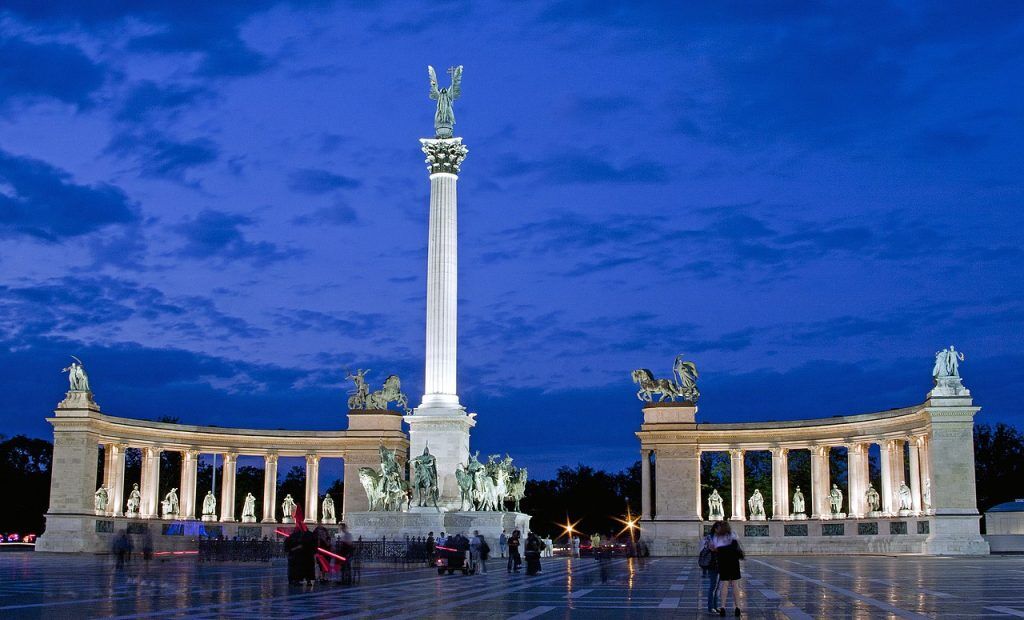
There’s a specific moment when you emerge from the M1 Metro station at Hősök tere and the Millennium Monument suddenly fills your entire field of vision. Thirty-six meters of stone column topped by a golden archangel, flanked by two sweeping colonnades of bronze kings and warriors, all arranged with the kind of theatrical precision that makes you wonder if 19th-century Hungarians did anything without dramatic flair.
They did not. And Heroes’ Square is the proof.
Built in 1896 to celebrate a thousand years of Hungarian history (give or take some rounding), this UNESCO World Heritage Site has become one of Budapest’s most photographed locations. It’s on every tourist’s checklist, every Instagram feed, and every “must-see” list—and for once, those lists are absolutely right.
But here’s what those lists don’t tell you: Heroes’ Square is more than a photo opportunity. It’s a history lesson in stone, a political statement frozen in bronze, and the gateway to one of Budapest’s best parks. Understanding what you’re looking at transforms a quick selfie stop into something genuinely meaningful.
This guide covers everything: what the statues actually represent, what happened here historically, and how to combine the square with nearby attractions for a full day of exploration.
📋 Heroes’ Square at a Glance
| Best For | History buffs, photographers, anyone exploring Andrássy Avenue or City Park |
| Time Needed | 20-30 minutes (square only) | 2-4 hours (with museums) |
| Cost | FREE (square is always open) |
| Museums Nearby | Museum of Fine Arts: 5,800 HUF | Kunsthalle: 1,800-4,900 HUF |
| Getting There | M1 Metro to Hősök tere (end of the line) |
| Best Time | Early morning for photos without crowds; sunset for dramatic lighting |
| Skip If | You have zero interest in history or monuments (but then why are you in Budapest?) |
Why Heroes’ Square Matters
Heroes’ Square was built between 1896 and 1906 to celebrate the 1,000th anniversary of the Hungarian conquest of the Carpathian Basin. The central Millennium Monument features the Archangel Gabriel holding the Holy Crown of St. Stephen atop a 36-meter column, surrounded by statues of the seven Magyar chieftains who founded the nation. The UNESCO-listed square marks the end of Andrássy Avenue and the entrance to City Park.
Let me set the scene: it’s 1896, and Hungary is throwing itself a birthday party. Not just any birthday—the thousandth anniversary of the Magyar tribes settling in the Carpathian Basin and establishing what would become Hungary. The Austro-Hungarian Empire is at its peak, Budapest is booming, and the Hungarian government decides to celebrate with characteristic restraint.
Just kidding. They built an underground railway (the first in continental Europe), constructed an entire fake castle, laid out a 2.3-kilometer ceremonial avenue, and erected a monument so imposing that it still dominates the Budapest skyline over a century later.
Heroes’ Square was the grand finale of this celebration—a statement in stone that said: “We’ve been here for a thousand years, and we’re not going anywhere.”
The square was designed by architect Albert Schickedanz (who also designed the Museum of Fine Arts across the way) and sculptor György Zala (who spent decades creating the monument’s countless statues). What they created wasn’t just a monument—it was a national identity in bronze and marble.
The Millennium Monument: What You’re Actually Looking At
The Millennium Monument consists of a central 36-meter column topped by Archangel Gabriel, surrounded by the seven Magyar chieftains on horseback. Behind them, two curved colonnades feature 14 statues of Hungarian rulers and heroes, each with a relief depicting a defining moment in their reign. The monument was originally completed in 1906 after ten years of construction.
Let’s decode this thing, because there’s a lot going on:
The Central Column
At the top stands Archangel Gabriel, holding two objects that define Hungarian national identity: the Holy Crown of St. Stephen in his right hand and the apostolic double cross in his left. According to legend, Gabriel appeared to Pope Sylvester II in a dream and instructed him to send a crown to Stephen, Hungary’s first Christian king. Whether you believe the legend or not, the symbolism is clear: Hungary’s nationhood has divine backing.
The column itself rises 36 meters (118 feet)—tall enough to be visible from significant distances down Andrássy Avenue, which was specifically designed with this view in mind.
The Seven Chieftains
At the base of the column, seven mounted figures represent the Magyar chieftains who led the Hungarian tribes into the Carpathian Basin around 895 AD:
- Árpád (front and center) — considered the founder of the Hungarian nation, his dynasty ruled for over 300 years
- Előd — Árpád’s father, led one of the seven tribes
- Ond — ancestor of several important noble families
- Kond — chieftain whose descendants became powerful lords
- Tas — led the tribe that settled in what is now Slovakia
- Huba — ancestor of the Szemere family
- Töhötöm (Tétény) — led the conquest of Transylvania
The horses and costumes are more artistic interpretation than historical accuracy (we don’t have photographs from 895 AD, shockingly), but the effect is powerful: seven leaders riding toward you, frozen at the moment of founding a nation.
The Colonnades
Behind the central column, two semicircular colonnades curve outward like welcoming arms. Each colonnade contains seven statues of significant Hungarian rulers and leaders—fourteen in total.
Left colonnade (from the square):
- King Stephen I — first king of Hungary, Christianized the nation
- King Ladislaus I — warrior king and saint
- King Coloman — known for prohibiting witch trials
- King Andrew II — issued the Golden Bull (Hungary’s Magna Carta)
- King Béla IV — rebuilt Hungary after the Mongol invasion
- King Charles Robert — stabilized the economy after chaos
- King Louis I (the Great) — expanded Hungarian territory significantly
Right colonnade:
- John Hunyadi — defended Europe against Ottoman expansion
- King Matthias Corvinus — Renaissance king, patron of arts
- István Bocskay — leader of anti-Habsburg uprising
- Gábor Bethlen — Prince of Transylvania, religious freedom advocate
- Imre Thököly — anti-Habsburg rebel leader
- Francis II Rákóczi — led the largest anti-Habsburg revolt
- Lajos Kossuth — leader of the 1848 revolution
💡 Pro Tip
Notice something about the right colonnade? Every single figure there fought against Habsburg rule. This wasn’t subtle—it was Hungary telling the Austrian emperors: “We may be part of your empire, but we never stopped fighting for independence.” The monument’s original design actually included Habsburg emperors, but they were removed after World War I when Hungary finally became independent.
The Allegorical Figures
At the corners of the colonnades, four chariots carry allegorical figures:
- War — a man driving a chariot with a snake as a whip
- Peace — a woman with a palm frond
- Work and Wealth — a man with a scythe and woman sowing seeds
- Knowledge and Glory — a man holding a golden statue, woman with a palm
These represent the pillars of a successful nation—though the prominence of “War” as one of four virtues tells you something about 19th-century priorities.
The Memorial Stone of Heroes
In front of the Millennium Monument stands the Memorial Stone of Heroes (Hősök emlékköve), a simple cenotaph dedicated to “those who gave their lives for the freedom of our people and our national independence.” Despite common misconceptions, it contains no remains—it’s a symbolic memorial, not a tomb.
Between the Millennium Monument and the street, you’ll notice a large stone slab surrounded by iron railings. This is the Memorial Stone of Heroes (Hősök emlékköve), often mistakenly called the “Tomb of the Unknown Soldier.”
Here’s the thing: it’s not actually a tomb. There are no human remains buried here—just an artesian well underneath (which, coincidentally, supplies thermal water to the Széchenyi Baths nearby). The memorial is a cenotaph, a symbolic monument to fallen soldiers, not a burial site.
The inscription reads: “To the memory of the heroes who gave their lives for the freedom of our people and our national independence.”
The original memorial was erected in 1929, removed during Communist rule in 1951 (its message about “national independence” was politically inconvenient), and rebuilt in 1956 during the brief Hungarian Revolution. The area inside the railings is off-limits to visitors—the gate only opens for state ceremonies and visiting dignitaries.
Historical Moments at Heroes’ Square
Heroes’ Square has hosted pivotal moments in Hungarian history, including the 1989 reburial of Imre Nagy that symbolized the end of Communist rule. The square has been a stage for political demonstrations, national celebrations, and moments of collective grief throughout the 20th and 21st centuries.
The square has witnessed some of Hungary’s most significant modern historical moments:
June 16, 1989: This date marks one of the most emotionally charged events in modern Hungarian history. Over 250,000 people gathered at Heroes’ Square for the ceremonial reburial of Imre Nagy, the prime minister executed for his role in the 1956 Hungarian Revolution. Nagy had been shot in secret in 1958 and buried in an unmarked grave. His reburial, broadcast live on television, became a powerful symbol of Hungary’s transition from communism to democracy.
A young politician named Viktor Orbán gave a speech at the ceremony demanding Soviet troops leave Hungary—a moment that launched his political career.
Other significant events:
- Regular site of national commemorations on March 15 (1848 Revolution anniversary)
- Venue for papal masses during Pope John Paul II’s visits
- Location of major political rallies and demonstrations throughout the 20th century
- Traditional gathering point for national celebrations, including Hungary’s entry into the European Union in 2004
The Museums Flanking the Square
Two major cultural institutions frame Heroes’ Square: the Museum of Fine Arts (Szépművészeti Múzeum) on the north side and the Kunsthalle (Műcsarnok) on the south. Both buildings were completed around 1906 as part of the same millennial celebration that produced the square itself.
Museum of Fine Arts (Szépművészeti Múzeum)
The neoclassical building on the left (as you face the monument) houses Hungary’s premier collection of international art. If you’ve ever wanted to see works by Raphael, El Greco, Goya, and Monet in the same building—without the crowds of the Louvre or Prado—this is your spot.
💰 Museum of Fine Arts Prices (2026)
- Permanent exhibitions: 5,800 HUF (~$15 USD)
- Concession (under 26, 62-70): 2,900 HUF (~$8 USD)
- Temporary exhibitions: varies, typically 3,400-6,800 HUF
- Audio guide: 1,200 HUF
- Annual pass: 9,800 HUF
- Budapest Card holders: FREE (permanent exhibitions only)
Under 6 and over 70: FREE | Under 26 on second Saturdays: FREE
🕐 Museum of Fine Arts Hours
- Tuesday-Sunday: 10:00 AM – 6:00 PM (admission until 5:00 PM)
- Monday: CLOSED
Current special exhibition: Terracotta Warriors (until May 2026)
The collection spans antiquity to 1800, with particularly strong holdings in Spanish art (one of the best outside Spain), Italian Renaissance works, and Dutch/Flemish masters. For a deeper dive, check our Museum of Fine Arts guide.
Kunsthalle (Műcsarnok / Hall of Art)
The matching neoclassical building on the right houses Hungary’s largest contemporary art exhibition space. Unlike the Museum of Fine Arts, the Kunsthalle has no permanent collection—it hosts rotating temporary exhibitions of modern and contemporary art.
💰 Kunsthalle Prices (2026)
- Main exhibitions: 1,800-4,900 HUF (~$5-$13 USD) depending on show
- Concession: 900-2,500 HUF
- Family ticket: 2,700-7,400 HUF
- Annual pass: 16,000 HUF (all exhibitions)
- Budapest Card holders: FREE
Under 7 and over 70: FREE
Hours: Tuesday-Sunday, typically 10:00 AM – 6:00 PM (check current exhibitions at mucsarnok.hu)
🎫 Budapest Card Tip
The Budapest Card gets you free entry to both the Museum of Fine Arts (permanent exhibitions) and the Kunsthalle. If you’re planning to visit both plus use public transport, the card starts making financial sense. Just remember: it doesn’t cover special exhibitions at the Museum of Fine Arts.
What’s Behind the Square: City Park
Heroes’ Square serves as the formal entrance to Városliget (City Park), Budapest’s largest park and home to attractions including Vajdahunyad Castle, Széchenyi Thermal Bath, the Budapest Zoo, the House of Hungarian Music, and the City Park Ice Rink. The park covers approximately 120 hectares and was one of the world’s first public parks when opened in the early 1800s.
Walk through Heroes’ Square and you’ll enter City Park (Városliget), one of Budapest’s treasures and the perfect complement to the square’s monumental formality.
What you’ll find in City Park:
- Vajdahunyad Castle — A fantastical building mixing Romanesque, Gothic, Renaissance, and Baroque styles, built for the 1896 exhibition and kept because everyone loved it
- Széchenyi Thermal Bath — Europe’s largest medicinal bath, fed by the same artesian well beneath the Memorial Stone
- Budapest Zoo & Botanical Garden — One of the oldest zoos in the world, with stunning Art Nouveau buildings
- House of Hungarian Music — A modern architectural marvel (opened 2022) dedicated to music education and performance
- City Park Ice Rink — Europe’s largest outdoor ice rink (winter only), transforms into a boating lake in summer
- Gundel Restaurant — Budapest’s most famous fine-dining establishment since 1894
You could easily spend an entire day combining Heroes’ Square with City Park attractions. For detailed thermal bath information, see our Budapest thermal baths guide.
Getting to Heroes’ Square
Heroes’ Square is easily accessible via the M1 Metro (Yellow line) to Hősök tere station—the world’s second-oldest underground railway. The square marks the end of Andrássy Avenue, making it a natural endpoint for a walk along this UNESCO-listed boulevard.
The square sits at the end of Andrássy Avenue, one of Budapest’s grandest streets and a UNESCO World Heritage Site in its own right.
📍 Heroes’ Square – Essential Info
- Address: Hősök tere, Budapest 1146, Hungary
- Metro: M1 (Yellow line) to Hősök tere — final stop
- Trolleybus: Lines 72, 75, 79 stop at Hősök tere
- Cost: FREE (the square is always open)
- Time needed: 20-30 minutes for the square; 2-4 hours with museums
- Best photo time: Early morning (fewer crowds) or sunset (golden light)
Pro tip: The M1 Metro line beneath Andrássy Avenue was the first underground railway in continental Europe (1896). Taking it to Heroes’ Square is a historical experience in itself—the stations still have their original tilework and fin-de-siècle charm.
Combining Heroes’ Square with Other Attractions
The square’s location at the intersection of Andrássy Avenue and City Park makes it ideal for combining with multiple attractions. A natural itinerary starts downtown, walks Andrássy Avenue with stops along the way, reaches Heroes’ Square, then explores City Park before finishing at Széchenyi Bath.
The Classic Andrássy Avenue Walk
The most natural way to reach Heroes’ Square is by walking the 2.3 kilometers of Andrássy Avenue from the city center:
- Start: Bajcsy-Zsilinszky út (near St. Stephen’s Basilica)
- Stop: Hungarian State Opera House (10-minute walk)
- Stop: House of Terror (20-minute walk from Opera)
- End: Heroes’ Square (10-minute walk from House of Terror)
Total walking time: about 45 minutes without stops. But why rush? The avenue is lined with cafés, mansions, and embassies worth admiring.
The Full Day Option
If you’re visiting Budapest for the first time and want to maximize your time:
- Morning: Walk Andrássy Avenue, visit the Opera House or House of Terror
- Midday: Heroes’ Square and one of the museums
- Afternoon: Explore City Park—Vajdahunyad Castle, a stroll around the lake
- Late afternoon: Széchenyi Thermal Bath (bring swimwear!)
- Evening: Dinner at Gundel or one of the restaurants near the park
For a complete multi-day itinerary, check our 3 Days in Budapest guide.
Practical Tips for Your Visit
A few practical considerations can significantly improve your experience at Heroes’ Square.
Weather and clothing: The square is completely exposed with no shade or shelter. In summer, this means intense sun and heat reflecting off the stone—bring water, sunscreen, and a hat. In winter, the open space amplifies cold winds coming across the flat terrain of City Park. Dress appropriately for the season and expect conditions to feel more extreme than in sheltered city streets.
Crowds: The square is busiest between 10:00 AM and 4:00 PM, especially in summer and during holidays. Tour buses arrive in waves, so you might have relative peace one moment and be surrounded by groups the next. Early morning (before 9:00 AM) and evening visits offer more tranquility.
Facilities: There are no public restrooms on the square itself. The nearest facilities are in the museums (which require admission) or in City Park. Plan accordingly, especially if traveling with children.
Food and drink: No vendors operate on the square itself, keeping it free of commercial clutter but also leaving you without refreshment options. The museums have cafés, and City Park has various food options ranging from Gundel (expensive fine dining) to casual vendors near the lake.
Duration planning: Budget at least 30 minutes to properly appreciate the square and monument. If you’re including museums, add 1-2 hours each. If continuing into City Park, you could easily spend half a day or more in the area.
Photographing Heroes’ Square
The square offers exceptional photography opportunities throughout the day, with early morning providing crowd-free shots and sunset delivering dramatic golden-hour lighting. The symmetrical composition of the monument and colonnades creates natural framing for both wide-angle and portrait shots.
Some practical tips for getting the best shots:
Best times:
- Sunrise/early morning: The square faces roughly east, so morning light illuminates the monument’s face. More importantly, you’ll have the place almost to yourself.
- Golden hour (1-2 hours before sunset): The warm light creates dramatic shadows on the colonnades and makes the monument glow.
- Blue hour (just after sunset): The monument is illuminated at night, and the deep blue sky provides a stunning backdrop.
Avoid: Midday (harsh shadows, maximum crowds) and any time during major events or national holidays (unless you want crowds in your photos).
Composition tips:
- The square’s symmetry is its defining feature—use the central column as your anchor point
- The colonnades create natural frames for both the monument and people
- Standing at the Memorial Stone gives you a straight-on view of the entire monument
- The reflecting pool (when filled in summer) adds another dimension to shots
💡 Pro Tip
For the classic “postcard shot” showing the full monument with both colonnades, you need to stand fairly far back—roughly where Andrássy Avenue meets the square. Bring a wider lens (or use your phone’s wide-angle mode) to capture everything.
What Visitors Say
TripAdvisor reviews consistently praise the square’s grandeur and historical significance, with visitors noting its impressive scale and photo opportunities. Common themes include the ease of access via Metro, the value of combining the visit with City Park, and recommendations to learn about the monument’s history beforehand.
Across review platforms, certain themes appear consistently:
What people love:
- “Impressed me with its size and monumentality” — the scale genuinely surprises first-time visitors
- The combination with City Park attractions creates a full day of activities
- Free access means no barriers to visiting
- The M1 Metro makes getting there easy and is an attraction in itself
- Night illumination creates a completely different (and equally impressive) experience
What to know:
- Some visitors find “just a square” underwhelming without historical context—knowing what the statues represent adds significant value
- The square is very exposed—hot in summer, cold in winter, with no shade or shelter
- Construction in City Park has affected views and access in recent years (the Liget Budapest Project is ongoing)
- Tour groups can overwhelm the square mid-morning, especially in summer
One Reddit commenter captured the split opinion: “If you’re in City Park, Heroes Square will be unavoidable… It’s very concrete.” True—but that concrete tells a thousand years of history if you know how to read it.
Frequently Asked Questions
Is Heroes’ Square free to visit?
Yes, completely free. The square is public space, open 24/7, with no tickets or reservations needed. The museums flanking the square (Museum of Fine Arts, Kunsthalle) charge admission, but the square itself costs nothing.
How long do I need at Heroes’ Square?
The square itself takes 20-30 minutes to appreciate if you walk around and examine the statues. Add 1-2 hours for the Museum of Fine Arts, another hour for the Kunsthalle, and several more hours if you explore City Park afterward.
What’s the best way to get to Heroes’ Square?
The M1 Metro to Hősök tere is the easiest option—it’s the final stop on the line. Walking from downtown via Andrássy Avenue takes about 45 minutes but is highly recommended for the experience.
Can I visit Heroes’ Square at night?
Absolutely. The monument is illuminated after dark and looks spectacular. The museums will be closed, but the square itself is always accessible. Night visits are often less crowded and more atmospheric.
Is Heroes’ Square wheelchair accessible?
Yes. The square is flat and paved, with no steps or barriers. The M1 Metro stations are historic and not all have elevators, so check accessibility for your specific route.
What’s the difference between the two museums?
The Museum of Fine Arts houses a permanent collection of international art (antiquity to 1800). The Kunsthalle has no permanent collection—it hosts rotating contemporary art exhibitions. Different purposes, different experiences.
Is the “Tomb of the Unknown Soldier” really a tomb?
No. The Memorial Stone of Heroes is a cenotaph (symbolic memorial), not a burial site. No human remains are interred there—only an artesian well beneath the stone.
What should I combine with Heroes’ Square?
Most visitors combine it with Andrássy Avenue (walking there), City Park (walking through), and/or Széchenyi Bath (in the park). The Opera House and House of Terror are natural stops along Andrássy Avenue.
The Artesian Well: An Underground Connection
Beneath the Memorial Stone lies a remarkable piece of engineering: an artesian well completed in 1878 by Vilmos Zsigmondy. Reaching a depth of 971 meters, it produces 831 liters of thermal water per minute at 74°C—the same water that feeds Széchenyi Bath just a few hundred meters away.
This connection between Heroes’ Square and Budapest’s famous thermal culture often surprises visitors. When you’re standing at the Memorial Stone, you’re directly above one of the deepest thermal wells in Budapest. The hot water rising from nearly a kilometer underground feeds the same bath complex that draws millions of visitors each year.
Zsigmondy was a pioneering engineer who drilled several of Budapest’s most important thermal wells. The plaque marking the well’s location sits behind the Memorial Stone, within the iron railings—easy to miss unless you know to look for it.
This hidden detail perfectly captures something about Budapest: even its most formal, monumental spaces are connected to the city’s thermal underground. The water that Hungarian kings bathed in still flows beneath the feet of tourists posing for selfies.
Events and Ceremonies at the Square
Throughout the year, Heroes’ Square hosts various national commemorations, cultural events, and public gatherings. The square’s size and central location make it ideal for large-scale events, though these can also affect your visit planning.
Annual events to know about:
March 15: National holiday commemorating the 1848 Revolution. Expect large crowds, political speeches, and patriotic celebrations. The square becomes a focal point for Hungarian national identity.
August 20: St. Stephen’s Day (founding of the Hungarian state). Major celebrations include fireworks, though the main events usually center on other locations.
October 23: Anniversary of the 1956 Revolution. The square holds special significance given the 1989 reburial ceremony that marked Hungary’s transition to democracy.
Cultural events: The square occasionally hosts concerts, festivals, and temporary exhibitions. The open space makes it suitable for events drawing tens of thousands of people.
Planning tip: Check local event calendars before your visit. Major commemorations mean larger crowds and potential access restrictions, but they also offer unique opportunities to witness Hungarian culture and national pride firsthand.
The Architecture of Memory
The design of Heroes’ Square follows classical principles of monumental architecture, with deliberate sight lines, symmetrical layouts, and carefully calibrated proportions. Understanding these design choices reveals how the architects intended visitors to experience the space.
Albert Schickedanz, the architect who designed the square’s layout and the Museum of Fine Arts, understood the power of perspective. The entire arrangement is designed to create specific emotional responses:
The approach from Andrássy Avenue: As you walk toward the square, the Millennium Monument slowly grows in your field of vision. The column is visible from over a kilometer away, drawing you forward. This wasn’t accidental—Andrássy Avenue was specifically designed to terminate at this monument.
The moment of arrival: When you reach the square, the sudden openness after the enclosed avenue creates a dramatic reveal. The monument fills your view, the colonnades sweep outward, and the two museums frame the scene like bookends.
The experience of the space: The square is deliberately oversized for typical human activity. This scale makes individuals feel small against the backdrop of history—which is exactly the point. You’re not just visiting a square; you’re entering a space designed to make you contemplate a thousand years of national history.
The symmetry: Almost everything in the square is mirrored. The two colonnades, the two museums, the balanced arrangement of statues—this symmetry creates a sense of order and permanence. Empires rise and fall, but the arrangement of Heroes’ Square suggests something eternal.
This kind of deliberate architectural psychology was common in the 19th century but is rarely employed today. Understanding it helps you appreciate why the square feels different from modern public spaces—and why it continues to inspire awe over a century after its completion.
The Statues That Were Removed
The monument originally included five Habsburg emperors in the left colonnade: Ferdinand I, Leopold I, Charles III, Maria Theresa, and Franz Joseph I. After Hungary gained independence following World War I, these figures were replaced with Hungarian kings and heroes, dramatically changing the monument’s political message.
The current arrangement of statues isn’t the original. When the monument was completed in 1906, Hungary was still part of the Austro-Hungarian Empire, and five of the fourteen colonnade statues depicted Habsburg rulers:
- Ferdinand I — Holy Roman Emperor, also King of Hungary
- Leopold I — who drove the Ottomans from Hungary
- Charles III — who reorganized Hungary after Ottoman rule
- Maria Theresa — the only female ruler depicted
- Franz Joseph I — the reigning emperor when the monument was built
After World War I, the Austro-Hungarian Empire collapsed and Hungary became an independent republic. The Habsburg statues were removed and replaced with Hungarian figures who had fought for independence—often against the very Habsburgs they replaced.
This wasn’t subtle political messaging. The monument went from celebrating Hungary’s place within the Habsburg empire to celebrating Hungarian resistance against that empire. The change tells you everything about how history is written by those in power—and rewritten when power shifts.
Some of the original Habsburg statues survived and can be found in other locations around Hungary. Maria Theresa’s statue, for example, was relocated to the Grassalkovich Palace in Gödöllő.
Final Thoughts
Heroes’ Square is one of those rare attractions that genuinely delivers on its reputation. It’s grand without being gaudy, historical without being dusty, and photogenic without feeling like a tourist trap.
More than that, it’s a place where Hungarian history comes alive in stone and bronze. The seven chieftains riding toward you, the kings and revolutionaries lining the colonnades, the archangel watching over it all—these aren’t just decorations. They’re a nation’s autobiography, written in a language that transcends words.
Visit at sunrise for solitude. Visit at sunset for drama. Visit at midnight for mystery. Just visit—and take a moment to understand what you’re looking at.
Because once you know the stories behind the statues, Heroes’ Square stops being just another photo opportunity. It becomes a conversation with a thousand years of history.
And that conversation is always worth having.
Whether you’re a history enthusiast seeking to understand Hungary’s complex past, a photographer chasing perfect light, or simply a traveler looking to check off a must-see attraction, Heroes’ Square rewards your time. It’s monumental without being oppressive, educational without being boring, and photogenic without feeling manufactured.
Come for the Instagram shot. Stay for the history. Leave with a deeper appreciation for a nation that has spent a thousand years fighting for its identity—and built this extraordinary square to prove it.
Prices verified: January 2026


