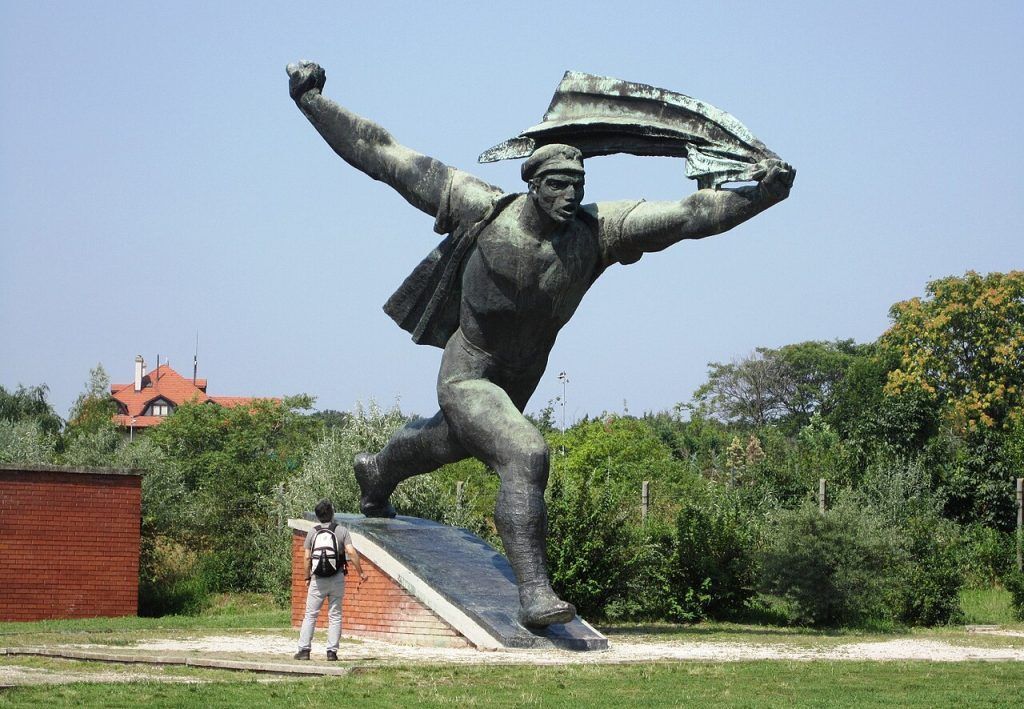
An outdoor graveyard for communist statues—and somehow one of the most thought-provoking places in Hungary
🎯 TL;DR
Hungary didn’t destroy its communist statues—it exiled them to a field outside Budapest. Memento Park is part outdoor museum, part sculpture graveyard, and entirely thought-provoking. Free with Budapest Card, otherwise 3,000 HUF. Worth the 30-minute trip if you want to stare down a six-meter Lenin and contemplate how power works. Skip if you’re just here for Instagram.
📋 Memento Park at a Glance
| Best For | History buffs, photography enthusiasts, anyone processing 20th-century trauma |
| Time Needed | 1.5–2.5 hours (plus 30 min each way) |
| Cost | 3,000 HUF (~$8/€7.50) | FREE with Budapest Card |
| Hours | Daily 10 AM – 6 PM (summer) | 10 AM – 4 PM (winter) |
| Getting There | M4 to Kelenföld → Bus 101B/101E/150 (25 min) |
| Skip If | You want quick central attractions or aren’t into historical context |

Here’s something most countries don’t do: instead of destroying the massive propaganda statues that once dominated their public squares, Hungary collected them all, dumped them in a field outside Budapest, and charges tourists to come stare at them. It’s either the most brilliant act of historical preservation or the world’s strangest sculpture garden. Possibly both.
Memento Park opened in 1993, just a few years after Hungary shed its communist government. The question facing the new democracy was what to do with all these giant bronze Lenins and heroic worker monuments that had spent decades reminding Hungarians who was in charge. Destroying them felt like erasing history. Leaving them in place felt like endorsing it. So architect Ákos Eleőd designed a solution that was part museum, part open-air cemetery, part ironic commentary on the nature of power.
The result is genuinely weird, occasionally moving, and unlike anything else you’ll see in Europe.
What You’ll Actually See at Memento Park
The park holds 42 communist-era statues including multiple Lenins, Marx and Engels, Soviet soldiers, and the famous Stalin’s Boots replica. These are the actual statues that once dominated Hungarian public spaces—not reproductions. Each one tells a story about propaganda, power, and what happens when ideology loses its enforcers.

The park holds around 42 statues, monuments, and plaques from Hungary’s communist period (1949-1989). These aren’t replicas or reconstructions—they’re the actual statues that once stood in city squares and public buildings across Hungary, silently enforcing ideological conformity through sheer bronze mass.
You’ll find Lenin in multiple poses—pointing toward the glorious future, striding confidently forward, generally looking like a man who knows exactly where history is heading. Marx and Engels stand together near the entrance, bearded and serious, as if still working out the finer points of dialectical materialism. There are Soviet soldiers, Hungarian communist leaders, and various allegorical figures representing things like “liberation” and “friendship between peoples” (translation: forced political alliance).
Stalin’s Boots: The Most Photographed Non-Statue
The most photographed piece isn’t a statue at all—it’s Stalin’s boots. The rest of Stalin was torn down during the 1956 revolution, one of the first acts of a briefly free Hungary. Only the boots remained on the pedestal, a perfect accidental metaphor for the hollowness of authoritarian power. The park displays a replica, because sometimes history creates better art than artists do.
If you want the full context on what life was actually like under the regime these statues celebrated, the House of Terror museum on Andrássy út provides the darker complement. The two experiences together give you a complete picture: the propaganda version and the reality.
The Hungarian-Soviet Friendship Memorial
The Hungarian-Soviet Friendship Memorial is particularly telling. Two soldiers, Hungarian and Soviet, clasp hands in eternal brotherhood. It’s the official story of liberation and alliance. The unofficial story—of occupation, suppression, and the bloody crushing of the 1956 revolution—stands in direct contradiction. The memorial now memorializes its own lie.
Why Memento Park Actually Works
Unlike museums that tell you how to feel, Memento Park simply presents the artifacts and lets you process them. The statues aren’t framed as evil relics or ironic curiosities—they just stand there, stripped of context and power, revealing the absurdity of propaganda when it can no longer propagandize.
Memento Park succeeds because it refuses to tell you how to feel. The statues aren’t presented as evil artifacts or quaint curiosities. They just… stand there. Massive, imposing, and slightly absurd now that they’re stripped of their original context and power.
Walking among them, you start noticing things. How the heroic workers are always striding forward, never standing still. How the Soviet soldiers are always liberating, never occupying. How every figure looks toward a future that never arrived. The propaganda is obvious once you see it, but that’s the point—this is what propaganda looks like when it can no longer propagandize.
That discomfort is probably the point. History should be uncomfortable. The alternative—forgetting, normalizing, repeating—is worse.
Memento Park Tickets and Prices (2026)
Adult admission is 3,000 HUF (~$8), with discounts for students and children. The big news: Budapest Card holders get in FREE. Given that Memento Park is somewhat out of the way, this free entry might tip the scales on whether the Budapest Card is worth it for your trip.
💰 Memento Park Ticket Prices (2026)
- Adults: 3,000 HUF (~$8/€7.50)
- Students (with ISIC): 1,800 HUF (~$4.75)
- Children (6-14): 1,200 HUF (~$3.15)
- Under 6: FREE
- Budapest Card: FREE ✨
- Hungary Card: Discount available
Payment: Cash (HUF/EUR), credit cards, and SZÉP Card accepted
Here’s the thing about value: if you’re debating whether to get a Budapest Card, Memento Park’s free admission might be the tipping point. The park is already a bit of a journey from central Budapest—making it free removes the “is this worth the trip?” friction entirely.
For groups, contact info@mementopark.hu for potential discounts. The park operates without state funding, so your ticket purchase directly supports preservation.
Getting to Memento Park from Central Budapest
Take Metro 4 (green line) to Kelenföld station, then catch bus 101B, 101E, or 150. The whole journey takes about 30-35 minutes. Your Budapest Card or BKK travel pass covers the transport. The location is intentionally inconvenient—only people who really want to be there make the trip.
Memento Park sits about 10 kilometers southwest of central Budapest, which is both its strength and its challenge. You’re not going to stumble across it while sightseeing. Getting here requires intention, and that intention filters out the casual tourists who might treat it like another checkbox attraction.
Step-by-Step Directions
- Metro: Take M4 (green line) to Kelenföld vasútállomás
- Bus: Exit and find bus stop for 101B, 101E, or 150
- Ride: About 20-25 minutes through suburban Budapest
- Get off: “Memento Park” stop (the driver knows it)
Buses run every 15-30 minutes, and your Budapest Card or any 24/72-hour BKK travel pass works on them. You’ll know you’re getting close when the housing developments give way to open fields.
Alternative: Direct Bus from Deák Ferenc tér
During peak season, there’s sometimes a direct tourist bus from Deák Ferenc tér. Check mementopark.hu for current schedules. It’s more convenient but less adventurous than the local bus route.
By Car or Taxi
If you’re driving, the park has free parking. From the city center, it’s about 25-30 minutes via the M1/M7 motorway, exiting at Budaörs. A taxi from central Pest runs about 6,000-8,000 HUF one way—not crazy if you’re splitting it, but you’ll need to arrange return transport.
Memento Park Opening Hours
The park is open daily year-round, but hours vary seasonally. Summer (May-October) offers the longest hours: 10 AM to 6 PM. Winter visitors get 10 AM to 4 PM. Plan to arrive at least 1.5 hours before closing.
🕐 Opening Hours
- May – October: Daily 10:00 AM – 6:00 PM
- November – April: Daily 10:00 AM – 4:00 PM
Note: The terrain is uneven and not fully accessible. Dogs welcome on leash.
A few timing tips:
- Best light: Late afternoon for dramatic photos of the statues
- Least crowded: Weekday mornings, especially in shoulder season
- Avoid: Rainy days (outdoor park, minimal shelter)
What Else to Do at Memento Park
Beyond the statues, there’s an indoor exhibition on communist-era life, a film about the secret police, and the Red Star Store for ironic souvenirs. You can even rent a Trabant to drive around the grounds—the famously terrible East German car that’s become a symbol of communist-era deprivation.
The Indoor Exhibition
The park includes a small indoor exhibition about communist-era life, including a section on the secret police that connects thematically to what you’ll see at the House of Terror. There’s also a short film about the 1956 revolution and its brutal suppression.
Trabant Experience
For peak irony, you can rent a genuine Trabant—the famously terrible East German car that’s become a symbol of communist-era deprivation—and drive it around the grounds. The two-stroke engine, the plastic body, the distinct smell of inefficiency… it’s either historically immersive or pure kitsch depending on your perspective.
The Red Star Store
The gift shop sells communist kitsch—Soviet army hats, propaganda posters, red star pins—which raises obvious questions about commodifying oppression. Is buying a Lenin fridge magnet ironic appreciation or tasteless trivializing? The park doesn’t answer; it just presents the merchandise and lets you wrestle with your own conscience.
Combining Memento Park with Other Budapest Attractions
Memento Park pairs naturally with the House of Terror for a full “communist Hungary” day. Visit Memento Park in the morning (before crowds), House of Terror in the afternoon, and decompress with dinner in the Jewish Quarter’s ruin bars. October 23rd (1956 Revolution anniversary) adds extra resonance.
Memento Park works best as part of a broader exploration of Hungary’s 20th-century history. Here are some smart combinations:
The Communist History Day
- Morning: Memento Park (arrive when it opens at 10 AM)
- Lunch: Quick bite near Kelenföld or back in Pest
- Afternoon: House of Terror (Andrássy út 60)
- Evening: Dinner and drinks in the Jewish Quarter
Where Memento Park shows you the public face of the regime, House of Terror shows you what happened behind closed doors. The contrast between Hungary’s darkest century and its vibrant present feels appropriately Hungarian—survival through adaptation, heaviness balanced with pleasure.
Special Dates
If you’re visiting around October 23—the anniversary of the 1956 revolution—the experience becomes even more resonant. That’s when Hungary briefly freed itself from Soviet control before the tanks rolled back in. The statues in Memento Park represent the ideology that those revolutionaries died fighting against.
Other History Museums
For more Hungarian history context, consider:
Is Memento Park Worth Visiting?
Yes, if you’re interested in history, propaganda, or how societies process trauma. The 30-minute journey filters out casual tourists, making the experience more contemplative. Skip it if you want quick, central attractions or aren’t interested in historical context.
Memento Park isn’t going to be everyone’s idea of a good time. It’s 30 minutes outside the city center, it’s full of propaganda statues, and it requires you to think about unpleasant history rather than just photographing pretty buildings. Some visitors find it boring—once you’ve seen one Lenin, you’ve seen them all, etc.
But if you’re interested in how societies process traumatic history, or how power expresses itself through public art, or what happens when ideology gets stripped of its enforcement mechanism, Memento Park is genuinely fascinating. It’s a memorial that questions the nature of memorials. A museum that displays propaganda without endorsing it. A tourist attraction that makes you uncomfortable about being a tourist.
Who Should Visit
- History and politics enthusiasts
- Photographers seeking unusual subjects
- Anyone interested in Cold War / Soviet history
- Visitors who’ve already covered Budapest’s main attractions
- Budapest Card holders (it’s free!)
Who Might Skip It
- First-time visitors with limited time
- Those uninterested in 20th-century history
- Families with young children (nothing interactive)
- Rainy day visitors (outdoor park)
The Verdict: A Unique Way to Process History
Hungary could have destroyed these statues. It could have left them standing. Instead, it found a third option: preserve them, but remove their power. It’s a solution that’s both practical and philosophical, and walking through the result, you get the sense that Hungary has thought harder about its communist legacy than most former Soviet bloc countries.
The dictators still stand. But now they stand where we put them.
📍 Memento Park – Essential Info
- Address: Balatoni út – Szabadkai utca sarok, 1223 Budapest (District XXII)
- Tickets: 3,000 HUF adult | 1,800 HUF student | 1,200 HUF child | FREE with Budapest Card
- Hours: Daily 10 AM – 6 PM (summer) | 10 AM – 4 PM (winter)
- Getting There: M4 to Kelenföld → Bus 101B/101E/150 (25 min)
- Time Needed: 1.5–2.5 hours
- Website: mementopark.hu
- Contact: info@mementopark.hu
Pro tip: Combine with House of Terror for a full communist history day. Both are FREE with Budapest Card.
Related Guides
Want more Hungarian history? Start here:
- House of Terror: The Museum That Stays With You
- October 23rd in Budapest: Why This is the Best Day to Visit
- Budapest History Museum at Buda Castle
- Budapest Card: Worth the Money?
- Holocaust Memorial Center
- Hungarian National Museum
Last updated: January 2026. Prices verified at mementopark.hu. Images via Wikimedia Commons (CC BY-SA 3.0).


