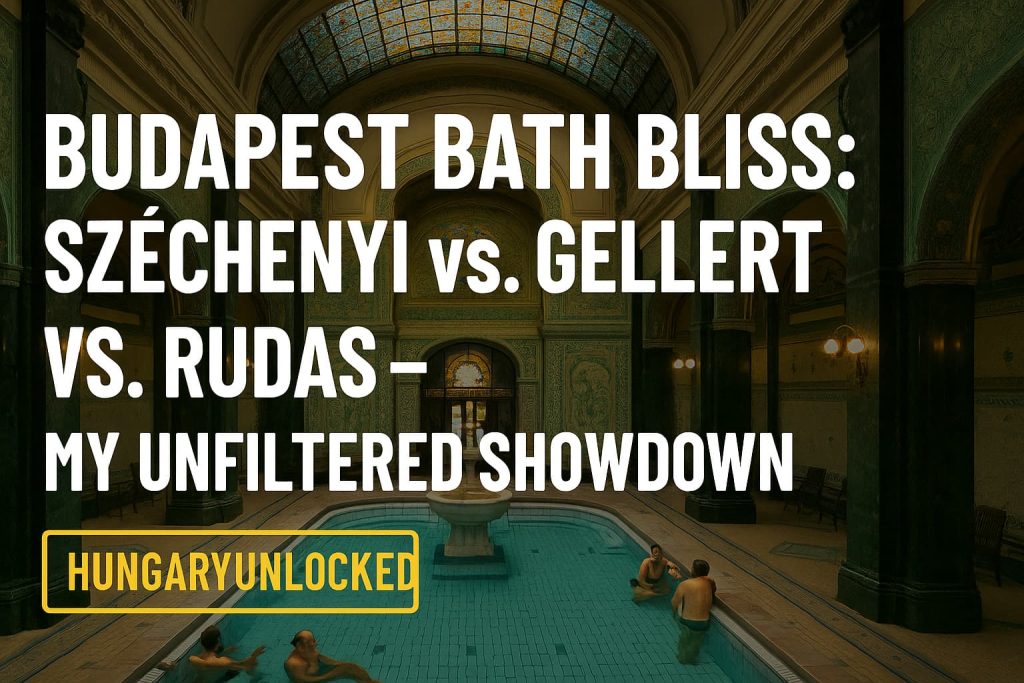
⚠️ 2026 Update: Gellért Bath is CLOSED for renovation until 2028. This guide features Lukács Bath as your third must-visit option, alongside Széchenyi and Rudas. We’ve kept Gellért info for context — scroll down for the full story.
🎯 TL;DR
Gellért and Király baths are both closed through 2026. The three Budapest thermal baths worth your time right now are Széchenyi (neo-Baroque crowd favorite, 18 pools), Rudas (Ottoman dome plus rooftop Danube views), and Lukács (the local’s bath, lower prices, no posturing). Pick based on your budget and tolerance for tourist density.
📋 At a Glance
| Best For | First-timers → Széchenyi | Architecture lovers → Rudas | Locals & budget travelers → Lukács |
| Time Needed | 2–3 hours minimum; 4–5 hours if you want the full spa + sauna circuit |
| Cost | Széchenyi ~13,000 HUF weekday | Rudas ~6,000–11,000 HUF | Lukács ~7,200 HUF |
| Hours | Széchenyi daily 6:00–22:00 | Rudas varies by section | Lukács daily 6:00–20:00 |
| Getting There | Széchenyi: M1 metro | Rudas: Tram 19/41 | Lukács: Tram 17/19 |
| Skip If | You hate crowds (avoid Széchenyi weekends) or you’re hoping Gellért is secretly open (it isn’t) |
The 2026 Context: Three Baths Carrying the Whole City
Budapest’s thermal bath landscape looks a little different in 2026 than the brochures prepared you for. Two of the city’s most storied baths — Gellért and Király — are both closed for renovation, leaving the remaining three to absorb every curious tourist, health-seeking local, and chess-playing pensioner in the city. Understanding what’s closed, for how long, and why it actually matters for your planning is the useful starting point before you commit to any booking.
The closure is significant. Gellért wasn’t just photogenic — it was a functioning therapeutic complex with a mineral water profile optimized for musculoskeletal conditions, a wave pool, private bathing cabins with century-old tile work, and an atmosphere that managed to feel both grand and slightly faded in the most charming way possible. All of that is currently behind scaffolding. The hotel attached to the bath remains open; the bath itself does not. Do not let anyone sell you a ticket to it.
The double-closure of Gellért and Király is what makes the 2026 bath landscape feel simultaneously compressed and clarified. Two options removed from the board means less decision paralysis for visitors, but also means the remaining three baths — Széchenyi, Rudas, and Lukács — are carrying proportionally more of the city’s thermal tourism weight. Rudas, in particular, now represents the entire Ottoman heritage category by itself, which has predictably made it busier on weekends.
Why This Changes Your Planning in 2026
The practical consequence of these closures is straightforward: book in advance, especially for Rudas on weekends, and recalibrate your expectations about which baths Budapest thermal baths can deliver right now. The city’s bathing culture is not diminished — the springs still produce the same 38–76°C mineral water they always have — but the options are fewer and the competition for space is real. Planning a visit around which bath is open, rather than which is most famous, is the more useful starting point for any 2026 trip.
Quick Comparison: Széchenyi vs Rudas vs Lukács at a Glance
Three baths, three completely different personalities. Széchenyi is the theatrical one — big, golden, and impossible to miss. Rudas is the atmospheric one — small, dark, domed, and historically loaded. Lukács is the sensible one — no drama, reasonable prices, and a clientele that is actually from Budapest. Knowing the difference before you arrive saves you from paying Széchenyi prices when what you actually wanted was a quiet soak with locals.
Széchenyi: The Grand Showpiece
Széchenyi Thermal Bath is Europe’s largest medicinal bath complex — 18 pools, 6,220 square meters of neo-Baroque magnificence, open since 1913, and almost certainly the bath you’ve already seen on social media whether you sought it out or not. It’s the one where elderly Hungarian men play chess while floating in steaming 38°C water and tourists photograph them with a reverence usually reserved for religious sites. The chess is real, incidentally. It has been happening since the Cold War and no one is performing it for you.
Entry starts at ~13,000 HUF (~$35) on weekdays with a locker, climbing to ~14,500–15,000 HUF (~$39) on weekends. Cabins cost extra. The hours — daily 6:00–22:00 — make it accessible for early risers who want to beat the midday crush. The scale means there’s almost always a pool with space, even when it’s busy, which is the key distinction from smaller baths where crowd dynamics feel more claustrophobic.
Rudas: The Ottoman Survivor
Rudas Thermal Bath has been in continuous operation since 1550, which makes it older than the concept of the tourist industry by several centuries. The centerpiece is a 16th-century domed Ottoman pool chamber with star-cut skylight apertures that cast shifting light patterns across the water — an architectural and atmospheric experience that no amount of restoration at Széchenyi or Lukács can replicate, because it requires nearly five centuries of actual use to achieve. On top of that, literally, sits a modern rooftop panorama pool with unobstructed views across the Danube to the Pest skyline.
Pricing splits between sections: the Ottoman pool section runs ~6,000–7,200 HUF (~$16–19), the rooftop adds ~4,000–5,500 HUF (~$11–15) separately, or a combined ticket comes to ~9,000–11,000 HUF (~$24–29). Hours vary significantly depending on whether you’re visiting the single-sex Ottoman section (weekdays) or the weekend mixed sessions. The distinction matters enormously for your experience and what you’re expected to wear — more on that in the etiquette section.
Lukács: The Local’s Refuge
Lukács Thermal Bath has been operating since 1884 on the Buda riverbank and has historically maintained a low profile by choice — or at least by temperament. It is where Budapestians with actual rheumatological complaints go, where university professors do their morning laps, and where nobody is trying to be photographed doing anything. Since Gellért closed, Lukács has absorbed a meaningful portion of that bath’s regular clientele — the people who valued a serious therapeutic soak over a grand architectural statement — and has handled the transition with characteristic quiet dignity.
At ~7,200 HUF (~$19) for adult entry, Lukács is the most affordable of the three major baths without feeling budget-tier. The hours — daily 6:00–20:00 — are slightly shorter than Széchenyi, which matters if you’re planning an evening visit. The outdoor therapeutic pools, the drinking water courtyard, and the notably lower crowd density on weekdays make it the most rewarding purely therapeutic choice among the three currently open Budapest thermal baths.
Architectural Grandeur and Ottoman Heritage
The physical fabric of Budapest’s baths is not incidental — it is, in many cases, the primary reason to visit. These buildings were not designed as utilitarian shower blocks. They are monuments to competing imperial visions of what civilized bathing should look like: Ottoman minimalism filtered through star-shaped skylights, Austro-Hungarian maximalism expressed in gilded tile work and vaulted ceilings, and the specific Central European confidence that a bath complex should, by default, look more impressive than most government ministries.
Széchenyi: Neo-Baroque Palace in City Park
Széchenyi was designed by architect Győző Czigler and completed in 1913 in the neo-Baroque style — which is to say, with the full confidence of an empire that hadn’t yet noticed it was about to collapse. The exterior is a pale yellow palace of considerable scale, sitting at the edge of City Park alongside Vajdahunyad Castle, giving the entire neighborhood the feeling of a theme park where the theme is “the Austro-Hungarian Empire was really quite something.” Inside, the architecture layers thermal chambers, mosaic-tiled interiors, sculptural detailing, and the kind of ceiling heights that make you feel briefly important.
The two outdoor pools — one of which maintains 38°C year-round — occupy a courtyard framed by the bath’s neo-Baroque facade, creating the visual effect that photographs well regardless of season. In winter, steam rises from the hot water against the cold air, obscuring the pool surface and giving the whole scene an atmospheric drama that the building’s architects probably did not specifically plan for but would certainly have approved of.
Rudas: 450 Years of Ottoman Infrastructure Still in Daily Use
The original Rudas bath was built in the 1560s under the governorship of Sokollu Mustafa Pasha, the Ottoman military commander who oversaw much of the Turkish infrastructure expansion in Buda. The central dome — roughly 10 meters in diameter, pierced by star-shaped and circular apertures — is a direct descendant of hammam design principles developed over centuries of Ottoman building practice. What is remarkable is not that it exists, but that it has been in continuous use since the 16th century and still functions as its designers intended: the natural light enters in shafts through the dome openings, the thermal water rises from below, and the acoustics of the circular chamber create a specific kind of underwater quiet that is difficult to describe and easy to become dependent on.
The modern extensions added in the late 20th and early 21st centuries — including the rooftop pool complex and updated wellness facilities — are clearly differentiated from the original structure rather than grafted onto it, which represents better architectural thinking than similar renovations at other historic European baths. The Ottoman core remains spatially and experientially dominant. You are not visiting a modern spa that happens to have an old room. You are visiting a 16th-century hammam that happens to have a modern spa attached.
Lukács: Austro-Hungarian Functionality with Quiet Dignity
Lukács does not have a dome from the 16th century or a neo-Baroque facade designed to make tourists stop walking and stare. What it has is the specific architectural character of late 19th-century Central European civic seriousness: solid, competent, scaled for actual human use, and decorated with enough restraint to signal institutional credibility without tipping into pomposity. The main building dates to 1884, with the outdoor pool complex developed and refined through the early 20th century.
The exterior courtyard — where the drinking water fountain sits, where plaques from grateful former patients cover the walls, and where a modest garden provides separation from the surrounding Buda streets — has the feeling of a sanatorium from a Wes Anderson film if you squint slightly. The covered therapeutic pool halls retain their original structure, with high ceilings and large windows that keep the indoor pools from feeling oppressive. It is not a bath designed to impress you. It is a bath designed to work. Those are actually different things, and Lukács has always understood the distinction.
Pools, Rooftops, and Aquatic Features
The number and variety of pools across the three baths differs dramatically, and pool count alone is a poor guide to the quality of experience. Széchenyi’s 18 pools include everything from lap pools to medicinal soaking tanks to the famous outdoor pools. Rudas counters with fewer pools but more concentrated character — the Ottoman chamber alone is worth the entry price, and the rooftop pool has earned its reputation independently. Lukács sits in the middle: a manageable number of pools with clearly therapeutic intent and outdoor space that outperforms its competitors for spring and autumn visitors.
Széchenyi: Eighteen Pools and the Steam-in-Winter Outdoor Experience
Széchenyi’s 18 pools are distributed across indoor and outdoor sections, with temperatures ranging from cool swimming pools to the 38°C outdoor soaking pools that operate year-round regardless of ambient temperature. The indoor section includes medicinal thermal pools, a swimming pool for actual lap swimming (a rarity among the thermal baths), and a series of smaller therapeutic pools with varying mineral concentrations. The scale means crowd distribution works in your favor: even when the outdoor pools are dense with visitors, the indoor sections typically have space.
The outdoor winter experience at Széchenyi is the one that appears in every Budapest winter travel piece for good reason. Sitting in 38°C water while the ambient temperature is below freezing creates a sensory experience that requires actual presence to fully appreciate — the steam rising around you, the cold air on your face, the implausible comfort of the thermal water. The chess players tend to appear on weekend afternoons in the outdoor pools, and yes, the boards are real, waterproof, and have been there for decades.
Rudas Rooftop Pool: 360-Degree Danube Views as a Standalone Experience
The rooftop pool at Rudas was added in the early 2000s and is architecturally and experientially separate from the Ottoman section below. It sits on the roof of the modern extension, at an elevation that provides unobstructed views across the Danube to the Pest skyline — including the Parliament building, Chain Bridge, and the Buda Castle district. The pool is smaller than anything at Széchenyi, maintained at a comfortable soaking temperature, and operates on session schedules that change between day and evening access.
The rooftop can be accessed via a separate ticket (~4,000–5,500 HUF, ~$11–15) or as part of a combined ticket with the Ottoman section (~9,000–11,000 HUF, ~$24–29). Evening sessions on the rooftop are particularly in demand, especially in summer when the combination of warm water, city lights, and the sound of the Danube below creates an atmosphere that the Ottoman architects of the building below could not have imagined and would presumably have approved of anyway.
Rudas Ottoman Pool: The Original 16th-Century Bathing Chamber
The central octagonal pool in the original Ottoman chamber is the primary reason serious thermal bath visitors choose Rudas over more visually accessible alternatives. The pool temperature hovers around 36°C, the dome overhead filters natural light through star-shaped apertures in patterns that shift through the day, and the surrounding alcove pools offer slightly varying temperatures for those who want to move between heat levels. The acoustics of the stone chamber absorb and diffuse sound in a way that creates an unusual quiet even when the pool is occupied by multiple bathers.
On weekdays, the Ottoman section operates on single-sex schedules (typically men’s and women’s days alternating). On weekends, it runs as mixed bathing with swimwear required. The single-sex weekday sessions are where the traditional clothing-optional bathing practice remains — apron or towel rather than swimsuit — which is both historically authentic and considerably more comfortable in a 16th-century stone pool than modern synthetic swimwear.
Lukács: Therapeutic Outdoor Pools and the Drinking Water Courtyard
Lukács operates several outdoor thermal pools year-round, with temperatures in the 32–38°C range depending on the pool. The outdoor area is the bath’s strongest asset in terms of atmosphere: an enclosed courtyard setting with the drinking water fountain at its center, surrounded by walls covered in plaques from former patients who apparently felt strongly enough about their rheumatological improvements to commemorate them in stone. It is one of the stranger and more touching architectural features in Budapest’s bath circuit.
The indoor pools and therapeutic bathing halls complete the circuit without adding the grand-gesture theatrics of Széchenyi or the dome-drama of Rudas. Lukács is a bath designed for people who intend to come back regularly, and the layout reflects that — logical, efficient, and organized around therapeutic use rather than tourist spectacle. The indoor swimming pool offers genuine lap lanes, which is more than Rudas can claim and more practically useful than Széchenyi’s version for dedicated swimmers.
Night Swimming: Evening Tickets at Rudas and Széchenyi
Both Rudas and Széchenyi offer evening access that functions differently from daytime entry. At Széchenyi, the bath stays open until 22:00 and evening visits after 19:00 carry a slightly different atmosphere — fewer families, more locals using it as a post-work unwinding ritual, and the outdoor pools lit against the night sky with the neo-Baroque facade illuminated behind them. At Rudas, the rooftop evening sessions are the specific draw, offering the Danube panorama under darkness with the city lights across the water. Both experiences are substantively different from daytime visits and worth planning specifically.
Mineral Waters Decoded: What Each Bath Actually Treats
Budapest’s springs produce mineral water through geological processes that take centuries, emerging at temperatures between 21°C and 76°C with mineral profiles that differ meaningfully between locations — not just in the tourist brochure sense, but in the clinical sense that Hungarian physicians have been prescribing specific baths for specific conditions since the Austro-Hungarian period. Understanding the mineral composition of each bath does not require a geology degree, but it does help explain why Lukács attracts a specific demographic of rheumatology patients while Rudas has a centuries-old reputation for respiratory support.
Széchenyi Waters: Calcium-Bicarbonate Profile and Joint Benefits
Széchenyi draws from two deep springs — the Széchenyi spring at 74°C and the Árpád spring at 77°C — which are then blended and cooled to therapeutic bathing temperatures. The water is classified as calcium-magnesium bicarbonate-sulfate in composition, which is a chemist’s way of saying it’s particularly associated with joint and musculoskeletal support. Hungarian balneological medicine (yes, that’s a real specialty, and Budapest has several practicing balneologists) recognizes Széchenyi water as appropriate treatment for degenerative joint conditions, chronic back pain, and post-surgical rehabilitation.
The practical experience of the water is a notably soft, slightly silky texture — distinct from untreated tap water in a way most bathers notice within the first few minutes. The mineral content is high enough to be perceptible without being overwhelming, and the water does not carry the sulfurous smell that sometimes characterizes Budapest’s springs. For visitors who have concerns about bathing in mineral water, Széchenyi’s profile is among the most approachable.
Rudas Waters: Sulfurous Springs and Respiratory Tradition
Rudas draws from five distinct springs, the most significant of which — the Hungária spring — emerges at 43°C and carries a measurable sulfur content. This is where the distinctive Rudas smell comes from: not unpleasant exactly, but unmistakably mineral in a way that Széchenyi’s waters are not. The sulfurous content has historically been associated with respiratory health support, and Rudas maintained a reputation as a treatment destination for lung conditions through the 19th and early 20th centuries.
The mineral profile also includes calcium, magnesium, and fluoride in concentrations that vary between the five springs. The Ottoman pool chamber blends waters from multiple sources, creating a composite mineral profile that sits slightly warmer and more mineral-dense than the outdoor pools at Lukács or the larger pools at Széchenyi. For those specifically seeking the therapeutic tradition of Budapest thermal bathing rather than the recreational experience, Rudas makes the strongest claim to authenticity.
Lukács Waters: Bicarbonate-Rich and Rheumatology-Focused
Lukács draws from bicarbonate-rich calcium-magnesium sulfate springs, with water temperatures at the source ranging from 22°C to 49°C. The bath has maintained an official medical profile since the 19th century — it was formally classified as a medicinal establishment under Austro-Hungarian regulation and continues to operate partnerships with Hungarian rheumatology services. This is not marketing language. There are actual Hungarian physicians who prescribe Lukács visits as part of treatment protocols for specific rheumatological conditions.
The bicarbonate concentration in Lukács water is notably higher than at Széchenyi, which balneologists associate with enhanced anti-inflammatory properties. The practical consequence is that regular Lukács visitors — the ones coming three times a week for their joints — tend to stay longer in the pools than typical tourist visitors, and the bath’s layout and entry pricing reflects this pattern. You’re not just tolerated as a long-stay bather at Lukács; the entire operation is designed around that model.
Drinking the Water: Ivócsarnok Halls at All Three Baths
All three baths maintain ivócsarnok — drinking halls or fountains where visitors can consume the mineral water directly. At Széchenyi, this is an indoor hall with taps. At Rudas, a drinking fountain near the entrance. At Lukács, the outdoor courtyard fountain is the centerpiece of the experience, surrounded by the commemorative plaques mentioned earlier. The water ranges from mildly mineral at Széchenyi to distinctly sulfurous at Rudas. Locals consume it regularly; visitors often do not finish their cup. It is considered part of the complete therapeutic bath experience and is included in entry price at all three locations.
Ticket Types, Prices, and How to Book in 2026
Budapest thermal bath pricing in 2026 has grown considerably from its earlier baseline — Széchenyi in particular has become a meaningful expense for budget travelers. The pricing structures are also complicated: weekday versus weekend rates, locker versus cabin options, combined tickets at Rudas, Budapest Card discounts that require careful calculation, and online versus walk-in price differences that can be significant enough to change your planning. Here is what you actually need to know, without the spin.
Széchenyi Pricing: Weekday vs Weekend, Cabin vs Locker Breakdown
At Széchenyi, the fundamental pricing split is weekday versus weekend and locker versus cabin. A weekday locker ticket runs ~13,000 HUF (~$35). Weekend locker prices climb to ~14,500–15,000 HUF (~$39). Upgrading from a shared locker to a private cabin adds ~2,000–3,000 HUF (~$5–8) to either rate. Cabins give you a private changing room with a lockable door and a more comfortable space to store your belongings — worth the surcharge if you’re spending a full afternoon and want somewhere to retreat, less necessary for a two-hour visit.
The locker system involves a wristband with an RFID chip that also serves as your payment mechanism within the bath — you can buy food, drinks, and services against your entry bracelet, settling the tab on exit. This is convenient enough to become a minor spending hazard if you’re not paying attention. Set a mental budget before you enter. The massage desk in particular has a way of looking very reasonable when you’re relaxed and slightly damp.
Rudas Pricing: Ottoman Section, Rooftop Pool, and Combined Tickets
Rudas pricing is modular in a way that gives visitors meaningful choice. The Ottoman section alone runs ~6,000–7,200 HUF (~$16–19). The rooftop pool accessed separately adds ~4,000–5,500 HUF (~$11–15). A combined bath and rooftop ticket comes to ~9,000–11,000 HUF (~$24–29), which represents slightly better value than buying separately and is the appropriate choice if you want both experiences in one visit. Evening rooftop sessions sometimes carry a premium over daytime access — check the current schedule when booking, as pricing can shift with session timing.
The operational complexity at Rudas — single-sex versus mixed sessions, Ottoman versus rooftop, day versus evening — means the official website is worth consulting directly before you arrive. Turning up expecting the rooftop to be open and finding it closed for a private event is an avoidable disappointment that happens more often than it should to visitors who did not check ahead.
Lukács Pricing: The Most Affordable Major Bath in 2026
Lukács maintains the most straightforward and most affordable pricing of the three major baths: ~7,200 HUF (~$19) for adult locker entry, covering access to all pools, saunas, and the outdoor area. There are no cabin options at Lukács — the locker system is standard — and the pricing structure lacks the weekday/weekend split that makes Széchenyi planning slightly more complicated. What you see is what you pay. This pricing reflects a deliberate institutional identity: Lukács is a medicinal bath serving a regular local clientele, not a tourist attraction setting prices to the upper limit of what the market will bear.
The relative affordability also means Lukács is the most accessible option for a longer stay: at ~7,200 HUF you can spend four hours in the pools without the background financial math that a ~13,000 HUF Széchenyi ticket generates. For budget-conscious travelers or anyone planning multiple bath visits across a week in Budapest, the Lukács price point makes repeat visits viable.
Online Booking vs Walk-In: Price Differences and Queue Reality
Széchenyi offers online advance booking that guarantees entry and occasionally carries a small discount over walk-in rates — more importantly, it removes the risk of arriving to a sold-out session on a summer weekend or a holiday. Walk-in queues at Széchenyi on peak days can run 30–45 minutes, which is not an experience that improves with thermal bath anticipation. Rudas similarly benefits from advance booking for weekend mixed sessions and rooftop evening access. Lukács, with its lower visitor density, typically accommodates walk-ins without meaningful wait times on weekdays; weekend mornings can see short queues.
Budapest Card Discounts: Which Baths, How Much, Is It Worth It
The Budapest Card offers discounts at Széchenyi and Lukács — typically in the range of 10–15% off entry price. The discount at Széchenyi on a weekend locker ticket saves approximately 1,500–2,000 HUF. Whether the Budapest Card pays for itself depends entirely on how many other included attractions and transport days you’ll use during your visit. For a visitor spending three or more days in the city and visiting at least two or three paid attractions, the math usually works. For a visitor who came specifically to bathe and nothing else, the card is likely not worth it on thermal bath discounts alone.
2026 Price Reference Table
| Bath & Ticket Type | Price (HUF) | Price (USD approx.) |
|---|---|---|
| Széchenyi — Adult weekday locker | ~13,000 HUF | ~$35 |
| Széchenyi — Adult weekend locker | ~14,500–15,000 HUF | ~$39 |
| Széchenyi — Cabin upgrade surcharge | ~2,000–3,000 HUF extra | ~$5–8 extra |
| Rudas — Adult Ottoman section | ~6,000–7,200 HUF | ~$16–19 |
| Rudas — Rooftop pool (separate/add-on) | ~4,000–5,500 HUF | ~$11–15 |
| Rudas — Combined bath + rooftop | ~9,000–11,000 HUF | ~$24–29 |
| Lukács — Adult entry (locker) | ~7,200 HUF | ~$19 |
| Széchenyi — 20-minute massage | ~6,500–8,000 HUF | ~$17–21 |
| Rudas — 20-minute massage | ~5,500–7,000 HUF | ~$14–18 |
| Lukács — 20-minute massage | ~5,000–6,500 HUF | ~$13–17 |
Prices verified: February 2026. Prices subject to change — confirm at time of booking.
When to Go: Best Days, Times, and Seasons for Each Bath
Timing your bath visit correctly can be the difference between a transcendent afternoon of thermal soaking and standing in a queue watching someone’s sunburned shoulders for forty minutes. The crowd patterns at each bath are predictable and avoidable with minimal planning. Each bath has its sweet spots — specific day-and-time combinations that deliver the experience as it was meant to be had rather than as it typically gets experienced when visitors arrive based on general optimism alone.
Széchenyi: The Tuesday Morning Rule and Weekend Crowd Reality
The single best piece of timing advice for Széchenyi: arrive on a weekday, ideally Tuesday through Thursday, before 10:00. Early weekday mornings give you the outdoor pools at near-capacity calmness, the indoor halls largely to yourself, and the specific pleasure of watching regular Budapest residents — the retired pensioners, the morning swimmers, the people who have been coming here every Tuesday for twenty years — go about their actual bathing routine rather than performing it. By 11:00, tour groups arrive. By 13:00 on weekends, the outdoor pools fill to a density that makes the therapeutic benefits debatable.
Saturdays between 11:00 and 16:00 are the peak crowd window — avoid unless you enjoy proximity to strangers or are arriving with a social group large enough that being immersed in a crowd feels like your own party. Sunday afternoons are marginally better than Saturday afternoons. Monday mornings after a major public holiday are essentially weekend conditions. None of these are reasons to skip Széchenyi; they are reasons to plan the specific timing rather than defaulting to whatever fits the tour schedule.
Rudas: Weekday Single-Sex Sessions vs Weekend Mixed Swimming
At Rudas, the timing question is inseparable from the session-type question. Weekday sessions in the Ottoman section run on a single-sex schedule — historically men’s days and women’s days alternating, though the current schedule should be verified directly before visiting as it has shifted periodically. These single-sex sessions are where the traditional bathing experience is most intact: slower, quieter, with a more local clientele and the clothing-optional protocol in effect. They are also typically less crowded than weekend sessions.
Weekend sessions at Rudas run as mixed bathing with swimwear required throughout, which changes the atmosphere considerably — more social, louder, and significantly more popular with tourists. The rooftop pool on weekend evenings requires advance booking and tends to sell out. If your goal is the Ottoman dome experience rather than the rooftop view, a weekday visit during the appropriate single-sex session delivers the more concentrated version of what makes Rudas worth visiting.
Lukács: Why Wednesday Afternoon Is the Sweet Spot
Lukács operates at lower overall visitor density than either Széchenyi or Rudas throughout the week, which gives it more timing flexibility. That said, Wednesday afternoons represent a consistent low-point in visitor numbers: the midweek timing filters out weekend tourists, the afternoon slot misses the morning regulars, and the result is a bath running at perhaps 30–40% capacity. The outdoor pools are occupied by a smattering of locals with no particular urgency about anything. The drinking fountain courtyard is quiet. The sauna has space. It is, in the most understated possible way, very good.
Weekend mornings at Lukács are busier than midweek but still considerably more relaxed than Széchenyi under similar conditions. Lukács does not attract the volume of organized tour groups that characterize peak Széchenyi visits, partly because it’s not as photogenic and partly because it caters to a bathing-focused rather than tourism-focused visitor. Both of these are qualities rather than limitations.
Seasonal Timing: Summer Rooftop vs Winter Steam Decisions
All three baths operate year-round with no seasonal closures. The seasonal experience, however, differs meaningfully. Summer at Széchenyi means the outdoor pools operating in warm air — pleasant but not the visually striking steam experience of winter. Summer is the peak tourist season and corresponds to the highest crowd density across all three baths. Winter at Széchenyi delivers the steaming outdoor pool experience against cold air and potentially snow — atmospheric and worth the visit specifically in December through February. Winter at Rudas’s rooftop pool offers a different kind of spectacle: city lights across the Danube from a warm pool. Spring and autumn split the difference — comfortable temperatures, lower tourist numbers, and the outdoor sections at Lukács in their most photogenic light. If you have flexibility, March–April and September–October consistently offer the best crowd-to-experience ratio at all three baths.
Etiquette, What to Wear, and Practical First-Timer Advice
Budapest thermal bath culture has accumulated a set of unwritten rules over two millennia that no one will explicitly explain to you when you arrive. The changing rooms are not intuitive. The locker system involves a bracelet you are expected to understand without a tutorial. The nudity policy at Rudas is frequently misrepresented in online guides. And the photography rules vary between baths in ways that will generate genuine local irritation if you get them wrong. None of this is complicated once explained — the problem is that it usually isn’t.
Navigating the Changing Rooms: Lockers, Cabins, and the Bracelet System
At all three baths, entry generates a wristband — usually RFID — that opens your assigned locker or cabin. At Széchenyi, the locker rooms are large and can feel chaotic during peak hours; the RFID bracelet taps against a sensor on the locker door. At Rudas, the locker system is smaller and more manageable. At Lukács, it is the most straightforward of the three. In all cases: the bracelet is also your cashless payment device within the bath, so keep it on your wrist at all times. Losing it is an annoying process involving the staff office that adds approximately twenty minutes to your exit.
Bring: a towel (or rent one on-site for additional cost), flip-flops (the stone floors of thermal baths have been warm and damp for centuries, act accordingly), and a swimsuit you don’t mind swimming in mineral water. Leave: excessive valuables, breakable items, and expectations that someone will explain the process step by step before you’re standing in the middle of a changing room looking confused.
What ‘Clothing Optional’ Actually Means at Rudas
Clothing-optional bathing at Rudas applies exclusively to designated single-sex weekday sessions in the Ottoman pool section. During these sessions, traditional practice involves bathing in an apron or towel rather than swimwear — or in nothing at all, depending on personal preference. This is historically accurate to Ottoman hammam culture and remains the norm during single-sex sessions rather than the exception. It is not an invitation to treat the bath as a nudist facility during other sessions.
During weekend mixed sessions and in the rooftop pool at all times, swimwear is required. The distinction is simple and the bath staff enforce it without drama but without flexibility. The internet has generated considerable confusion on this point, partly because Gellért’s historic private cabin bathing has been incorrectly attributed to Rudas, and partly because several travel blogs have described the Ottoman sessions in terms that implied broader nudity policies than actually exist. The correct answer: swimwear is required everywhere except Rudas’s single-sex Ottoman sessions, where it is traditional but optional.
Photography Rules at Each Bath
Photography policies vary and are enforced with varying degrees of consistency. At Széchenyi, photography in the pools and public areas is generally tolerated — the outdoor pools are essentially photographed continuously by visitors — but cameras and phones in changing rooms are explicitly prohibited. At Rudas, the Ottoman pool section has stricter photography norms; during single-sex sessions, photography is effectively not appropriate regardless of any posted policy, and attempting it will generate a specific category of local disapproval that is both reasonable and uncomfortable. The rooftop is more permissive. At Lukács, photography in public areas is generally acceptable but the bath’s regular clientele is not there to be photographed, and treating a local pensioner doing his therapeutic soak as a picturesque background element will not make you any friends.
Family-Friendliness: Children’s Access and Age Restrictions
Széchenyi is the most family-friendly of the three baths — its scale means children can be supervised in outdoor pools while adults use other sections. Children under a certain age (check current policy, typically under 14) have restrictions on access to sauna sections and some thermal pools. Lukács outdoor pools accommodate families during daytime hours. Rudas is not a family destination — the Ottoman section is single-sex and adult-focused by tradition, and the overall atmosphere is not oriented toward children. Age restrictions at the rooftop pool vary by session; evening sessions are adults-only.
If Something Goes Wrong: Security and Valuables Policy
All three baths have security and staff offices. Passports and significant cash should not come into the pools — leave them at your accommodation. Each bath’s RFID system provides a degree of security for locker contents. Valuables reported stolen should be addressed immediately with bath security and a police report filed if necessary. Pickpocketing in the pools is rare but not unknown in high-density tourist periods at Széchenyi. Vigilance in the changing rooms rather than the pools is the more relevant concern.
Sauna Culture, Wellness Extras, and On-Site Food
The thermal pools are the headline, but the sauna circuits, massage menus, and on-site food options at each bath round out the experience in ways that can meaningfully extend your visit or accelerate its value. Each bath handles these extras differently — Széchenyi’s scale means more options but also more organization required; Rudas’s smaller footprint means more limited but more concentrated choices; Lukács offers the most modest but consistently competent supplementary services at the lowest price point.
Sauna Comparison: Dry, Steam, and Temperature Ranges
Széchenyi maintains multiple sauna types — Finnish dry sauna, steam rooms, and aromatherapy sauna variants depending on the current facility configuration. The sauna sections are included in standard entry and sit adjacent to the indoor pool complex. Rudas includes steam rooms integrated into the wellness circuit, particularly relevant in the newer extension section. Lukács has a sauna section included in entry price, typically a dry sauna and steam room combination that serves the bath’s therapeutic ethos. None of the three baths has achieved the multi-room sauna intensity of dedicated Finnish sauna culture — this is Central European thermal bathing culture, which prioritizes pool soaking and mineral water contact over prolonged dry heat cycles.
Massages: What’s Available, What It Costs, and Whether to Pre-Book
All three baths offer massage menus with standard options including aromatherapy, Swedish/invigorating massage, and occasionally couples massage. A 20-minute session at Széchenyi runs ~6,500–8,000 HUF (~$17–21); at Rudas ~5,500–7,000 HUF (~$14–18); at Lukács ~5,000–6,500 HUF (~$13–17). The Lukács pricing advantage extends to massage services, making it the most affordable option for a combined bathing and massage afternoon. Pre-booking is strongly recommended at Széchenyi on weekends — the massage desk fills quickly after opening. At Rudas and Lukács on weekdays, walk-in availability is more reliable. Longer sessions (45 or 60 minutes) are available at all three baths and generally represent better per-minute value than the 20-minute option.
Eating and Drinking Inside the Baths
Széchenyi has an on-site restaurant and café accessible within the bath complex — the food quality is functional rather than exceptional, the beer is cold, and the novelty of eating in a neo-Baroque building while still damp from the thermal pools is real enough to justify one meal. Rudas has a café near the entrance with drinks and light food. Lukács has an on-site café that serves the regulars efficiently and without theatrical presentation. Food and drinks can be charged to the RFID wristband at Széchenyi; bring cash as backup at Rudas and Lukács.
Accessibility: Which Bath Works Best for Mobility-Limited Visitors
Lukács is generally considered the most accessible of the three baths for mobility-limited visitors — the outdoor pool area is largely level, ramps have been added to key transition points, and the overall scale is manageable. Széchenyi has made accessibility improvements over its most recent renovation cycles but the historic building constraints mean some sections remain challenging. Rudas is the most difficult — the Ottoman section in particular involves stairs and uneven stone surfaces that predate accessibility standards by approximately four centuries. Contact each bath directly before visiting to confirm current accessibility provisions, as improvements are ongoing.
Getting There: Location, Transport, and Parking
All three baths are accessible by public transport without difficulty, which is the recommended approach — Budapest’s transit network is functional enough that driving to a thermal bath and managing parking adds complication without benefit in most cases. The three baths are distributed across the city in a way that makes visiting more than one in a single day possible but probably inadvisable unless you have a very specific agenda and a high tolerance for extended mineral water immersion.
Széchenyi: City Park Access by Metro and on Foot
Széchenyi sits inside Városliget (City Park) in Pest, directly accessible from the M1 metro line at the Széchenyi fürdő stop — one of the oldest metro lines in continental Europe, a detail the local transit authority would like you to appreciate. The walk from the metro exit to the bath entrance takes approximately two minutes. From Heroes’ Square (Hősök tere), the walk through the park adds perhaps five minutes. Street parking in the City Park vicinity is limited and frequently occupied; arriving by metro is the practical default. The M1 connects to the main metro interchange at Deák Ferenc tér, making Széchenyi accessible from anywhere in the city center without transfers.
Rudas: The Riverside Location and Tram Options
Rudas occupies a position directly on the Buda bank of the Danube at the foot of Gellért Hill, accessible by Trams 19 and 41 from the Rudas fürdő stop — the tram runs along the riverbank and the stop is essentially at the bath’s entrance. From the Erzsébet Bridge (Elizabeth Bridge) on foot across the river takes about ten minutes from the Pest side and offers a direct approach to the building’s riverside facade. Some street parking is available on Döbrentei tér and the adjacent streets, but given the bath’s riverside location, tram access is considerably easier and more reliable.
Lukács: Buda’s Northern Bath and How to Reach It
Lukács sits in the Víziváros (Watertown) neighborhood on the Buda side, roughly 1.5 kilometers north of the Chain Bridge. Trams 17 and 19 serve the Lukács fürdő stop directly in front of the bath — the same riverside tram line that serves Rudas continues north to Lukács, making it theoretically possible to visit both Buda baths on the same day using a single tram line. Street parking is more available in the Lukács neighborhood than at the other two baths, which is the one situation where driving adds marginal convenience. From Batthyány tér metro station (M2 line), Lukács is a fifteen-minute walk or a short tram ride.
Can You Visit Two Baths in One Day?
Physically possible, probably not advisable. Spending three to four hours in mineral water at 36–38°C is tiring in a way that creeps up on you slowly and then announces itself with notable authority around the time you’re trying to decide whether to get back in the tram or simply sit on a bench until next Tuesday. Rudas and Lukács are linked by the same riverside tram line and represent the most logical same-day pair if you’re committed to the project — Ottoman dome in the morning, Lukács outdoor pools in the afternoon. Széchenyi’s distance from the Buda baths makes a Széchenyi-plus-anything combination a full logistical undertaking. One bath, done properly, is the right amount for most visitors.
The Verdict: Matching the Right Bath to the Right Visitor
After covering the architecture, the mineral water, the pricing, and the logistical details, the actual recommendation comes down to a question of what kind of experience you’re looking for rather than which bath is objectively superior. They’re not interchangeable, and the mismatch between visitor expectation and bath personality is the most common source of bath-related disappointment in Budapest. Here is where each bath earns its place.
First-Timer: Go to Széchenyi
If this is your first time visiting Budapest’s thermal baths and you want the complete, unambiguous, this-is-what-everyone-means-when-they-say-Budapest-thermal-baths experience, Széchenyi is the correct answer. The scale is impressive, the outdoor pool experience is iconic, the chess players are present, and the neo-Baroque architecture delivers the visual weight that photographs suggested. It is crowded, particularly on weekends — plan accordingly — but the scale means crowd density is manageable in ways it wouldn’t be at a smaller bath. At ~13,000 HUF on weekdays, it is the most expensive of the three, but the price-to-spectacle ratio is defensible for a once-in-a-Budapest-trip visit.
Returning Visitor or Architecture Lover: Go to Rudas
If you’ve done Széchenyi and want something that goes deeper into the historical fabric of the city’s bathing culture, Rudas is where the serious architectural and historical experience lives. The Ottoman dome is one of the most remarkable interior spaces in Budapest — not just among baths, but among any surviving 16th-century structures in the city. Add the rooftop pool for the contemporary contrast, visit on a weekday for the single-sex session to experience the Ottoman section under its traditional conditions, and you have an afternoon that covers five centuries of bathing culture in two hours. At ~6,000–11,000 HUF depending on what you access, it is also better value than Széchenyi for the specific experience it delivers.
Budget Traveler or Local Experience Seeker: Go to Lukács
If your priority is an authentic, low-drama, good-value thermal bath experience that resembles how Budapest residents actually use these places, Lukács is the answer. At ~7,200 HUF, it is the most affordable entry of the three. The crowd is local. The therapeutic credentials are genuine. The atmosphere is quiet in a way that isn’t the absence of atmosphere — it’s the presence of a different, more considered one. No tour groups. No one positioning for social media. Just people using a 140-year-old mineral bath for the purpose it was designed for.
The Displaced Gellért Regular: Your Best Alternative
If you’re a visitor who specifically wanted Gellért — the Art Nouveau interior, the private bathing cabins, the particular status of the building — the consolation is imperfect but manageable. For the architectural and historical experience closest to Gellért’s character, Rudas is the substitute: a historic building with genuine Ottoman heritage rather than Gellért’s 1918 Art Nouveau, but comparable depth of historical significance and a more intimate scale. For the therapeutic and local-atmosphere experience that Gellért’s regulars valued, Lukács is the closer match — similar Buda location, similar therapeutic focus, similar local clientele. Neither is Gellért. Both are worth visiting in their own right.
Solo, Couple, or Group: Which Bath Works for Your Party
Solo visitors benefit most from the early-weekday Széchenyi experience or a Rudas Ottoman session — both offer the kind of contemplative, anonymous bath culture that solo travel handles well. Couples visiting together should note Rudas’s single-sex weekday sessions before planning: if you want to be in the Ottoman pool together, a weekend mixed session is the correct timing. The Rudas rooftop on a weekend evening is one of the city’s better date-specific experiences. Groups are best handled at Széchenyi’s scale — the outdoor pools accommodate groups naturally, and the social atmosphere of a larger bath suits a collective visit more than the intimate Rudas dome or the therapeutic quietness of Lukács.
Frequently Asked Questions About Budapest Thermal Baths
The same questions about Budapest’s thermal baths surface repeatedly, and several of them have answers that contradict the most widely circulated online information. These are the ones worth getting right before you arrive.
Why does Budapest have so many thermal baths?
Budapest sits atop over 100 natural hot springs — more than any other capital city in the world. The city’s geological position on the boundary between the Buda Hills and the Pannonian Basin creates conditions where geothermally heated water rises through faults and reaches the surface at temperatures between 21°C and 76°C. Bathing culture built on these springs dates to Roman Aquincum, was systematically institutionalized under Ottoman rule in the 16th and 17th centuries, and became formally organized as a therapeutic industry under the Austro-Hungarian Empire in the 19th century. The result is a city with both the physical infrastructure and the cultural habit of thermal bathing embedded in daily life over two thousand years.
Can you be nude in Budapest thermal baths?
Swimwear is required in almost all Budapest baths at almost all times. The exception is Rudas during designated single-sex weekday sessions in the original Ottoman pool section, where clothing-optional bathing with an apron or towel is traditional. During weekend mixed sessions and in the rooftop pool, swimwear is required at Rudas as well. The rumor that Gellért permitted nudity is a misconception — Gellért’s private bathing cabins allowed solitary bathing in enclosed rooms, which is a different category. At Széchenyi and Lukács, swimwear is required throughout. The correct bath for the clothing-optional tradition is Rudas, and only during single-sex sessions.
What are the health benefits of Budapest’s thermal waters?
Thermal water is associated with muscle relaxation, joint comfort, and improved circulation. Mineral-specific effects vary by spring: sulfurous springs at Rudas support respiratory health; calcium-bicarbonate waters at Széchenyi are linked to bone and joint function; bicarbonate-rich waters at Lukács are traditionally associated with rheumatological conditions. Drinking mineral water from ivócsarnok halls is said to support digestive and metabolic health. Hungarian balneological medicine treats these spring waters as therapeutic rather than purely recreational — a perspective shared by the many Budapest residents using these baths for specific medical reasons rather than leisure. For medical advice specific to your condition, consult a physician.
Which Budapest thermal bath is best to visit in winter?
Széchenyi is the standard winter recommendation: soaking in 38°C outdoor pools while ambient temperatures are below freezing and steam rises around you is among the city’s most distinctive experiences, and one that requires winter conditions to achieve. The Rudas rooftop pool offers a compelling alternative — warm water, Danube views, city lights — particularly for evening sessions. Lukács’s outdoor pools operate year-round and provide a quieter winter bathing option. All three baths remain open throughout winter with no seasonal closures, and the lower tourist numbers of January and February often make the experience better across all three.
Can you drink the thermal water at Budapest baths?
Yes. Széchenyi, Lukács, and Rudas all maintain ivócsarnok — drinking halls or fountains where visitors can drink the mineral water directly. This is included in entry price and considered part of the authentic bath experience. The taste varies by source: Széchenyi’s water is mildly mineral, Rudas carries a detectable sulfurous note, and Lukács’s outdoor courtyard fountain water has a distinctly bicarbonate-chalky character. Locals use these fountains regularly and have strong opinions about which water tastes best. Visitors frequently manage about half a cup before their enthusiasm for the exercise moderates. Both responses are reasonable.
How do massages work at Budapest thermal baths?
All three open baths offer massage menus with sessions typically available in 20, 45, or 60-minute increments. Types include aromatherapy, Swedish/invigorating massage, and at some baths, couples or specialized therapeutic options. Prices range from ~5,000 HUF (~$13) for 20 minutes at Lukács to ~8,000 HUF (~$21) for 20 minutes at Széchenyi. At Széchenyi on weekends, pre-booking is strongly advised as slots fill quickly. At Rudas and Lukács on weekdays, walk-in appointments are more consistently available. Massages are charged to the RFID bracelet at Széchenyi; cash or card payment at the massage desk at Rudas and Lukács.
Can you visit the baths without getting in the water?
Technically, some baths offer brief architectural tours — typically 15 minutes — that allow access to public areas without entering the pools. In practice: these tours are poorly advertised, availability changes frequently, and the experience is minimal. Széchenyi and Rudas allow the most visual impact from poolside areas even without swimming, which matters if mobility limitations make pool entry difficult. For any meaningful visit, full entry tickets are the practical default. The baths are designed for bathing. Touring them as museums is an imperfect approximation of what they were built to be.
Essential Info: Budapest’s Three Open Thermal Baths (2026)
Széchenyi Thermal Bath
Address: Állatkerti krt. 9-11, Budapest 1146
Hours: Daily 6:00–22:00
Entry: ~13,000 HUF weekday (~$35) | ~14,500–15,000 HUF weekend (~$39)
Transport: M1 metro — Széchenyi fürdő stop
Best for: First-timers, outdoor winter soaking, social atmosphere, chess appreciation
Rudas Thermal Bath
Address: Döbrentei tér 9, Budapest 1013
Hours: Daily — varies by section; verify current schedule before visiting
Entry: Ottoman section ~6,000–7,200 HUF (~$16–19) | Rooftop ~4,000–5,500 HUF (~$11–15) | Combined ~9,000–11,000 HUF (~$24–29)
Transport: Tram 19/41 — Rudas fürdő stop
Best for: Architecture, Ottoman heritage, rooftop Danube views, evening sessions
Lukács Thermal Bath
Address: Leó út 25-29, Budapest 1023
Hours: Daily 6:00–20:00
Entry: ~7,200 HUF (~$19)
Transport: Tram 17/19 — Lukács fürdő stop
Best for: Local atmosphere, budget visitors, therapeutic soaking, lower crowd density
Prices verified: February 2026. All prices in HUF; USD approximations based on current exchange rate. Confirm all prices and hours directly with each bath before visiting.


