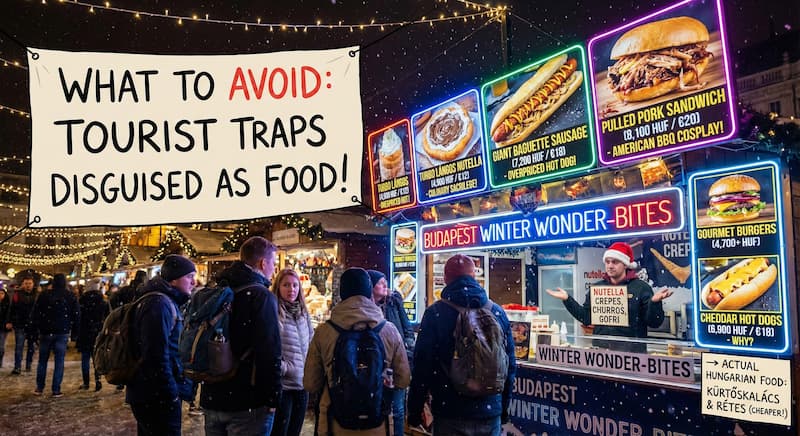
I knew Christmas markets were getting creative, but nothing—and I mean nothing—prepared me for the sight of someone joyfully paying 8,100 HUF for a pulled pork sandwich in the middle of Budapest. At that point I wasn’t sure whether I was at an Advent fair or an undercover Texan food festival. American BBQ wafting through a Hungarian winter night? My brain needed a moment to sit down, drink a pálinka, and process the sheer culinary identity crisis unfolding in front of me.
But here’s the thing. Budapest’s Christmas markets genuinely offer some of the best festive food experiences in Europe. The problem isn’t the food—it’s knowing what to order, what to sidestep like it’s a suspiciously wet cobblestone, and where to actually find meals that won’t require a second mortgage. St. Stephen’s Basilica market has won Europe’s Best Christmas Market four years running, and while that accolade is well-deserved for atmosphere and light shows, it doesn’t automatically mean every food stall deserves your forints.
So grab your warmest coat and loosen your belt. This is everything I’ve learned about eating your way through Budapest’s Christmas markets—without the financial hangover.
Walking into a Hungarian Christmas market hits different
The first thing that strikes you isn’t the towering Christmas tree or the baroque architecture glowing under a thousand lights. It’s the smell. That unmistakable collision of woodsmoke, caramelizing sugar, sizzling pork fat, and cinnamon that wraps around you like your grandmother’s favorite blanket—except this grandmother also makes a mean pálinka.

I remember my first December evening at Vörösmarty Square, Budapest’s original Christmas fair that’s been running since 1998. The crowds were thick, children were dragging parents toward the miniature train, and somewhere behind me, a vendor was bellowing something about “friss kürtőskalács” (fresh chimney cake) with the enthusiasm of a football announcer. Steam rose from paper cups of mulled wine, creating this hazy, golden atmosphere that made everyone look like they were walking through a Renaissance painting—if Renaissance painters had encountered LED fairy lights.

The St. Stephen’s Basilica market is a different beast entirely. Where Vörösmarty feels like organized chaos, the Basilica market is pure spectacle. Every thirty minutes from 5:30 PM, the entire facade of the church transforms into a 3D light show, and suddenly you’re eating goulash while angels literally dance across neo-classical architecture. It’s ridiculous in the best possible way.

For more details on navigating all the markets and their opening times, check out our comprehensive guide to Budapest’s Christmas Markets 2025/2026.
What the tourists don’t see is how locals actually use these markets. Most Budapestis don’t come here to eat a full meal—they pop by for one chimney cake, one mug of forralt bor (mulled wine), and maybe some roasted chestnuts while meeting friends. The seasoned locals hit Óbuda’s Fő tér market instead, where prices stay reasonable because the crowd speaks Hungarian and would collectively riot at tourist pricing. More on that secret weapon later.
The magnificent seven: Foods actually worth your forints at Budapest Christmas markets
Let’s cut through the noise. After years of eating my way through these markets—sometimes regrettably—these are the foods that justify both the price and the calories.
Kürtőskalács sits at the top of this list for good reason. This Transylvanian chimney cake has been documented since 1784, and watching one being made is half the experience. The vendor wraps sweet yeast dough around a wooden cylinder, rolls it in your chosen coating, then rotates it over hot coals until the exterior caramelizes into a crackling shell while the inside stays impossibly soft. The best ones—and I cannot stress this enough—have that perfectly crispy exterior with a soft, almost stretchy interior. Get the traditional flavors: cinnamon, walnut, or vanilla sugar. They run about 2,800 HUF ($7.50) at the main markets, though you can find them for 1,300-1,600 HUF at dedicated shops away from the Christmas crowds.
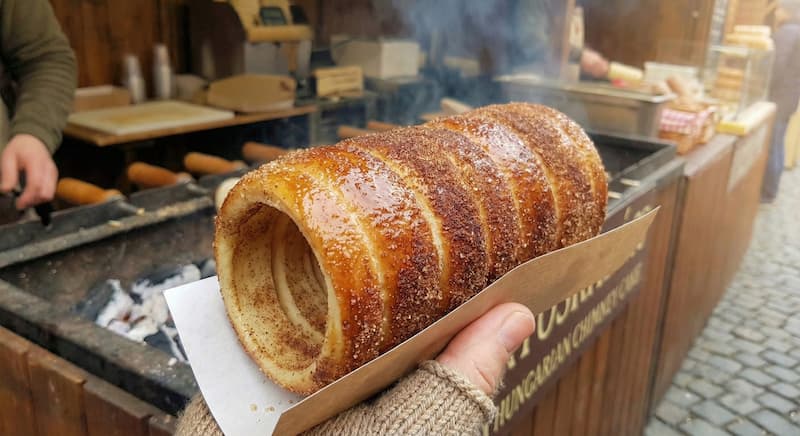
The spot locals whisper about is Vitéz Kürtős near the Basilica. They do a traditional charcoal-baked version that puts the mass-produced alternatives to shame, and they even offer gluten-free options on Tuesdays and Wednesdays. For the complete rundown on Budapest’s best chimney cakes year-round, see our dedicated guide on where to find Budapest’s best kürtőskalács.
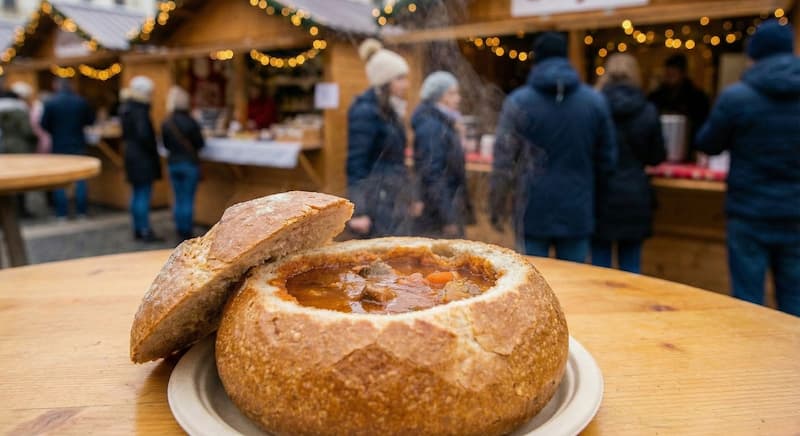
Gulyásleves (goulash soup) is the dish that makes every food writer type furiously. Let me be clear: authentic Hungarian goulash is a soup, not a stew. It’s a rich beef broth swimming with tender meat chunks, potatoes, paprika, and tiny dumplings called csipetke. At Christmas markets, it’s often served in hollowed-out bread bowls, which is admittedly theatrical but does keep your hands warm while you eat. Expect to pay around 4,500-5,700 HUF ($12-15) depending on presentation. The bread bowl version hits the higher end but gives you an edible container.
If you want to understand the difference between gulyás, pörkölt, and paprikás—three dishes tourists constantly confuse—we break it all down in our Hungarian Culinary Delights: Pörkölt, Paprikás, and Goulash guide.
Lángos is Hungary’s gift to carbohydrate enthusiasts. This deep-fried flatbread achieves something almost spiritual when done correctly: crispy and golden on the outside, pillowy and slightly chewy inside. The classic market topping is tejfölös-sajtos—sour cream and grated cheese—though adding garlic transforms it into something you’ll think about at 2 AM for weeks afterward. A properly loaded lángos runs about 3,200-3,900 HUF ($8.50-10.50) at the Christmas markets.

Here’s insider knowledge worth gold: Retro Lángos is packed with locals, has an English menu without being touristy, and serves the authentic preparation. For a deep dive into Budapest’s legendary lángos scene beyond the markets, our guide to the 10 best lángos spots has your back.
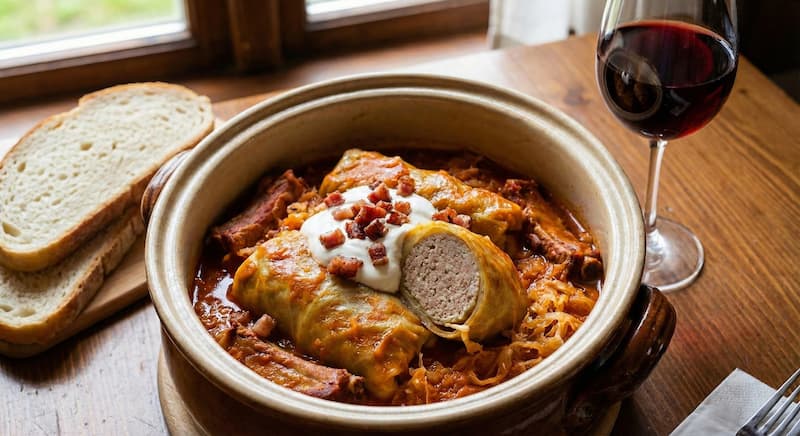
Töltött káposzta (stuffed cabbage) is quintessentially Hungarian Christmas food. Minced pork and rice wrapped in fermented cabbage leaves, slow-simmered in a paprika-spiked sauerkraut sauce until everything melds into warming perfection. It’s not glamorous—it looks like something your nagymama would ladle from a cast-iron pot—but it delivers comfort in a way that Instagram-friendly foods simply cannot. At the markets, portions run 5,500-7,000 HUF ($14.50-18.50).
Marhapörkölt with nokedli (beef stew with Hungarian egg dumplings) is the hearty option for serious appetites. Unlike goulash soup, pörkölt is a proper thick stew, slow-cooked until the beef practically dissolves into the paprika-rich sauce. The nokedli—irregular little dumplings that look like they’ve been torn by hand—soak up the sauce beautifully. This will set you back about 6,500-8,000 HUF ($17-21), but the portions are legitimately large enough to share.

Rétes (strudel) deserves mention as the best-value dessert at the markets. Cherry, apple, poppy seed, and sweet cottage cheese (túrós) fillings wrapped in layers of impossibly thin, flaky pastry. At around 1,800-2,000 HUF ($4.75-5.25), it’s sweet satisfaction without the financial sting. The pastry should shatter when you bite it—if it doesn’t, keep walking.

Forralt bor (mulled wine) is the social lubricant of Hungarian Christmas. The standard version—red wine heated with cinnamon, cloves, and citrus—runs about 1,500 HUF ($4) and is genuinely pleasant. The souvenir mug costs an additional 600 HUF but hey, you get three collectible designs per year. For quality over quantity, the DiVino stalls at the Basilica market serve a noticeably better wine base.

What to skip unless you enjoy financial pain
Not everything wrapped in steam and Christmas ambiance deserves your attention. Some items at Budapest’s Christmas markets are tourist traps wearing festive costumes, and you need to recognize them.
The “Turbo” or Nutella Lángos is perhaps the greatest culinary sin committed at these markets. At 4,700-4,900 HUF ($12.50-13), it takes a savory Hungarian classic and smothers it in chocolate spread like some confused cultural hybrid. Locals view this approximately how Italians view pineapple on pizza. Lángos is garlic, sour cream, and cheese. It has been for generations. The Nutella version exists because tourists will buy anything sweet, and vendors know this.
The giant baguette sausage is another money pit at 7,200 HUF ($19). Sounds exciting on paper, delivers like an overpriced hot dog in practice. It’s not particularly Hungarian, not particularly impressive, and definitely not worth almost twenty dollars.
Pulled pork sandwiches with fries top out around 8,100 HUF ($21.50), making them possibly the most expensive item that isn’t actual steak. You’re at a Hungarian Christmas market in Central Europe, surrounded by centuries of culinary tradition. Why you would choose American BBQ is genuinely beyond my comprehension—but the vendors thank you for your financial support.
“Premium” mulled wine versions running 2,800 HUF aren’t substantially better than the standard 1,500 HUF pour. The difference rarely justifies nearly doubling the price. Stick with basic forralt bor or, if you want quality, specifically seek out the DiVino stalls rather than paying premium prices for standard wine at regular stalls.
Gourmet burgers, cheddar hot dogs, and American-style food cluster around 4,700-6,900 HUF ($12.50-18.50). They exist because vendors observed that some tourists are intimidated by unfamiliar foods and will gladly overpay for something recognizable. Don’t be that tourist. You’ve traveled to Hungary—eat Hungarian.
Churros, Nutella crepes, and Belgian waffles are Spanish, French, and Belgian respectively. They’re perfectly fine desserts, but paying 2,500-3,500 HUF for them at a Hungarian market when you could have kürtőskalács or rétes is like going to Tokyo and ordering a cheeseburger.
The 1,600 forint hack most tourists never discover
Here’s something that changed how I approach market eating, and almost nobody knows about it. At the major markets, vendors are required to offer a rotating budget dish for 1,600 HUF (about $4.25). Same quality, smaller portion. The dish changes throughout the market season—sometimes it’s stuffed cabbage, sometimes goulash soup, sometimes sausage with sides—but it’s always legitimate Hungarian food at a fraction of typical market prices.
This means you can sample multiple dishes across different stalls without your bank account staging an intervention. See the “napi akció” or “Garantált magyar termék” signs. This is how smart locals approach the markets: one affordable dish here, a chimney cake there, mulled wine somewhere else. Rather than dropping 20,000 HUF on a single “meal experience,” you can eat diversely for under 10,000 HUF.
Speaking of budget eating in Budapest, our guide to dirt-cheap eats covers the napi menü (daily menu) system that savvy visitors use at restaurants citywide.
Where the locals actually go: Markets with soul (and reasonable prices)
The markets at Vörösmarty Square and St. Stephen’s Basilica are spectacular—but they’re priced for visitors with strong currencies and short stays. If you want the experience without the financial guilt, you need to venture slightly off the tourist trail.
Óbuda’s Fő tér market is where actual Budapestis go when they want Christmas atmosphere without feeling financially violated. Located in Óbuda (Budapest’s third district), this smaller market offers free ice skating, reasonable food prices, and a crowd that speaks more Hungarian than English. Stumbling upon it feels like discovering a village fête that somehow materialized in a capital city. The smoked pork hock here has developed something of a cult following, and prices stay honest because the vendors know their customers live here year-round.
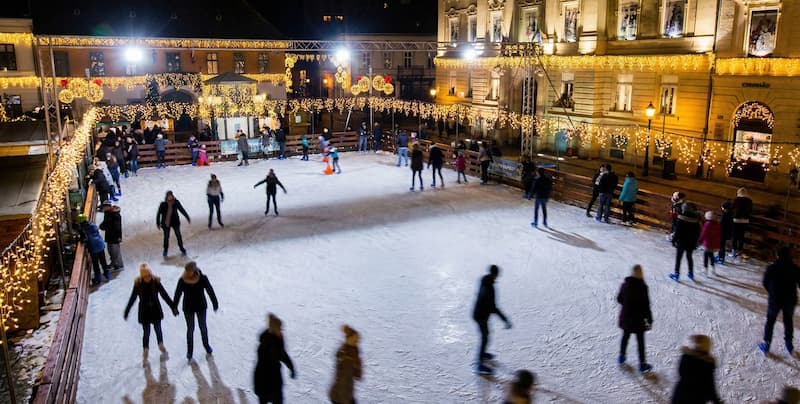
Ferenc Tér market runs for four weeks and deliberately maintains low prices—it’s cash only, which keeps the Instagram-first crowd somewhat at bay. You’ll find proper artisan foods: Szabi a Pék’s sourdough pizza, Zabáljcsak BBQ, hot pelmeni dumplings. It feels more like a neighborhood gathering than a tourism product.
The Green Christmas Market at Klauzál Square runs only on select days (November 30, December 7, and 14 for 2024) but focuses on eco-conscious, artisan products from local producers. It’s indoor, intimate, and decidedly not mass-market.
Complete Budapest Christmas market food prices for 2025
Understanding prices before you arrive prevents that unpleasant moment when you realize your “quick bite” cost as much as a restaurant meal. Here’s the comprehensive breakdown using current rates (1 USD ≈ 370-380 HUF).
Traditional savory dishes anchor the higher end of market spending. Goulash soup in a bowl runs 4,000-4,500 HUF ($10.50-12), while the bread bowl presentation hits 5,700 HUF ($15). Beef stew with dumplings costs 6,500-8,000 HUF ($17-21). Stuffed cabbage portions go for 5,500-7,000 HUF ($14.50-18.50). Pork knuckle, a dramatic-looking option, lands around 6,700-6,800 HUF ($17.65-18). The premium salmon served on wood planks tops the scale at roughly 9,500 HUF ($25).
Street food staples offer better value. Basic lángos with garlic starts at 2,000-2,400 HUF ($5.25-6.30), climbing to 3,200-3,900 HUF ($8.40-10.25) with sour cream and cheese. Adding bacon pushes it to 4,500 HUF ($11.80). Grilled sausage in bread runs 5,500-5,700 HUF ($14.50-15) at major markets, though the budget menu version drops to around 1,600 HUF ($4.25). Langalló (Hungarian flatbread pizza) ranges 2,500-4,000 HUF ($6.60-10.50).
Sweet treats vary considerably. Chimney cakes start at 2,500 HUF ($6.60) for basic versions, with traditional toppings at 2,800 HUF ($7.40) and filled premium varieties reaching 4,500 HUF ($11.80). Strudel slices cost 1,800-2,000 HUF ($4.75-5.25). Roasted chestnuts go for about 2,500-2,800 HUF ($6.60-7.40) per 100 grams.
Drinks are where small purchases add up. Standard mulled wine costs 1,500 HUF ($4), premium versions 1,650-2,150 HUF ($4.35-5.65). Tea runs 900-1,300 HUF ($2.35-3.40), coffee 1,100-1,250 HUF ($2.90-3.30), and hot chocolate 1,700-2,200 HUF ($4.50-5.80). A 4cl pour of pálinka (fruit brandy) costs approximately 2,600 HUF ($6.85).
Getting there, accessibility, and when the markets actually open
Reaching Budapest’s Christmas markets couldn’t be simpler. Deák Ferenc tér serves as the hub—metro lines M1, M2, and M3 all converge here, putting you within a two-minute walk of both Vörösmarty Square and St. Stephen’s Basilica markets. From the airport, the 100E express bus terminates at Deák Ferenc tér.
For external reference and real-time updates, check the official sites:
Official St. Stephen’s Basilica market website – click here https://adventbazilika.hu/en
Official Vörösmarty Square market website – click here https://vorosmartyclassicxmas.hu/en/home/
St. Stephen’s Basilica market (Advent Bazilika) runs from November 15, 2024 through January 1, 2025. Hours are 11 AM to 10 PM Monday through Thursday, extending to 11 PM on Fridays and Saturdays. Christmas Eve closes early at 3 PM. The light show runs every 30 minutes starting at 5:30 PM. For the 2025/2026 season, confirmed dates are November 14, 2025 through January 1, 2026.
Vörösmarty Square market operates from November 15 through December 31, 2024, with hours of 11 AM to 9 PM on weekdays (10 PM on weekends). Christmas Day closes at 2 PM. The children’s train runs from 2 PM to 8 PM on weekdays, 11 AM to 8 PM on weekends. The 2025/2026 season runs November 14, 2025 through December 31, 2025.
Accessibility at both main markets is generally good. Surfaces are mostly flat (some cobblestones at Vörösmarty), wheelchair access is available, and adapted restrooms exist at both locations. Metro Line M4 is fully accessible via lift. Heated toilets at Vörösmarty Square—located at the northwest corner—are a genuine blessing when temperatures drop.
Payment is card-only at most vendors in the major markets. Vörösmarty Square went essentially cashless; the Basilica market accepts both but card is far more common. Smaller markets like Óbuda still appreciate cash.
For combining markets with other winter activities, our Budapest winter thermal baths guide explains how to recover from cold market browsing in 38°C outdoor pools.
Insider hacks from someone who’s done this too many times
You’ve made it this far, so you deserve the genuinely useful tips that took me years of frozen fingers and buyer’s remorse to learn.
Visit on weekday afternoons if humanly possible. Saturday evenings at the Basilica market resemble rush hour on the Tokyo metro, except everyone’s holding mulled wine and taking selfies. Weekday crowds are manageable, food is fresher (vendors cook more frequently to smaller crowds), and you can actually see the stalls.
Eat breakfast elsewhere. Markets don’t open until 11 AM, and trying to make heavy goulash your first meal is a digestive decision you’ll regret. Have a proper Hungarian breakfast—we cover options in our Hungarian breakfast traditions guide—then hit the markets for lunch or afternoon snacking.
Walk two minutes in any direction for dramatically better value. That same goulash costing 5,500 HUF at the market drops to 2,500-3,500 HUF at restaurants around the corner. If you want multiple proper meals, eat one “experience” meal at the market for atmosphere, then duck into nearby streets for the rest. Our guide to the best goulash joints in Budapest lists restaurants where locals actually eat.
Check prices before ordering. Some stalls advertise tantalizing “sample plates” with small prices, but everything is individually priced—sauces, sauerkraut, bread can each add significant cost. Ask for the total before committing.
Target the budget menu rotations. That 1,600 HUF daily special exists; you just have to look for it. It’s genuine Hungarian food at local prices, designed to keep the markets accessible to Hungarian visitors.
Take the decorated tram. Lines 2, 47, and 49 get wrapped in Christmas lights during December. Riding one while clutching a chimney cake and watching the Danube roll past is free therapy. For the full rundown on festive illuminations, see our Budapest Christmas lights guide.
The honest downside nobody mentions
No guide worth reading pretends everything is perfect, and Budapest’s Christmas markets have a genuine problem: the prices have become genuinely painful, even by European Christmas market standards.
Multiple visitors describe feeling “financially assaulted” after a casual evening of eating. Reports of paying €40-52 for two people’s snacks aren’t exaggerations—they’re documented experiences. Food that looks spectacular sometimes arrives lukewarm. Some vendors have been known to not offer change, hoping you won’t notice. A few stalls position payment terminals so you can’t easily see the amount being charged.
The crowds on weekend evenings can make the experience genuinely unpleasant. At peak times, you’re shuffling through dense masses, unable to actually see stalls, eating food while being jostled, wondering why you thought this would be relaxing.
The atmosphere is incredible. The food—when chosen wisely—is genuinely good. The light shows are legitimately magical. But going in expecting “charming European Christmas market at Central European prices” will lead to disappointment. These markets increasingly cater to visitors from stronger currencies, and pricing reflects that reality.
Wrapping it all up with a bow (and possibly heartburn)
Budapest’s Christmas markets offer something legitimately special when approached strategically. The kürtőskalács is world-class. The goulash in bread bowls delivers exactly the warmth a December evening demands. The mulled wine pairs perfectly with the spectacle of light shows dancing across Baroque architecture. And those roasted chestnuts, eaten while snow flurries drift past illuminated spires, create memories no restaurant can replicate.
But the magic requires knowing the game. Skip the Nutella lángos and American BBQ. Use the 1,600 HUF budget menus. Venture to Óbuda for local prices. Eat one atmospheric market meal and supplement with restaurant dinners around the corner.
Do this, and you’ll walk away with Instagram content, a full stomach, authentic Hungarian flavors, and most of your forint supply intact. Ignore it, and you’ll join the tourists clutching €20 hot dogs while wondering what went wrong.
Either way, bring an extra belt notch. You’ll need it.
For more honest local takes on navigating Budapest during the holidays, don’t miss our survival guide: Hot Wine, Cold Nose: Surviving—and Loving—Christmas in Budapest.
FAQ: Your burning Christmas market food questions, answered
Is the food at Budapest Christmas markets actually good, or is it all tourist-trap quality?
Here’s the thing—the traditional Hungarian dishes (goulash, chimney cake, stuffed cabbage, lángos with proper toppings) are genuinely good when you choose established vendors. The problem isn’t quality; it’s international fusion nonsense priced for visitors who don’t know better. Stick to Hungarian classics, avoid anything that sounds like it belongs in Brooklyn, and you’ll eat very well indeed.
Can I eat vegetarian at Budapest Christmas markets without starving?
Vegetarian options exist but require effort. Lángos with sour cream and cheese (no bacon) works beautifully. Chimney cakes are inherently vegetarian. Strudels, potato pancakes (tócsni), and roasted chestnuts fill gaps nicely. For proper vegetarian Hungarian food, our guide to vegan restaurants in Budapest covers spots serving plant-based goulash and stuffed cabbage that would make even traditionalists pause.
How much money should I budget for an evening of eating at Budapest Christmas markets?
For two people doing the “full experience”—two main dishes, two chimney cakes, four mulled wines, and some chestnuts—budget approximately 15,000-20,000 HUF ($40-53). Use the budget menu hacks and share portions, and you can slash that to around 8,000-10,000 HUF ($21-27) for two. Going premium at the tourist-priced stalls? Bring 25,000+ HUF ($66+) and try not to cry.
Which Budapest Christmas market has the best food value?
Óbuda’s Fő tér market wins for value without question—local prices, authentic food, actual Hungarians eating there. Among the major markets, both St. Stephen’s Basilica and Vörösmarty Square charge similar prices, though the Basilica market edges ahead slightly for food quality thanks to curated vendors like Vitéz Kürtős and DiVino.
Should I bring cash or cards to Budapest Christmas markets?
Cards dominate the major markets—Vörösmarty Square is essentially cashless, and most Basilica vendors prefer card. Smaller markets (Óbuda, Ferenc Tér) still appreciate cash. Bring a card as your primary payment method, with maybe 10,000 HUF cash backup for smaller vendors or market emergencies.
What’s the one food I absolutely cannot leave without trying?
Kürtőskalács (chimney cake), no question. It’s the symbol of Budapest Christmas markets for good reason. Get the cinnamon or walnut version from a vendor who bakes over actual coals, eat it warm while the caramelized exterior still crackles, and understand immediately why this Transylvanian recipe has survived since the 1700s. Everything else is negotiable.