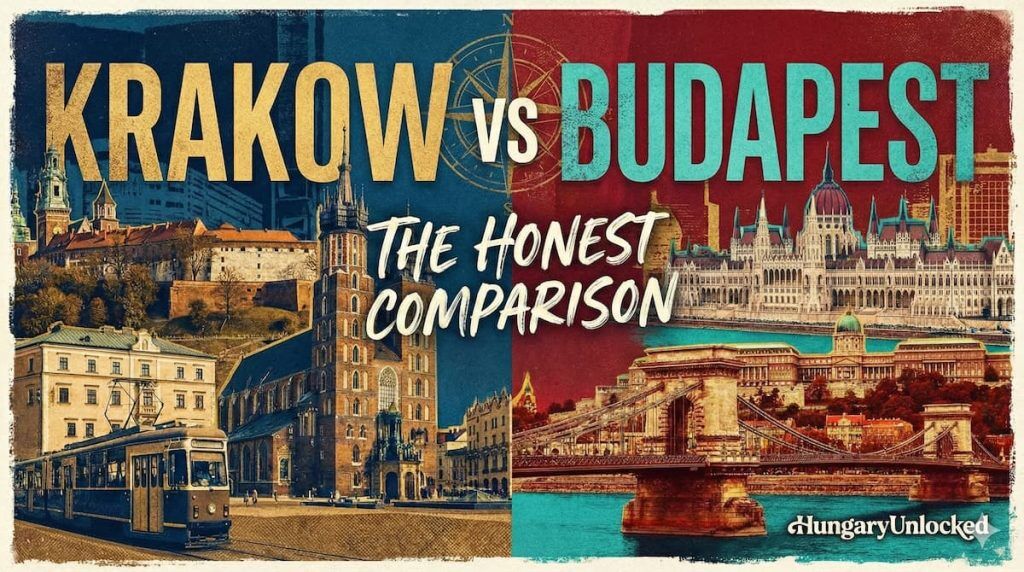
Two Eastern European capitals. One decision. Here’s everything you need to pick the right city for your trip.
🎯 TL;DR
Budapest wins for thermal baths, river views, nightlife variety, and romantic couples’ trips. Krakow wins for budget travelers, walkability, history buffs (Auschwitz), and those who want a more compact city. Budapest costs ~$124/day average; Krakow ~$83/day. Both have incredible food and drinking scenes. For a 4-day trip: Budapest offers more variety; Krakow is more manageable.
📋 Quick Comparison at a Glance
| Category | Budapest 🇭🇺 | Krakow 🇵🇱 |
| Daily Budget | ~$124 USD | ~$83 USD |
| Beer Price | 800-1,500 HUF ($2-4) | 10-18 PLN ($2.50-4.50) |
| Ideal Duration | 3-5 days | 2-4 days |
| Best For | Couples, nightlife, baths | History, budget, groups |
| Walkability | Medium (use metro) | Excellent (very compact) |
| Nightlife | Ruin bars, rooftops | Student bars, clubs |
| Unique Feature | Thermal baths | Auschwitz day trip |
The Core Question: What Kind of Trip Are You Planning?
Budapest and Krakow aren’t competing for the same traveler—they’re serving different travel moods. Understanding this upfront will save you from picking the “wrong” city and feeling disappointed.
Here’s the fundamental difference: Budapest is a sprawling, grand European capital split across two banks of the Danube, with the gravitas of a city that once co-ruled an empire. Krakow is a charming, walkable medieval town that happens to have absolutely world-class nightlife and one of the most significant historical sites of the 20th century an hour’s drive away.
Choose Budapest if:
– You want thermal bath experiences (Krakow has nothing comparable)
– You’re traveling as a couple seeking romance
– You want dramatic river views and grand architecture
– You prefer nightlife variety (ruin bars, rooftops, clubs)
– You want a “bigger city” feel
Choose Krakow if:
– Budget is a primary concern
– You want a compact, walkable city center
– You’re interested in WWII history (Auschwitz, Schindler’s Factory)
– You prefer student-heavy, raucous nightlife
– You’re coming from elsewhere in Poland and want easier logistics
Neither city is objectively “better”—they’re different experiences at different price points.
The Money Breakdown: How Much Will You Actually Spend?
Let’s talk numbers, because this is often the deciding factor. Based on 2025-2026 data from actual travelers:
💰 Daily Budget Comparison (Per Person)
| Expense | Budapest | Krakow |
| Budget hostel | $15-25 | $12-20 |
| Mid-range hotel | $60-100 | $45-75 |
| Budget meal | $8-12 | $6-10 |
| Restaurant dinner | $20-35 | $15-25 |
| Beer (bar) | $2-4 | $2.50-4.50 |
| Cocktail | $8-14 | $6-10 |
| Thermal bath entry | $15-35 | N/A |
| Public transport day | $5-7 | $3-5 |
The bottom line: Krakow is approximately 22-33% cheaper than Budapest depending on your spending style. On a 4-day trip, a budget traveler might save $100-150 by choosing Krakow. A mid-range traveler might save $150-200.
However, Budapest offers experiences you simply cannot get in Krakow (thermal baths, Danube views), which might justify the premium depending on what matters to you.
Where Budapest Costs More
– Thermal baths: $15-35 per visit, and you’ll probably want to go at least twice
– Accommodation: Central Pest hotels run 20-30% higher than central Krakow
– Tourist attractions: Parliament tour ~$15, vs. most Krakow attractions under $10
– Nightlife in tourist areas: Ruin bar prices have crept up significantly
Where Krakow Costs More
– Auschwitz tours: The site is free, but most visitors book guided transport (~$40-60)
– Actually, that’s about it. Krakow is consistently cheaper.
Nightlife: Different Vibes, Both Excellent
Both cities have reputations as nightlife destinations, but they deliver very different experiences.
Budapest Nightlife
Budapest’s nightlife is defined by ruin bars—abandoned buildings transformed into eclectic, multi-room drinking complexes. Szimpla Kert is the most famous, but there are dozens across the Jewish Quarter.
Imagine walking into what looks like a condemned building, only to find five bars, a cinema, a design market, and 500 people across multiple floors of organized chaos. That’s the ruin bar experience. Szimpla gets 15,000 visitors on busy weekends—it’s essentially a tourist attraction that happens to serve beer. But don’t let that put you off; the atmosphere is genuinely unique, and the scale allows you to find quieter corners even during peak times.
Beyond ruin bars, Budapest offers:
– Rooftop bars with Danube and Parliament views—places like Leo Rooftop and High Note SkyBar offer sunset cocktails overlooking St. Stephen’s Basilica
– Underground clubs with serious electronic music scenes—Akvárium Klub, Instant-Fogas
– Wine bars showcasing Hungarian varieties (Tokaji, Egri Bikavér)—Doblo Wine Bar is excellent
– Thermal bath parties (Sparty at Széchenyi)—imagine a club night in a historic bath complex
– Craft beer spots—the scene has exploded in recent years
– Classic cocktail bars—Boutiq’Bar, Black Swan, Kollázs
The nightlife is spread across the city but concentrated in District VII (Jewish Quarter). It appeals to a broader age range and feels more “curated” than Krakow’s scene. You’ll find well-dressed 35-year-olds sipping wine next to backpackers doing shots—the diversity is part of the appeal.
What travelers consistently note about Budapest nightlife: it’s possible to have a “nice” night out, not just a messy one. The rooftop bars and wine bars provide sophisticated options that Krakow largely lacks. But if you want messy, Budapest delivers that too—the ruin bar crawl is legendary for a reason.
Best for: Couples, mixed groups, people who want Instagram-worthy venues, electronic music fans, anyone seeking nightlife variety within one city.
Krakow Nightlife
Krakow’s nightlife is more traditional but absolutely relentless in intensity. The combination of large student population (over 200,000 students in a city of 750,000), cheap drinks, and compact old town creates a perfect storm for all-night sessions.
The scene centers on:
– Student bars with absurdly cheap shots—we’re talking €1-2 shots, beers for €2-3
– Underground clubs in medieval cellars—Krakow has a network of basement venues in historic buildings
– Craft beer bars—Poland’s beer scene has exploded; check out House of Beer or Omerta
– Late-night kebab stops—essential infrastructure for post-midnight sustainability
– Jazz clubs—Harris Piano Jazz Bar is legendary
– Cocktail spots—fewer than Budapest but improving
The vibe is distinctly younger and more raucous. On any weekend night, the Main Square and surrounding streets transform into an open-air party. You’ll see hen and stag groups (Krakow is a major destination for British parties), Erasmus students, and Polish twenty-somethings all mixing together.
The infamous “strip club promoters” are worth mentioning—you’ll encounter aggressive salespeople in the Old Town trying to lure tourists (especially male groups) into clubs that then present eye-watering bills. This is a genuine Krakow scam to avoid. Legitimate venues don’t need to drag people in off the street.
What makes Krakow nightlife special is the compactness. Within a 10-minute walking radius, you can find jazz, techno, craft beer, shots bars, and 24-hour clubs. You don’t plan a route—you just wander and let the night take you. In Budapest, changing neighborhoods means transport logistics; in Krakow, you just turn a corner.
Best for: Groups of friends, budget drinkers, people who want to party hard, stag/hen parties, students, anyone who values walking distance convenience.
The Verdict
As one traveler put it: “Budapest > very nice for chill couples. Danube cruises at sunset, thermal baths, etc. Krakow > deffo if you’re into nightlife and your liver can keep up with Polish youth.”
Food Scene: Hungarian Hearty vs Polish Comfort
Both cuisines are firmly in the “Central European hearty comfort food” category, but with distinct personalities.
Budapest Food
Hungarian cuisine is paprika-forward and proudly hearty. The national obsession with paprika (which only arrived in the 16th century) has created a distinctive flavor profile you won’t find anywhere else in Central Europe.
Essential dishes to try:
– Gulyás (goulash soup—yes, SOUP, not the stew tourists expect)
– Pörkölt (the actual stew, what foreigners think goulash is)
– Lángos (fried dough with sour cream and cheese—street food perfection)
– Kürtőskalács (chimney cake, sweet spiral pastry)
– Halászlé (fisherman’s soup, aggressively paprika’d)
– Töltött káposzta (stuffed cabbage, a comfort food staple)
– Lecsó (vegetable stew, like ratatouille’s Hungarian cousin)
– Paprikás csirke (chicken paprikash with nokedli dumplings)
Budapest also has an impressive fine dining scene with several Michelin-starred restaurants. Costes, Stand, Babel, and Onyx have all held stars at various points. The best part? A tasting menu at a Budapest Michelin restaurant runs €80-120, compared to €200-300 in Paris or London. It’s genuinely accessible fine dining.
The mid-range restaurant scene is where Budapest shines for everyday eating. Places like Kőleves, Menza, and Borkonyha offer excellent Hungarian cuisine in stylish settings for €15-25 per person including drinks. You’ll struggle to find this quality-to-price ratio in Krakow.
The street food scene centers on Central Market Hall—a stunning 19th-century building where you can eat lángos, pick up paprika, and absorb the atmosphere. The upper floor food stalls are touristy but still decent; the real treasures are the butchers and produce vendors on the ground floor.
For budget eating, Budapest has a network of self-service canteens (étkezde) where €5-7 gets you a full traditional meal. They’re not pretty, but the food is authentic and filling.
Krakow Food
Polish cuisine is heavier on dumplings and dairy, with a comfort-food orientation that’s perfect for cold weather and long nights.
Essential dishes to try:
– Pierogi (dumplings with various fillings—ruskie with potato/cheese is classic)
– Żurek (sour rye soup, often served in a bread bowl)
– Bigos (hunter’s stew, sauerkraut and meat slow-cooked together)
– Zapiekanka (Polish pizza-baguette hybrid, the go-to drunk food)
– Placki ziemniaczane (potato pancakes)
– Oscypek (smoked sheep cheese from the mountains)
– Gołąbki (stuffed cabbage rolls)
– Kotlet schabowy (breaded pork cutlet, Poland’s schnitzel)
Krakow’s secret weapon is the milk bar (bar mleczny). These communist-era cafeterias were subsidized canteens serving cheap, simple meals to workers. Many survived into the modern era and still serve massive portions of traditional food for €3-5. Pod Temidą and Bar Mleczny Tomasza are local favorites. The vibe is institutional—think school cafeteria—but the food is authentic and absurdly cheap.
The craft beer scene in Krakow is excellent and arguably more developed than Budapest’s. Polish microbreweries have exploded in the last decade, and Krakow has dozens of multi-tap bars showcasing local producers. If beer matters to you, this is a genuine Krakow advantage.
Coffee culture is also surprisingly strong. Third-wave specialty coffee shops have proliferated, with places like Wesoła Café and Karma Coffee serving excellent espresso in stylish spaces. Poland has embraced specialty coffee more thoroughly than Hungary.
The Verdict
Budapest offers more culinary range—from €5 canteen meals to €100 tasting menus—and more distinctive flavors (paprika everything). The fine dining scene is genuinely impressive. Krakow is more consistent, considerably cheaper, and better for craft beer and specialty coffee. Both deliver satisfying comfort food; Budapest just has higher highs and more variety.
Attractions and Things To Do: The Daily Activity Comparison
Beyond nightlife and food, what will you actually DO each day? This is where Budapest pulls ahead for most travelers.
Budapest Day Activities
Budapest offers genuine variety in how you spend your days:
Thermal Baths (Budapest’s Unique Advantage)
This is the single biggest differentiator. Budapest sits on over 120 hot springs, and bathing culture dates back to the Roman era. You can choose from:
– Széchenyi – largest, most famous, outdoor pools, social atmosphere (13,200+ HUF)
– Rudas – Ottoman-era, rooftop pool, night bathing on weekends
– Lukács – local favorite, less touristy
– Dandár – budget option, authentic experience
Krakow has nothing comparable. Poland has thermal spas, but none in Krakow itself and none with this historical/architectural significance.
River Activities
The Danube defines Budapest. Activities include:
– Sightseeing cruises (day or evening with Parliament lit up)
– Dinner cruises
– Kayaking
– Simply walking the embankments
Krakow’s Vistula river is pretty but not a major activity focus.
Grand Architecture Walking
Budapest rewards aimless wandering:
– Andrássy Avenue (UNESCO-listed boulevard)
– Parliament building exterior and interior tours
– Opera House
– St. Stephen’s Basilica (climb the dome!)
– Castle District cobblestones
– Art Nouveau buildings in the Jewish Quarter
Day Trips
From Budapest, you can visit:
– Szentendre (charming artist town, 40 min)
– Esztergom (massive basilica, Danube bend)
– Visegrád (medieval fortress)
– Eger (wine region, 2 hours)
Krakow Day Activities
Krakow’s daytime options are more focused:
Old Town Exploration
The Main Market Square (Rynek Główny) is one of Europe’s largest medieval squares. You can spend hours just sitting with coffee, watching the hourly trumpet call from St. Mary’s Church, browsing the cloth hall market.
Wawel Castle
The Polish royal castle sits on a limestone hill above the Vistula. The complex includes:
– State rooms and royal apartments
– Crown treasury and armory
– Wawel Cathedral (where Polish kings were crowned)
– Dragon’s Den cave
It’s impressive but can be done in half a day.
Jewish Quarter (Kazimierz)
Once a separate Jewish city, now a trendy neighborhood with:
– Seven synagogues (several open to visitors)
– Jewish museums
– Excellent restaurants and bars
– Street art and vintage shops
Day Trips
The main day trip options from Krakow:
– Auschwitz-Birkenau – essential, 1-hour drive, allow full day
– Wieliczka Salt Mine – underground chambers, impressive but touristy
– Zakopane – mountain resort town, 2 hours south (winter sports, hiking)
Day Activity Verdict
Budapest simply has more to do. The thermal baths alone add an entire category of activity that Krakow can’t match. The Danube provides another dimension—literally a river running through the city center with viewpoints from both banks.
Krakow’s Old Town is beautiful but can feel “seen” after 2 days. Budapest reveals itself more slowly and rewards longer stays.
Historical Sites: Two Different Eras of Significance
Both cities have profound historical importance, but from completely different periods.
Budapest History
Budapest’s historical narrative is primarily:
– Austro-Hungarian Empire grandeur (Parliament, Opera House, thermal baths)
– 20th-century tragedy (House of Terror, Nazi and Soviet occupations)
– 1956 Revolution (bullet holes still visible on some buildings)
The city’s architecture tells this story visually—grand 19th-century boulevards interrupted by stark communist blocks, with Art Nouveau gems scattered throughout.
Key historical experiences:
– House of Terror (2-3 hours, emotionally heavy)
– Memento Park (communist statues, outside city)
– Castle District (medieval origins, WWII siege damage)
– Shoes on the Danube memorial (Holocaust)
Krakow History
Krakow’s historical significance centers on:
– Medieval Poland (Wawel Castle, Old Town—both UNESCO sites)
– The Holocaust (Auschwitz-Birkenau, 1 hour away)
– Nazi occupation (Schindler’s Factory, Jewish Ghetto)
Unlike Warsaw, Krakow survived WWII relatively intact, preserving one of Europe’s finest medieval town centers. But the Holocaust history is unavoidable and should be engaged with respectfully.
Key historical experiences:
– Auschwitz-Birkenau (full-day trip, absolutely essential, emotionally devastating)
– Schindler’s Factory museum (3-4 hours)
– Wawel Castle complex
– Kazimierz (Jewish Quarter)
The Verdict
For WWII and Holocaust history, Krakow is unmatched—Auschwitz alone justifies the trip for many visitors. For imperial grandeur and Cold War history, Budapest is more immersive. Both cities require emotional preparation for their heavier sites.

Getting Around: Sprawl vs Compactness
This is where Krakow has a clear advantage for casual tourists.
Budapest
Budapest is a big city (1.7 million people, spread across two sides of a river). You’ll need public transport:
– Metro: 4 lines, efficient, the M1 is a UNESCO site itself
– Trams: Extensive network, scenic along the Danube
– Walking: Possible within districts, but crossing the city requires transit
Expect to walk 15,000-20,000 steps daily if you’re sightseeing actively, plus metro/tram time between areas.
Krakow
Krakow’s Old Town is remarkably compact. Everything tourists care about is within a 20-minute walk:
– Old Town square
– Wawel Castle
– Kazimierz (Jewish Quarter)
– Nightlife areas
You might never need public transport except for:
– Schindler’s Factory (tram)
– Auschwitz (bus/tour from outside center)
Daily step counts are similar, but you’ll feel like you’re covering more ground in Krakow because the city doesn’t fight you.
The Verdict
If walkability and simplicity matter to you, Krakow wins decisively. Budapest requires more logistics but rewards you with more distinct neighborhoods to explore.
Weather Considerations (Since Someone Always Asks About February)
Many travelers ask about February travel, so let’s address this:
February Weather
| City | Avg High | Avg Low | Rainy Days |
|---|---|---|---|
| Budapest | 5°C (41°F) | -2°C (28°F) | 8 |
| Krakow | 3°C (37°F) | -5°C (23°F) | 7 |
Both cities are cold in February. Krakow is slightly colder. Neither is pleasant for extensive outdoor sightseeing.
Budapest advantage: Thermal baths are actually MORE enjoyable in winter. Sitting in 38°C water while snow falls around you is magical.
Krakow advantage: Fewer tourists, including at Auschwitz (which can be overwhelmingly crowded in summer).
For winter trips, Budapest’s thermal baths provide a unique cold-weather activity that Krakow simply cannot match.
The “Guy’s Trip” vs “Couples Trip” Consideration
The question of a “guy’s trip,” which has different requirements than other travel types.
For Groups of Friends / “Guy’s Trips”
Krakow is probably better:
– Cheaper drinks = longer nights
– More concentrated nightlife = easier group coordination
– Student bar energy matches group trip vibes
– Easier walking logistics for groups
Budapest counter-argument:
– Ruin bars are incredible group venues
– Thermal baths work surprisingly well for friend groups (less romantic than it sounds)
– More diverse nightlife options if group interests vary
For Couples
Budapest is clearly better:
– Danube sunset cruises
– Romantic thermal bath experiences
– Rooftop bars with views
– More upscale dining options
– Generally more “Instagram couple” moments
Krakow is charming but not optimized for romance the way Budapest is.
Practical Logistics
Getting There (From Major European Cities)
Both cities have good budget airline connections. Budapest has slightly better connectivity to Western Europe; Krakow has better connections within Poland and to the UK (easyJet, Ryanair heavy presence).
Direct flights exist from: London, Paris, Berlin, Amsterdam, Rome, Barcelona, and most European capitals to both cities.
Visa/Entry
Both Hungary and Poland are EU/Schengen members. Same entry requirements for both.
Currency
– Budapest: Hungarian Forint (HUF)—bring cash, cards widely accepted
– Krakow: Polish Złoty (PLN)—cards widely accepted, some small vendors cash-only
Neither uses the Euro (both planned to adopt it eventually, neither has).
Safety
Both cities are very safe by European standards. Normal urban awareness applies—watch for pickpockets in tourist areas, avoid obvious scams.
Krakow has more aggressive street promoters for strip clubs (especially targeting obvious tourist groups). Budapest has some tourist-trap restaurants near major attractions. Neither is dangerous, just annoying.
Final Recommendation Matrix
| If You Want… | Choose… |
|---|---|
| Thermal bath experiences | Budapest 🇭🇺 |
| Maximum budget stretching | Krakow 🇵🇱 |
| Romantic couples trip | Budapest 🇭🇺 |
| Group/friends trip | Either, edge to Krakow |
| Stag/hen party | Krakow 🇵🇱 |
| Holocaust history | Krakow 🇵🇱 (Auschwitz) |
| Imperial grandeur | Budapest 🇭🇺 |
| Compact walkability | Krakow 🇵🇱 |
| Winter trip | Budapest 🇭🇺 (baths!) |
| Nightlife quantity | Krakow 🇵🇱 |
| Nightlife variety | Budapest 🇭🇺 |
| Easier first-time trip | Krakow 🇵🇱 |
Accommodation: Where to Stay in Each City
Budapest Accommodation
Budapest’s accommodation spreads across several distinct areas:
District V (Belváros/Inner City)
– Most central, near Parliament and Chain Bridge
– Highest prices, most tourist-dense
– Walking distance to major sights
– Best for: First-timers, short stays
District VII (Jewish Quarter)
– Ruin bar central, nightlife hub
– Mid-range pricing, trendy boutique hotels
– Can be noisy at night (feature or bug?)
– Best for: Nightlife focus, younger travelers
District VI (Terézváros)
– Andrássy Avenue area, slightly more residential
– Good mid-range options
– Walking distance to both Castle and Party districts
– Best for: Balance seekers
Buda Side (Districts I, II, XI, XII)
– Quieter, more residential
– Castle District (I) is expensive but stunning
– Requires more transport to Pest nightlife
– Best for: Couples, families, quiet seekers
Average nightly rates (mid-range double room):
– Budget hostel: €15-30
– Mid-range hotel: €60-120
– Boutique/luxury: €150-300+
Krakow Accommodation
Krakow is more compact, with accommodation concentrated in:
Old Town (Stare Miasto)
– Maximum convenience, everything walkable
– Premium prices for location
– Can book up fast in peak season
– Best for: Everyone, honestly
Kazimierz (Jewish Quarter)
– 10-15 minute walk from Main Square
– More character, better restaurants
– Increasingly hipster/trendy vibe
– Best for: Food and bar lovers, return visitors
Podgórze
– Across the river, Schindler’s Factory area
– Budget-friendly, up-and-coming
– Requires more walking/trams
– Best for: Budget travelers, history buffs
Average nightly rates (mid-range double room):
– Budget hostel: €12-25
– Mid-range hotel: €45-90
– Boutique/luxury: €120-250+
Accommodation Verdict
Krakow is 20-30% cheaper for equivalent quality. But Budapest has more neighborhood variety—you can genuinely choose a different experience based on where you stay. In Krakow, you pretty much want to be in or near the Old Town; in Budapest, you might deliberately choose Buda for a quieter experience.
Sample 4-Day Itineraries
Budapest in 4 Days
Day 1: Pest Introduction
– Morning: St. Stephen’s Basilica and dome climb
– Lunch: Central Market Hall
– Afternoon: Walk along Danube promenade to Parliament exterior
– Evening: Ruin bar crawl starting at Szimpla Kert
Day 2: Buda and Baths
– Morning: Castle District, Fisherman’s Bastion, Matthias Church
– Lunch: Castle District restaurant
– Afternoon: Széchenyi or Rudas thermal bath (2-3 hours)
– Evening: Dinner in Jewish Quarter, rooftop bar for sunset views
Day 3: Culture and History
– Morning: House of Terror
– Lunch: Break for recovery (heavy content)
– Afternoon: Walk Andrássy Avenue, Heroes’ Square, City Park
– Evening: Dinner cruise or fine dining, wine bar
Day 4: Flexible / Day Trip
Option A: Szentendre day trip
Option B: Second thermal bath (different experience)
Option C: Sleep in, brunch, shopping, easy exploration
– Evening: Final ruin bars or rooftop drinks
Krakow in 4 Days
Day 1: Old Town
– Morning: Main Market Square, St. Mary’s Church
– Afternoon: Wawel Castle complex
– Evening: Old Town dinner, bar exploration
Day 2: Auschwitz (Full Day)
– 6-7 AM: Tour pickup
– All day: Auschwitz-Birkenau visit
– Evening: Recovery, quiet dinner (heavy day)
Day 3: Jewish Heritage
– Morning: Kazimierz walking tour, synagogues
– Afternoon: Schindler’s Factory museum
– Evening: Kazimierz restaurants and bars
Day 4: Flexible
Option A: Wieliczka Salt Mine
Option B: Sleep in, revisit favorites
Option C: Day trip to Zakopane (if mountains interest you)
– Evening: Final night out
Itinerary Verdict
Budapest’s itinerary has more variety—different neighborhoods, activities (baths!), and vibes each day. Krakow’s itinerary is more historically intense, with Auschwitz dominating one full day. Neither is better; they serve different travel moods.
The Honest Answer
Both cities are excellent choices. You won’t regret visiting either one.
If you’re genuinely torn and your trip allows flexibility: Budapest offers more unique experiences (thermal baths exist nowhere else like this), while Krakow offers better value and simplicity.
For a 4-day winter trip with a group of friends who want to explore by day and party by night? Flip a coin—you’ll have a great time either way. Groups of friends visiting would probably enjoy Krakow slightly more for budget and nightlife density, but Budapest’s thermal baths would give them stories Krakow can’t match.
For couples, Budapest wins convincingly. The romance factor—river views, thermal baths for two, rooftop sunset cocktails—is simply higher.
For history-focused travelers, it depends on which era fascinates you. WWII and Holocaust: Krakow (Auschwitz is unmissable). Cold War and imperial grandeur: Budapest.
But if those thermal baths are calling to you… that’s probably your answer. There’s nothing else like floating in 38°C water in a 19th-century palace while snow falls around you. Krakow is wonderful, but it can’t offer that.
📍 Planning Your Budapest Trip
If Budapest won your internal debate, here are essential resources:
Frequently Asked Questions
Is Budapest or Krakow safer?
Both are very safe for tourists. Budapest has slightly more petty crime in tourist areas; Krakow has more aggressive nightlife promoters trying to lure people into strip clubs. Neither is dangerous for normal travelers exercising basic urban awareness. Violent crime affecting tourists is extremely rare in both cities.
Can I do both cities in one trip?
Yes! There are direct trains and buses between them (5-6 hours). A 7-10 day trip covering both cities works well: 4 days Budapest, 3 days Krakow (or vice versa). The overnight train/bus is an option for saving accommodation cost, though daytime travel is more comfortable.
Which city has better day trip options?
Budapest: Szentendre (artist town), Esztergom (basilica), Visegrád (castle), Lake Balaton (summer beaches). Krakow: Auschwitz (unmissable), Wieliczka Salt Mine (underground chambers), Zakopane (mountain resort). Both have excellent options, but Auschwitz gives Krakow a unique draw.
Is English widely spoken in both cities?
Yes, particularly among younger people and in tourist areas. You’ll have no problems in either city. Service staff almost universally speak English in restaurants, hotels, and attractions. Older locals and people outside tourist zones may have limited English.
Which is better for solo travelers?
Both work well for solo travel. Krakow’s hostel scene is slightly more social and backpacker-oriented; Budapest offers more diverse solo activities including thermal baths (surprisingly great alone—you just zone out and relax). Budapest’s larger size means more anonymity; Krakow’s compactness means easier navigation.
Which has better coffee culture?
Budapest has grander historic coffee houses—think chandeliers, marble, and waiters in waistcoats. Krakow has a more developed third-wave specialty coffee scene with modern cafés serving excellent espresso. For aesthetics and history, Budapest; for coffee quality and café modernity, Krakow edges ahead.
What’s the best time of year to visit each city?
Both cities are excellent in spring (April-May) and autumn (September-October) when weather is mild and crowds are manageable. Summer (June-August) brings peak tourists and heat. Winter (December-February) is cold but atmospheric—Budapest’s thermal baths shine in winter; Krakow’s Christmas markets are famous. For the “guy’s trip in February” from the original Reddit thread, Budapest’s baths make it the better winter choice.
How do I get from the airport to city center?
Budapest: BUD airport is 16km from center. Options include airport shuttle bus (100E, ~1,500 HUF), taxi (~10,000 HUF fixed rate), or transfer services.
Krakow: KRK airport is 11km from center. Options include train to main station (easy), bus, or taxi (~70-90 PLN).
Both airports have good, affordable transport links.
Are credit cards widely accepted?
Yes, in both cities. Major cards work at restaurants, hotels, and most shops. Smaller vendors and some older establishments may prefer cash. Neither city requires you to carry large amounts of cash, but having some local currency is useful.
What about tipping customs?
Both countries expect 10-15% tips for restaurant service if satisfied. In Budapest, check if service is already included (sometimes it is). In Krakow, 10% is standard. Thermal bath attendants in Budapest appreciate small tips (500-1,000 HUF) for locker assistance.
Which city is better for vegetarians/vegans?
Both traditional cuisines are meat-heavy, but both cities have embraced modern dietary trends. Budapest has more dedicated vegan restaurants and better plant-based options at mainstream restaurants. Krakow has excellent pierogi options (cheese-potato filling is vegetarian) and improving vegan scenes. Neither will leave vegetarians stranded, but Budapest is slightly better.
Can I drink tap water?
Yes, tap water is safe and drinkable in both Budapest and Krakow. Save money and plastic by refilling bottles.
A Note on “Eastern Europe” Sensitivity
Both Hungary and Poland have complex relationships with the “Eastern Europe” label. Geographically, both countries consider themselves Central European. Culturally, both were part of the Western-facing Austro-Hungarian or Polish-Lithuanian spheres before the Iron Curtain artificially grouped them with the Soviet bloc.
You’ll find locals in both cities mildly irritated by the “Eastern Europe” shorthand. Budapest especially emphasizes its Habsburg heritage and architectural connections to Vienna. Krakow points to its position as a European intellectual center for centuries.
None of this affects your trip planning—just be aware that “Central Europe” is the preferred and more accurate term. And both cities very much belong in any “best of Europe” conversation, not some second-tier “Eastern” category.
The Final Word
The internet loves a clear winner, but travel doesn’t work that way. Budapest and Krakow are both genuinely excellent cities that happen to serve slightly different travel needs.
If budget is the primary constraint, Krakow wins mathematically—you’ll save €100-200 over a 4-day trip compared to Budapest.
If unique experiences matter more than cost, Budapest’s thermal baths are genuinely one-of-a-kind. Nothing in Krakow (or most of Europe) compares to soaking in centuries-old bathhouses built over natural hot springs.
If nightlife intensity is the priority, Krakow’s student-fueled scene edges out Budapest’s more varied but less concentrated offerings—though Budapest’s ruin bars are a must-experience regardless.
If you’re a couple looking for romance, Budapest is purpose-built for it. River cruises, thermal baths, rooftop sunsets—it’s almost unfair how well the city works for romantic getaways.
If WWII history matters to you, Krakow and Auschwitz are non-negotiable. That experience cannot be replicated elsewhere.
Ultimately, you’ll probably visit both cities eventually. They’re close enough that a return trip combining them is easy to justify. For now, pick based on your current trip’s vibe, budget, and companions—and enjoy whichever city you choose. Both will exceed expectations.
Prices verified: January 2026
Related articles:
– 3 Days in Budapest: The No-BS Local’s Itinerary
– Budapest’s Best Thermal Baths in 2026
– Hungary on a Budget: What You’ll Actually Spend
– 5 Best Ruin Bars in Budapest


