Budapest's Palace Quarter Is District VIII Without the Reputation
On this page
- Getting In: Two Stops From Deák, and You Are There
- The Two Museums, and What They Actually Cost
- Hungarian National Museum
- Hungarian Natural History Museum
- Side by side
- The Palaces, and Which Numbers They Are On
- The Wenckheim Palace Library, the Best 2,000 Ft in the District
- Eating and Drinking
- Rosenstein
- Geraldine, in the museum garden
- Café Csiga
- Mikszáth tér
- Rákóczi tér Market Hall
- Fiumei úti Sírkert, the Part Nobody Expects to Like
- Where to Stay, and Where Not To
- The Safety Question, Answered Properly
- Getting Around
- Two Things Worth Knowing Before You Go
- The One Real Downside
- The Verdict
Budapest’s Palace Quarter is the inner slice of District VIII, and it answers a question most visitors never think to ask: where do you go when the Jewish Quarter is too loud and District V is too expensive. It starts behind the Hungarian National Museum and you can walk the whole thing in an afternoon.
The reputation is the obstacle. Guidebooks written before the 2010s treated Józsefváros as somewhere you crossed quickly, and that framing outlived the reality by about fifteen years. In 2024 Time Out put the Palace Quarter 31st on its list of the coolest neighborhoods in the world. What actually happened here is duller and better than a ranking: aristocratic palaces became university buildings, a 150-year-old confectionery family opened a shop in a museum garden, and the streets stayed quiet because nothing in them photographs well enough to draw a crowd.
Getting In: Two Stops From Deák, and You Are There
Take the M3 or the M4 to Kálvin tér, where the two lines cross, and come up the escalators. The neoclassical columns of the Hungarian National Museum are the orientation point. That is two stops on the M3 from Deák Ferenc tér, which makes this the closest off-the-trail neighborhood in Budapest to the middle of the trail.
The verdict up front: worth half a day if you like museums, buildings or bookshops, and worth booking a hotel in if you want District V walking distances without District V prices. Not worth a full day if you came to Budapest for ruin bars and thermal water, in which case take it as a morning.
The first thing you notice at street level is the quiet. Not museum-district quiet, which is manufactured. Ordinary quiet, of the kind a neighborhood has when it has not yet worked out that it is supposed to be fashionable. The buildings are enormous, four and five storeys, put up in the window when Hungarian aristocrats had money and no interest in restraint. They come in grey and ochre rather than the pastel of the inner city, peeling in places and immaculately restored in others.
Múzeum körút is the western edge and Budapest’s antiquarian row, where secondhand bookshops have traded since the Austro-Hungarian empire was a going concern. Központi Antikvárium at number 13 to 15 is the one to walk into: open weekdays 10:00 to 18:00 and Saturdays 10:00 to 14:00, closed Sundays, and stocked deep enough that the smell of the place reaches you before the shelves do.
The Two Museums, and What They Actually Cost
Hungarian National Museum
The building is a Mihály Pollack neoclassical palace and it is worth the ticket on its own, which is useful, because four of its rooms are shut, including the one most people arrive for. The Coronation Mantle, the Seuso Treasure, the Széchényi Hall and the Open Storage are all closed to visitors. What is open is History of Hungary Part I and Part II, On the Border Between East and West, the Lapidary and the Medieval Lapidary, which is a solid two hours.

Photo: Nikolai Karaneschev, CC BY 3.0, via Wikimedia Commons. The lawn in the foreground is the free museum garden.
The steps outside are the ones the country gathers on every 15 March. If the museum itself is the reason you came to this side of town, read the full Hungarian National Museum guide before buying a ticket, because there is a guided-tour ticket that costs barely more than standard entry.
The museum garden is free, separate from the ticket desk, and it is the better lunch stop of the two options in this section.
Hungarian Natural History Museum
Down in the southern end of the district, in the old Ludovika Military Academy at Ludovika tér 2 to 6, and worth the tram ride if you have children with you. The museum holds 11.5 million registered items and its signature is a 122 square meter glass floor with the coral reef display 60 centimeters beneath your shoes, which sounds like a gimmick until you are standing on it working out where to put your feet.
Tickets are sold through Jegymester rather than at the museum’s own site, and an English guided tour is 17,000 Ft (about $54) for one to fifteen people on top of entry. The ticket desk shuts at 16:30.
Side by side
| Hungarian National Museum | Hungarian Natural History Museum | |
|---|---|---|
| Adult | 3,500 Ft (about $11) | 3,000 Ft (about $9) |
| Ages 6 to 26, 62 to 70 | 1,750 Ft (about $6) | 1,500 Ft (about $5) |
| Family | 7,200 Ft (about $23), 2 adults + 1 to 3 children | 6,000 Ft (about $19), 2 adults + 1 child over 6 |
| Group, 10 or more | 3,000 Ft (about $9) per head | 2,700 Ft (about $9) per head |
| Open | Tuesday to Sunday, 10:00 to 18:00 | Tuesday to Sunday, 9:00 to 17:00 |
| Closed | Mondays | Mondays |
| Last entry | Ticket office shuts 17:00 | Ticket desk shuts 16:30 |
| Free monthly | Third Saturday, under 26 | First Sunday, under 26 |
Prices are in HUF, which is what you pay at the counter. Converted at 1 USD = 316 HUF, the ECB rate on 1 September 2026. Rates move, so treat the converted figures as indicative.
Both museums admit under-6s, over-70s, visitors with a disability plus a companion, and teachers in public education free. The National Museum is free to everyone on 20 August and 23 October, and the Budapest Card covers its permanent exhibitions outright with 20% off temporary shows.
The Palaces, and Which Numbers They Are On
The “Palace” in Palace Quarter is not marketing. These are real palaces, built in the 19th century when Hungary’s noble families were competing over architects.
Pollack Mihály tér is where three of them face each other across one small square.
- Festetics Palace, number 3. An 1862 Miklós Ybl building, Italian Renaissance in style, now the home of Andrássy University Budapest.
- Esterházy Palace, number 8. Built in 1865 by Sándor Baumgarten. Its Marble Hall belonged to Hungarian Radio until 2022, and the building is a protected monument inside the new Pázmány Péter Catholic University campus project.
- Károlyi Palace, number 10. Stood empty for decades as a Hungarian Radio store. It is being restored as part of the same Pázmány campus, due 2027.
Bródy Sándor utca runs off the square and is the oldest cobbled street in the quarter. The building at number 8 was the Hungarian House of Representatives from 1865 to 1902, another Ybl design, put up in a matter of months and good enough that the emperor decorated him for it. It has been the Italian Cultural Institute since 1943.
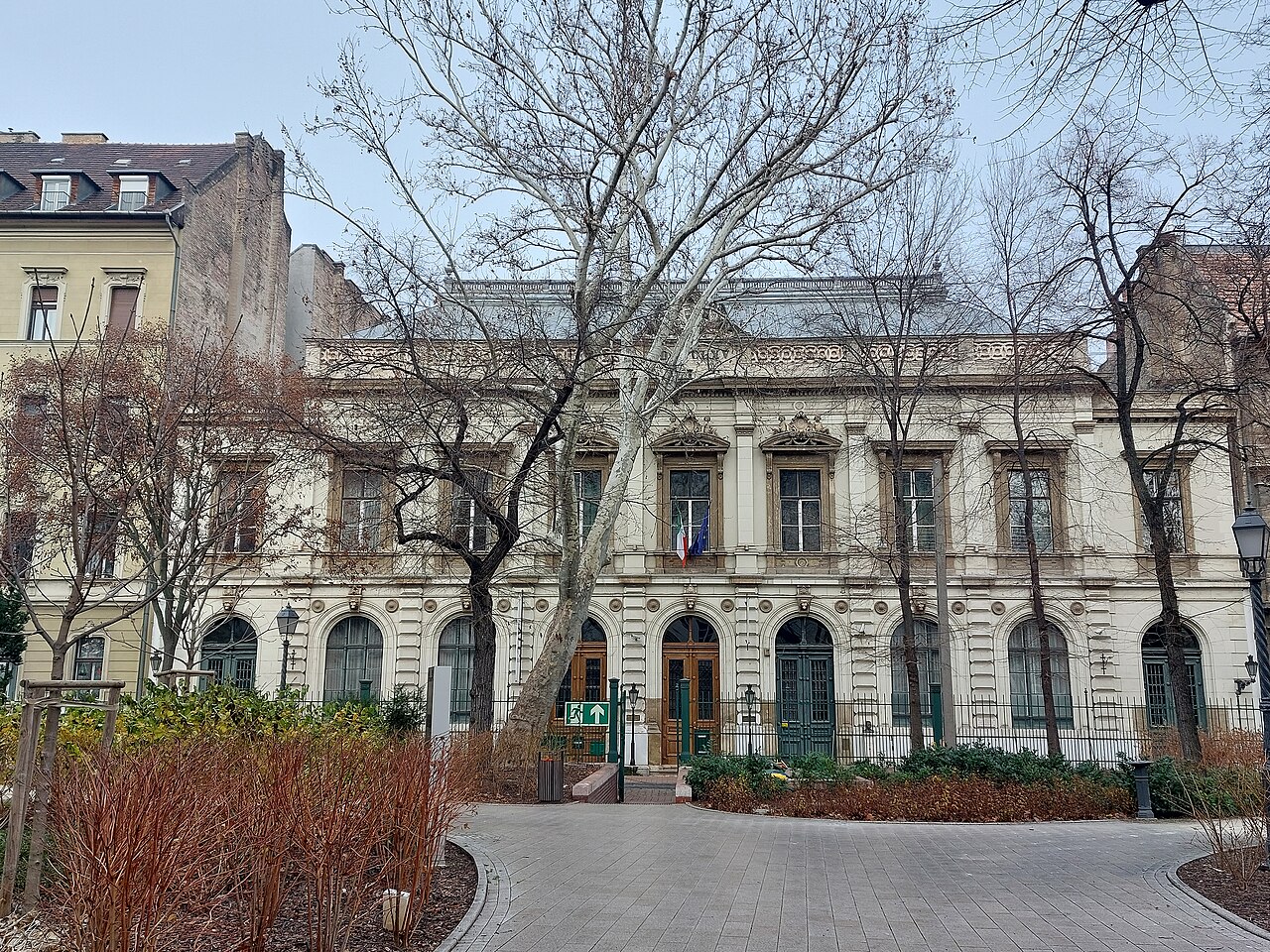
Photo: Hujber Tünde, CC BY-SA 4.0, via Wikimedia Commons. Shot in winter, so the trees are bare; in summer the facade is largely hidden behind them.

None of this costs anything from the outside, and the streets are the attraction. Wear shoes you can walk slowly in.
The Wenckheim Palace Library, the Best 2,000 Ft in the District
The main branch of Budapest’s public library system occupies a converted aristocratic palace at Reviczky utca 1, and it is the most impressive interior in the Palace Quarter that a visitor can simply walk into.
A tourist ticket costs 2,000 Ft (about $6), bought at the information desk in the Central Library foyer. That gets you the palace floor, reached by the imperial staircase from the entrance hall, with the Gold Salon on the Reviczky utca side and the Silver Salon on the Baross utca side. The library runs 10:00 to 20:00. A guided tour is a separate booking at a separate price.

Photo: Backofbourke99, CC BY-SA 4.0, via Wikimedia Commons. One of the palace salons, not the modern reading rooms in the newer wing behind it.

The reason it lands is that this is a working library, not a museum. Students in hoodies sit with laptops under gilded ceilings, which is a fair summary of how Budapest treats its own grandeur.
Eating and Drinking
Rosenstein
What is it? A Hungarian and Hungarian-Jewish restaurant on Mosonyi utca near Keleti station, run by the Rosenstein family, and one of the few kitchens in Budapest where the cooking your grandmother would recognize is done to a standard that also satisfies people who eat out for a living.
Why it’s worth it For one proper sit-down Hungarian meal on a short trip, this is the one. If you want the specific dish this kitchen is known for, the tripe stew guide has the detail and the day of the week to go.
Insider tip Book. Walking in and getting a table is not the normal outcome here.
The facts Mosonyi utca 3, 1087. Open Monday to Saturday 12:00 to 23:00, closed Sundays. +36 1 333 3492 or +36 30 746 1603. rosenstein.hu
Geraldine, in the museum garden
What is it? One of the Auguszt confectionery family’s four Budapest shops, this one in the National Museum garden, named after Geraldine Apponyi, the Hungarian countess who became Queen of Albania.
Why it’s worth it The garden terrace under the chestnut trees is the best place to sit down in the Palace Quarter, and the garden itself is free to enter, so the cake is the only thing you pay for.
Insider tip Auguszt dates its Budapest baking to 1870, and this branch is the least famous of the four, so it takes the overflow when the Belváros shop on Kossuth Lajos utca has a queue. More context in the Budapest dessert guide.
The facts Múzeum körút 14 to 16, in the garden. Open Tuesday to Sunday 10:00 to 19:00, closed Mondays. +36 70 614 8009.
Café Csiga
What is it? A scruffy, mismatched, mostly-local café and restaurant on the corner by the Rákóczi tér market hall.
Why it’s worth it It is the brunch answer in a district that does not have many, and the crowd is people who live here rather than people who found it in a guide.
Insider tip It opens at 9:00 and breakfast service runs to 11:45, after which the kitchen switches to the lunch menu.
The facts Vásár utca 2, 1084. Open 9:00 to 22:00. +36 1 790 5946.
Mikszáth tér
The small square around the corner from Bródy Sándor utca is the quiet alternative to the Jewish Quarter: café terraces on the pavement, university students, and the Continental habit of sitting three hours over one coffee. Lumen is the anchor and it runs two doors, KisLumen on Mikszáth tér 2 and NagyLumen on Horánszky utca 5, which does concerts and food as well as coffee. If you want the loud version of a Budapest night out instead, the themed bar guide covers it.
Rákóczi tér Market Hall
Most visitors head for the Great Market Hall on Fővám tér, which is beautiful and in every guidebook. Rákóczi tér market is the one people who live here use, and it is a ten-minute walk from the National Museum.
Built in 1894, burned down in 1988 and reopened in 1991, it serves the neighborhood rather than the camera: produce, meat, fish, dairy, the sour-vegetable counters Hungarians call savanyúság, and a lángos window that is not priced for cruise passengers. The Budapest markets guide compares it against the Great Market Hall if you want to do both.
| Day | Hours |
|---|---|
| Monday | 06:00 to 16:00 |
| Tuesday to Friday | 06:00 to 18:00 |
| Saturday | 06:00 to 13:00 |
| Sunday | Closed |
It also shuts on public holidays. Getting there: M4 to Rákóczi tér, or trams 4 and 6 along the boulevard.
Fiumei úti Sírkert, the Part Nobody Expects to Like
Bear with this one. The Fiumei úti nemzeti sírkert, still called Kerepesi by everyone, covers 56 hectares on the eastern edge of the district and works as Hungary’s national pantheon, the local equivalent of Père Lachaise.
The tombs read like a history syllabus: Lajos Kossuth, whose mausoleum is the largest thing in the cemetery; Ignaz Semmelweis, the doctor who worked out that handwashing saves lives and was ignored for it; and a plot for the dead of the 1956 revolution, including Erika Szeles, shot at fifteen and buried here that November. Zsa Zsa Gabor, who left Budapest in the 1930s and died in Los Angeles in 2016, is buried here too.
Entry is free during opening hours, which move with the season: 07:30 to 17:00 in the depth of winter, 07:00 to 20:00 in high summer. Give it two hours. It is near Keleti station on the M2.
Where to Stay, and Where Not To
The rule is simple and it works at street level, not district level. Book inside the inner Palace Quarter: the blocks behind the National Museum taking in Pollack Mihály tér, Bródy Sándor utca, Trefort utca, Mikszáth tér and everything inside the Kiskörút. That zone is quiet, walkable and a few minutes on foot from Kálvin tér.
Three properties sit squarely inside it, in genuine District VIII buildings rather than on the boundary:
- Hotel Museum Budapest, Trefort utca 2. A four-star hotel a minute from the National Museum, with a free wellness area and a fitness room. museumhotel.hu
- Eurostars Palazzo Zichy, Lőrinc pap tér 2. Eighty rooms in the neo-baroque palace Count Nándor Zichy built for his family, with the former courtyard under a glass dome where breakfast is served, plus a sauna and a gym. Breakfast runs 07:00 to 10:30 on weekdays and to 11:00 at weekends.
- Brody House, on Bródy Sándor utca, the street named after the writer Sándor Bródy. An 1896 townhouse built to Ernő Schannen’s designs for Dr Vilmos Tauffer and converted into a boutique hotel in 2009. Every bedroom is named for an artist who had a studio here or worked with the house, and carries that artist’s work. There is a bar, a bistro and a gallery in the building. brody.house
Avoid booking beyond the Nagykörút in outer District VIII: the Magdolna Quarter around Dankó utca and Lujza utca, Népszínház utca and the streets off it, and Teleki László tér. These have improved a great deal over the past decade, but the atmosphere after dark is not what the Palace Quarter photographs promised you.
If the Palace Quarter is full or over budget, the two neighbours are covered in detail: District VII hotels and hostels and District V hotels. The district-by-district comparison is the place to start if you have not picked a side of the river yet.
The Safety Question, Answered Properly
Most travel writing either ignores District VIII’s reputation or leans on a version of it that expired years ago. Neither helps.
The inner Palace Quarter, roughly Múzeum körút to József körút, is quiet and safe day and night. The museums, the palaces, the hotels and the cafés are all inside it, and walking it at midnight feels the same as walking District V or District VI at midnight. The residents are students, university staff and people who have lived on those streets for decades.
Past József körút it changes. Népszínház utca, Teleki László tér, Orczy tér and parts of Magdolna utca still carry some of the old character. Violent crime against visitors is close to nonexistent across Budapest, so this is not a danger warning, it is a comfort warning, and it applies after dark. Stick to the quarter proper for sightseeing and sleeping, keep your bearings if you go east, and treat 2am the way you would in any transitional neighborhood anywhere. The Budapest safety guide has the city-wide version, including what actually goes wrong here.
Getting Around
Metro. The M3 runs through Kálvin tér, Corvin-negyed and Semmelweis Klinikák. The M4 connects Kálvin tér, Rákóczi tér and II. János Pál pápa tér. Trams 4 and 6 run the Nagykörút, which is the district’s outer edge.
| BKK ticket | Price in HUF | In USD |
|---|---|---|
| Single ticket, bought in advance | 500 Ft | $2 |
| 24-hour Budapest travelcard | 2,750 Ft | $9 |
| 72-hour Budapest travelcard | 5,750 Ft | $18 |
BKK sells no 7-day card, so the 72-hour travelcard is the longest short-stay option before the monthly Budapest-pass at 8,950 Ft. Download BudapestGO for tickets and routing. It works in English.
A walking route, two and a half to three hours. Start at Kálvin tér. Walk to the Hungarian National Museum and its garden. Browse the antiquarian shops along Múzeum körút, 15 minutes. Turn into Bródy Sándor utca for the palaces and the old parliament building, 15 minutes. See the Wenckheim Palace rooms at the Szabó Ervin library, 30 minutes. Coffee at Mikszáth tér, 20 minutes. Cross József körút to the Rákóczi tér market, 30 minutes. Finish at Rákóczi tér on the M4.
Two Things Worth Knowing Before You Go
Corvin-negyed is not this. The area around Corvin-negyed metro is glass, steel and shopping-mall energy, and some guides group it in with the Palace Quarter. It is a different experience. Fine if you need a supermarket or want to see the Bud Spencer statue, but it is not the reason to come to District VIII.
Time Out Market is next door. The food hall at Blaha Lujza tér opened in September 2025 and sits on the district boundary, which makes it an easy end to a Palace Quarter afternoon. Our Time Out Market review has the prices and the verdict on whether it earns them.
The One Real Downside
The Palace Quarter is not a complete neighborhood in the way visitors usually mean it. There is no single street you can drift along for hours discovering shops. The points of interest are spread out and you navigate between them deliberately. The blocks around the National Museum empty out in the evening, and the grey-and-ochre severity of the architecture wins people over more slowly than the painted facades further in.
If you want a district you can spend a whole unplanned day in, District VII is still the better answer. The Palace Quarter pays off for people who arrive with a list.
The Verdict
Time Out did not put the Palace Quarter 31st in the world because it photographs well. It ranked it because the thing is genuinely rare in a European capital: a historic neighborhood that has not been reorganized around tourism, where local life continues undisturbed and the prices have not adjusted to what a visitor would pay.
The museums are serious. The architecture carries 150 years of Hungarian history with almost no explanatory plaques. The restaurants are places people here choose. The hotels are in actual palaces at mid-range money.
Give it a morning. Bring shoes.
Prices, hours and closures read at the operators on 3 September 2026.
Good to know
Is District VIII safe for tourists?
The inner Palace Quarter, between Múzeum körút and József körút, is quiet and safe day and night. It is a district of students, university staff and residents who have been there for decades. Past József körút the character changes and some streets still feel rough after dark, which is a reason to plan your evening walk, not a reason to avoid the district.
How do I get to the Palace Quarter from the city center?
Take the M3 or the M4 to Kálvin tér and walk out of the station. That is two stops from Deák Ferenc tér on the M3. Trams 47 and 49 also stop at Kálvin tér, and trams 4 and 6 run along József körút at the far edge of the quarter. From District V or the Jewish Quarter it is a walk of 10 to 20 minutes.
What is the difference between the Palace Quarter and District VIII?
District VIII (Józsefváros) is a whole administrative district that runs from the museum blocks near the center out to working-class streets on the city edge. The Palace Quarter, or Palotanegyed, is only the historic inner portion around the Hungarian National Museum and the aristocratic palaces. When a guide says District VIII is worth seeing, this is the part it means.
How long do you need in the Palace Quarter?
Half a day covers it comfortably: two to three hours on foot for the streets, the bookshops, the library and the market, plus an hour or two if you go inside the National Museum. A full day only makes sense if you add the Natural History Museum in the south of the district or the Fiumei úti sírkert.
Which museum is better, the National Museum or the Natural History Museum?
The National Museum if you want Hungarian history and a neoclassical building that is an exhibit in itself, and it is a two-minute walk from Kálvin tér. The Natural History Museum if you have children, because the glass floor over the coral reef display lands better with under-12s. They are a tram ride apart, so pick one per visit.
Where should I eat in the Palace Quarter?
Rosenstein on Mosonyi utca for a proper Hungarian and Hungarian-Jewish sit-down meal, booked ahead. Geraldine in the National Museum garden for cake from the Auguszt family. Café Csiga by the Rákóczi tér market for brunch. Mikszáth tér for a drink outdoors without the Jewish Quarter noise.
Is the Coronation Mantle on display at the Hungarian National Museum?
No. The Coronation Mantle room is closed to visitors, along with the Seuso Treasure, the Széchényi Hall and the Open Storage. What is open is History of Hungary Part I and Part II, On the Border Between East and West, the Lapidary and the Medieval Lapidary.
Can you get into the Szabó Ervin library palace rooms without a library card?
Yes. A tourist ticket for the Wenckheim Palace rooms costs 2,000 Ft and is sold at the information desk in the Central Library foyer at Reviczky utca 1. A guided tour is a separate booking at a separate price.
Should I book a hotel in District VIII?
In the inner Palace Quarter, yes. Hotel Museum on Trefort utca, Eurostars Palazzo Zichy on Lőrinc pap tér and Brody House on Bródy Sándor utca all sit inside the good part and put you a few minutes' walk from Kálvin tér. Beyond József körút, and around Népszínház utca and Teleki László tér in particular, book somewhere else.
Find a bed, pick your district
Booking through these links supports the site at no extra cost to you. How this works.