Budapest Has 23 Districts. These 8 Are the Ones to Book.
On this page
- How Budapest’s District Numbers Actually Work
- The quick answer
- District V (Belváros-Lipótváros): The Grand, Expensive Center
- District VI (Terézváros): Elegant, and Now Airbnb-Free
- District VII (Erzsébetváros): The Jewish Quarter and the Ruin Bars
- District VIII (Józsefváros): The Palace Quarter, and a Regulation Coming
- District IX (Ferencváros): Craft Beer and the Market Hall
- District XIII (Újlipótváros): Where Local Families Actually Live
- District I (Várnegyed): The Castle District
- District II (Rózsadomb): Buda’s Quiet Hillside
- The Eight Districts at a Glance
- Getting Around: Transport That Should Shape Where You Book
- Five Booking Tricks Worth Knowing
- How Budapest’s Accommodation Market Has Changed
- The Decision, District by District
- FAQ: Your Budapest Neighborhood Questions Answered
Budapest’s twenty-three districts don’t follow any geographic logic, and the numbers won’t tell you which one to book. Choose by street as well as by district: a “charming flat in the heart of the party district” with a bedroom over Kazinczy utca and a hotel near Parliament are both central, and they make for very different nights.
Only about eight of those twenty-three districts matter for a visit. The rest are residential suburbs with nothing wrong with them and no reason for a tourist to sleep there. This guide covers the eight that do, what each one is like, who it suits, and the short-term rental rules that have shifted twice since this post first went up.

How Budapest’s District Numbers Actually Work
The city splits into hilly Buda on the west bank and flat Pest on the east, unified into one city in 1873. Districts are numbered with Roman numerals, District I through District XXIII, in a spiral that made sense to a 19th-century Hungarian bureaucrat and means nothing to anyone planning a trip today. District I is the medieval Castle District on the Buda side. District V is Pest’s downtown core. District VII is the ruin bar heartland. There is no pattern to memorize; there’s just the list below.
Most first-timers stay in Pest, where the ruin bars, restaurants, Jewish Quarter, and shopping streets are. Buda offers views, history, and thermal baths, but you’ll cross the river, or take a tram, for most of what’s worth seeing.
The quick answer
| If you are… | Book… | Because |
|---|---|---|
| A first-timer who wants everything walkable | District V or VI | Landmarks, safety, and transit all in one small footprint |
| Chasing ruin bars and nightlife | District VII | Just don’t book on Kazinczy utca if you plan to sleep |
| A repeat visitor who wants real Budapest | District VIII (Palace Quarter) | Cheaper, handsome, but read the 2027 rental note below first |
| Into craft beer and a calmer local scene | District IX | Ráday utca, the Great Market Hall, less chaos than VII |
| Traveling with kids or staying a week+ | District XIII | Margaret Island, playgrounds, actual Hungarian neighbors |
| After the postcard view, not convenience | District I (Castle District) | Gorgeous, quiet at night, no metro |
| A repeat visitor who wants nature and quiet | District II (Rózsadomb) | Hiking trails and thermal baths, badly connected |
District V (Belváros-Lipótváros): The Grand, Expensive Center
Walking through District V feels like stepping into an Austro-Hungarian time capsule. Wedding-cake facades in cream and gold, wrought-iron balconies, and the Hungarian Parliament anchoring the riverfront like a Gothic Revival fever dream. Come up from the metro at Vörösmarty tér during the Christmas market and the smell of roasted almonds and kürtőskalács hangs in the frozen air.
That’s District V: Budapest’s greatest hits, packed into a walkable square kilometer.

What’s good. St. Stephen’s Basilica, the Chain Bridge, the Danube Promenade, and the Opera House all sit within a 15-minute walk. It’s the safest district in the city, day or night. The dining scene is genuinely serious once you leave Váci utca: Borkonyha is Michelin-starred and offers a tasting menu (more on Budapest’s Michelin restaurants here). Café Gerbeaud has served cake and coffee since 1858, in a room that looks like a Habsburg ballroom.
What to know. It’s the priciest district, and polished in a way that is clearly made for visitors. Váci utca, the pedestrian shopping street, is lovely for a stroll; for dinner, the side streets serve you better. Nightlife here means hotel bars and cocktail lounges, not ruin bars; for those, you’re taking the metro to District VII.
Book District V if you want the classic first-timer trip, you’re traveling with family, or your idea of a good night is dinner and a Danube view rather than a 2 AM bar crawl. Skip it if you’re on a tight budget.
District VI (Terézváros): Elegant, and Now Airbnb-Free
If District V is Budapest’s grandmother dressed for the opera, District VI is her younger sister who works in the arts: still refined, better coffee, none of the stuffiness. Andrássy Avenue, the district’s spine, carries UNESCO World Heritage status and the nickname “Budapest’s Champs-Élysées.” Below it runs the M1, continental Europe’s oldest underground railway, still running its original yellow cars.

The real magic is on the side streets. Liszt Ferenc tér turns into an outdoor café scene every evening, and the Opera House anchors the cultural end of things.

From Liszt Ferenc tér it’s a 15-minute walk east to the ruin bars of District VII, which is District VI’s real advantage: elegance and culture with nightlife within stumbling distance.
The Airbnb situation, updated. District VI banned all short-term rentals outright, effective January 1, 2026, following a local referendum and a Kúria (Supreme Court) ruling upholding the ban. That ban is in force now and being actively enforced, with fines running 200,000-500,000 HUF for individuals and up to 2,000,000 HUF for companies caught operating unlicensed rentals. It’s still working through a Constitutional Court challenge, so the legal picture isn’t fully settled, but for a trip you’re planning today, treat it as final: hotels, hostels, and licensed guesthouses only. Book those early. For the full picture, including what’s happening in neighboring districts, see our Budapest Airbnb ban guide.
Book District VI if you want culture and central location without District V prices, and you don’t mind a hotel instead of an apartment.
District VII (Erzsébetváros): The Jewish Quarter and the Ruin Bars
Walk into Szimpla Kert on a quiet weekday and the first reaction is usually the same: “What is this place?” Mismatched furniture, bathtubs repurposed as seating, a Trabant converted into a DJ booth, walls covered in street art and communist-era posters, drinks flowing across multiple floors.
The ruin bar scene started in the early 2000s when entrepreneurs began converting the district’s crumbling pre-war buildings into makeshift bars. Officially the district is Erzsébetváros; everyone calls it the Jewish Quarter, and it’s both the historic heart of Budapest’s Jewish community and the center of the city’s nightlife. For a deeper dive into the bars themselves, read our guide to Budapest’s best ruin bars.
Two districts in one. By day it’s bohemian and historic: the Dohány Street Synagogue, opened in 1859 and one of the largest synagogues in the world, with close to 3,000 seats, and beside it the Heroes’ Temple and the memorial park where Imre Varga’s metal tree carries the names of Holocaust victims on its leaves; independent coffee shops in art nouveau buildings; vintage stores on Kazinczy and Dob utca.

The synagogue is a working house of prayer, the heart of the Neolog community, and visitors can join its services: from April 1 to October 31 in the Dohány Temple, on Friday at 18:00 and Saturday at 9:30, and from November 1 to March 31 in the Heroes’ Temple, on Friday at 17:00 and Saturday at 9:30. Send the community your names in advance, bring ID for the security check at the entrance, and dress for a sacred place: knees and shoulders covered, a modest neckline, and a head covering for men. Men and women sit separately, and photos and video are not allowed during Shabbat services. You can also join the community for Shabbat dinner or the Kiddush lunch: registration and a contribution paid in advance are recommended, and the Kiddush is 10,000 HUF per person.
By night, starting around 10 PM on weekends, it becomes something else. Gozsdu Udvar, the covered courtyard passage, turns into an open-air drinking venue, and the streets fill with visitors from across Europe.
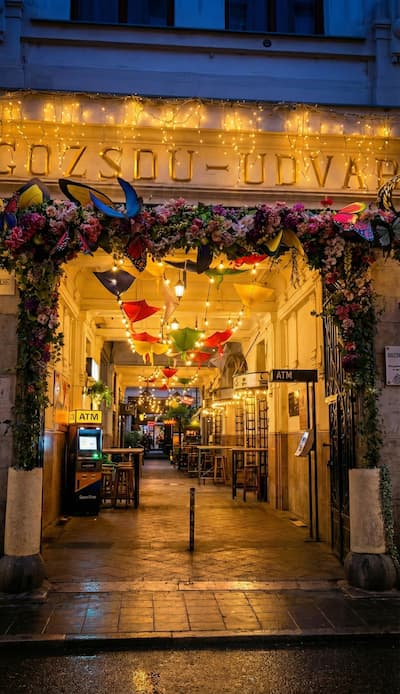
If you value sleep, think hard before booking here. The noise isn’t occasional, it’s structural: streets stay loud until 4-6 AM on weekends, and increasingly on summer weekdays too. If you book in District VII, request a courtyard-facing room (“belső udvari” in Hungarian), avoid Kazinczy utca, lower Dob utca, and anything near Gozsdu Udvar, and bring earplugs regardless. The northern part of the district near Városliget is quieter and residential.
Eating. Bors Gasztrobár does soup in bread bowls, Mazel Tov does Middle Eastern food in a greenhouse, and Kőleves Kert covers Hungarian classics with a twist. For more, see our guide to Budapest’s affordable restaurants.
Book District VII if nightlife is the point, you’re young and budget-minded, and you can sleep through anything. Skip it if you’re traveling with kids or need to function the next morning.
District VIII (Józsefváros): The Palace Quarter, and a Regulation Coming
District VIII’s inner Palace Quarter (Palotanegyed) is the local tip for visitors who want everyday Budapest without the party noise. The area’s neoclassical buildings survived both World War II and the communist era. Six universities cluster nearby, and Mikszáth Kálmán tér, a small square ringed with terraces, is one of the city’s most pleasant spots for a coffee or an evening glass of wine.
Walk five minutes east from the ruin bars and the mood changes completely: tree-lined streets, neighbors walking dogs, buildings just as beautiful, and far fewer visitors.
It splits into two zones. Inner District VIII, the Palace Quarter, is safe, increasingly stylish, and good value. Outer District VIII, particularly around Mátyás tér, Kálvária tér, and Magdolna, is Budapest’s most economically mixed area and warrants more caution after dark. Even the rougher stretches are calmer than troubled neighborhoods in most Western European or American cities, but for a first Budapest trip, staying within the Palace Quarter boundaries is the sensible call.
The regulatory piece, and this is new. District VIII isn’t banning short-term rentals the way District VI did, but it isn’t leaving them alone either. In June 2026 the district council adopted a framework that caps short-term rentals at 3.5% of housing stock district-wide and 5% in the Palace Quarter and the Corvin area; the draft building-code amendment of September 2026 sets 15% of the flats in any one apartment building. From January 1, 2027, new listings can only be registered with the building’s consent; for hosts already operating, that consent is presumed until the building’s residents’ meeting decides otherwise. The rules are planned to take effect on January 1, 2027. Nothing changes for a trip booked this year, but if you’re planning further out, don’t assume the current wide-open Airbnb inventory here will look the same by 2027. Check current listings rather than working from an old bookmark.
Gastronomically, the Palace Quarter punches well above its size: Rosenstein Vendéglő serves Hungarian-Jewish cuisine locals rate among the city’s best, and community spots like Auróra and Gólya anchor the creative scene.
Book District VIII if you’re a repeat visitor after something more local, you want value without leaving the Palace Quarter, or you care about well-preserved 19th-century architecture. Not the pick for a first trip.
District IX (Ferencváros): Craft Beer and the Market Hall
Every city has the neighborhood locals call “up-and-coming” for fifteen years before it arrives. In Budapest that’s Ferencváros, District IX, which went from post-industrial grit to genuinely interesting while staying affordable.
The center of gravity is Ráday utca, a semi-pedestrianized restaurant and bar strip that’s a calmer version of District VII: you can hear the person across the table, and the crowd skews local.

Ferencváros’s real claim to fame is craft beer, with 20-plus dedicated venues and the nickname to match. Élesztőház anchors the scene in a converted industrial space; for more, see our guide to Budapest’s craft beer pubs and breweries.
The district’s northern edge sits at the Great Market Hall (Nagy Vásárcsarnok), an 1897 iron-and-glass cathedral of a building that would be worth visiting empty, and isn’t: the ground floor overflows with produce and paprika, and the upper gallery serves everything from lángos to töltött káposzta.

Book District IX if craft beer matters, you want market access and local restaurants, or you want District VII’s energy without the chaos.
District XIII (Újlipótváros): Where Local Families Actually Live
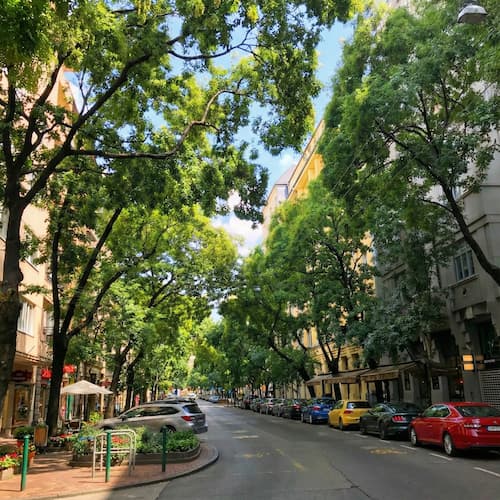
Staying a week or more, or traveling with kids? Újlipótváros, District XIII, is where many Budapest families live, and it shows. The main street, Pozsonyi út, is lined with independent bookshops, bakeries, and restaurants that cater to residents, not tourists. Everything is a notch cheaper and a notch slower.
The real draw is Margaret Island, reachable via Margaret Bridge at the district’s southern edge: a 2.5-kilometer, car-free island of parks, a running track, and the Palatinus outdoor bath complex, which locals rate as one of the city’s best summer spots.

If you’re bringing kids and want Budapest’s thermal bath culture in a family-friendly setting, this is the base. See our guide to Budapest with kids for more. Architecture fans should also note: Újlipótváros has Budapest’s densest concentration of Bauhaus and modernist buildings, built mostly 1927-1944, a different Budapest than the ornate Habsburg-era streets tourists usually photograph.
Book District XIII if you’re traveling with children, staying a week or longer, or want a residential neighborhood feel over central buzz.
District I (Várnegyed): The Castle District
If you’ve seen a photograph of Budapest, you’ve seen the Castle District: the Gothic spires of Matthias Church, the turrets of Fisherman’s Bastion, the bulk of Buda Castle. Staying here means cobblestone streets that date to medieval times and, before the tour groups arrive in the morning, empty squares that have looked roughly the same for five hundred years.

The view across the Danube to Parliament, especially at sunset from Fisherman’s Bastion, is one of Europe’s better urban panoramas. For the thermal baths on this side of the river, see our guide to Rudas Baths.

The catch. The Castle District sits on a hill, reachable by funicular, bus, or a steep 20-minute walk from the Chain Bridge, with no metro, and cobblestones that are murder on luggage wheels. By evening, when the tour buses leave, restaurants start closing because there aren’t enough people left to serve. Nightlife means a 30-minute trip down to Pest, minimum.
Book the Castle District if atmosphere matters more than convenience, you’re celebrating something, or you want golden-hour access to the best viewpoints. Skip it if nightlife matters, you’re on a budget, or you have mobility issues.
District II (Rózsadomb): Buda’s Quiet Hillside
Most tourists never set foot in District II, which is its whole appeal. Rózsadomb (Rose Hill) is Budapest’s most prestigious residential area, nicknamed “Gazdagistan” by locals for the wealth concentrated in its hillside villas. No backpacker hostels, no ruin bars: instead, hiking trails into the Buda Hills, cave systems at Pálvölgy and Szemlő-hegy, and some of the city’s best panoramic views. Active travelers can reach János Hill (528 meters) by chairlift, and the Children’s Railway, staffed by kids aged 10-14 as a holdover from a communist-era youth program, still runs.

For thermal baths, Lukács Bath is popular with locals and far less crowded than Széchenyi. See our winter thermal bathing guide for more.
The catch. This is a residential district with limited tourist infrastructure. The M2 reaches Batthyány tér and Széll Kálmán tér, but getting to Pest’s attractions takes planning, and hotels are scarce, mostly apartments and boutique guesthouses.
Book District II if you’re a repeat visitor who’s done central Budapest, you prioritize nature and quiet, or thermal baths and wellness are the whole trip.
The Eight Districts at a Glance
| District | Vibe |
|---|---|
| V (Belváros) | Central, safe, polished, the priciest |
| VI (Terézváros) | Elegant, hotels only since Jan 2026 |
| VII (Erzsébetváros) | Lively, budget-friendly, nightlife-first |
| VIII (Józsefváros) | Good value, watch the 2027 rental cap |
| IX (Ferencváros) | Craft beer, local, calmer budget pick |
| XIII (Újlipótváros) | Family-friendly, residential |
| I (Várnegyed, Castle) | Romantic, quiet at night, no metro |
| II (Rózsadomb) | Nature, quiet, fewer transit links |
Room rates move with the season, and they climb during summer, the Christmas markets and the Hungarian Grand Prix, so compare current prices on the hotels’ own sites for your dates.
Getting Around: Transport That Should Shape Where You Book
Budapest’s public transport is cheap and thorough: four metro lines, an extensive tram network, buses, trolleybuses, and suburban rail. A single ticket costs 500 HUF, a 24-hour pass runs 2,750 HUF, and a 72-hour pass runs 5,750 HUF.
Best connected: District V (Deák Ferenc tér, where the M1, M2, and M3 meet), District VI (the M1 runs the length of Andrássy), and the District VII border (M2 at Astoria and Blaha Lujza tér). Adequately connected: District VIII (M4), District IX (M3 plus trams), District XIII (M3). Harder work: the Castle District (bus only, no metro) and District II’s outer stretches.
Tram 6 is the one to know: it runs 24 hours around the Grand Boulevard (Nagykörút), the semicircle touching Districts VI, VII, VIII, and IX, at reduced frequency (roughly every 15-20 minutes) between 1 and 4 AM. Tram 4 shares the same route by day but doesn’t run all night, so after the last one, tram 6 alone covers that ring. Book near it and you can close down a ruin bar at 4 AM and tram home instead of paying for a taxi.
Airport. Budapest Airport (BUD) sits about 20 km southeast of the center. The 100E Airport Express runs direct to Deák Ferenc tér (District V) and Kálvin tér (District IX border) in 35-50 minutes for 2,500 HUF each way (a separate ticket, regular BKK passes don’t cover it). Budapest taxis are metered, not flat-rate, and the official tariff rose on August 1, 2026: 1,300 HUF to start, 520 HUF per kilometer and 130 HUF per minute of waiting, the same rate day or night with no surge pricing. Airport journeys run on a different starting fare rather than an add-on: whenever the airport is either end of the trip, the meter opens at 2,100 HUF instead of 1,300, and that applies to the ride back out to the terminal just as much as the ride in. On that tariff a metered run between Terminal 2 and Deák Ferenc tér lands around 13,500-15,500 HUF depending on traffic. Bolt prices dynamically and can come in under that, or well over it at peak. For more, see our airport-to-city guide.
Source: the taxi tariff in 31/2013. (IV. 18.) Főv. Kgy. rendelet 15. § and 16. §, consolidated text in force from 1 August 2026 as amended by 12/2026. (VI. 30.), cross-checked against the identical figures published by fotaxi.hu and bud.hu. Checked 11 August 2026.
Five Booking Tricks Worth Knowing
Ask for “belső udvari.” It means courtyard-facing; “utcai” means street-facing. In central Pest, especially District VII, requesting a courtyard room costs you some light and a view in exchange for actual sleep.
Check the Budapest Card math yourself. The card bundles unlimited transport with free or discounted museum, bath, and attraction entry. Whether it pays for itself depends entirely on your itinerary, so run the numbers for your own plan in our Budapest Card guide rather than taking anyone’s word for it.
Check the hotel’s own site. Many Budapest boutique hotels sell rooms directly, so look at their own booking page before you book through a platform.
Ride tram 2 instead of a hop-on-hop-off bus. It runs the Pest-side Danube embankment past Parliament and the Chain Bridge with Buda Castle views the whole way, for the price of a regular 500 HUF ticket.
Hit Szimpla Kert on a Sunday morning. Budapest’s most famous ruin bar runs a Sunday farmers’ market: same venue, daylight, organic produce instead of pálinka shots.
How Budapest’s Accommodation Market Has Changed
Budapest’s accommodation market has become more expensive over the past decade. The Airbnb boom of the 2010s turned entire buildings in Districts VI and VII into de facto hotels and pushed apartment prices up faster than local wages. District VI’s ban and District VIII’s coming cap are the city’s response, aimed at keeping these neighborhoods livable for the people who live there.
Hotel prices have risen with Budapest’s popularity too, so budget with current prices for your dates rather than a figure from an older blog post.
The Decision, District by District
District V if you’re a first-timer who wants safety, walkability, and a comfortable budget, and doesn’t mind paying for it.
District VI if you want the sweet spot between culture and nightlife and you’re booking a hotel, not an apartment.
District VII if nightlife is the priority, your budget is tight, and you can sleep through anything.
District VIII if you’re a repeat visitor after value and authenticity in interesting surroundings, with an eye on the 2027 rental rules if you’re planning that far out.
District IX if craft beer and market access matter more than being in the absolute center.
District XIII if you’re traveling with family, staying a week or more, or want Margaret Island on your doorstep.
The Castle District if romance and atmosphere outrank convenience.
District II if nature and thermal baths are the trip, and you’re comfortable with an inconvenient commute to get there.
Whatever you pick, Budapest forgives a wrong turn better than most cities. Egészségedre!, that’s “cheers” in Hungarian, and you’ll want it for the ruin bars either way.
FAQ: Your Budapest Neighborhood Questions Answered
I’m a light sleeper. Where should I not stay?
Avoid the party zone of District VII, specifically anywhere near Kazinczy utca, Gozsdu Udvar, or lower Dob utca. Even with earplugs, you’ll hear bass until 4-6 AM on weekends. Districts V, VI, and XIII are safer bets, and the Castle District is close to silent at night.
Is Budapest safe for solo travelers, including women?
Yes. Standard urban precautions apply (keep valuables out of sight, use licensed taxis or Bolt, stay aware at night), but Budapest ranks among Europe’s safer capitals, and the tourist districts are well-lit and busy.
How much should I budget for accommodation per night?
Rates depend on the season, the events in town and how far ahead you book, so compare current prices for your dates on the hotels’ own sites. Booking ahead for spring and autumn usually gives you the widest choice; summer and the Christmas markets cost more.
Buda or Pest?
Pest for first-timers, Buda for romance and repeat visits. Pest has the nightlife, restaurants, the Jewish Quarter, and most of the walkable attractions. Buda has the views, the castle, and the thermal baths. Most visitors end up splitting their days between both regardless of where they sleep.
I only have 2-3 days. Where should I book?
District V or VI. Both keep you within walking distance of Parliament, St. Stephen’s Basilica, the Jewish Quarter, and the Danube, which matters when time is short. District VI is the better value; District V is marginally more central.
What about the districts you didn’t cover?
Districts XI (Újbuda, near Gellért Hill), XII (outer Buda hills), and XIV (City Park) turn up in accommodation searches occasionally. They’re fine, safe and residential, and they make sense when you have a specific reason to be there, such as a conference, family or a favorite bath nearby.
Visiting rules and prices read at the operators on 16 October 2026: dohany-zsinagoga.hu with its prayer schedule and bkk.hu. District VIII rental rules: concept, July 2026 and building-code amendment, September 2026 on jozsefvaros.hu.
Find a bed, pick your district
Booking through these links supports the site at no extra cost to you. How this works.