Kis-Balaton: Water Buffalo, Herons and the Wetland Behind Lake Balaton
On this page
- Why Kis-Balaton Is Worth the Trip
- 📋 At a Glance
- What Kis-Balaton Is, and Which Parts You Can Visit
- Kápolnapuszta Water Buffalo Reserve
- Kányavári-sziget: The Bridge and the Bird Trail
- The Kis-Balaton Visitor Center at Fenékpuszta
- Diás Island and the Fekete István Memorial
- Birdwatching With a Guide
- Zalavár: Monuments on the Castle Island
- Seasons: When to Go
- Getting There
- A Day at Kis-Balaton
Why Kis-Balaton Is Worth the Trip
The largest herd of water buffalo you can visit in Hungary grazes at Kápolnapuszta, on the edge of Kis-Balaton, the reedy wetland where the Zala river reaches Lake Balaton. The national park keeps the herd to save the breed, and out on Diás Island its guides tell how buffalo were once used to clear the plants choking the marsh canals.
Around the herd lies almost 150 square kilometers of reed, open water and wet meadow, protected since 1951 and listed as a wetland of international importance since 1979. You can cross a timber bridge onto Kányavári-sziget and walk a two-kilometer bird trail, watch the buffalo from the lookout and the pasture jeep at Kápolnapuszta, watch the 27-minute wetland film at the Kis-Balaton Visitor Center at Fenékpuszta in season, and stop at the ruins and monuments of Zalavár, where Saints Cyril and Methodius worked as missionaries. It is about two hours from Budapest by car, best as part of a stay at Keszthely or Hévíz. One caveat: the strictly protected core is closed to visitors without a park guide, so on your own you see the wetland from its edges.

Water buffalo wallowing at the Kápolnapuszta reserve. Photo by VargaA, CC BY-SA 4.0, resized, via Wikimedia Commons.

📋 At a Glance
| 📍 Where | Zala county, southwest of Lake Balaton, between Keszthely, Zalavár and Balatonmagyaród (Google Maps) |
| 🐃 Open on your own | Kápolnapuszta buffalo reserve, Kányavári-sziget and its bird trail, the Vörs folk house; the strictly protected core only with a park guide |
| 🎟️ Tickets 2026 | Buffalo reserve adult 2,200 Ft, family 5,900 Ft; visitor center adult 3,500 Ft |
| 🕘 Seasons | Buffalo reserve open almost every day, 9:00 to 16:00 in winter; visitor center and Diás Island closed 2 Nov to 31 Dec |
| 🚗 Getting there | About 2 hours by car from Budapest; visitor center 15 to 20 minutes from Keszthely and Hévíz; Kápolnapuszta 35 to 40 minutes from Keszthely and Hévíz, 17 minutes from Zalakaros |
| 🚫 Skip if | You want to hike deep into the marsh on your own; that part is closed without a guide |
What Kis-Balaton Is, and Which Parts You Can Visit
Kis-Balaton, “Little Balaton”, is the marshland at the southwest corner of Lake Balaton, where the Zala river arrives. The national park lists it as a bird reserve, a Ramsar site and part of Natura 2000. It is also where organized nature conservation in Hungary began, with its first warden, the “egret keeper”. Kis-Balaton is the setting of Fekete István’s novels, and its marsh works as a filter that protects the water of Lake Balaton.
The rule that shapes every visit: the strictly protected core can only be entered with a guide from the Balaton-felvidéki National Park. If you do not join a guided tour, you can visit three places freely: Kányavári-sziget, the Kápolnapuszta water buffalo reserve and the Vörs folk house. Stay on the marked paths everywhere; leaving them is forbidden.

Kis-Balaton seen from Kányavári-sziget in summer. Photo by Jarba, CC BY 3.0, resized, via Wikimedia Commons.

What lives here. The herons are the stars: the great egret, the emblem of Hungarian nature conservation, as well as the little egret, gray and purple herons, squacco herons and night herons. Greylag geese breed here, and huge flocks of them migrate through and winter here. The pygmy cormorant returned at the end of the last century after vanishing from Hungary, and the huge, fish-eating white-tailed eagle hunts here. Otters have a large population, and the marsh holds Hungary’s biggest population of the root vole, a small mammal left over from the Ice Age.
Kápolnapuszta Water Buffalo Reserve
This is the place to start, and the one that works in every season. The reserve, near Balatonmagyaród, plays a key role in keeping the Hungarian water buffalo alive as a breed, and it holds the largest herd you can visit in Hungary. A signposted walking trail runs through it, with binoculars and a lookout tower for watching the animals wallow and graze; with luck you also spot ground squirrels darting about. The barn has old photographs and the tools of traditional buffalo keeping, the reception building has an exhibition on the wildlife of Kis-Balaton and sells coffee, drinks, souvenirs and buffalo salami, and there is a playground and a petting area for children.
Winter is the close-up season. In the cold months the buffalo stay in and around the barn and in the paddock, so you see them up close rather than as dark shapes across a pasture. The animals are behind an electric fence: keep your distance and do not touch it.
The jeep tour. From spring to autumn, a 30-minute jeep tour takes you out onto the buffalo pasture. It is not included in the entry ticket. In November the tours no longer run continuously: you call ahead or ask at reception, a tour leaves once four passengers are signed up (you can team up with other visitors), or at any time if you pay at least 10,000 HUF for the whole jeep.
The reserve holds a Water Buffalo Festival every year in May or June. Dogs are welcome on a leash, on the trail.
| Kápolnapuszta, 2026 | Price |
|---|---|
| Adult | 2,200 HUF (about $7) |
| Child, 3 to 14 | 1,200 HUF (about $4) |
| Ages 15 to 18 | 1,800 HUF (about $5) |
| Child under 3 | 300 HUF |
| Family: 2 adults + 2 children aged 3 to 14 | 5,900 HUF (about $18) |
| Each extra child with a family ticket | 500 HUF |
| Visitor with a disability (as defined in the park’s rules) | free |
| Jeep tour, adult / student or pensioner / child to 14 | 2,500 / 2,000 / 1,500 HUF |
The ticket covers the petting area, and an audio guide is free with any ticket. You do not need to book. Pay in forint cash, by card or with a SZÉP card.
| Period, 2026 | Hours |
|---|---|
| 2 January to 31 March | 9:00 to 16:00 |
| 1 April to 31 May | 9:00 to 17:00 |
| 1 June to 31 August | 9:00 to 18:00 |
| 1 September to 31 October | 9:00 to 17:00 |
| 1 November to 23 December | 9:00 to 16:00 |
| 24 and 25 December | closed |
| 26 December | 10:00 to 14:00 |
| 27 to 30 December | 9:00 to 16:00 |
| 31 December | closed |
The ticket desk closes 45 minutes before closing time, so on a winter afternoon arrive by 15:15.
Kányavári-sziget: The Bridge and the Bird Trail
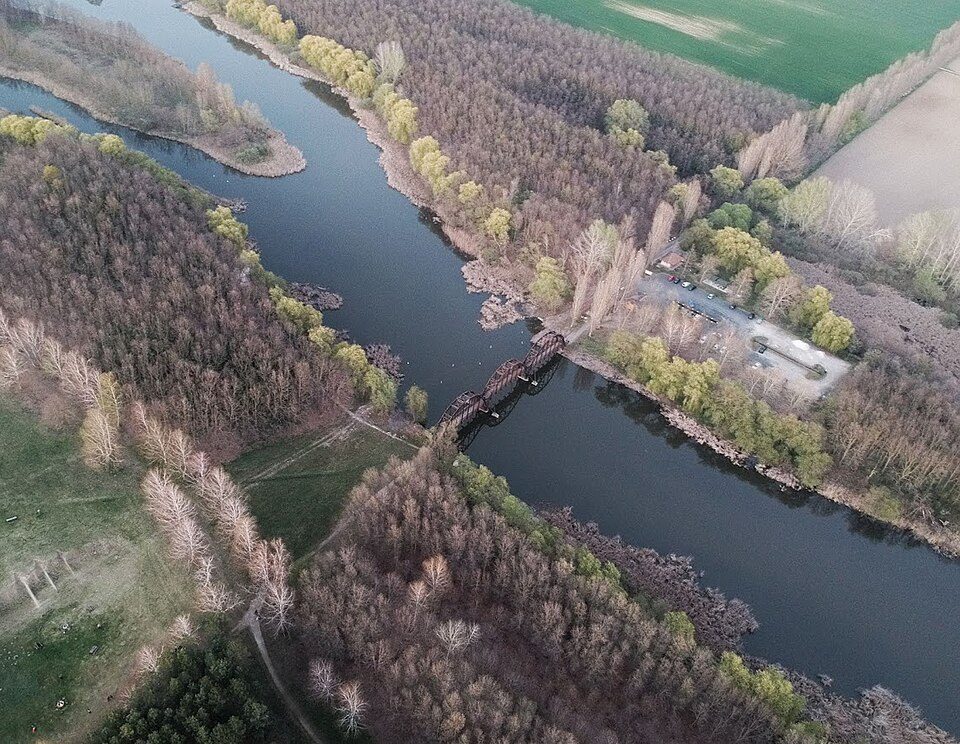
The timber bridge to Kányavári-sziget from above, in early spring. Photo by Inritter, CC BY-SA 4.0, resized, via Wikimedia Commons.

If you have seen one photo of Kis-Balaton, it was probably the timber bridge to Kányavári-sziget, an island in the reed reached from the road between Zalavár and Balatonmagyaród. The bridge was designed by forest engineer Gellért Varga, built in 1983 and renovated in 2005 and 2006.
On the island, the Great Crested Grebe nature trail (Búbos vöcsök tanösvény) is a walk into Kis-Balaton you can do on your own, all year: almost two kilometers, one to one and a half hours, with 15 stations on the wetland’s birds (waders, songbirds, birds of prey), its bats and the water engineering that shaped the marsh. Dogs may come on a leash.
Practical notes: the island is run by the regional water authority, not the national park, and parking there is paid. Wear walking shoes.
The Kis-Balaton Visitor Center at Fenékpuszta
The national park’s Kis-Balaton Visitor Center opened in September 2020 in an almost 1,000-square-meter building at Keszthely-Fenékpuszta, about 15 minutes by car from central Keszthely. Inside are an interactive exhibition, a 27-minute film about the wetland’s wildlife, a nature trail on the green roof and a playground for children and adults. The shop sells books, souvenirs and buffalo salami, and an open kitchen serves coffee, drinks and hot food.
It is a seasonal site. In 2026 it opened on 14 and 15 March, then daily from 2 to 12 April, Friday to Sunday for the rest of April, Tuesday to Sunday from May to September (9:00 to 16:00, and to 18:30 in July and August), Friday to Sunday from 1 to 22 October, and daily from 23 October to 1 November. It is closed from 2 November to 31 December, and the 2027 calendar is not published yet. Tickets are sold until 30 minutes before closing. No animals inside.
| Visitor center, 2026 | Price |
|---|---|
| Adult | 3,500 HUF (about $11) |
| Child, 3 to 14 | 2,300 HUF (about $7) |
| Family: 2 adults + up to 2 children aged 3 to 14 | 10,200 HUF (about $31) |
| Combined with the Diás Island land tour, adult | 5,500 HUF (about $17) |
| Combined with the Diás Island land tour, child 3 to 14 | 3,900 HUF (about $12) |
| VR headset, up to 20 minutes | 800 HUF |
Pay in forint cash or by card (not American Express). Online tickets cannot be refunded.
Diás Island and the Fekete István Memorial
From the visitor center, park guides lead trips to Diás Island, inside the strictly protected zone, where a memorial and the Matula hut recall the writer Fekete István, whose novels are set in this marsh. You cover the first 2.4 km in your own car or in the park’s open, 13-seat electric golf cart (1,000 HUF, book a seat by email), then walk 650 meters to the island with the guide. The trip takes 1.5 to 2 hours; the island’s Great Egret trail has signs in Hungarian and English. Bikes cannot do the access road.
In 2026 the tours left at 10:00 and 13:00 on the visitor center’s open days, with an extra 16:00 departure in July and August. A land tour on its own costs 2,700 HUF for adults and 1,900 HUF for children aged 3 to 14.
Birdwatching With a Guide
The dikes of the protected zone are where the birds are, and they are only open on the park’s guided tours, which you must book by 16:00 the day before. In summer 2026 they ran on set dates in July and August, starting at 9:00 from the visitor center and lasting about three to three and a half hours, moving slowly along the dikes in your own vehicle or the park’s minibus. Bring binoculars if you have them; the guides also lend binoculars and a spotting scope. Joining a guided tour also gets you the reduced ticket at Kápolnapuszta, if you show the park’s stamped minileporello (the small tour leaflet) at the ticket desk.
In winter, by canoe. Until 15 March 2027 the park runs winter canoe trips on the warm-water Hévíz canal. The trip costs 15,000 HUF (about $46) per person and includes the canoe tour, a buffalo salami sandwich, a warming drink and a cup of hot tea. Book by phone through the visitor center (+36 70 645 7203 or +36 30 134 5202); a car transfer can be arranged.
Zalavár: Monuments on the Castle Island
The village of Zalavár has the Zalavár Historical Memorial Park on its Vársziget, the “castle island”. Saints Cyril and Methodius worked here as missionaries, and Benedictine monks later built churches and an abbey. Today the park shows the ruins of the Hadrian pilgrimage church, a Saint Stephen chapel rebuilt on the foundations of an 11th-century church, and memorials from Hungary, Bulgaria, Slovenia and Austria. The Kis-Balaton Ház, an exhibition house built by the water authorities, stands at the same spot.
Zalavár is at one end of the road to Kányavári-sziget, so the memorial park is an easy stop for anyone who likes a ruin with a story.
Seasons: When to Go
The pattern below follows the 2026 calendar; the 2027 one is not published yet.
- April to June. The best all-round season: the visitor center and Diás Island tours run, the jeep goes out to the buffalo on the pasture, and the buffalo festival falls in May or June.
- July and August. The longest opening hours and the guided birdwatching tours on the dikes.
- September and October. The visitor center stayed open Tuesday to Sunday through September, went down to Friday to Sunday from 1 to 22 October and opened daily from 23 October to 1 November.
- November to March. The visitor center and Diás Island are closed from 2 November to 31 December (in 2026 they reopened on 14 March), but Kápolnapuszta stays open with the buffalo by the barn, Kányavári-sziget is open, and the park’s winter canoe trips run on the warm-water Hévíz canal until 15 March 2027.
Getting There
By car. Kis-Balaton is car country: the sites are spread around the marsh. From central Budapest it is about 184 km to the visitor center (about two hours), and about 200 km to Kápolnapuszta or Kányavári-sziget (about two hours and ten minutes). Between the sites:
| Drive | Distance | Time |
|---|---|---|
| Keszthely center to the visitor center | 10 km | 15 min |
| Hévíz to the visitor center | 16 km | 18 min |
| Hévíz to Kápolnapuszta | 29 km | 35 min |
| Keszthely to Kápolnapuszta | 30 km | 38 min |
| Visitor center to Kányavári-sziget | 17 km | 20 min |
| Kányavári-sziget to Kápolnapuszta | 7 km | 13 min |
| Zalakaros to Kápolnapuszta | 12 km | 17 min |
For trains to the area, see our Keszthely day trip guide.
Where to base yourself. Keszthely and Hévíz are the natural bases: see our Keszthely and Hévíz thermal lake guides. From the south, the spa town in our Zalakaros thermal bath guide is 17 minutes from the buffalo. For more of Zala county, the Zalaegerszeg open-air village museum shows the region’s old rural life.
A Day at Kis-Balaton
Winter version. Morning at Kápolnapuszta with the buffalo by the barn, then the 13-minute drive to Kányavári-sziget for the bridge and the bird trail. Stop at the Zalavár memorial park on the way north, and end the day in the warm water of the Hévíz lake.
Spring or summer version. Start at the visitor center when it opens, take the morning Diás Island tour (10:00 in 2026), then lunch from the open kitchen. Afternoon on Kányavári-sziget and at Kápolnapuszta, with the jeep tour onto the pasture.
Kis-Balaton protection, wildlife and access rules from the Balaton-felvidéki Nemzeti Park Kis-Balaton page; Kápolnapuszta hours, prices, jeep tours and rules from its buffalo reserve page and English page; visitor center hours, prices and the winter canoe trip from its visitor center page and English page; Diás Island from its Fekete István memorial page; Kányavári-sziget from its nature trails page; guided tours from its Kis-Balaton guided tour page; Zalavár from the Zalavár Historical Memorial Park site and the village of Zalavár; driving distances from OSRM; checked on 22 November 2026. Prices in dollars are approximate, at the ECB rate of 11 November 2026 (328 HUF to the dollar).
Good to know
Can you visit Kis-Balaton without a guide?
Partly. The strictly protected core can only be entered with a guide from the Balaton-felvidéki National Park. Without a guide you can visit Kányavári-sziget, the Kápolnapuszta water buffalo reserve and the Vörs folk house, and walk the Kányavári nature trail year round. Leaving the marked paths is forbidden.
How much does the Kápolnapuszta buffalo reserve cost?
In 2026: adults 2,200 HUF, children aged 3 to 14 1,200 HUF, ages 15 to 18 1,800 HUF, children under 3 300 HUF, and a family ticket for two adults and two children aged 3 to 14 costs 5,900 HUF. The ticket includes the petting area, and an audio guide is free with it. The 30-minute jeep tour onto the pasture costs extra: 2,500 HUF for adults and 1,500 HUF for children up to 14.
Is Kis-Balaton worth visiting in winter?
Yes, if you pick the right places. The Kápolnapuszta buffalo reserve stays open through winter (for the rest of 2026 it is open every day except 24, 25 and 31 December), and the buffalo spend the cold months in and around the barn, where you can see them up close. Kányavári-sziget is open year round. The visitor center and the Diás Island tours are closed from 2 November to 31 December, but the park runs winter canoe trips on the warm-water Hévíz canal until 15 March 2027.
Where is the Kis-Balaton Visitor Center?
At Keszthely-Fenékpuszta, Tőzegtelep 5, about a 15-minute drive from central Keszthely. It has an interactive exhibition, a 27-minute film about the wetland's wildlife, a nature trail on the roof and a playground. In 2026 it opened on set days from mid-March to 1 November; an adult ticket costs 3,500 HUF.
How far is Kis-Balaton from Budapest?
About 184 km by road to the visitor center and about 200 km to Kápolnapuszta or Kányavári-sziget, roughly two hours to two and a quarter hours by car, depending on which site you head for. The three main sites are spread out: Kányavári-sziget to Kápolnapuszta is about 13 minutes by car, the visitor center to Kányavári-sziget about 20 minutes.