Zalaegerszeg and the Göcsej Village Museum: Hungary's First Skanzen, Oil Derricks and a Clock on the Ground
On this page
Why Zalaegerszeg Is Worth the Trip
In the 1950s, thatched log houses still lined the village streets of Göcsej, the hilly, forested corner of Zala county that stayed cut off from the rest of Hungary until the middle of the 20th century. Within a decade or two they had vanished from the streets, replaced by brick houses with tiled roofs. A museum man named Imre Szentmihályi went out collecting before the last ones disappeared, and on 20 August 1968 the result opened on the edge of Zalaegerszeg: the Göcsej Village Museum, Hungary’s first open-air folk museum.
That is the reason to come, and it is a good one: you walk a village street that never existed, built from houses that each stood somewhere else, beside a backwater of the Zala river and a water mill that was here first. Next door, the Hungarian Oil and Gas Museum fills a park with drilling derricks and vintage petrol pumps; the skanzen ticket costs 1,800 HUF, and a combined ticket for both museums 2,800 HUF. In town, a 250-year-old church clock ticks at street level in a glass case, and two museums tell the story of the town and of Cardinal Mindszenty.
Zalaegerszeg is a little over three hours from Budapest by direct train, so it works as a long day trip, and better as an overnight that adds Hévíz or Keszthely. The trade-off: the derrick park opens only from April to October, and from November to March the skanzen closes at 16:00 and on Sundays and Mondays.
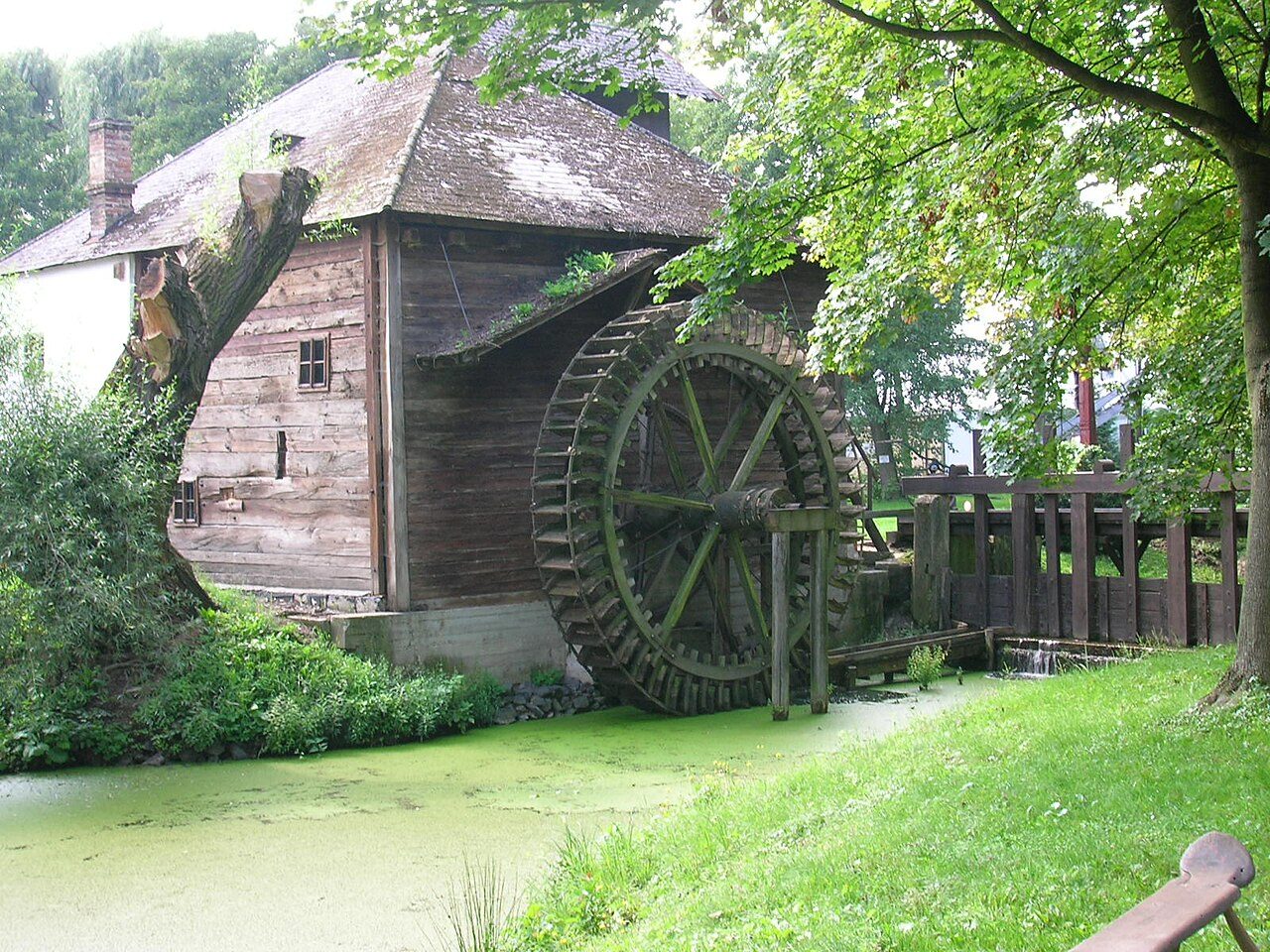
The water mill at the Göcsej Village Museum, which stood on this spot before the museum was built. Photo by Alensha, public domain, resized, via Wikimedia Commons.

📋 At a Glance
| 📍 Where | Zalaegerszeg, the seat of Zala county in western Hungary; the skanzen is at Falumúzeum utca (Google Maps) |
| 🏡 What you see | About forty village buildings from Göcsej, a water mill, a wooden church and hill cellars; the oil and gas museum next door |
| 🎟️ Tickets | Skanzen 1,800 Ft; with the oil museum 2,800 Ft; three-museum ticket 5,000 Ft |
| 🕘 Skanzen hours | 1 Nov to 31 Mar: Tue to Sat 10:00 to 16:00; 1 Apr to 31 Oct: Tue to Sun 10:00 to 18:00; closed Mondays |
| 🛢️ Oil museum | 1 Apr to 31 Oct, 10:00 to 18:00, closed Mondays |
| 🚆 Train | Direct InterCity from Budapest-Déli every two hours on the odd hour, 3 h 8 min |
| 🚫 Skip if | You can only come on a winter Sunday or Monday, or you want the derricks and it is November to March |
The Göcsej Village Museum: A Village That Never Existed
This is an imagined village: its houses never stood together. They were taken apart in the small villages of Göcsej, carried here and rebuilt along one street, to show what a late-19th-century one-street village looked like. Building started in 1963, and the scientific plan came from ethnographer Jenő Barabás, museum director Imre Szentmihályi and architect János Tóth.
Today the village counts about forty structures: houses, a wooden church, stables, barns, pigsties, a pálinka distiller’s hut, hill cellars and wayside crosses, with several hundred pieces of furniture and tools inside. A few things to look for:
- The smoke-kitchen houses. Most thatched log houses in Göcsej later got chimneys where they stood. Here they were rebuilt in their oldest form, without a chimney, with the smoke finding its own way out. The oldest, from Felsőszenterzsébet, dates from the 18th century and is the only house without a separate living room.
- The water mill. It was on this spot before the museum: the wooden northern part is from the 18th century, the southern half from 1902. The village was laid out around it and the Zala backwater.
- The hill cellars. Until phylloxera wiped out most vineyards at the end of the 19th century, Zala county made a lot of wine, so the village has its own cellars on the slope.
- The wooden church from Zalacséb and the belfry from Csöde, along with the smithy from Hottó and the yards of houses from Kávás, Kalócfa and Zalalövő.
- The Green Path (Zöld ösvény), a small nature trail with composting and drying displays, folk games and a fish and bird hide.
How the visit feels. Dogs on a lead are allowed in the skanzen grounds. A small village shop sells coffee, soft drinks and ice cream; there is no restaurant on site.
The museum gives the village about 1 hour 15 minutes. Add an hour or more for the oil museum in season.

The hajlított ház (“bent house”) from Zalalövő, one of the thatched houses rebuilt in the skanzen. Photo by Kiss Tamás, CC BY-SA 3.0, resized, via Wikimedia Commons.

The Hungarian Oil and Gas Museum Next Door
The skanzen’s western neighbor is an unexpected one. The Magyar Olaj- és Gázipari Múzeum was founded in 1969, a year after the village, as Hungary’s national museum of the oil and gas industry. Its open-air site covers 30,000 square meters: complete drilling rigs, pumps, machinery, petrol pumps from 1940 to 1992, a sculpture park of busts of outstanding engineers and a memorial room on Vilmos Zsigmondy and his family’s link to water drilling in Hungary. According to the city’s tourist office, more derricks stand here than anywhere else in Hungary, three of them 50 meters tall.
The contrast with the thatched village next door is the fun of it: a few minutes’ walk takes you from smoke kitchens to steel towers.

A drilling derrick in the open-air park of the Hungarian Oil and Gas Museum. Photo by VargaA, CC BY-SA 3.0, resized, via Wikimedia Commons.

The oil museum opens from 1 April to 31 October, 10:00 to 18:00, except Mondays. The skanzen ticket alone costs 1,800 HUF; to see both museums, buy the 2,800 HUF combined Skanzen + Oil and Gas Museum ticket at the skanzen desk.
Tickets and Hours
| Ticket | Price |
|---|---|
| Göcseji Skanzen, full price | 1,800 HUF (about $5) |
| Skanzen, student/pensioner or family adult | 900 HUF (about $3) |
| Skanzen + Oil and Gas Museum, full price | 2,800 HUF (about $9) |
| Skanzen + Oil and Gas Museum, student/pensioner or family adult | 1,900 HUF (about $6) |
| Museum ticket: skanzen, Göcseji Múzeum and Mindszentyneum | 5,000 HUF (about $15) |
| Göcseji Múzeum permanent exhibitions | 3,000 HUF (about $9) |
| Mindszentyneum permanent exhibitions | 3,200 HUF (about $10) |
Who pays the reduced price. Students aged 6 to 26 with a valid student card, pensioners aged 62 to 70 with a valid pensioner card, and adults arriving with one or more children aged 6 to 18 (the family adult ticket).
Who gets in free. Children under 6, visitors over 70, people with disabilities and one companion, and everyone on Hungary’s national holidays, 15 March, 20 August and 23 October. These free entries apply to Hungarian citizens and citizens of the European Economic Area. Visitors entering free pay a 900 HUF service fee (cloakroom, toilets, wifi, phone charging, photography without flash), except children under 6 and visitors with disabilities. Photography without flash is included with every ticket; no separate photo ticket is needed.
The three-museum ticket is the good deal if you want the town museums too: 5,000 HUF, valid on the day you buy it and the next two opening days, so you can split the skanzen and the town into two days.
The desks take cash, Mastercard, Visa and Maestro.
| Period | Skanzen | Göcseji Múzeum and Mindszentyneum |
|---|---|---|
| 1 November to 31 March | Tue to Sat 10:00 to 16:00; closed Sun and Mon | Tue to Sat 9:00 to 17:00; closed Sun and Mon |
| 1 April to 31 October | Tue to Sun 10:00 to 18:00; closed Mon | Tue to Sun 10:00 to 18:00; closed Mon |
Zalaegerszeg Town Center
The town museums sit side by side in the center, about a 20-minute walk from the skanzen.
The Göcseji Múzeum (Batthyány Lajos utca 2) reopened after a renovation from 2018 to 2022. Its town-history exhibition runs from the medieval castle to the 20th century, and it also holds the ceramics of János Németh, a memorial exhibition for the sculptor Zsigmond Kisfaludi Strobl, and József Preisz’s collection of several hundred clocks and watches from the 18th to the 20th century.
The Mindszentyneum (Batthyány Lajos utca 4-6), next door, remembers Cardinal József Mindszenty, who served as the town’s parish priest for 25 years, and the persecution of the churches under communism. In its basement are remains of the old Egerszeg castle and medieval brick kilns found during the dig before the building went up. It also has a café with coffee, tea, hot chocolate and cakes, the easiest break near the museums.
The Mary Magdalene Parish Church, next to the Göcseji Múzeum, is the twin-towered Baroque church built between 1747 and 1769; the Holy Trinity statue in the square in front dates from 1810.
The Földönjáró toronyóra, the “clock that walks on the ground,” is the church’s old tower clock. The first record of it is a contract with a clockmaker from 1771. Since 2005 the 250-year-old, 600 kg mechanism has stood in a glass case on the square in front of the Hevesi Sándor Theater on Kosztolányi utca, ticking away in full view, with its weights dropping into a 3-meter shaft below the pavement. The mechanism is checked every forty days.
AquaCity and a Bath Nearby
On the shore of the Gébárti lake, AquaCity is a summer water park with seven giant slides and what the operator calls the largest wave pool in Hungary. It is not a thermal bath. In summer 2026 it ran from 13 June to 31 August, daily 10:00 to 20:00, with an adult day ticket at 4,600 HUF (about $14) and the giant slides 1,500 HUF (about $5) extra on top; check the operator’s page for the 2027 season.
For warm water out of season, drive east: Hévíz, with its thermal lake, is about 37 km away (around 40 minutes by car), and Zalakaros about 55 km (around an hour). Keszthely, with the Festetics Palace on Lake Balaton, is about 45 km. For birds and marshland, add the Kis-Balaton wetland on the same trip.
Getting There
By train. Direct InterCity trains leave Budapest-Déli every two hours on the odd hour, at 5:00, 7:00, 9:00, 11:00, 13:00, 15:00, 17:00 and 19:00 (Budapest-Kelenföld seven minutes later), and reach Zalaegerszeg at 8 minutes past the hour three hours later, for example 9:00 to 12:08, via Székesfehérvár, Veszprém and Ajka. These are daily times in MÁV’s current timetable, and the same pattern runs in the timetable that starts on 13 December 2026. Back, trains leave Zalaegerszeg at 49 minutes past the odd hour and reach Déli 3 hours 10 minutes later, for example 15:49 to 18:59.
From the station to the skanzen. The skanzen is about 3 km from the railway station. Local buses 1 and 18 run from the station toward the museum; buses 1, 6 and 14 stop at Ola temető, a 350-meter walk from the entrance along Falumúzeum utca. The Göcseji Múzeum is 1.5 km from the station and 300 meters from the bus station.
By car. About 230 km from central Budapest, roughly 2 hours 45 minutes. The skanzen has its own large parking lot by the entrance; for the town museums, the museum recommends the Galamb utca lot next to the ZTE Aréna.
A sample day. Take the 7:00 from Déli and arrive at 10:08. Take local bus 1 or 18 from the station to the skanzen, give the village an hour and a half (plus the oil museum from April to October), then walk 20 minutes into town for coffee and cake at the Mindszentyneum café, the town museum and the ground-level clock. Take the 15:49 or 17:49 back to Budapest. On a winter day, remember the skanzen closes at 16:00 and on Sundays and Mondays, so do it first. Better still, stay the night and drive to Hévíz or Keszthely the next morning.
Skanzen hours, history and buildings from ZEGI Múzeumok: the Göcseji Skanzen page, the exhibition page, opening hours, tickets, locations and parking, FAQ, accessibility, the Göcseji Múzeum and the Mindszentyneum; oil museum hours and collections from the Magyar Olaj- és Gázipari Múzeum; derricks, the tower clock and the parish church from the city tourist office’s pages on the oil museum, the Földönjáró toronyóra and the Mária Magdolna church; AquaCity from its hours, prices and about pages; train times from MÁV’s line 20 timetables valid from 31 August 2026 and from 13 December 2026; road distances from OSRM; checked on 22 November 2026. Prices in dollars are approximate, at the ECB rate of 11 November 2026 (328 HUF to the dollar).
Good to know
How much is the ticket to the Zalaegerszeg skanzen?
A full-price ticket to the Göcseji Skanzen costs 1,800 HUF. Students aged 6 to 26 with a valid student card and pensioners aged 62 to 70 pay 900 HUF, as do adults arriving with children aged 6 to 18. A combined ticket with the Hungarian Oil and Gas Museum next door costs 2,800 HUF. The 5,000 HUF museum ticket covers the skanzen, the Göcseji Múzeum and the Mindszentyneum and is valid on the day of purchase and the next two opening days.
Is the Göcsej Village Museum open in winter?
Yes. From 1 November to 31 March it opens Tuesday to Saturday, 10:00 to 16:00, and is closed on Sundays and Mondays. From 1 April to 31 October it opens Tuesday to Sunday, 10:00 to 18:00, and is closed on Mondays. The oil museum next door opens its grounds from 1 April to 31 October, 10:00 to 18:00, except Mondays.
Who gets in free at the Zalaegerszeg museums?
Children under 6, visitors over 70, people with disabilities and one companion, and everyone on 15 March, 20 August and 23 October. These free entries apply to Hungarian citizens and citizens of the European Economic Area. Visitors entering free pay a 900 HUF service fee, except children under 6 and visitors with disabilities.
How long do you need at the skanzen?
The museum gives about 1 hour 15 minutes for the village. With the oil and gas museum next door in season, plan on two hours or more. The town center, with the Göcseji Múzeum, the Mindszentyneum and the ground-level tower clock, is about a 20-minute walk away.
How do I get from Budapest to Zalaegerszeg?
Direct InterCity trains leave Budapest-Déli every two hours on the odd hour (7:00, 9:00, 11:00 and so on, Kelenföld seven minutes later) and arrive in Zalaegerszeg at 8 minutes past the hour three hours later, for example 9:00 to 12:08. The same pattern runs in the timetable that starts on 13 December 2026. By car it is about 230 km from central Budapest, roughly 2 hours 45 minutes.