Budafok Is Budapest's Wine Cellar Town, and Two of You Cannot Just Walk In
On this page
- 📋 The short version
- Budafok or Castle Hill: which cellar you actually mean
- The Faust Wine Cellar, stated plainly
- What is actually under Budafok
- The Törley price band nobody quotes
- The guaranteed visit, and what it does not guarantee
- If you speak English and there are two of you
- Which cellars take visitors, and on what terms
- Getting there: tram 47, and there is no HÉV
- Pincejárat: the first Saturday of every month
- Two wine festivals, one week apart
- The cave dwellings on Veréb utca
- So is Budafok worth the trip out?
- Before you go
Two places in Budapest get called its wine cellars, and they are about nine kilometers apart. One is Budafok, District XXII, a former wine-trade town with somewhere between 80 and 120 kilometers of limestone cellars running underneath it, working sparkling-wine plants, family cellars, a museum and a monthly open-cellars day. The other is the Faust Wine Cellar, a tasting room of roughly 50 square meters under the Hilton on Castle Hill, reached by walking down 54 steps from the Dominican Cloister.
Both are real. Both are good. They are different products, and the gap between them is the difference between an hour and half a day.
This post is mostly about the first one, because it is the one with the booking rules that catch people out. Budafok is 32 minutes from Deák Ferenc tér on tram 47, seventeen stops, no change, and it is a town built on top of its own hollowed-out hillside. What it is not is a wander. Almost nothing down there is walk-in, most of it carries a group minimum, and the price everyone quotes for the biggest name in town is a price a couple cannot get.
📋 The short version
| 📍 Where | Budafok, District XXII. The Törley museum is at Anna utca 7 |
| 🚋 Getting there | Tram 47 from Deák Ferenc tér to Városház tér, 17 stops, ~32 min. No HÉV |
| 🕳️ How much cellar | 80-120 km of limestone. The operators will not narrow it further |
| 💸 The trap | Törley's 1-7 person band is a 50,000 Ft flat fee, not 6,900 Ft each |
| 🇬🇧 In English | Sauska, 10,500 Ft per ticket online, English by arrangement |
| 🗓️ Free option | Budafoki Pincejárat, first Saturday of every month, free shuttle |
| ⏱️ Time needed | Half a day. An afternoon tour plus the tram back is a full outing |
Budafok or Castle Hill: which cellar you actually mean
The two get talked about interchangeably, so here is the side by side.
| Budafok | Faust Wine Cellar | |
|---|---|---|
| District | XXII, Budafok-Tétény | I, the Castle District |
| What it is | A former wine town with 80-120 km of cellars under it | One tasting room, about 50 m², under the Hilton |
| Address | Nagytétényi út, Anna utca, Savoyai Jenő tér | Hess András tér 1-3, entered from the Dominican Cloister |
| Getting there | Tram 47 from Deák Ferenc tér, about 32 min | Walk up from the Chain Bridge, or bus 16 |
| Time needed | Half a day minimum | An hour or two |
Törley is not in the Castle. Faust is not in Budafok. Neither of them is pretending otherwise.
The Faust Wine Cellar, stated plainly
It is a small cellar under a genuinely medieval cloister, and the arrival is the best part: you cross the Dominican Cloister inside the Hilton Budapest at Hess András tér 1-3, then go down 54 steps. Not step-free, and worth knowing in advance if stairs are a factor.
Downstairs there is about 50 square meters of vaulted room, seating 24 to 28 for a tasting or holding 40 to 45 standing. The list runs to roughly 70 wines and 15 pálinkas, all Hungarian, rotated by region, poured and talked through by a sommelier. Reserve ahead rather than turning up: the cellar takes bookings on +36 20 326 3503 and at faustwinecellar@gmail.com.
That is a good hour of Hungarian wine in a room that could not exist anywhere else in the city. It is also, unavoidably, one room. If what you pictured was tunnels, keep reading, and if you want more Castle Hill underground while you are up there, the Labyrinth of Buda Castle is the other side of that coin.
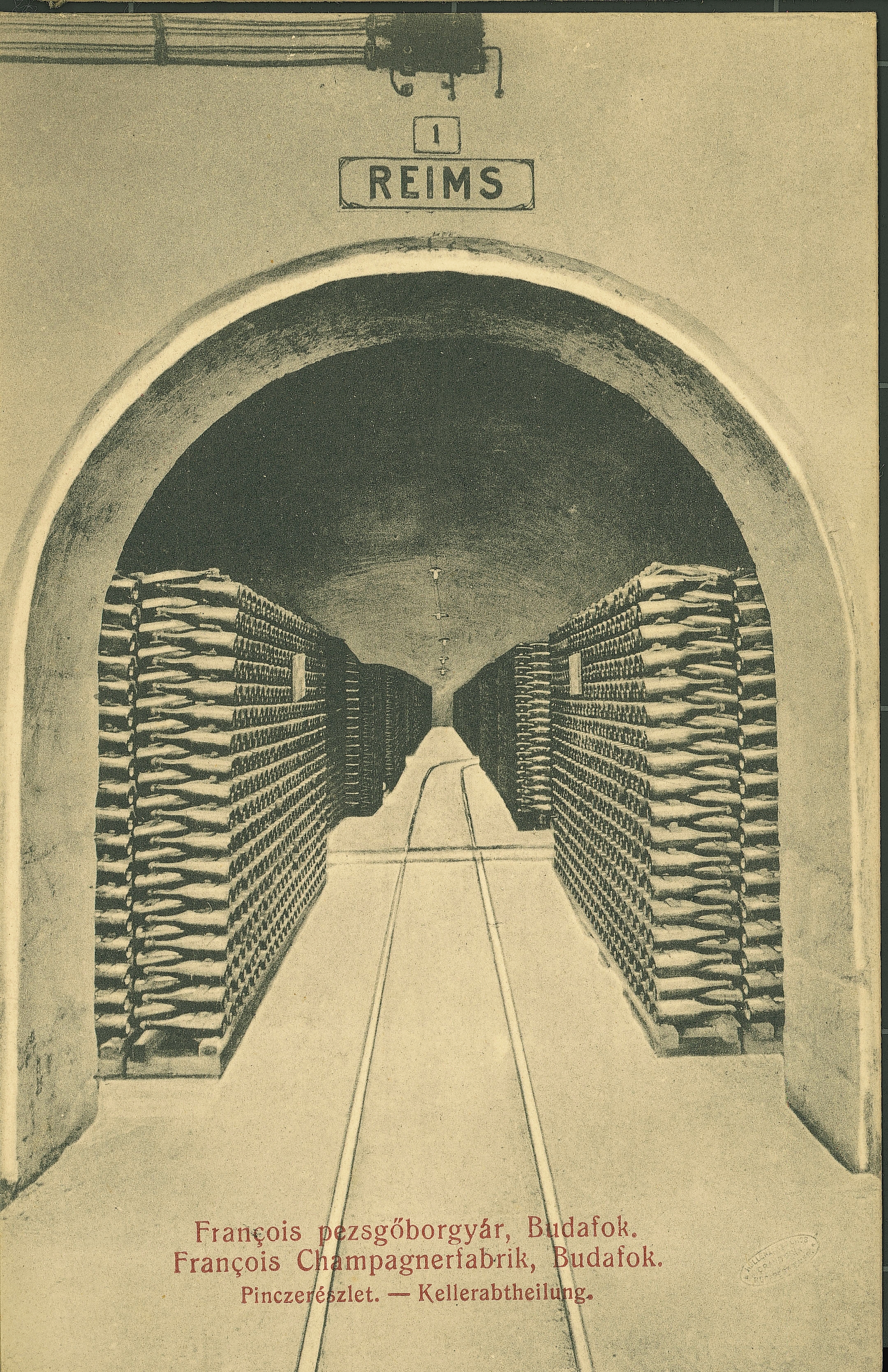
The François sparkling wine cellar in Budafok on a printed postcard from around 1910: riddling racks and a rail track down a limestone tunnel. Historical, not current condition. Public domain, via Wikimedia Commons.
What is actually under Budafok
Somewhere between 80 and 120 kilometers of cellar. The wine quarter’s own operators publish that range and decline to sharpen it, because the full extent has never been measured. Given how many numbers get confidently attached to this place, a range with an admission attached to it is the one to trust.
The reason the cellars exist has almost nothing to do with the reason they are still used. Budafok grew grapes. Then, in the mid-1880s, phylloxera arrived and destroyed 90 to 95 percent of the region’s vine stock in a few years. The vines died. The limestone did not. So the town stopped growing wine and started storing, blending and trading other people’s, which turned out to be the more durable business, and by the early 1900s Budafok held 302 commercial wine cellars.
József Törley is the reason it went that direction rather than quietly declining. Born in Szabadka in 1858, he met Théophile Roederer while studying at the commercial academy in Graz, learned the method in Champagne, and set up his first sparkling-wine cellar in Reims in 1880. Two years later he moved the whole operation to Budafok, having decided that Etyek grapes plus Budafok limestone beat what he had in France. The firm was registered on 1 August 1882. He brought his first head of production, Louis François, over from Reims, and by 1886 François had opened a sparkling-wine factory of his own down the road. Two French-method producers, one Hungarian town.
The scale arrived fast. By the 1890s there were 20,000 square meters of cellar on Anna utca alone, cut three levels deep, and output crossed 300,000 bottles a year. By the turn of the century it was a million. Törley built a residence and an Art Nouveau family mausoleum between 1893 and 1911, and died in 1907, in the firm’s twenty-fifth year. Budafok became a city in its own right in 1926, which makes 2026 its centenary, and was swallowed into Budapest as District XXII on 1 January 1950.
Two methods still run at Anna utca. The méthode traditionnelle bottles get handled about thirty times across three years on riddling racks and stacked máglyák, and the méthode transvasée line works in 1.5 liter magnums over 9 to 18 months. The tasting is built to match: one traditional, one transvasée, one tank-fermented, so you drink the production routes against each other rather than three similar glasses. As tour concepts go, that one is properly thought through.
The Törley price band nobody quotes
Here is the part worth the price of reading this page. Törley’s own list, valid from 1 March 2026, bands by headcount:
| Group size | 3 Technológia | Bővített | Extra | Bubbles of Europe |
|---|---|---|---|---|
| 1-7 people | 50,000 Ft | 55,000 Ft | 60,000 Ft | 75,000 Ft |
| 8-14 people | 99,000 Ft | 110,000 Ft | 115,000 Ft | 149,000 Ft |
| 15+ people | 6,900 Ft/person | 7,500 Ft/person | 8,000 Ft/person | 10,500 Ft/person |
Read the first row twice. The 1-7 band is a flat fee for the entire booking, not a rate per head. A couple walking in for the basic tour pays 50,000 Ft, about $158, and so does a group of seven, which means the price per person swings from $158 to $23 depending purely on how many friends you brought.
The 6,900 Ft figure that gets quoted as “the Törley price” is a real number. It is the fifteen-people-and-up number. If there are two of you and you budgeted from it, you are out by roughly a factor of seven.
Prices are in HUF, which is what you pay at the counter. Converted at 1 USD = 316 HUF, the ECB rate on 1 September 2026. Rates move, so treat the converted figures as indicative.
The guaranteed visit, and what it does not guarantee
There is an escape hatch, called a garantált látogatás: occasional published dates that individuals can join at 6,900 Ft per person without assembling a group. Ninety minutes, museum plus aging cellar plus a three-sample tasting, and you keep the glass. On paper it solves everything.
Three conditions do most of the work:
- Fifteen people minimum, and the operator may cancel below it. The guaranteed visit is not guaranteed. If fourteen register, nobody goes.
- Registration closes at noon on the Thursday before a Saturday date.
- The guiding is in Hungarian only. The booking page states it outright, and the tours are 18+.
Bookings go through muzeum@torley.hu or +36 70 441 4669.
If you speak English and there are two of you
Email Sauska. That is the whole answer, and it is worth stating as flatly as that, because everything else in Budafok is built for groups.
Sauska’s sparkling-wine cellar at Nagytétényi út 36-42 sells tours as individual tickets through its own webshop at 10,500 Ft, runs 60 minutes, publishes a monthly calendar, and states no group minimum anywhere. On the published evidence it is the only Budafok cellar where two people can simply buy two tickets and turn up. English tours happen by individual arrangement rather than on the standard schedule, and the addresses for that are visitbudapest@sauska.hu and +36 20 210 7473.
One operational detail that catches people: on-site cash payment is not possible. The ticket is an online transaction or it is nothing, so this is not a plan you can improvise at the door.
The alternative English route is a third-party Budafok cellar tour, where an operator handles the bookings, the language and the walking between cellars for you. That costs more than doing it yourself and removes every one of the problems above, which for a lot of visitors is a fair trade.
Katona Borház is the third option and the one with a catch. Its tastings at Borkő u. 6/B are genuinely good value at 9,500 Ft per person for six wines with borkorcsolya, the salty bites Hungarians eat between sips, or 10,500 Ft per person with a cold plate. But it needs 10 people to run, and 15 for the version with a hot dinner. Fine if you are a stag party, a wine club or a company offsite. Not fine if you are two.
Which cellars take visitors, and on what terms
| Cellar | Address | Booking | Language | Price | Minimum |
|---|---|---|---|---|---|
| Törley Látogatóközpont | Anna utca 7, District XXII | Registration only, Mon-Fri 10:00-16:00, first and second Saturdays by arrangement | Hungarian on scheduled tours | See the band table above | 15 |
| Sauska Pezsgőpince | Nagytétényi út 36-42 | Online ticket, no cash on site | Hungarian standard, English by arrangement | 10,500 Ft, 60 min | None published |
| Katona Borház | Borkő u. 6/B | Advance arrangement | Not stated | 9,500 Ft or 10,500 Ft per person | 10, 15 for the dinner |
| Barlanglakás Emlékmúzeum | Veréb u. 4 | Appointment only, 1 March to 31 October | Hungarian | 1,000 Ft adult, 500 Ft student and pensioner | Not stated |
On Sauska’s minimum, the wording matters: none is published. That is silence rather than a promise, so it is still worth naming your headcount in the email.
Getting there: tram 47, and there is no HÉV
Tram 47 from Deák Ferenc tér to Városház tér, the Budafok terminus. Seventeen stops, about 32 minutes, no change, and the route is a sightseeing tour it does not charge for: Astoria, Kálvin tér, Fővám tér, Szent Gellért tér, Móricz Zsigmond körtér, Újbuda-központ, Savoyai Jenő tér, then Budafok.
The other options, per Sauska’s own directions page, which is the cleanest transport writing any of these operators has produced:
- Bus 133E from Keleti to Városház tér.
- Buses 213, 114, 33 and 214 from Móricz Zsigmond körtér to Tóth József utca.
- Free parking on site, on a page the winery has titled with the advice to leave your car at home. A producer telling you not to drive to its own tasting is the correct instruction and a rare one.
There is no HÉV to Budafok. The H6 suburban railway runs down the Pest bank toward Ráckeve and does not come near District XXII, so any plan that starts with a HÉV to Budafok has gone wrong before it left the flat. A mainline train does exist, at Budafok station on Mária Terézia u. 35, line 40a, and it is a station with no ticket office at all, machine only. It gets you to Budafok. It does not get you to the cellars.
Here is the counter-intuitive bit. Budafok feels like the outer edge of the city, which makes people schedule tastings for the early afternoon so they can get back. They do not need to. Tram 47 runs late into the evening, so an evening tasting is a normal thing to plan rather than a logistical risk. Check the last departure from Városház tér in BudapestGO before you commit to the final glass, and then stop worrying about it.
Pincejárat: the first Saturday of every month
The Budafoki Pincejárat is the open-cellars day, and the pattern is the useful thing to know rather than any one date: cellars across the district open on the first Saturday of every month, with a free shuttle running between them from Városház tér in 6 to 8 person vehicles. That is the one day a month when Budafok behaves the way visitors assume it behaves all the time.
It is also the answer to every group-minimum problem above, since the cellars open to whoever turns up rather than to a booked party of fifteen. Cellar Garden at Nagytétényi út 64, an event venue the rest of the month, opens for cellar walks on Pincejárat days.
2026 is a triple anniversary here: a hundred years since Budafok became a city, ten years of the Pincejárat, and 125 years since the country’s first oenology school opened in the district.
One practical note: if there is a specific cellar you have come for, confirm it with that cellar rather than assuming the whole district is open.
Two wine festivals, one week apart
The Budafoki Pezsgő- és Borfesztivál reached its 35th edition in 2026, spread across the streets and squares of District XXII with Törley, Sauska and Katona Borház opening as venues, and added a Jubileumi Színpad for the centenary year. The organizer’s position on money was unusually clean: every concert and every sub-program was free.
It fell on the weekend before the Budapest Wine Festival at Buda Castle, which ran 9 to 12 September 2026 and was ticketed from 4,450 Ft. So within eight days Budapest holds two large wine festivals, one on each side of the river, and only one of them charges at the gate.
For the other 51 weeks, Budapest’s real wine bars is where the same wine turns up without a festival wristband attached.
The cave dwellings on Veréb utca
The oddest thing in Budafok is not a cellar at all. The Barlanglakás Emlékmúzeum at Veréb u. 4 preserves one of the district’s cave dwellings, the rock-cut homes people actually lived in here, and it costs 1,000 Ft for an adult, 500 Ft for students and pensioners. Tours run hourly, in Hungarian, by appointment.
Two constraints. It is appointment-only, so it is not a spontaneous add-on. And it opens 1 March to 31 October only, which puts it out of reach for the whole of November through February, exactly the months when a warm cellar sounds most appealing.
So is Budafok worth the trip out?
Yes, with one condition attached: book something before you go.
The verdict splits cleanly by who you are. If there are two of you and you want a proper cellar tour, buy Sauska tickets online and build the afternoon around that. Sixty minutes underground, 10,500 Ft each, English if you arrange it in advance, and the tram gets you back in half an hour. That is a clean, complete outing and it costs less than a mid-range dinner.
If you can be here on the first Saturday of a month, come then instead. The Pincejárat with its free shuttle turns the whole district into the thing people imagine when they hear “wine cellar town,” and it removes every booking minimum in one move.
If you are a group of ten or more, the arithmetic reverses entirely and Budafok becomes cheap. Törley at 6,900 Ft a head from fifteen people, Katona from ten, and the flat-fee bands stop mattering.
Skip it if you have one afternoon in Budapest, or if you want a glass of wine rather than a production tour. A tasting room in town does that better, faster and without a tram ride. Budafok rewards the person who gives it half a day and made one phone call first.
While you are out this far, two other District XXII attractions are worth knowing about: Memento Park with its retired communist statuary, and Tropicarium inside Campona at Nagytétényi út 37-43, directly across the road from Sauska. A shark aquarium and a sparkling-wine cellar facing each other across one suburban street is the sort of thing District XXII does without comment.
Want vines in view rather than tunnels? Etyek wine tasting from Budapest is the countryside version, a 44-minute bus ride from Kelenföld.
Before you go
Navigate to Anna utca 7. Törley’s company address on Háros utca is a working site, not a visitor entrance, and a navigation app will send you there without hesitation if you type in the company name. The museum and the visitor center are on Anna utca.
Dress for 12 to 14 °C. That is the cellar temperature year-round, which means a summer afternoon underground is genuinely cold if you arrive in a t-shirt. Heels are discouraged on the cellar floors, pets are not admitted, and Törley accepts SZÉP card.
Book before you travel, not when you arrive. That single line covers Törley, Sauska, Katona and the cave museum, all four of which need arranging in advance, and it is the difference between a good afternoon in Budafok and a long tram ride to look at some doors.
Good to know
Are the Budafok wine cellars the same thing as the Faust Wine Cellar on Castle Hill?
No, and they are about 9 km apart. Budafok is District XXII, a former wine-trade town with 80 to 120 km of limestone cellars underneath it, working sparkling-wine producers, family cellars and a museum. The Faust Wine Cellar is a single tasting room of roughly 50 m² inside the Hilton Budapest at Hess András tér 1-3 in District I, entered from the Dominican Cloister down 54 steps. Both are worth doing. They take different amounts of your day: Faust is an hour or two, Budafok is half a day minimum, and if you book Faust picturing 100 km of tunnels you have bought a different product.
How much does a Törley cellar tour cost for two people?
50,000 Ft, about $158, for the basic 3 Technológia tour. That is the number people get wrong. Törley's price list, valid from 1 March 2026, bands by headcount: 1 to 7 people pay a flat 50,000 Ft for the whole booking, 8 to 14 people pay 99,000 Ft, and only from 15 people does it become a per-person rate at 6,900 Ft each. The widely repeated 6,900 Ft figure is real, but it is the fifteen-plus price, so a couple reading it will be out by roughly seven times.
Can I do a Budafok cellar tour in English?
Sauska is the straightforward route. It sells per-ticket online at 10,500 Ft for a 60-minute cellar tour at Nagytétényi út 36-42, runs English tours by individual arrangement through visitbudapest@sauska.hu or +36 20 210 7473, and publishes no group minimum, which makes it the one Budafok cellar where two people can simply buy two tickets. Note that on-site cash payment is not possible, so the booking has to happen online. Törley's scheduled tours run in Hungarian only, stated plainly on its own booking page. Third-party operators also run Budafok cellar tours in English if you would rather have the whole afternoon organized.
How do I get to Budafok from central Budapest?
Tram 47 from Deák Ferenc tér to Városház tér, the Budafok terminus: 17 stops, about 32 minutes, no change, and it runs through Astoria, Kálvin tér, Fővám tér, Szent Gellért tér, Móricz Zsigmond körtér and Savoyai Jenő tér on the way. Bus 133E from Keleti also reaches Városház tér, and buses 213, 114, 33 and 214 run from Móricz Zsigmond körtér to Tóth József utca. There is no HÉV: the H6 suburban line runs down the Pest bank and does not go near Budafok. Sauska offers free parking on site and still titles its own directions page with advice to leave the car at home, which is the correct instruction for a place whose entire output is alcohol.
Can I just turn up at a Budafok cellar without booking?
Almost nowhere. Törley is registration-only. Sauska requires an online ticket and cannot take cash on site. Katona Borház is by advance arrangement and needs 10 people, or 15 for the format with a hot dinner. The cave-dwelling museum on Veréb utca is appointment-only. The exception is the Budafoki Pincejárat, the open-cellars day on the first Saturday of every month, when cellars open to visitors and a free shuttle circulates between them from Városház tér.
When is the Budafoki Pincejárat?
The first Saturday of every month. That is the rule the wine quarter's operators publish, and it is more useful than any single date because it holds all year. On those Saturdays cellars across the district open up and a free shuttle runs between them from Városház tér in 6 to 8 person vehicles. 2026 is a triple anniversary in Budafok: 100 years since it became a city, 10 years of the Pincejárat, and 125 years of Hungary's first oenology school. If you have come for one specific cellar, confirm it with that cellar before you travel.
Is the Budafok wine festival the same as the Budapest Wine Festival at Buda Castle?
No, and mixing them up costs you money in one direction and a festival in the other. The Budafoki Pezsgő- és Borfesztivál held its 35th edition over the first weekend of September 2026, took over the streets and squares of District XXII, and was free: the organizer stated that every concert and sub-program cost nothing. It fell on the weekend before the Budapest Wine Festival at Buda Castle, which ran 9 to 12 September 2026 and was ticketed from 4,450 Ft. Two wine festivals, one week and one river crossing apart, and only one of them charges at the gate.