The Kiscelli Museum Is a Baroque Monastery With a Bare-Brick Church Inside
On this page
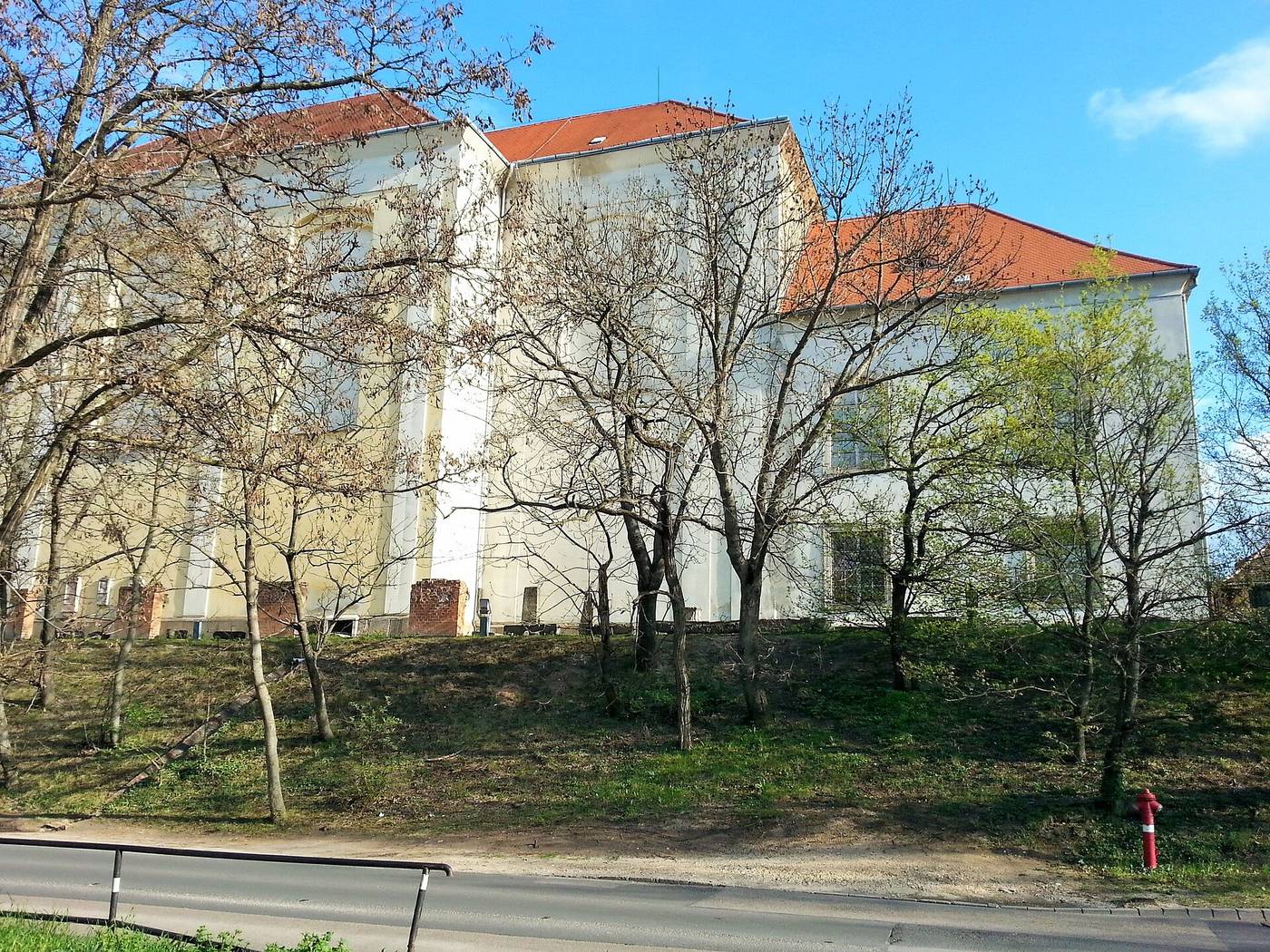
The Trinitarians consecrated a Baroque church on an Óbuda hill in 1760; the army later floored its nave into three stories, the Second World War took the roof, and when a new roof went on between 1976 and 1983, the inside was left as raw brick on purpose. That church is now the heart of the Kiscelli Museum, and its bare nave hosts the museum’s big temporary shows: Design Without Borders runs until 1 November 2026.
Stand in that nave first, then go down into the former crypt for Kriptagram, NagyMolnár’s light installations, with entry once an hour with an attendant until 1 November. In the permanent rooms, meet the original 1712 figures from the Holy Trinity column in front of Matthias Church, find the Golden Hand inn sign that gave Aranykéz utca its name, and look at the Columbia press known for printing the 12 Points in 1848. Then step out into the wooded park around the museum. Allow about two hours here; the Roman ruins of Aquincum, on the same BTM+ ticket, stretch it to a whole day. Come for the building and the city’s story rather than modern art, since only part of the 20th-century collection is on the walls.
The essentials: open Tuesday to Sunday 10:00 to 18:00 (last entry 17:30), and until 1 November 2026 on Mondays too. An adult ticket is 3,000 HUF (about $9), free with the Budapest Card.


The museum’s own English pages call it the Kiscell Museum, while everyone in Budapest says Kiscelli. It is the Budapest History Museum’s branch for the city from the 1780s onward, at Kiscelli utca 108 above Bécsi út, and it also houses the Budapest Municipal Gallery (Fővárosi Képtár), the city’s own art collection.
📋 At a Glance
| Detail | What to know |
|---|---|
| 📍 Address | Kiscelli utca 108, 1037 Budapest, District III (Óbuda) |
| 🕙 Hours | Tue to Sun 10:00 to 18:00, last entry 17:30 |
| 📅 Mondays | Closed, except 5 October to 1 November 2026, when it opens 10:00 to 18:00 |
| 🎫 Adult ticket | 3,000 HUF, free with the Budapest Card |
| 🚋 Tram | 17, 19 or 41 to Szent Margit Kórház, then a steep walk up |
| 🚌 Bus | 165 from Kolosy tér to Remetehegyi út, no climb |
| ⏱️ Time needed | About two hours |
| ⛔ Closed in 2026 | 24 to 26 December, 31 December to 1 January |
The church that never got its interior back
The Trinitarians built the church and monastery to plans by the Viennese architect Johann Entzenhoffer, starting in 1745, and consecrated the church in 1760, with a copy of the Mariazell Madonna from the Zichy family’s earlier chapel on the high altar. Then Joseph II dissolved the order and the army moved in. Barracks, then a military hospital, with the nave floored over into three stories.
The Viennese furniture maker Miksa Schmidt bought the empty building in the 1910s and turned it into a mansion, which is why it is still known as the Schmidt-kastély. He left it to the city when he died in 1935, on condition that it became a museum. The Second World War took the roof. A new roof went on between 1976 and 1983, the inside was deliberately left as it was, and the Municipal Gallery held its first exhibition in the ruin in 1988.
That space is now the Templomtér, the church space: raw brick, empty niches, a nave open all the way to the roof. It hosts the big temporary shows and the concerts, and whatever is on, do not leave without seeing it.
What is on this autumn
| Exhibition | Where | Dates |
|---|---|---|
| Design Without Borders 2026, object and photography, close to 180 makers from more than 15 countries | Church space | 4 October to 1 November 2026 |
| Kriptagram, light installations by NagyMolnár | Former crypt, entry with an attendant once an hour | 3 October to 1 November 2026 |
| The Diplomat: Culture in the Cold War, Guy Turbet-Delof in Budapest, 1947 to 1958 | Oratory and upper corridor | 7 October 2026 to 28 February 2027 |
| Fragments of Scent, the legacy of the Vértessi perfumers, 1860 to 1930 | Museum rooms | 9 April to 31 December 2026 |
The permanent rooms carry the city-history side. The Baroque sculpture hall holds the original 1712 figures from the Holy Trinity column that stands in front of Matthias Church. There is a collection of old Pest and Buda shop signs, among them the Golden Hand inn sign that gave Aranykéz utca its name, the complete fittings of the Golden Lion pharmacy, and a printing room whose Columbia press is the one known for printing the 12 Points and the National Song in 1848.


One thing to know if you are coming for the art: the Municipal Gallery’s 20th-century collection is not currently hung as a whole, and the second part of the city-history display, public and private spaces from 1873 to 1940, is also closed for now. Labels in some of the permanent rooms are in Hungarian only, so keep a translation app handy there; the temporary shows tend to be better served in English.
Tickets and free entry
| Ticket | Price |
|---|---|
| Adult, 26 to 62 | 3,000 HUF (about $9) |
| Ages 6 to 26, or with a full-time student card | 1,000 HUF (about $3) |
| Ages 62 to 70, or with a pensioner card | 1,500 HUF (about $5) |
| Adults in a family of two adults and at least two children aged 6 to 18 | 1,500 HUF (about $5) each |
| BTM+, one entry to each Budapest History Museum site within 30 days | 5,500 HUF (about $17) |
| Program ticket for most of this October’s curator tours and concerts | 4,000 HUF (about $12) |
| Guided tour for a group of up to 15, booked ahead | 20,000 HUF (about $62) per group, plus entry |
Prices are in HUF, which is what you pay at the counter or in the museum’s webshop. Converted at 1 USD = 323 HUF, the ECB rate on 16 October 2026. Rates move, so treat the converted figures as indicative.
Entry is free for under-6s, visitors over 70, disabled visitors with one companion, holders of the Budapest Card, and residents with an Óbuda address. Everyone gets in free on 15 March, 20 August and 23 October, so Friday 23 October 2026 costs nothing. On the last Saturday of every month, under-26s and up to two close relatives accompanying under-18s go free too. Free entry covers the exhibitions only; most curator tours, concerts and other events need a program ticket, while the Goldberg Variations concert on 31 October needs just a museum entry ticket.
The desk takes cash, cards, and OTP and MBH SZÉP cards, and tickets are also sold online at kiscelli.jegy.hu. The BTM+ costs 5,500 HUF against 3,000 HUF here, so it pays for itself as soon as your second museum’s adult ticket tops 2,500 HUF. Aquincum, the Roman town in the same district, is the obvious candidate.
Getting up the hill

The tram is the standard route. Tram 17 runs from Széll Kálmán tér, trams 19 and 41 from Batthyány tér, and all three also stop at the Buda end of Margaret Bridge. Get off at Szent Margit Kórház, walk back a little along Bécsi út, then turn up Kiscelli utca. That last stretch is properly steep, so wear shoes with some grip.
Bus 165 is the way to skip it. It leaves Kolosy tér and loops back from its Remetehegyi út terminus: get off there, cross at the zebra by the roundabout, and follow the brown museum sign along Kolostor utca for about 300 meters. You then go through the park in good weather, or carry on to where the pavement ends and take the steps down. Both lead to the entrance. Buses 160, 260 and 260A no longer stop at Szent Margit Kórház, so ignore older directions that send you that way. For tickets and passes, the BudapestGO app guide covers what you need.
Driving is easy for once: parking in front of the museum is free, and you ask for the entry permit at the ticket desk.
Before you go
- Time: about two hours covers the permanent rooms and one temporary show; longer if you read everything.
- Bags: backpacks go into the cloakroom lockers, which take a 100 HUF coin and give it back.
- Food: eating and drinking are allowed only in the ground-floor reception area, so plan lunch down in Óbuda before or after.
- Photos: allowed for personal use, without flash.
- Access: no lift. The sculpture hall, the shop signs and the church-space exhibitions are on the ground floor and reachable by wheelchair, with an accessible toilet.
- Dogs: on a lead, as far as the courtyard only.
- Events: the rooms have limited capacity, and the museum asks visitors who are not attending a program to come outside program times. This October most concerts and curator tours start at 16:00 or 16:30, so a morning visit keeps clear of them.
Making a half day of it in Óbuda
The museum sits at the edge of the Kiscelli park forest, 15 hectares of woodland that Schmidt laid out as the mansion’s park, and a walk under the trees afterwards is the natural second half of the visit. Add Aquincum on the BTM+ and you have a full Óbuda day; our ranking of Budapest museums by time cost shows where both sit against the big central names. With the church, the crypt and the sculpture hall all indoors, Kiscelli also earns a place on the rainy day list.
Source: Kiscelli Museum, with ticket prices, free entry, opening hours, 2026 closures, access, parking and visitor rules checked 17 October 2026 on its ticket, opening hours, getting there and exhibitions pages and its program calendar; the Monday opening from 5 October to 1 November checked the same day on its homepage; tram and bus lines checked the same day on bkk.hu.
Good to know
Is the Kiscelli Museum open on Mondays?
Normally no. Monday is the closed day, public holidays included, unless the Monday is a national holiday. This autumn is the exception: from 5 October to 1 November 2026 the museum also opens on Mondays, 10:00 to 18:00. From November it is back to Tuesday to Sunday, 10:00 to 18:00, with the last entry at 17:30.
How much does the Kiscelli Museum cost?
An adult ticket (ages 26 to 62) is 3,000 HUF. Visitors aged 6 to 26, or with a full-time student card, pay 1,000 HUF, and ages 62 to 70 pay 1,500 HUF. Two adults with at least two children aged 6 to 18 pay half the adult price. The BTM+ ticket, 5,500 HUF, gives one entry to every Budapest History Museum site within 30 days. Entry is free for under-6s, over-70s, Budapest Card holders, Óbuda residents, and everyone on 15 March, 20 August and 23 October.
How do you get to the Kiscelli Museum by public transport?
Take tram 17 from Széll Kálmán tér, or tram 19 or 41 from Batthyány tér, to the Szent Margit Kórház stop. All three also stop at the Buda end of Margaret Bridge. Walk back a short way along Bécsi út and then up Kiscelli utca, which is steep. To avoid the climb, take bus 165 from Kolosy tér to its Remetehegyi út terminus and walk about 300 meters along Kolostor utca to the entrance.
Is the Kiscelli Museum wheelchair accessible?
Partly. The building has no lift, so the upper floor is out of reach. The ground-floor Baroque sculpture hall, the old shop-sign collection and the temporary exhibitions in the church space are accessible by wheelchair, and there is an accessible toilet on the ground floor.
Book it, skip the counter


Prices checked 2026-10-19. Booking through these links supports the site at no extra cost to you. How this works.